How to Write a Cover Letter in NZ: Structure, Examples and What Employers Actually Read

A job application has two parts, and they do different jobs. Your CV is the record: roles, dates, qualifications, the facts of your working life. The cover letter is the argument. It takes the handful of facts that matter for this vacancy and explains why they add up to a person worth interviewing.
Careers NZ, the government careers service, points out that employers will usually read your cover letter before they look at your CV. If the letter works, they open the CV already interested; if it is generic or obviously recycled, the CV may never get a fair reading. This guide covers how a New Zealand letter is put together, how to tailor it, and the fiddly cases: public sector criteria, email applications, career changes and gaps.
Quick answer
Write a fresh, one page letter for every job you apply for. Address it to a named person if you can find one. Open by naming the role and any vacancy reference number. In the body, give brief, concrete evidence against the two or three requirements that matter most. Say something specific about why this organisation. Close by noting your CV is attached and thanking them for their time. Then proofread it twice and get a second reader.
What a cover letter does (and what it is not)
The Ministry for Women describes the cover letter, in its public sector board guidance, as the narrative that draws the link between you and what a particular vacancy requires. The CV lists what you have done; the letter explains what it means for this employer.
- It is a snapshot, not a repeat. Careers NZ is blunt: the letter should not repeat everything in your CV. It selects the skills and experience matching what the employer wants. If yours reads like your CV in sentences, cut most of it and start again.
- It answers the “why” questions a CV cannot. Why this job? Why this organisation? Why now? A CV is silent on all three.
- It handles what needs a sentence of explanation. A career change, a gap, a move to a new town: the letter is where you deal with these briefly, on your own terms.
What it is not: a formality to dash off in five minutes, or a life story. The full record belongs in the CV, and if yours needs work, our guide to the NZ CV template covers that document. The letter’s job is narrower: persuade a busy reader, in one page, that the CV underneath is worth their time.
One modern wrinkle: larger employers may run applications through applicant tracking software first. Careers NZ notes that this software searches CVs and cover letters for the advertisement’s own words, the job title, key skills, named tools, and ranks applications on the match.

The structure, paragraph by paragraph
Contact details and the reference line
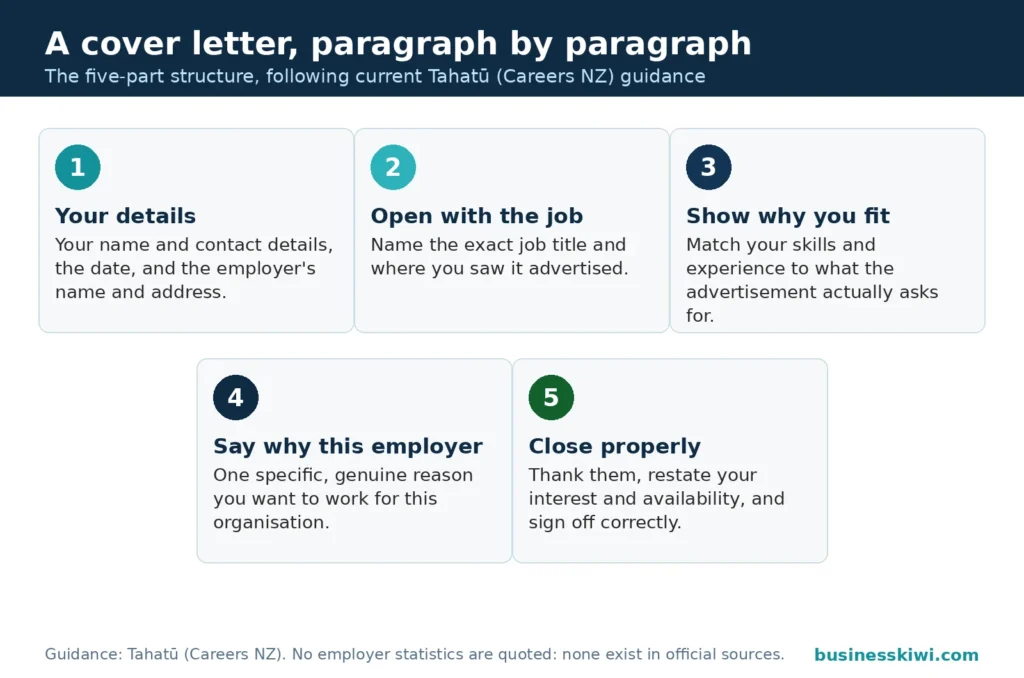
Start with your own details, as Careers NZ templates lay them out: full name, address, phone number, email, then the date. Many people reduce this to name, town or city, phone and email, which is fine. Use a professional email address, not a nickname account from school, and a phone number you actually answer.
Then the recipient’s details: name, job title, organisation, address or email. Add a reference line, the “Re:” line in Careers NZ’s template guidance, naming the role in full plus any vacancy reference number the advertisement gives. It tells the reader which vacancy your letter belongs to, and makes shortlisting easier.
The greeting
Address the letter to a person, not a department. Careers NZ advises using the advertiser’s full name rather than falling back on “Dear Sir/Madam”. The name is usually in the advertisement; if not, check the website or ring and ask. If no name can be found, Careers NZ suggests “Dear hiring manager”, or “Kia ora” where that suits the organisation.
The opening paragraph
Three or four sentences. Name the job, using its exact title, and say where you saw it advertised. Give your current situation in a line. Then land one genuine reason for applying, specific enough that it could not be pasted into an application elsewhere.
The body: your evidence
This is the heart of the letter, and where tailoring happens. Pull the two or three requirements carrying the most weight in the advertisement or position description. For each, write a short paragraph giving evidence rather than assertion. “I am a strong communicator” asserts. “In my current role I write the weekly rosters and the customer update emails for a team of twelve” evidences.
Keep each example tight: what you did, in what setting, what came of it, in two or three sentences. You need only the matches; Careers NZ advises including the skills and experience from your CV that fit this job, and leaving the rest to the CV. Add one brief line on what you bring to a team, something Careers NZ says a letter should always cover.
The “why this organisation” paragraph
A short paragraph from real research separates a tailored letter from a mail merge. Look at what the organisation actually does: a new service, its community, a project you would like to join, values you share. The Ministry for Women’s drafting guidance makes the same point for governance roles: an effective letter demonstrates understanding of the organisation’s mission and goals. One specific, true sentence beats a paragraph of flattery.
The closing paragraph
Note that your CV is attached, thank the reader for considering your application, and say you would welcome the chance to discuss it. A practical detail, such as your notice period, can go here if it genuinely helps. Do not plead or apologise, and do not promise to “call next week to discuss”, which reads as pressure rather than enthusiasm.
The sign off
“Yours sincerely” is the standard sign off when you have addressed a named person, and it is the one Careers NZ templates use; many New Zealanders also close with “Ngā mihi”. Sign your name, typed underneath for electronic letters.
Length and format
One page. Careers NZ and its templates agree: a cover letter runs to one page, usually three to five short paragraphs. If your draft spills onto a second page, the fix is rarely smaller type; it is cutting material that belongs in the CV.
- Use a plain black font, such as Calibri at size 11.
- Keep sentences and paragraphs short, with clear space between them and decent margins.
- Bullet points are fine for listing matching skills.
- No images, logos or decorative borders.
- Send the letter as a PDF unless the employer asks for a Word document. Name the file with your name and the words “cover letter”, as in Careers NZ’s example, “sam-henderson-cover letter.pdf”.

How to tailor it to the job: a repeatable method
Tailoring is not starting from a blank page every time. It is a method.
Step 1: Pull the advertisement apart. Highlight the skills, qualities and experience the employer asks for. Careers NZ’s Job Hunters’ guidance recommends exactly this: read the advertisement and job description and mark the key requirements first.
Step 2: Build your matches. For each highlighted requirement, note your strongest piece of evidence. Where you have no direct experience, note the nearest transferable one.
Step 3: Research the organisation. Read its website properly. For public bodies, look at the annual plan or statement of intent; for businesses, their services and recent news. The Ministry for Women’s preparation guidance lists the position specification, the entity’s website and its corporate documents as the research base.
Step 4: Choose two or three matches and cut the rest. A letter answering every line of the advertisement answers none of them well.
Step 5: Mirror their language, honestly. Where the advertisement says “stakeholder engagement” and you have done that work, use their term. Never claim a skill just to match a keyword you cannot back up at interview.
Step 6: Write the new letter. Careers NZ is unambiguous: do not use the same cover letter for every application. The opening, the evidence selection and the organisation paragraph must be written for this job. Tauranga City Council’s guidance describes the result: a letter that makes the reader want to open your CV.
Example paragraphs
The three paragraphs below are original examples written for fictional applicants. Names, employers and details are invented.
Example 1: retail
I have worked weekends at a busy community pharmacy in Riccarton for the past two years, where Saturdays regularly mean a queue at the counter and a phone that does not stop. I serve customers, process sales and deliveries, and I have trained three new weekend staff on the till and the store’s procedures. Our manager has twice asked me to stay on for extra shifts during stocktake because my counts are accurate. I am applying for this role because I want to move into outdoor retail, I am a keen tramper myself, and I know your Riccarton store well as a customer.
Why it works: it evidences what retail advertisements usually ask for, service under pressure and reliability, with concrete details rather than adjectives.
Example 2: trades
I am in the final months of my electrical apprenticeship with a Hamilton firm, working mainly on residential rewires and switchboard upgrades. I hold a current Site Safe passport and a first aid certificate, I have my own tools and a full licence, with my practical assessments signed off as they come due. On site I am the apprentice the builders ask for by name, mostly, I think, because I leave a tidy site and I flag problems early rather than covering them up.
Why it works: it answers the practical questions a trades employer has: tickets, stage of apprenticeship, tools, licence. Then it adds a character claim with a reason attached.
Example 3: office and administration
For the past three years I have been the administrator for a Wellington medical practice, supporting three doctors and a practice nurse. I manage the shared inbox and appointment diaries, process invoices and ACC paperwork, and I am the person staff come to when the booking system misbehaves. Last year I reorganised our patient recall process, and overdue recalls dropped noticeably within two terms. I am confident with Microsoft 365 and learn new systems quickly, as I had to when the practice changed providers in 2024.
Why it works: it sizes the setting, names the tasks the new role involves, and includes one small achievement with a result. It also answers a common requirement, learning new software, with a time the writer has already done it.
Cover letters for the public sector
Government and council roles follow the same principles, with a few habits of their own. Advertisements on jobs.govt.nz typically ask for a tailored CV and a cover letter describing your motivation, your relevant skills and experience, and how you align with the organisation’s work; Department of Corrections advertisements ask for exactly that combination.
The bigger difference is the position description. Public sector advertisements come with one, and shortlisting is usually done against it. So:
- Work from the position description, not just the advertisement. The capabilities listed there are what the panel scores against.
- Address criteria directly where asked. Some agencies ask applicants to address selection criteria or key competencies in the letter, or in a separate portal statement. If they ask, do it explicitly: take each criterion in turn and answer with one brief evidence example, the situation, what you did, and what resulted. Two tight sentences per criterion is enough; save detail for the interview.
- Follow the instructions exactly. Applications go through the agency’s careers portal, and some advertisements state that emailed applications will not be considered. Note the closing time, often 11pm on the stated day.
- Research from the organisation’s own documents. Annual plans, statements of intent and strategies are published and free.
Email applications and online forms
Applying by email. Careers NZ’s guidance is specific: paste your cover letter into the body of the email itself, and attach the PDF version as well, with your CV. The Tertiary Education Commission’s job hunters’ checklist adds the surrounding habits: your name, the job title and the reference number in the subject line; labelled attachments; and a check of your sent folder afterwards.
Applying through an online form. Careers NZ describes the common patterns: a downloadable form, an account on the employer’s career hub, or a form emailed with your documents. Portal forms usually include a field asking why you are applying or what you would bring to the role. That field is your cover letter in disguise. Paste in a shortened, tailored version of your letter’s core content. Careers NZ’s form guidance adds: allow plenty of time, read instructions carefully because employers do reject applications that ignore them, answer every question (writing “Not applicable” where that is the honest answer), keep a saved copy of your answers, and proofread before sending.
Special cases
Changing careers. Name the change in one straightforward sentence, then get to transferable evidence. Careers NZ works with two letter styles: a skills focused letter, leading with skills rather than job history, and a work focused letter, leading with experience. Career changers usually do best nearer the skills focused end, drawing on their previous field, study and volunteering. Do not apologise for changing direction; a clear reason, briefly stated, reads as considered.
Employment gaps. Address the gap in the letter, briefly and honestly. Careers NZ’s returning to work guidance is direct: explain the gap in your cover letter, be honest, and show what the time gave you. Caring for children or whānau builds organisation, patience and resilience. Study and volunteering count too, described as the work they are. One or two sentences, then pivot to why you are ready now. Long explanations and medical detail are not required.
First job, or no experience yet. Use a skills focused letter, as Careers NZ recommends for school leavers and people without work history. Evidence comes from school, sport, cultural groups, casual work, family businesses and volunteering. Employers hiring at entry level mostly assess attitude and reliability, so show both with examples: the coach who trusts you to run warm ups, the Saturday job where you were never late in a year.
Returning to work after time away. Combine the two moves above: a brief, honest line on the gap, plus evidence your skills are current: recent training, volunteering, short courses. Careers NZ also suggests being open to starting at a level that rebuilds recent experience if interviews are not coming. Workbridge and Work and Income both offer support worth taking.
One legal note. Employment New Zealand sets out that employers have obligations throughout hiring, including not discriminating unlawfully on prohibited grounds. Your letter never needs to volunteer personal details that are not relevant to the job.
Common mistakes
- Sending the same letter everywhere. If the organisation’s name could be swapped without changing anything else, the letter is not finished.
- Repeating the CV. The letter selects and argues; it does not summarise your whole history.
- The leftover name. A previous employer, or the wrong job title, surviving from the last application.
- No name on the greeting when one was available. Ten minutes of research, undone by “To whom it may concern”.
- Padding and overclaiming. Claims you cannot support at interview damage the honest claims beside them.
- Spelling and grammar errors. Check the letter yourself and ask someone else to check it too, as Careers NZ advises.
- Two pages, small font, walls of text. Readers skim. Help them.
- American spelling and generic phrasing from AI drafts. If you use an AI tool for a first draft, Careers NZ’s guidance is to check it, personalise it and edit it: output tends to be general, can exaggerate, and may use American spelling.
- Forgetting the attachment, or naming it “document1.pdf”. Check before sending, and name files as described above.
FAQs
Do I always have to send a cover letter?
If the advertisement asks for one, always. If it is optional, a short tailored letter still does work nothing else in your application does, so include one unless the portal gives you nowhere to put it. If the instructions say CV only, follow them.
How long should a cover letter be?
One page. Letters addressing set public sector criteria can run a little fuller, but still within the page unless the agency allows more.
Who do I address it to if the advertisement has no name?
Try to find one, via the website or a quick call. Careers NZ suggests “Dear hiring manager” or “Kia ora” as fallbacks. Avoid “Dear Sir/Madam”.
What if I do not meet every requirement?
Apply anyway if you meet the core requirements. Some employers say so outright, including government agencies noting they still want to hear from applicants whose experience does not align 100 percent. Address the main requirements with evidence, and show how you would close a gap.
Should I mention salary, notice period or availability?
Not salary; that conversation comes later. A notice period or fixed availability constraint can go in the closing paragraph if it genuinely helps the reader. Otherwise leave it out.
Where to next
A good cover letter gets your CV read by someone already half persuaded. When the application works and an offer lands, the next piece of writing is a resignation letter to leave your current job on good terms. More guides on applications, interviews and working life are in our Jobs & Education hub.
Sources
All guidance in this article comes from official New Zealand sources:
- Careers NZ / Tahatū Career Navigator (Tertiary Education Commission), “How to write a cover letter”: https://tahatu.govt.nz/work/applying-for-a-job/how-to-write-a-cover-letter
- Careers NZ, “How to look for a job”: https://www.careers.govt.nz/help-finding-a-job/
- Careers NZ, “Making your Career Kakala: Applying for jobs: CVs, cover letters and more”: https://api.careers.govt.nz/assets/Uploads/Making-your-Career-Kakala-Applying-for-jobs-CVs-cover-letters-and-more-Interactive-2022.pdf
- Tertiary Education Commission, Job Hunters’ Toolkit checklist (via Careers NZ): https://www.careers.govt.nz/assets/Uploads/job-hunters-checklist.pdf
- Careers NZ / Tahatū, “How to complete a job application form”: https://tahatu.govt.nz/work/applying-for-a-job/how-to-complete-a-job-application-form
- Careers NZ / Tahatū, “Returning to work after a gap”: https://tahatu.govt.nz/work/looking-for-a-job/returning-to-work-after-a-gap
- Careers NZ / Tahatū, “How to write a CV” (applicant tracking systems): https://tahatu.govt.nz/work/applying-for-a-job/how-to-write-a-cv
- Careers NZ / Tahatū, “Using AI to create a CV or cover letter”: https://tahatu.govt.nz/work/applying-for-a-job/using-ai-to-create-a-cv-or-cover-letter
- Ministry for Women, cover letter webinar slides (public sector boards): https://www.women.govt.nz/sites/default/files/2024-07/Cover%20Letter%20webinar%20slides%20260624.pdf
- Tauranga City Council, “Preparing a CV and cover letter”: https://jobs.tauranga.govt.nz/tcc/content/Preparing-a-CV-and-cover-letter/?locale=en_GB
- Employment New Zealand, “The hiring process”: https://www.employment.govt.nz/starting-employment/hiring/the-hiring-process
- NZ Government Jobs (jobs.govt.nz): agency advertisements reviewed for public sector application requirements, including Department of Corrections roles.
Disclaimer
This article is general information about writing job applications in New Zealand. It is not personalised career, legal or employment advice, and it does not guarantee any application outcome. Always follow the instructions in the specific advertisement you are applying for. For advice on your own situation, talk to Careers NZ (Tahatū) or Work and Income.