Casual Employment Contracts in NZ: What Casual Work Really Means, and the Rights That Come With It

Casual work fills real gaps in New Zealand workplaces: the harvest crew taken on for six weeks, the cafe worker who covers Saturdays when the roster falls apart, the extra pair of hands for a one-off event. For employers it is flexible cover without a fixed commitment. For workers it is income that fits around study, family or a main job. But “casual” is also one of the most misused labels in employment law. It is not a lesser category of worker with thinner rights. A casual employee is an employee, entitled to a written agreement, the minimum wage and leave that builds over time. What makes the arrangement casual is the pattern of the work, not the word at the top of the contract. This guide explains what casual means in law, how it differs from part-time, fixed-term and contracting work, what a casual agreement must cover, and where both sides get caught out.
What casual means in New Zealand law
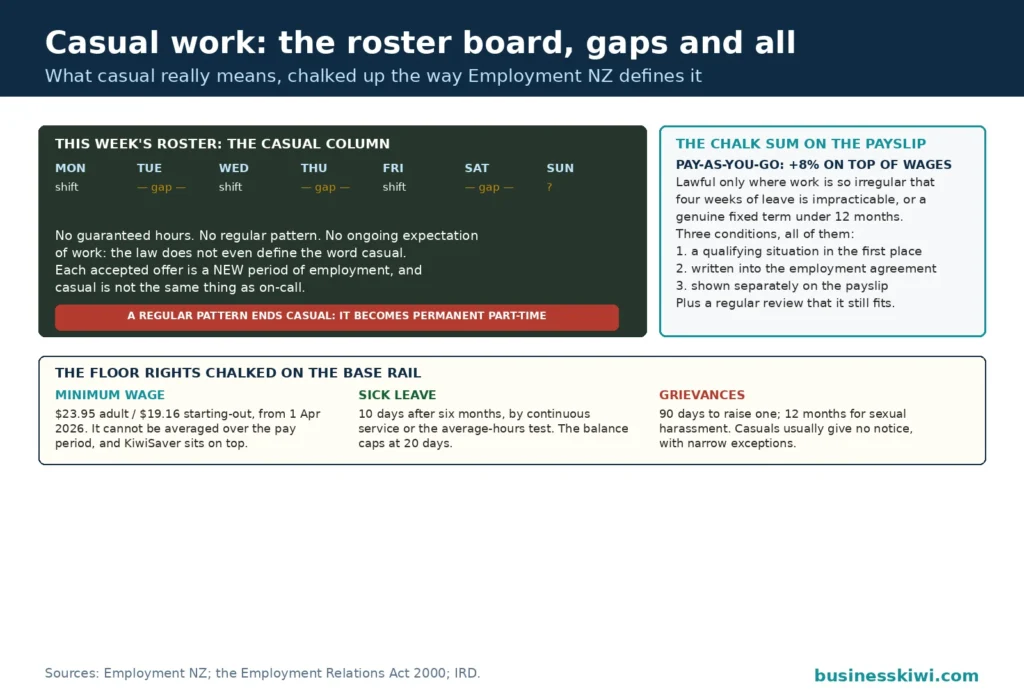
Start with a surprise: employment legislation does not define “casual employee” at all. Employment New Zealand, MBIE’s employment service, describes the arrangement the word is usually used for. The employee has no guaranteed hours, no regular pattern of work and no ongoing expectation of employment. The employer does not have to offer work, and the employee does not have to accept work that is offered. The person simply works as and when it suits both of them.
Casual arrangements appear where demand is hard to predict, or work turns up at short notice. Each time the employee accepts an offer of work, that work is treated as a new period of employment. The terms of the employment agreement apply to each period, but finishing one stretch of work creates no promise of another. Between engagements, neither side owes the other anything.
Three points in that description deserve emphasis. First, casual is not the same as on-call, a different arrangement with its own rules about availability provisions and compensation. Second, the casual nature of the arrangement has to be made clear in the employment agreement itself: no guarantee of work on any particular day, hours that vary, and each accepted offer standing as its own period of employment. Third, casual employees hold most of the same rights as any other employee from the first shift, including rest and meal breaks, a safe workplace and being dealt with in good faith. The differences lie mostly in how leave entitlements are worked out, because those entitlements depend on patterns of work that a genuine casual does not have.
The label is not decisive: when a “casual” is really a part-timer
Because the law looks at how the relationship works in practice, calling someone casual does not make them casual. Employment New Zealand sets out the signs the Employment Relations Authority and the Employment Court weigh up when the true nature of an arrangement is questioned. It starts to look like ongoing employment where the person is expected to turn up regularly, hours are rostered well in advance, the worker must notify the employer, or get agreement, before being unavailable, work runs on without significant breaks, start and finish times are consistent, and the work is essential to the business.
If a pattern like that has developed, the status of the employment changes. In Employment New Zealand’s words, the employee moves to permanent part-time employment, and practical consequences follow: a new agreement reflecting the real arrangement, a review of leave entitlements, an end to pay-as-you-go holiday pay (explained below), and the dismissal and notice rules that protect ongoing staff. An employer who leaves a regular worker on a casual agreement is not saving paperwork. They are building up leave arrears and grievance risk, and the longer the pattern runs, the bigger both become.
Casual, part-time, fixed-term and contractor compared
The four arrangements are often confused because the same person can move between them across a working life. They are legally distinct, and the differences matter most in three places: whether hours are guaranteed, how leave builds up, and how the arrangement ends.
The contractor boundary is a separate question from the casual one. Contractors are not employees and are not covered by most employment law, so a business that engages an employee as a contractor by mistake strips the person of minimum entitlements and KiwiSaver contributions, and leaves tax and ACC levies with the wrong party. Employment New Zealand publishes two routes for testing status: a statutory gateway test that has applied since 21 February 2026, and the common law tests the courts developed, which look at intention, control, integration into the business and the economic reality of the relationship. If you are unsure which side of the line a worker sits on, resolve that first. The casual rules in this guide apply only once you know the person is an employee.
What the law requires in the written agreement
Every employee, casuals included, must have a written employment agreement. An employer who fails to meet those requirements can face a penalty in an action brought by a Labour Inspector, so this is not a formality to tidy up later.
As Employment New Zealand lists them, an individual employment agreement must include:
- the names of the employer and the employee
- a description of the work the employee is to perform
- an indication of where the employee is to perform the work
- the agreed hours of work or, if no hours are agreed, an indication of the arrangements relating to the times the employee is to work
- the wages or salary payable
- a statement that the employee will get at least the payment the law requires for working on a public holiday
- an employment protection provision, covering what happens to the employee if the business is sold or transferred, or their work is contracted out
- any other matters the parties have agreed, such as trial periods, probationary arrangements or availability provisions
- a statement of the nature of the employment where it is fixed-term or casual
- a plain language explanation of how to get help resolving employment relationship problems, including a statement that most personal grievances must be raised within 90 days, and a sexual harassment grievance within 12 months
The employer must also tell the employee about their entitlements under the Holidays Act 2003. Two further rules frame everything else: minimum employment rights cannot be contracted out of, however the agreement is worded, and both parties owe each other good faith, a duty the Employment Relations Act 2000 applies to making and varying individual agreements as well as to the relationship itself. MBIE’s free Employment Agreement Builder on business.govt.nz walks through the mandatory and optional clauses, a sensible starting point for a small business drafting from scratch.
Clauses a casual agreement should add
The statutory list is the floor, not the whole document. A casual agreement that stops at the mandatory clauses leaves the mechanics of the arrangement unwritten, and unwritten mechanics are where disputes breed. Clauses worth adding include:
- A clear casual statement. No guaranteed hours, work varies in amount, no obligation to offer or accept work, and the agreement’s terms apply to each period of work.
- How offers work. How shifts are offered (a phone call, a text, a rostering app), and how the employee accepts or declines.
- Cancellation practice. There is no general statutory notice period for cancelling a casual shift, so the agreement sets the parties’ own practice: how much warning each side will give, and what, if anything, is paid when a shift is cancelled at short notice. Where an agreement also contains agreed hours or an availability provision, statutory requirements on cancellation notice and compensation can apply, and ignoring them can ground a personal grievance.
- Notice for accepted work. Whether notice is expected once a shift has been accepted, and how much. Without this clause, the default position below applies.
- Holiday pay method. Whether annual holidays accrue in the usual way or are paid as pay-as-you-go, and if the latter, the percentage and how it will appear on the payslip.

Pay: minimum wage, PAYE and KiwiSaver
Casual status changes nothing about pay floors. The minimum wage applies to every hour a casual employee works, from the first hour of the first shift, and it cannot be averaged out over a season or a pay period. From 1 April 2026 the adult rate is $23.95 an hour, with starting-out and training rates of $19.16 an hour for those who qualify. There is no minimum wage for employees under 16. If the agreement promises more than the minimum, the higher rate is what must be paid. Employer KiwiSaver contributions sit on top of the minimum wage and cannot be folded into the rate.
For tax, a casual employee is simply an employee. The employer deducts PAYE using the tax code the employee declares on the IR330 tax code declaration, including a secondary code where the casual work is a second job. Inland Revenue provides two special codes worth knowing. The CAE code is for casual agricultural work only: day-to-day seasonal work for up to three months, where the worker earns no other income in that time, with shearers and shearing shed-hands the classic example. The EDW code covers temporary work during a general election, across the two-week period of advanced voting and election day; election work outside that window uses the standard codes.
Annual holidays and the 8 percent pay-as-you-go option
The default rule is the same as for everyone else: after 12 months of continuous employment, a casual employee is entitled to four weeks of paid annual holidays. Employment New Zealand’s guidance explains which breaks in work still count as continuous, so gaps between engagements do not automatically reset the clock.
The alternative is pay-as-you-go: instead of leave accruing, the employer pays an extra percentage of gross earnings in each pay. The rate must be at least 8 percent, always paid on top of the wage, never deducted from it. Employment New Zealand is blunt that this is an exception, not a default setting for casuals. It is available only in two situations:
- the work is so irregular or intermittent that giving the employee four weeks of annual holidays is impracticable, impossible in practice rather than merely inconvenient: the employer cannot work out what a week is for this person, or does not know if or when they will work again; or
- the employee is on a genuine fixed-term agreement of less than 12 months.
Where pay-as-you-go is used, three conditions must all be met. The employee’s situation must actually qualify. The employee must have agreed to the arrangement in their employment agreement. And the money must be paid as an identifiable component of pay, at or above 8 percent of gross earnings, in practice a separate amount stated in the agreement, shown separately on the payslip, ideally under its own pay code. Employers must also review regularly whether each person still qualifies. If the work has settled into a pattern and pay-as-you-go is no longer justified, the fix is a new agreement providing four weeks of annual holidays after 12 months and removing the pay-as-you-go clause, with options for setting off amounts already paid.

Public holidays, sick leave and other leave
Public holiday entitlements turn on a single question: is the day an “otherwise working day” for this employee, a day they would have worked if it had not been a public holiday? Permanent staff usually have an obvious pattern to point to; casuals do not, so Employment New Zealand answers it case by case, from whether the employee has worked regularly on that day, had agreed to work it, or could reasonably have expected to. No formula substitutes for looking at the actual history.
If the day is an otherwise working day and the casual does not work it, it is a paid day off. If they do work it, they must be paid at least time and a half for the time worked and also earn an alternative holiday to take later. If they work a public holiday that is not an otherwise working day, the entitlement is at least time and a half for the time worked, with no alternative holiday.
Sick leave follows the general rules, and casuals are expressly included. An employee qualifies for 10 days of paid sick leave a year once they have worked for the same employer continuously for six months, or over a six-month period have averaged 10 hours a week and worked at least one hour in every week or 40 hours in every month. Unused sick leave carries over, up to a maximum balance of 20 days. Paid sick leave is only available for otherwise working days, so a casual who is sick on a day they were not going to work has no sick leave to take for that day. Bereavement leave and family violence leave also become available once the same six-month qualifying tests are met, and are likewise taken on otherwise working days.
Ending casual work
The clean exit is one of the genuine advantages of a casual arrangement. A casual employee who wants to stop can simply stop accepting offers, and Employment New Zealand confirms that casual-hours employees do not usually have to give notice, because their employment ends each time a period of work finishes. An employer can likewise stop offering work once a period of work is done, and doing so is not a dismissal.
Two exceptions qualify that freedom. Notice is required if the employee has already started work, or has accepted an offer of work that has not yet happened, or if the agreement itself says notice must be given. And the mirror-image trap catches employers: stopping offers is safe, but sending a casual home partway through a shift, or pulling back an offer already accepted, can amount to a dismissal. A dismissal has to be justifiable, with a good reason and a fair process, whatever the agreement calls the worker. Good faith also applies to how both sides wind the arrangement down.
If things go wrong, casual employees have the same personal grievance framework as other employees. A grievance covers claims such as unjustified dismissal and unjustified disadvantage, and must generally be raised with the employer within 90 days of the event or of becoming aware of it, with 12 months for sexual harassment grievances. MBIE’s early resolution and mediation services are the usual first steps, and unresolved claims can be taken to the Employment Relations Authority.
Where employers get it wrong
The mistakes repeat so often that they are worth listing plainly:
- Keeping regular staff on casual agreements. A worker rostered every Friday for a year is not casual in substance, whatever the agreement says. The status, and the leave position, will be corrected eventually, usually at the worst moment.
- No written agreement, or a thin one. Missing mandatory clauses, or no agreement at all, risks a penalty and removes the employer’s best evidence of what was actually agreed.
- Pay-as-you-go switched on by default. Paying 8 percent to every casual, including regulars, is the single most common holiday pay breach in this area. It is only lawful where the work genuinely qualifies, the employee has agreed in writing, and the amount is identifiable.
- Rolling the 8 percent into the rate. Holiday pay paid as-you-go must be on top of gross earnings. A rate described as “inclusive of holiday pay” fails the test.
- Never reviewing the arrangement. Casual arrangements drift. A quarterly look at who is actually working regular patterns is cheap insurance against arrears and grievances.
For workers: questions to ask, and what to check on your payslip
Before signing, a casual agreement should be able to answer these questions clearly:
- Is any work guaranteed, or is this genuinely as-and-when? What does the agreement actually say?
- How will shifts be offered, and how do I accept or turn them down?
- What is my hourly rate, and is it at or above the minimum wage that applies to me?
- Is my holiday pay accruing towards four weeks of leave, or being paid as pay-as-you-go? If pay-as-you-go, is it at least 8 percent, on top of my wage?
- What happens if a shift is cancelled, and what notice applies once I have accepted a shift?
- When will I be paid, and will I get a payslip each pay?
You are entitled to the agreement in writing, and to time to read it before you start. On each payslip, check the hours and rate match what you worked, the tax code is the one you declared (a secondary code matters if this is your second job), and any pay-as-you-go holiday pay appears as its own separate amount, not buried in the hourly rate. If the figures do not line up, raise it promptly, and keep your own record of shifts worked.
Frequently asked questions
Does a casual employee need a written employment agreement?
Yes. Every employee in New Zealand must have a written employment agreement, casuals included. It must contain the clauses the Employment Relations Act 2000 requires and state clearly that the work is casual, with no guaranteed hours.
Can my employer just stop giving me shifts?
If the arrangement is genuinely casual, yes. Stopping offers after a period of work ends is not a dismissal. But if your work has settled into a regular pattern, you may in substance be a permanent part-time employee, and cutting your shifts is a different legal matter.
Do casual employees get holiday pay?
Yes, one way or the other. The default is four weeks of paid annual holidays after 12 months of continuous employment. Where the work is genuinely irregular or intermittent, the employer may instead pay holiday pay as-you-go at a minimum of 8 percent of gross earnings on top of your wage, provided you agreed in your employment agreement and it shows as a separate amount.
Can an employer pay the 8 percent to every casual worker?
No. Pay-as-you-go is only available where the work is so irregular or intermittent that providing four weeks of annual holidays is impracticable, or for a genuine fixed-term engagement of under 12 months. A casual working a regular pattern does not qualify, even if both sides are happy with the arrangement.
Do casual employees get sick leave?
Yes. After six months of continuous employment, or after meeting the alternative six-month test based on average hours, a casual employee is entitled to 10 days of paid sick leave a year, taken on days they would otherwise have worked.
What am I paid if I work on a public holiday?
At least time and a half for the time you work. If the day would otherwise have been a working day for you, you also earn an alternative holiday. For a casual, that question is decided on the facts: whether you worked regularly on that day, had agreed to work it, or could have expected to.
I have worked the same shifts every week for months. Am I still casual?
Possibly not. The law looks at the real nature of the relationship, not the label. Regular hours, advance rosters and an expectation that you will be there all point to permanent part-time employment, with the leave entitlements and dismissal protections that come with it.
Can a casual employee raise a personal grievance?
Yes. Casual employees are employees, so the personal grievance framework applies, including unjustified dismissal in cases such as being sent home mid-shift. A grievance must generally be raised within 90 days, or 12 months for sexual harassment.
Sources
- Employment New Zealand, employment.govt.nz: Casual employment; Pay-as-you-go holiday pay; Collective and individual employment agreements; Permanent or fixed-term employment; Employee or contractor?; Minimum wage rates and types; Taking sick leave; Notice periods; Personal grievances
- Employment Relations Act 2000, New Zealand Legislation, legislation.govt.nz
- Inland Revenue, ird.govt.nz: What tax code should I use?
- business.govt.nz, Ministry of Business, Innovation and Employment: Employment Agreement Builder
This article is general information about casual employment arrangements in New Zealand. It is not legal advice, and it cannot cover every situation. Whether an arrangement is genuinely casual turns on how the work actually runs, not the label in the agreement. If you are unsure about your own position, check Employment New Zealand’s guidance or get advice from an employment lawyer, union or advocate before you act.