Special Leave in NZ: What It Covers, What the Law Gives You and How to Ask

“Special leave” sounds like a single legal entitlement. In New Zealand it is not. No part of the Holidays Act 2003 creates a leave type with that name, and Employment New Zealand does not list it among the statutory entitlements.
Special leave is a workplace label, used for leave that sits in an employment agreement or policy, or leave granted case by case. Underneath it sit two different things: leave the law guarantees, which no agreement can reduce, and extra leave an employer chooses to offer.
This guide separates the two, then covers pay and how to ask.
The short answer
New Zealand law gives employees annual holidays, public holidays, sick leave, bereavement leave and family violence leave under the Holidays Act 2003. Parental leave sits in its own Act. None is called special leave.
When Employment New Zealand uses the term, it means leave provided for in employment agreements or workplace policies, or agreed between employer and employee.
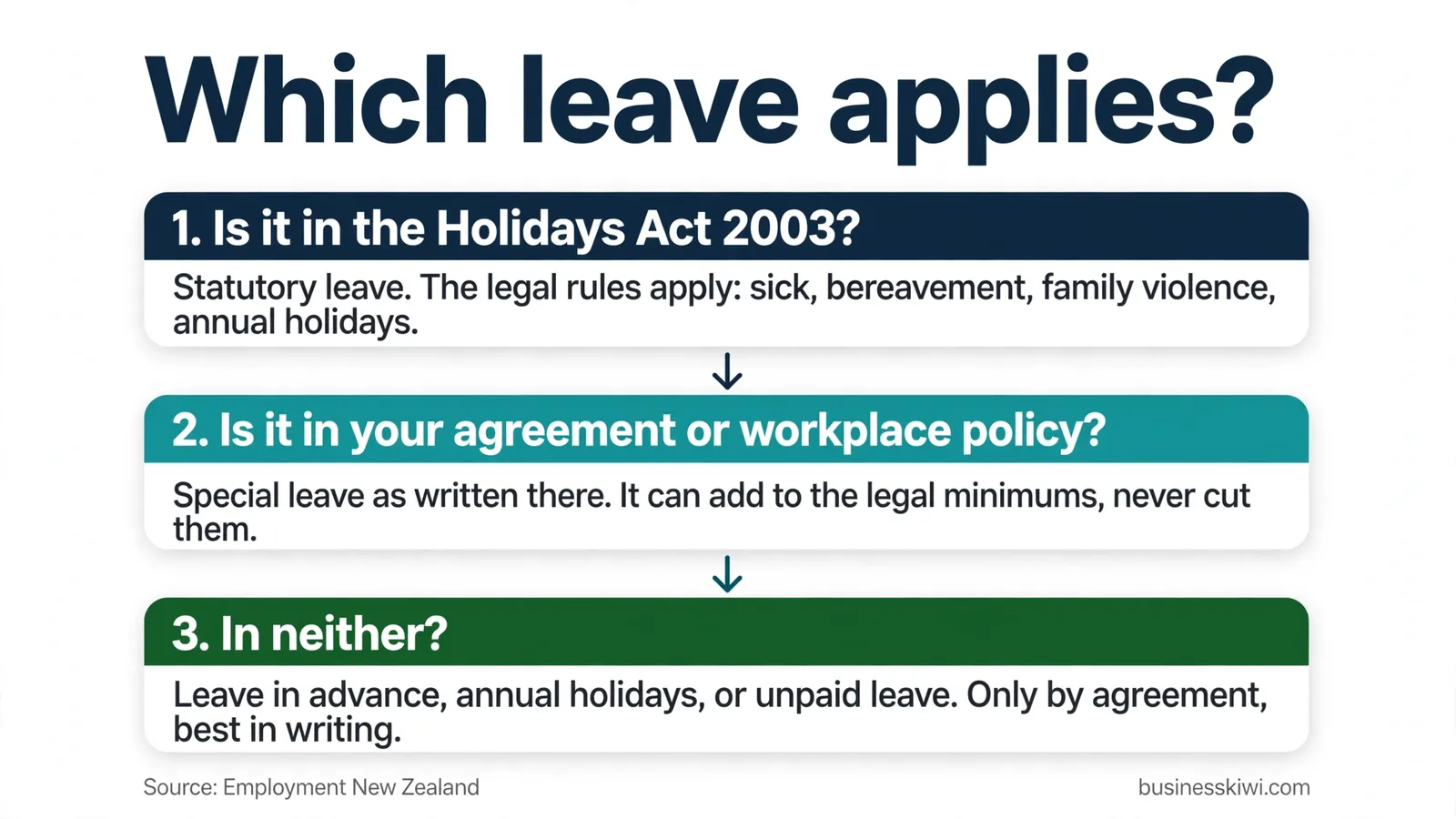
So the first question is never “how much special leave do I get?” It is “which type of leave is this, and where does it come from?” Statutory leave follows the legal rules below. Agreement-based leave follows the agreement’s wording, if it never drops below the legal minimums.
Bereavement leave: the statutory core
Bereavement leave is what most people mean by special leave: paid time off when someone close to you dies.
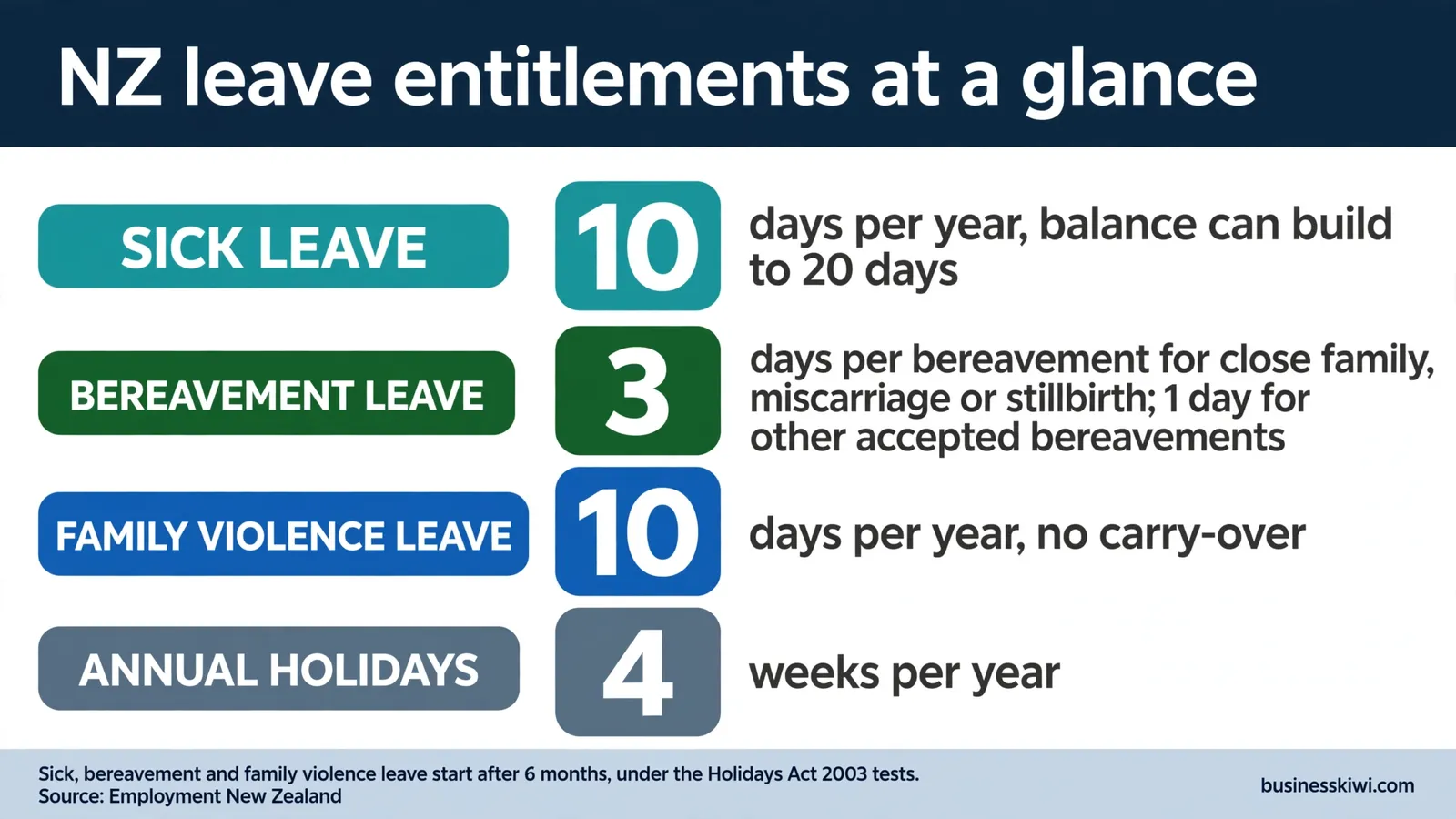
Once you meet the qualifying tests below, you get a minimum of 3 days for each bereavement where:
- an immediate family member dies: a parent, child, partner or spouse, grandparent, grandchild, brother, sister or parent-in-law
- you have a miscarriage or stillbirth
- another person has a miscarriage or stillbirth and you are their partner, their former partner who would have been a biological parent, someone who had agreed to be the primary carer of the child (for example through adoption or whāngai), or the partner of that agreed carer
You get a minimum of 1 day for each bereavement when someone else dies and your employer accepts you have suffered a bereavement. Your employer weighs how close you were, your responsibility for the ceremonies around the death, and any cultural responsibilities.
The days apply per bereavement, not as a yearly pool. They need not be taken straight away or all in a row, and can be taken later, for example at a memorial service months afterwards.
If you need more time, or have not yet qualified, your employer can agree to leave in advance, annual holidays, or other paid or unpaid leave. Your employer cannot make you take annual holidays as bereavement leave.
On proof, the law is silent: proof cannot be made a condition of taking the leave, although an employer may still ask.
Family violence leave: the other statutory entitlement
Family violence leave is the second statutory entitlement often folded into the phrase special leave. It is separate from sick leave, annual holidays and bereavement leave, with its own rules.
If you, or a child who lives with you (even only some of the time), has been affected by family violence, you can take up to 10 days of paid leave in each 12-month period once you meet the same qualifying tests as bereavement leave. It does not matter when the violence happened; it may predate the job. The leave exists for people affected by family violence, not for people who commit it.
It can be used to get support, move house, go to court or care for children. Unused days do not carry over, and they are not paid out if you leave the job.
Two connected rights sit beside the leave. Your employer must protect your personal information and must not treat you adversely because of it. You can also ask for short-term flexible working for up to 2 months, covering hours, days, duties or location. The request goes in writing, and your employer must answer in writing within 10 working days. Refusal is allowed only if requested proof was not provided in time, or on set business grounds.
Your employer may ask for proof, and need not pay the leave until they receive it, unless you have a reasonable excuse. Proof can be a letter from a support person, doctor, nurse or school, a witnessed declaration, or court or police documents.
Sick leave, briefly
Sick leave is the third Holidays Act entitlement. Eligible employees get 10 days of paid sick leave each year, for their own illness or injury or to care for a partner, child or other dependant. Unused days carry over, up to a maximum balance of 20 days.
This site covers sick leave in depth elsewhere, including refusal and proof disputes. The boundary matters here: once sick leave runs out, the options are sick leave in advance, annual holidays, unpaid leave, or paid leave your employer agrees to provide.

Special leave that comes from your agreement or policy
Employment agreements and workplace policies can provide leave types the law does not create, paid or unpaid. Employment New Zealand lists the common ones: jury service leave, leave in lieu of notice, long service leave, Employment Relations Education leave, leave for defence force volunteers, leave during and after a natural disaster, and time off to vote. Some have legal backing outside the Holidays Act; others exist only because an agreement or policy says so.
Workplace special leave clauses usually cover situations like these:
- extra bereavement or compassionate leave beyond the statutory days
- study leave and sabbaticals
- disaster or emergency leave when the workplace closes or staff cannot get in
- topped-up pay for jury service, which the law requires to be allowed but not to be paid
- stress leave, which is not a legal entitlement but is offered by some employers in policies or agreements
Two rules govern all of it. Better terms must be honoured: if your agreement promises more than the legal minimum, your employer has to provide it. And minimum rights cannot be traded away. If a special leave clause gives you less than the Holidays Act on a covered situation, the Act wins.
Special leave content varies widely between employers, so the agreement and the policy are the documents that matter. Read the clause before you rely on it.
Who qualifies, and when entitlements start
Sick leave, bereavement leave and family violence leave share the same gateway. You qualify once you have either:
- 6 months of current continuous employment with the same employer, or
- worked for the employer over a period of 6 months for an average of at least 10 hours a week, and at least 1 hour in every week or 40 hours in every month
The tests are the same for permanent, fixed-term, part-time and casual employees. There is no pro-rating: a part-timer who meets the test gets the same 10 days of family violence leave as a full-timer. Annual holidays run on a longer clock: the 4-week entitlement arrives after each 12 months of continuous employment.
Employers can offer leave sooner than the law requires. If your hours drop below the test, new entitlements pause until you qualify again, although a carried-over sick leave balance can still be used.
How pay works
Statutory sick, bereavement and family violence leave is paid only for days you would otherwise have worked. Pay is your relevant daily pay: what you would have been paid had you worked that day. Where that cannot be worked out, or your pay varies, average daily pay is used instead. Payment is made in your normal pay cycle.
If a public holiday falls on a day you would have worked during bereavement leave, the day is treated as a paid, unworked public holiday and no leave is deducted. If a bereavement happens just before, or during, annual holidays, your employer must let you take bereavement leave for that period instead. The same swap applies to family violence leave.
Family violence leave is not paid while you are receiving weekly compensation from ACC. During leave without pay you will generally not be paid for public holidays or statutory leave falling inside it, because those days were not going to be worked. Narrow exceptions exist, such as a public holiday on a usual work day where the unpaid leave exists only because statutory leave ran out.
Leave without pay, and discretionary extras
Leave without pay is not an entitlement in law. You can take it only if your employer agrees, in the agreement or negotiated at the time. The usual pattern is a return to the same job on the same terms. Time off without agreement is unauthorised leave and can lead to disciplinary action.
People typically use it when they lack enough annual holidays, when illness or injury outlasts their sick leave, or for study or a sabbatical.
One side effect is easy to miss. A continuous stretch of more than 1 week’s leave without pay normally moves your annual holidays anniversary date out by the extra time beyond that first week. By agreement, the date can instead stay put, with average weekly earnings later calculated over fewer weeks so the unpaid period does not drag holiday pay down. Time on ACC, parental leave or protected voluntary military service does not move the date. Whatever you settle on, record it in writing.
Employers can also help beyond this: sick leave in advance, extra paid days, or leave under a policy. None of it must be offered unless the agreement says so.

How to ask for special leave
Start with your employment agreement and any leave policy. Work out which type of leave fits, and use its name. “Bereavement leave” and “family violence leave” trigger legal duties. “Special leave” by itself triggers only whatever your agreement says.
Ask as early as you can, with the dates you need and the reason in plain terms. Your employer needs enough to apply the right rules, not your life story.
Proof rules differ by type. Proof cannot be a condition of bereavement leave. For family violence leave, proof can be required before pay is released, subject to reasonable excuses. Sick leave proof is covered in this site’s sick leave guides.
For discretionary arrangements, get the agreement in writing, including the annual holidays anniversary treatment if unpaid leave runs past a week. If you are refused a statutory entitlement you qualify for, raise it promptly: Employment New Zealand is the first port of call, and the personal grievance process exists for unfair treatment.

What employers should do
Know the minimums cold, because they cannot be contracted out of. Recurring failures are treating statutory leave as discretionary, demanding proof as a condition where the law does not allow it, and recording agreement-based leave too loosely to show later what was agreed.
A short special leave policy earns its keep. Set out what extra leave the business offers, who approves it, whether it is paid, and how it interacts with the statutory types. Keep leave records accurate: employers must record hours, wages and leave, and employees can ask to see their own records.
Family violence leave carries extra duties: protect the employee’s information, think about safety at work, pass on support service information, and consider how the leave appears on a payslip. Answer flexible working requests in writing within the legal timeframes.
Handle statutory and discretionary leave in good faith. Most disputes here are communication failures: an unanswered request, or an unwritten arrangement.
Special leave, annual leave and leave without pay compared
Annual holidays are a rest entitlement: at least 4 weeks of paid time off after each 12 months, measured against your own working week. Your employer must let you take them, needs a good reason to refuse your timing, and cannot force them on you as a substitute for bereavement leave. Up to 1 week a year can be cashed up, covered in this site’s cashing-up guide.
Special leave, in the agreement sense, is a label for extra leave an employer provides. Its amount, pay and conditions are whatever the agreement or policy says, and it can never undercut the statutory types.
Leave without pay is unpaid time off by agreement. It suits longer or uncovered absences, and carries the anniversary-date side effect described above.
When a situation fits a statutory type, use it. It carries set days, set pay rules and legal protection a discretionary label cannot dilute.
| Leave type | What it is | Paid? | Where the rules live |
|---|---|---|---|
| Annual holidays | A rest entitlement: at least 4 weeks of paid time off after each 12 months | Paid | Holidays Act 2003 |
| Special leave (agreement sense) | A label for extra leave an employer provides beyond the statutory types | Only if the agreement or policy says so | Employment agreement or workplace policy |
| Leave without pay | Unpaid time off for longer or uncovered absences | Not paid | Agreement between employer and employee |
Watch out for these misconceptions
“Special leave is 10 days by law.” No. Ten days is the yearly figure for sick leave and, separately, for family violence leave. There is no statutory special leave pool.
“My agreement’s special leave clause replaces bereavement leave.” It cannot. Minimum entitlements cannot be traded off against other terms.
“Unused family violence leave gets paid out when I resign.” It does not: it neither carries over nor forms part of final pay. Unused sick leave is not paid out either.
A change is coming in 2028
Parliament has passed a replacement law, the Employment Leave Act. Employment New Zealand states that employers must follow the current Holidays Act rules until the new law starts on 6 August 2028. Everything here states the law as it stands now.
More employment guides: browse the Business & Industry section for the rest of our employing-people guides.
Frequently asked questions
Is special leave a legal entitlement in New Zealand?
No. The Holidays Act 2003 does not create a leave type called special leave. The term covers leave provided by an employment agreement or policy, or agreed case by case. The legal entitlements underneath it, such as bereavement and family violence leave, cannot be reduced by any agreement.
How many days of bereavement leave can I take?
A minimum of 3 days for each bereavement when an immediate family member dies, or for a miscarriage or stillbirth affecting you or, in defined cases, your partner or an agreed carer. A minimum of 1 day applies for another death where your employer accepts the bereavement. The 6-month qualifying tests apply first.
How much family violence leave can I take?
Up to 10 days of paid leave in each 12-month period, once you meet the 6-month qualifying tests, if you or a child who lives with you has been affected by family violence. When the violence occurred does not matter. Unused days do not carry over or get paid out.
Does special leave get paid?
Statutory leave is paid at relevant daily pay, or average daily pay where that applies, for days you would otherwise have worked. Agreement-based special leave is paid only if the agreement or policy says so. Leave without pay is never paid.
Can my employer make me use annual holidays instead of bereavement leave?
No. Employment New Zealand is explicit: an employer cannot make an employee take bereavement leave as annual holidays. If a bereavement occurs just before or during annual holidays, bereavement leave must be allowed instead. Extra time can be annual holidays only by agreement.
What can I do if I have used up my sick leave?
Ask for sick leave in advance, annual holidays, unpaid leave, or paid leave under your agreement or a policy. Your employer does not have to agree unless the agreement says so. If unpaid leave runs past a week, get the annual holidays anniversary treatment in writing.
Is leave without pay the same as special leave?
Not quite. Leave without pay is unpaid time off your employer agrees to. Special leave is the broader label for agreement-based leave, and it can be paid or unpaid. Neither is a statutory entitlement, and both should be recorded in writing.
The bottom line
Special leave is a label, not a law. Underneath it sit firm statutory entitlements (bereavement leave, family violence leave, sick leave and annual holidays) and a flexible layer of agreement-based leave. Work out which layer applies, use the correct name when you ask, and write down anything discretionary.
Sources
- Employment New Zealand, Taking bereavement leave
- Employment New Zealand, Managing bereavement leave
- Employment New Zealand, Taking family violence leave
- Employment New Zealand, Managing family violence leave
- Employment New Zealand, Taking sick leave
- Employment New Zealand, Taking annual holidays
- Employment New Zealand, Leave without pay
- Employment New Zealand, Leave during and after a natural disaster
- Employment New Zealand, Leave and holidays (section overview)
- Employment New Zealand, Employee rights and responsibilities
- Employment New Zealand, Addressing Holidays Act non-compliance
This article is general information about special leave in New Zealand. It is not legal advice for your situation. Leave entitlements depend on your employment agreement and your work pattern, so check your agreement first, and contact Employment New Zealand or an employment lawyer if you need advice on a specific case.