Cashing Up Annual Leave in NZ: How to Cash Out One Week of Your Holidays

Plenty of employees would happily swap a week of holidays for the money. Maybe a car needs repairs, a deposit needs topping up, or there is simply no trip planned this year. New Zealand law allows a limited version of that swap. It is called cashing up, and it lets an employee ask to be paid out for up to one week of their annual holidays each year instead of taking that week off work.
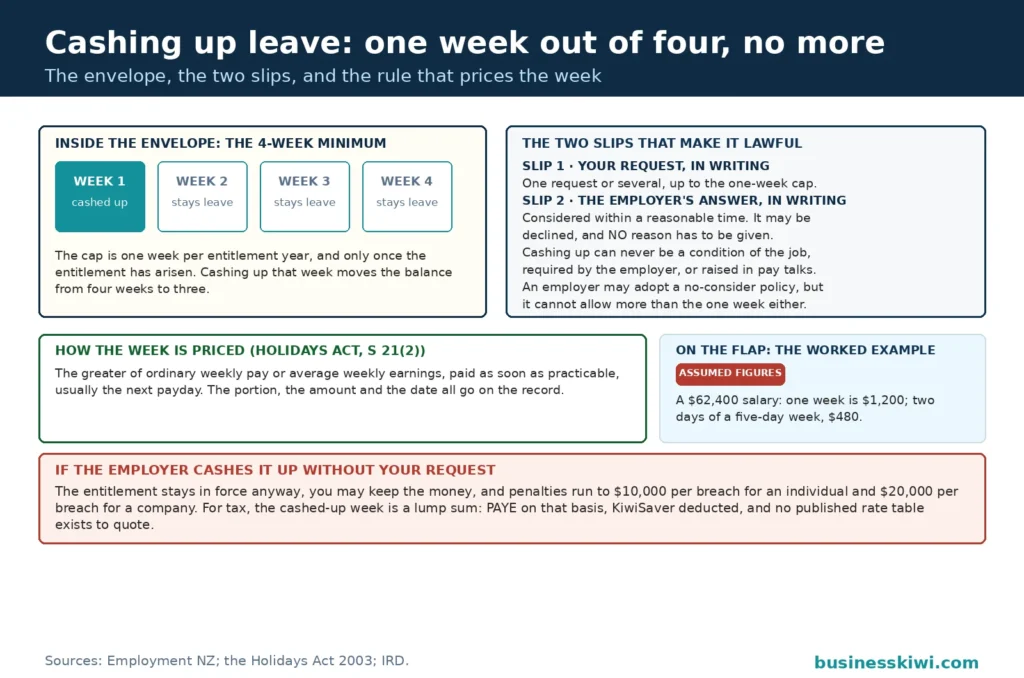
The catch is that cashing up is tightly controlled. It can only happen at the employee’s request, it can only ever be one week of the minimum four-week entitlement, and the employer is allowed to say no.
What cashing up is, and what it is not
Cashing up means an employee asks their employer to pay out part of their annual holiday entitlement in cash, and the employee’s leave balance drops by the amount paid out. The holidays are not taken as time off. They are converted into money, at the same rate the employee would have been paid for taking them.
It is easy to confuse cashing up with two other arrangements, and the differences matter.
The first is pay-as-you-go holiday pay. Under that arrangement, which is only available in limited situations such as genuine fixed-term agreements of less than 12 months or work so irregular that providing four weeks of holidays is impracticable, the employee is paid at least 8 percent of their gross earnings on top of their pay each pay period, instead of building up an entitlement to take holidays as time off. Cashing up is different: it applies to holidays the employee has actually become entitled to take as time off, and it happens one request at a time.
The second is the payment of unused holidays in a final pay when employment ends. That is a separate legal requirement with its own calculation rules, and it only applies once the job has finished. Cashing up happens during employment, while the job is ongoing. A later section of this guide explains the boundary.
The basic rule: one week a year, and only ever one week
Under section 28A of the Holidays Act 2003, an employee may request that their employer pay out a portion of their entitlement to annual holidays. Employment New Zealand puts the limit plainly: an employee can ask to cash up up to one week of their four-week minimum annual holidays entitlement in each entitlement year.
Three features of that rule are worth understanding properly.
First, the limit is one week of the minimum entitlement, not one week of whatever holidays you happen to have. If your employment agreement gives you exactly four weeks a year, one week is the most that can ever be cashed up in that year, no matter how large your accumulated balance is. Even with six weeks sitting unused from earlier years, the cashing-up right in the current entitlement year is still capped at one week of that year’s minimum entitlement.
Second, because only one of the four minimum weeks can be cashed up, at least three weeks of annual holidays must remain available to take as time off work. Employment New Zealand is explicit that employees must have at least three weeks of annual holidays that they can take off work, and that employers must not allow employees to cash up more than one week of the minimum entitlement each year. The law protects a genuine break from work, and cashing up is not a way around that.
Third, the right belongs to the employee. Cashing up starts with the employee asking. It is never something the employer initiates, a point covered in detail below.
There is one extension to the basic rule. If your employment agreement or workplace policy gives you more than the four-week minimum, you may be able to cash up some or all of the extra entitlement on top of the one minimum week, if the agreement or policy allows it and your employer agrees. Employment New Zealand gives the example of an agreement providing five weeks a year that allows up to two weeks to be cashed up: one week from the four-week minimum entitlement, plus the extra fifth week. Without that kind of provision, the one-week cap is the whole story.
When you can ask: the entitlement has to exist first
You cannot cash up holidays you have not yet become entitled to. Annual holidays cannot be cashed up until the employee gets their annual holiday entitlement, and under the Holidays Act that entitlement arises after each 12 months of continuous employment.
Employment New Zealand illustrates the timing with an example. An employee who starts work on 1 June 2024 becomes entitled to annual holidays on 1 June 2025. From that date, they can ask to cash up up to one week of those holidays. Their request can be made at any point in the entitlement year that runs from 1 June 2025 to 31 May 2026.
An entitlement year, as the Act defines it, is a period of 12 months of continuous employment beginning on the anniversary of the employee’s employment. Each new entitlement year resets the one-week allowance. A week cashed up in one year does not reduce what can be requested the following year, and an unused allowance does not carry over to make two weeks available later.
This also means there is no such thing as cashing up in advance. A cash-up request can only attach to an entitlement that has already arisen. If you are in your first year of a job, there is nothing to cash up yet, however your payslip describes accruing leave.

How to make a request
The Act sets the form of the request, and it is simple: a request must be in writing.
You can ask for the whole week in a single request, or you can make several smaller requests across the entitlement year until the total paid out reaches one week. So an employee who works a five-day week might cash up two days in March and three days in October, and both requests together use up the year’s allowance.
A written request should say how much of the entitlement you want paid out, in days or hours, so there is no argument later about what was agreed.
What your employer must do with your request
Once a written request is made, the Act puts three duties on the employer. The employer must consider the request within a reasonable time, must advise the employee in writing whether they agree to it, and, if they agree, must make the payment in the way the Act requires.
The important word is “consider”. The employer does not have to agree. Section 28A says an employer may decline an employee’s request, and is not required to give the employee a reason for declining it. Cashing up is a right to ask and to have the request genuinely considered and answered in writing. It is not a right to demand payment.
For employees, the practical consequence is that a refusal is usually the end of the matter for that request. You can ask again later in the entitlement year, but there is no appeal process in the Act against a simple refusal.
For employers, the duties are process duties: consider the request within a reasonable time rather than letting it sit, and put the decision in writing either way.
The workplace policy that can switch the whole process off
There is one situation where an employer does not have to consider requests at all. Under section 28E of the Act, an employer may adopt a policy that allows the employer not to consider cash-up requests. The policy can cover the whole business, or only some parts of it. If such a policy applies to the part of the business you work in, section 28A does not apply there, and the consider-and-respond duties fall away.
Employment New Zealand adds two limits on what a workplace policy can say. A policy must not allow an employee to cash up more than one week of their four-week minimum entitlement each year, and it must not dictate how many requests an employee can make. A policy that said “one request per year only” would overstep, because the Act gives employees the ability to make requests on one or more occasions up to the one-week cap.
Employers who introduce a cashing-up policy should consult with employees (and unions, if applicable) and make sure new and existing employees know about the policy. For employees, the lesson is to check whether your workplace has such a policy before assuming a request will be considered.
The lines that can never be crossed
Two sections of the Act fence cashing up off from bargaining and pressure, and they bind both sides.
Section 28C says a requirement that an employee must make a cash-up request must not be a term or condition of the employee’s employment, whether it sits in an employment agreement or anywhere else. An employer cannot require an employee to ask for a payout, and cannot build an expectation of cashing up into the deal. The one thing an employment agreement can legitimately do is set out the process for making a request, such as who to send it to and in what form.
Section 28D covers the mirror image. A requirement for an employer to pay out part of an employee’s holidays must not be a term or condition of employment, and must not be raised in negotiations between employer and employee about salary or wages. Cashing up cannot be traded at the bargaining table by either side: an employee cannot insist on a contractual promise of future payouts, and an employer cannot offer a lower pay rise in exchange for holidays being cashed up.
The reason for both rules is the same: the decision to convert holidays into money has to be a genuine, one-off choice made by the employee at the time, not a standing arrangement agreed in advance or extracted under pressure.
How the payment is calculated
If the employer agrees, section 28B requires the payment to be made in accordance with section 21(2) of the Act. That is the same calculation used when annual holidays are taken: the payment is based on the greater of the employee’s ordinary weekly pay at the time, or their average weekly earnings for the 12 months immediately before the end of the last pay period before the payment.
Ordinary weekly pay is, in broad terms, what the employee receives for an ordinary working week. Average weekly earnings are one fifty-second of the employee’s gross earnings over the relevant 12 months. For a salaried employee with steady pay, the two figures are often the same. For an employee whose earnings fluctuate with overtime, commission or allowances, the higher figure is the one that must be used.
Employment New Zealand summarises the result this way: the payment must be at least the amount the employee would have got if they had taken the holidays. A cash-up is not a discounted buy-back.
One calculation trap deserves a mention. Taking parental leave can affect how much cashed-up annual holidays are paid at. Annual holidays that an employee becomes entitled to during parental leave, or in the 12 months after returning from it, are paid based on average weekly earnings only, without the ordinary weekly pay comparison. If that is your situation, the amount may be lower than you expect, and it is worth checking the calculation before you rely on the money.
When you get paid, and the records both sides should keep
The Act requires the agreed payment to be made as soon as practicable after the employer has agreed to the request. Employment New Zealand notes this is usually the next payday.
Record-keeping is part of the arrangement, not an afterthought. Employment New Zealand says the employer must keep a record of the portion of annual holidays cashed up (for example, the whole week or part of a week), the amount of the payment, and the date the payment was made. The written request and the employer’s written decision sit alongside those records, so the leave record shows the balance reducing by exactly the amount paid out.
Disagreements can still happen, usually about how much of the entitlement was cashed up or what the payment should have been. Section 28F deals with that: if the employer has agreed to a request but the two sides cannot agree on the portion to be paid out or the amount payable, a Labour Inspector may determine either or both questions.
Tax: the payment is an extra pay
A cash-up is not tax-free, and it is not taxed like ordinary wages for the pay period either. Inland Revenue lists cashed-in annual leave among lump sum payments, also called extra pay. Lump sum payments are one-off amounts on top of regular pay, and the employer must deduct PAYE from them using the lump sum calculation, which is based on the employee’s tax code.
Two practical points follow. First, the amount that lands in your bank account will be noticeably less than the gross figure, because a lump sum is taxed in a single pay period. Second, other deductions can apply. Inland Revenue’s lump sum guidance explains that KiwiSaver contributions are deducted from lump sum payments (redundancy payments are one of the few exceptions, and cashed-in leave is not among them), and that student loan repayments are deducted where the employee has a student loan.
The tax treatment does not change the leave calculation itself: tax is worked out on the gross payment the Holidays Act requires, and the deductions happen afterwards, as they would with a bonus.

A worked example
The following example uses assumed figures, labelled as such, to show how the pieces fit together. They are not based on any particular employee.
Take an employee who has just become entitled to four weeks of annual holidays on the anniversary of starting their job. Their salary is an assumed NZD $62,400 a year, which is $1,200 a week, and their earnings have been steady, so their ordinary weekly pay and their average weekly earnings are both $1,200.
The employee asks in writing to cash up one week. The employer considers the request, agrees in writing, and pays $1,200 gross in the next pay run, taxed as an extra pay. One week of the new entitlement has been converted to cash, and three weeks remain to be taken as time off work during the year.
Now suppose the same employee later asks to cash up two more days in the same entitlement year. That request cannot be granted. The one-week cap for the year has already been used, and the remaining three weeks must stay available as holidays. The employee’s next chance to cash up comes in the following entitlement year, against that year’s fresh four-week entitlement.
A part-week version works too. If, instead of the full week, the employee had cashed up two days of a five-day week, the payment would be two-fifths of $1,200, which is $480 gross, and three days of the one-week allowance would remain available for a later request in the same year.
What happens to the rest of your leave
Cashing up one week reduces the entitlement it was taken from by one week. Everything else about your leave is untouched. The remaining three weeks of the minimum entitlement stay available until you take them, and annual holiday entitlement does not expire while you remain employed. Your sick leave, bereavement leave and public holiday entitlements are separate entitlements under the Act, and cashing up annual holidays does not change them in any way.
Termination is where the boundary needs care, because money for holidays does change hands then for a completely different reason. When employment ends, unused annual holidays are paid out in the final pay as a legal requirement, not under the cashing-up rules. If the employee has been working for less than 12 months and has not yet become entitled to annual holidays, the final pay instead includes 8 percent of gross earnings since the start of employment, less anything already paid for holidays taken in advance or paid on a pay-as-you-go basis. None of that requires a written request, and none of it is limited to one week. While you are still employed, the only way to convert holidays into cash is a cash-up request under the rules in this guide.
Common mistakes and misunderstandings
Assuming a refusal needs a reason, or can be appealed. It does not, and it cannot. The employer must consider your request within a reasonable time and answer in writing, but may decline without giving any reason. Employees who budget around an expected payout before the written answer arrives are setting themselves up for a shortfall.
The employer suggesting it first. Cashing up must start with the employee’s own written request. An employer who raises it in pay negotiations breaches section 28D, and one who requires or pressures an employee to request it breaches section 28C. A hint dropped in a pay review is not a loophole.
Paying a cash-up the employee never asked for. This is the most expensive mistake an employer can make here. If an employer pays out part of an employee’s holidays where the employee did not request it, section 28B says the employee’s entitlement to take that portion of holidays remains in force as if the payment had not been made. Employment New Zealand adds that the employee may be able to keep the cash-up money as well, because recovering it would be treated as a deduction, and that the employer may face a penalty of up to $10,000 per breach where the employer is an individual or $20,000 per breach where the employer is a company or other entity. The employer pays twice and still owes the leave.
Cashing up more than one week of the minimum. Payroll convenience is not a reason. Employers must not allow more than one week of the four-week minimum to be cashed up in an entitlement year. Extra weeks above the minimum are different, but only where the employment agreement or a workplace policy provides for cashing them up and the employer agrees.
Putting a promise in the employment agreement. An agreement can describe the process for making a request, and nothing more. A clause that requires the employee to cash up, or guarantees the employer will pay out, is prohibited from being a term or condition of employment at all.
A policy that limits the number of requests. Employers can adopt a policy of not considering requests, but a policy cannot cap how many requests an employee makes, and cannot authorise cashing up more than the one minimum week. Policies that try to do either are outside what the Act allows.
Treating a cash-up like a final pay while the person still works there. The one-week cap, the written request and the written answer all apply during employment. The final pay rules only take over when employment actually ends.
Sloppy records. If the request, the written decision, the portion cashed up, the amount and the payment date are not recorded, the employer cannot prove the balance is right, and disputes go to a Labour Inspector to determine.
Frequently asked questions
How much of my annual leave can I cash up each year?
Up to one week of your four-week minimum annual holidays entitlement in each entitlement year. You can take it as one request for the whole week or as several smaller requests that add up to no more than one week. If your agreement gives you more than four weeks, extra weeks above the minimum may also be cashed up if the agreement or a workplace policy allows it and your employer agrees.
Does my employer have to agree to my cash-up request?
No. Your employer must consider the request within a reasonable time and tell you the decision in writing, but they may decline, and they do not have to give you a reason. The exception is where the employer has a policy of not considering cash-up requests at all, in which case they do not even have to consider it.
Can my employer ask me to cash up my leave, or offer it instead of a pay rise?
No. Requiring an employee to make a cash-up request cannot be a term or condition of employment, and an employer cannot make a payout a condition of employment or raise it in salary or wage negotiations. The request has to be the employee’s own idea, made in writing at the time.
When can I first ask to cash up leave?
Only once you have become entitled to annual holidays, which happens after each 12 months of continuous employment. You can then make your request at any point during that entitlement year. You cannot cash up holidays in advance, before the entitlement exists.
How is the cash-up payment worked out, and when do I receive it?
It is calculated the same way as pay for holidays taken: the greater of your ordinary weekly pay at the time and your average weekly earnings over the previous 12 months, applied to the portion being cashed up. It must be paid as soon as practicable after your employer agrees, which is usually the next payday.
How is a cash-up taxed?
Inland Revenue treats cashed-in annual leave as a lump sum payment, also called an extra pay. Your employer deducts PAYE from it using the lump sum calculation for your tax code, rather than taxing it as ordinary wages. KiwiSaver contributions and, where applicable, student loan repayments can also be deducted from it.
I get five weeks of annual holidays a year. Can I cash up two weeks?
Possibly. One week can come from your four-week minimum entitlement under the Act. The fifth week is above the legal minimum, so cashing it up depends on what your employment agreement or workplace policy says and on your employer agreeing. If neither provides for it, the limit stays at one week.
What happens if my employer pays me for holidays I never asked to cash up?
Your entitlement to take those holidays remains in force, as if the payment had not been made. You may also be able to keep the money, and your employer may face a penalty. This is why employers are expected to insist on a written request before paying anything.
Sources
- Cashing-up annual holidays, Employment New Zealand, employment.govt.nz
- Taking annual holidays, Employment New Zealand, employment.govt.nz
- Pay-as-you-go annual holiday payments, Employment New Zealand, employment.govt.nz
- Holidays Act 2003, sections 21, 23, 24, 25, 28 and 28A to 28F, New Zealand Legislation, legislation.govt.nz
- Lump sum payments, Inland Revenue, ird.govt.nz
This article is general information about the rules for cashing up annual holidays in New Zealand. It is not legal or tax advice for your particular situation. Employment agreements and workplace policies vary, so check yours, and if a request or a payment does not look right, Employment New Zealand and Inland Revenue publish guidance for employees and employers, and a Labour Inspector can determine disputes about the portion or amount of a payout.