Can You Use Annual Leave When You Are Sick in NZ? Sick Leave Entitlements Explained

The short answer
Yes, you can use annual leave when you are sick, but only if your employer agrees. There is no automatic swap. Sick leave and annual holidays sit in separate buckets under the Holidays Act 2003, and neither you nor your employer can move a sick day from one bucket to the other on your own.
Employment New Zealand puts it this way: once your sick leave runs out, you can ask to take annual holidays instead, and your employer does not have to agree unless your employment agreement says they must. The reverse is also true. Annual holidays are taken at a time agreed between you and your employer, so an employer cannot simply deduct a day of annual leave from your balance because you called in sick. It has to be a conversation, and it has to end in agreement.
That one rule explains most of the confusion around this topic. Everything else in this guide covers the detail: how much sick leave you actually get, what it pays, how an annual leave day is worked out if you do use one for sickness, and what your options are when the sick leave balance hits zero.

How much sick leave you get, and when it starts
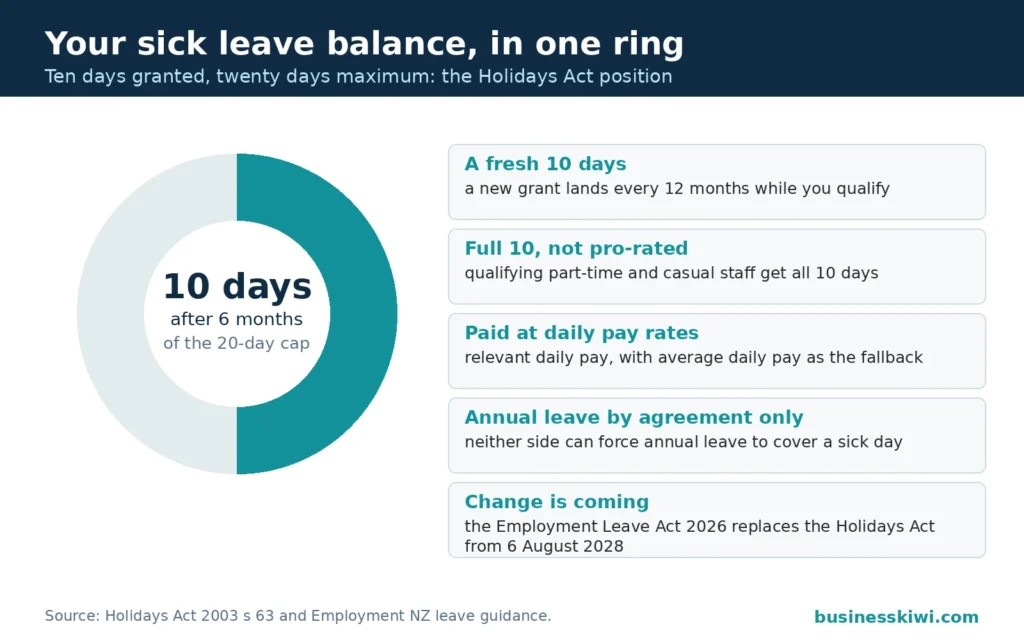
Eligible employees get 10 days of paid sick leave a year. That is the legal minimum. An employer can offer more in an employment agreement or workplace policy, and many do, but they cannot offer less.
The entitlement is not there from day one. It kicks in once you have:
- completed 6 months of continuous employment with the same employer, or
- worked for the employer over a 6-month period for an average of at least 10 hours a week, and at least 1 hour in every week or 40 hours in every month.
This is set out in section 63 of the Holidays Act 2003, and Employment NZ applies the same test to everyone. Full-time staff qualify. So do part-time and casual employees, provided they meet the hours pattern above. The 10 days are not pro-rated. A part-timer who works two days a week and meets the test gets the same 10 days as someone working full-time, because the Act counts sick leave in days, not hours.
After the first entitlement arises, a fresh 10 days is provided for each following 12-month period, as long as the qualifying circumstances still apply. If your work pattern changes and you no longer meet the criteria in a particular year, you do not get a new entitlement for that year. You can still use any balance carried over from the year before, and you can re-qualify once you meet the test again.
Employers and employees can also agree to sick leave being taken in advance of entitlement, with the days taken deducted from the entitlement when it arises. That is a matter of agreement, not a right either side can demand.
When you need a sick day, tell your employer as early as you can, ideally before you were due to start work. Employment NZ expects employees to let their employer know as soon as possible, and the Act builds notification into the entitlement itself. A quick call or message protects your position and gives your employer a fair chance to cover your shift.
Carrying sick leave over
Unused sick leave does not vanish at the end of the 12-month period. It carries over and is added to the next year’s entitlement. There is a ceiling: your balance can build up to a maximum of 20 days in total. In practice that means up to 10 unused days can roll into the following year alongside the new 10.
You and your employer can agree to a higher cap, either in the employment agreement or through workplace policy. What you cannot do is cash the leave up. Unused sick leave is never paid out, including when your employment ends. It simply disappears from the balance when you leave a job, unlike annual holidays, which must be paid out in your final pay.
What sick leave pays
Sick leave is paid at your relevant daily pay. In plain terms, that is the amount you would have earned if you had actually worked that day. It includes more than your base wage or salary. If you would have earned overtime on the day, or commission or piece rates, or a regular allowance such as an on-call allowance, those form part of relevant daily pay too. Reimbursements and employer superannuation contributions do not.
Sometimes relevant daily pay cannot be worked out, perhaps because your hours and earnings shift around too much. Average daily pay is used instead. Average daily pay takes your gross earnings over the previous 52 weeks and divides them by the number of whole or part days you worked or were on paid leave during that period. Your employer can also use average daily pay if your daily pay varies within the pay period the leave falls in.
Two more points catch people out.
First, sick leave is only paid for days you would otherwise have worked. If you are sick on a day you were not rostered, or a day you were already on unpaid leave, there is no paid sick leave for that day and nothing is deducted from your balance. Employment NZ calls these “otherwise working days”, and the whole system hinges on them.
Second, the Act measures sick leave in whole days. If you work part of a day and then go home sick, your employer can deduct a full day from your entitlement, no matter how much of the day you worked. You can agree with your employer to track the entitlement in hours or part-days instead, but the total still has to be worth at least 10 full days a year.
Payment itself is straightforward: sick leave is paid in the pay that relates to the period when the leave was taken, as part of your normal pay cycle.
Using sick leave for medical appointments
Sick leave can cover some medical appointments, but not all of them. The dividing line is whether the appointment is routine. A check-up at the dentist or picking up a repeat prescription is routine. Going to the doctor because you are unwell, attending hospital for surgery, or seeing a physio for an injury is not.
For a non-routine appointment, you can use sick leave to attend. For a routine one, your employer is not legally required to give you time off unless your employment agreement provides for it. If the agreement is silent, the two of you can negotiate, perhaps using paid leave or unpaid leave for a few hours, or you can book routine appointments outside work hours instead.
Sick leave is not the same as ACC
If your absence is caused by an injury covered by ACC, different rules take over. Once you are receiving weekly compensation from ACC, your employer cannot require you to use sick leave or annual holidays to cover that time. For a work injury, the employer pays 80 percent of your usual earnings for the first week; ACC pays from the second week. For an injury outside work, the first week is not covered by ACC, so you can use sick leave or another form of paid leave if you have it. After the first week, you and your employer can agree to top your ACC payments up from 80 percent toward your full pay by spending 1 day of sick leave for every 5 days you are on ACC. Injury absences are a whole topic of their own; the key point here is that sick leave and ACC compensation run in parallel, not as substitutes.

So how does using annual leave for a sick day actually work?
Say your sick leave balance is empty, or you would rather save it, and you want a sick day recorded as annual leave instead. The process looks like this.
You ask your employer, ideally as early as you can, just as you would report any sick day. Your employer considers the request. If they agree, the day is recorded against your annual holidays rather than your sick leave. If they do not agree, the day cannot be taken as annual leave. You would be looking at the other options covered later in this guide, such as unpaid leave.
Get the agreement in writing, or at least in an email or leave system entry you can both see later. Leave balances are one of the most common sources of payroll disputes, and a short written record of what was agreed, and when, protects everyone.
There is one mechanical difference worth understanding. Annual holidays are measured in weeks, not days. Your entitlement is 4 weeks a year, and a “week” means whatever a working week is for you. For a full-time employee working five days, one day of annual leave is one fifth of a week. For someone working three days a week, a week of their leave is three days, so one day is a third of a week. When you use annual leave for a single sick day, payroll deducts that portion of a week from your annual holiday balance.
The pay can differ too. Annual holidays are paid at the greater of your ordinary weekly pay at the start of the holiday, or your average weekly earnings over the previous 12 months. Sick leave, as explained above, is paid day by day at relevant daily pay (or average daily pay). Because the two calculations are built differently, a sick day taken as annual leave will not always come out at the same dollar figure as a sick day taken as sick leave. For someone whose earnings over the past year were boosted by overtime or bonuses, the annual leave rate can be higher. For someone who would have worked a long, overtime-heavy shift on the day itself, relevant daily pay may be the better number. Neither is guaranteed to win, which is worth keeping in mind before you choose which balance to spend.
One related option exists, but it is a different thing. Employees can ask in writing to cash up to 1 week of their annual holidays each year and receive payment instead of taking the time off. That is about converting leave to cash, not about covering sickness, and your employer can decline it.
Getting sick just before, or during, annual holidays
This is the mirror image of the main question, and the rules are stricter here, in the employee’s favour.
If you fall sick before your annual holidays begin, and you have sick leave available, your employer must let you take sick leave for the relevant period instead of annual holidays. The annual leave stays in your balance for later.
If you are already on annual holidays and fall sick partway through, the position flips to agreement. You can ask to take sick leave instead of annual holidays for the days you were sick, but your employer must agree. If they do, those days come off your sick leave balance and the annual holidays are credited back.
The same approach applies where it is your spouse, partner or a dependant who becomes sick or injured, since sick leave can be used to care for them as well.
Sick leave for someone else, and bereavement leave
You do not have to be the sick person. Sick leave can be taken when you are sick or injured, when your spouse or partner is sick or injured, or when a person who depends on you for care is sick or injured. Parents use it for sick children; it is also used for dependant parents and others who rely on you. The same entitlement, payment and balance rules apply.
Bereavement leave is a separate entitlement that sits alongside sick leave in the Holidays Act and uses the same 6-month qualifying test. It provides at least 3 days for the death of an immediate family member, such as a parent, child, spouse or partner, grandparent, grandchild or sibling, and at least 1 day where another person dies and your employer accepts that you have suffered a bereavement, taking into account how close you were and any responsibilities you have for the funeral or tangi arrangements. It is paid at relevant daily pay (or average daily pay) for days you would otherwise have worked.
If a public holiday lands in the middle of your sickness
If a public holiday falls on a day you would otherwise have worked, and you are sick that day, the day is treated as a public holiday rather than a sick day. You are paid your relevant daily pay (or average daily pay) for it, no sick leave is deducted from your balance, and because you did not work the day, there is no entitlement to time and a half or an alternative holiday. It is a small rule, but it protects your sick leave balance over periods like Christmas and New Year, when public holidays cluster.
When the sick leave runs out completely
Long illnesses and slow recoveries are where this stops being theoretical. If your entitlement is exhausted and you still cannot work, Employment NZ lists the options, and every one of them depends on agreement or on what your employment agreement already provides.
- Annual holidays. You can ask to use some of your annual holiday entitlement, or to take annual holidays in advance if your employer allows that. This is the route covered in detail above.
- Leave without pay. You and your employer can agree to a period of unpaid leave. Get the arrangement in writing, including how long it lasts. Note that if you take more than a week of unpaid leave in a year, it can shift the date your next annual holiday entitlement arises, unless you agree otherwise.
- Discretionary paid leave. Some employment agreements and workplace policies provide extra paid sick leave, sometimes called special leave, beyond the legal minimum. Where nothing is provided, an employer may still agree to paid leave as a one-off. They are not obliged to.
- Sick leave in advance. Employment NZ also lists asking for sick leave ahead of your next entitlement arising, to be deducted once it does. Again, this needs your employer’s agreement.
Your employer does not have to agree to any of these unless your employment agreement says otherwise. Equally, you cannot be forced onto annual leave to cover sickness; that too is a matter of agreement.
A quick word about proof. Employers can ask for evidence of sickness or injury, usually a medical certificate, and the cost rules and timing depend on how long you have been away. If an employer asks for proof and it is not provided without a reasonable excuse, they do not have to pay for the leave until it is. The detailed rules on certificates, disputes and what happens if an employer refusing sick leave becomes a problem are covered in our separate guide on that topic.
One change on the horizon
Everything above reflects the Holidays Act 2003, which is still the law that applies now. Parliament has since passed the Employment Leave Act 2026, which will replace the Holidays Act, but Employment NZ confirms it does not start until 6 August 2028. Until then the Holidays Act rules in this guide continue to apply, and Employment NZ is publishing preparation guidance ahead of the changeover.
Frequently asked questions
Can I use annual leave if I have no sick leave left?
Yes, if your employer agrees. Ask as early as you can and get the agreement recorded. Your employer does not have to say yes unless your employment agreement gives you that right.
Can my employer make me use annual leave when I am sick?
No. Annual holidays are taken at times agreed between you and your employer, so a sick day cannot be reclassified as annual leave without your agreement. If you have sick leave available and you are entitled to it, that is the leave that applies.
How many days of sick leave do I get each year in NZ?
Ten days of paid sick leave for each 12-month period, once you have completed 6 months with the employer and meet the qualifying test. Part-time and casual employees who meet the test get the same 10 days; the entitlement is not pro-rated.
Does unused sick leave carry over or get paid out?
Unused sick leave carries over into the next year, up to a maximum balance of 20 days, unless you and your employer agree to a higher cap. It is never cashed up and is not paid out when your employment ends.
What happens if I get sick during my annual holidays?
If you fall sick before your holidays start, your employer must let you use sick leave instead, if you have it. If you fall sick partway through your holidays, you can swap those days to sick leave only if your employer agrees.
Sources
All facts in this article were checked against official sources on 7 October 2026:
- Employment New Zealand, “Taking sick leave”, employment.govt.nz
- Employment New Zealand, “Managing sick leave”, employment.govt.nz
- Employment New Zealand, “Taking annual holidays”, employment.govt.nz
- Employment New Zealand, “Calculating holiday and leave pay”, employment.govt.nz
- Employment New Zealand, “Public holidays rights for employees”, employment.govt.nz
- Employment New Zealand, “Taking bereavement leave”, employment.govt.nz
- Employment New Zealand, “Employment Leave Act 2026”, employment.govt.nz
- Holidays Act 2003, section 63, New Zealand Legislation, legislation.govt.nz
Disclaimer
This article is general information about sick leave and annual holidays in New Zealand, based on Employment New Zealand guidance and the Holidays Act 2003. It is not legal advice, and it does not cover every situation. Your employment agreement may give you more than the legal minimums described here, so check it, and contact Employment New Zealand or get independent advice if you are in a dispute.
More employment guides for Kiwi businesses and workers are collected in our Business & Industry hub.