What Is the Average Power Bill for a 4 Person Household in NZ?

There is no official statistic that isolates households of exactly four people, so any honest answer has to be built in two parts. First, what does electricity actually cost per unit in New Zealand right now? Second, how much power does a household of four realistically get through in a year? Put those two together and you get a range you can budget around, rather than a single made-up number.
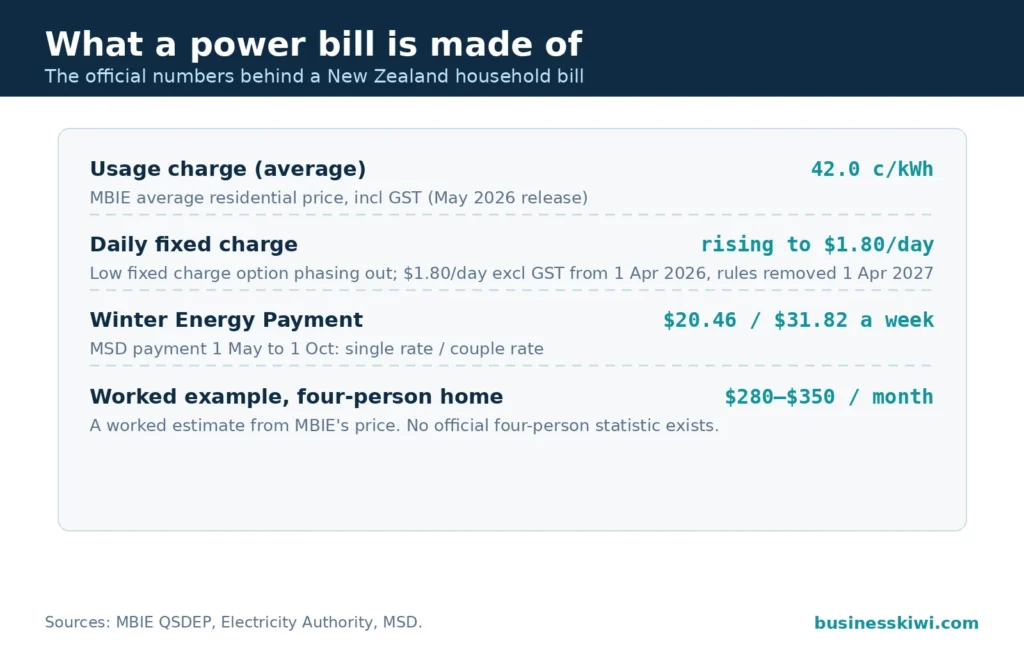
Here is the short version. MBIE, the government ministry that tracks energy prices, models a typical New Zealand household as using 8,000 kWh a year. At the national average price in its May 2026 survey, 42.0 cents per kWh including GST, that works out to $3,360 a year, or about $280 a month. Bigger households generally use more than the all-household average, and research commissioned by MBIE confirms that power use climbs with household size. So for four people, a sensible planning range is roughly 8,000 to 10,000 kWh a year, which at that average price means around $280 to $350 a month, or $3,360 to $4,200 a year. Where you live matters a lot too: the same usage can cost several hundred dollars a year more in the Far North or South Otago than it does in Wellington.
Everything below shows the working, so you can swap in your own usage and your own region and get a figure that fits your home.
How the official numbers work
MBIE runs the Quarterly Survey of Domestic Electricity Prices, usually shortened to QSDEP. Every quarter it records the advertised tariffs in about 40 towns and cities and works out what a model household would pay. That model household uses around 22 kWh a day, which adds up to 8,000 kWh a year, heats its water with electricity, pays on time to earn any prompt payment discount, and sits on the cheapest available low user plan with no fixed term.
Three details in that method matter when you read the results:
- The quoted price in cents per kWh is not just the per-unit rate on a bill. It is the household’s total annual cost, fixed daily charges included, divided by 8,000 kWh. That makes it a genuine all-in average price.
- All QSDEP prices include GST, both the total and the split between lines charges and the energy and other component.
- Because the model assumes a low user plan, the figures suit households using up to about 8,000 kWh. Past that point you would normally be on a standard plan, where the fixed daily charge is higher and the per-unit rate lower.
MBIE also publishes sales-based data, which divides everything retailers actually sold to households by the volume delivered. That series captures what people really paid, discounts and fixed-term deals included, but it is only published as a national average per kWh and does not break down by household size either.
The Electricity Authority uses the same 8,000 kWh benchmark when it talks about a typical household, so the two agencies’ numbers line up.
The worked estimate for a household of four
Start with consumption. The 8,000 kWh model is an average across every kind of household, from a single person in a flat to a family of six. Analysis by Sense Partners for MBIE’s review of the low fixed charge phase-out found that electricity use rises with household size and income, that households with children use more per person than adult-only homes, and that about two-thirds of households used less than 8,000 kWh in 2023. In other words, smaller households pull the average down, and a four person home will usually sit at or above it, especially if it is all-electric with no gas or wood burner helping out.
With that in mind, here is what different levels of use cost at the May 2026 national average price of 42.0 cents per kWh, GST included. These are estimates built from MBIE’s official average price, not official statistics in their own right.
Two cautions about the table. First, the 42.0 cent figure is calibrated at 8,000 kWh. Because part of every bill is a fixed daily charge that does not change with usage, a household using 6,000 kWh will usually pay a bit more per unit on average, and a household using 12,000 kWh a bit less. MBIE makes exactly this point about its own data: when average use falls, the cost per unit rises, because the same fixed costs are spread over fewer units. Treat the outer rows of the table as close approximations, not exact quotes.
Second, these are annual figures smoothed across twelve months. Real bills are seasonal. A four person household might pay well under the monthly average in February and well over it in July, when heating runs for longer and days are shorter. If your retailer offers an even-payment option that spreads the cost evenly across the year, it is working from the same arithmetic.
Where you live changes the answer
Electricity retail prices are broadly similar across the country for the energy itself. What varies is the cost of the local lines network that delivers it, and sparse rural networks cost more per customer to run than dense city ones. In the May 2026 QSDEP, lines charges made up 16.8 cents of the 42.0 cent national average, about 40 percent of the total. In Kerikeri the lines component alone was 23.3 cents per kWh, while in Wellington City it was 12.3 cents.
That flows straight through to bills. Here is the annual cost of the same 8,000 kWh in selected centres, using each centre’s average price from the May 2026 survey:
Balclutha, the most expensive centre surveyed, cost about 42 percent more per unit than Wellington City, the cheapest. For a family of four using 10,000 kWh, that regional gap is worth roughly $1,550 a year. You cannot choose your lines company, since it is set by your address, but the gap explains why a bill that looks normal in one town can look alarming in another.
Prices are also moving. The national average rose 3.5 percent in the May 2026 survey alone, from 40.6 cents in February, and almost all of that quarterly jump came from lines charges, which rose 10.7 percent while the energy and other component eased slightly. The Electricity Authority’s market reporting found that, after adjusting for inflation, domestic electricity prices rose 10 percent in the twelve months to September 2025, adding about $274 a year to the bill of a typical 8,000 kWh household. If your bill feels heavier than it did a year or two ago, the data backs you up.
What makes up the bill
Every power bill has two moving parts:
- A fixed daily charge, paid for every day you are connected, whatever you use.
- A variable charge for each kWh consumed, sometimes split into controlled and uncontrolled rates, or day and night rates, depending on your meter setup.
The fixed charge is where policy has been shifting. Since 2004, regulations have required retailers to offer a low fixed charge option for smaller users. The government is phasing those regulations out over five years, on the reasoning that the cap forced higher users, often larger low-income families, to subsidise low users, who are often higher-income small households. Under the phase-out set out by MBIE, the maximum daily fixed charge on a low user plan, excluding GST, rose from 30 cents before April 2022 in annual 30 cent steps: 60 cents in 2022, 90 cents in 2023, $1.20 in 2024, $1.50 in 2025 and $1.80 from 1 April 2026. On 1 April 2027 the regulations are removed altogether and retailers will no longer have to offer a low fixed charge plan at all, although some may keep one voluntarily.
A low user, for this purpose, is a household in the North Island or upper South Island using less than 8,000 kWh a year, or less than 9,000 kWh in the lower South Island. Many four person households sit right around that boundary, which is why checking which plan type you are on is worth real money. If your household uses more than the threshold, a standard plan with a higher daily charge but a lower per-unit rate is usually the cheaper shape, and vice versa.

What drives usage in a four person home
Four people means more showers, more laundry, more devices and more rooms in use for more hours. The main drivers, in rough order, are:
Heating. Keeping rooms warm through a New Zealand winter is the biggest single load in most homes, and the main reason bills spike between May and September. The type of heating matters as much as the thermostat: a heat pump moves heat rather than making it, so it delivers the same warmth for far less electricity than a plug-in resistive heater.
Hot water. EECA, the Energy Efficiency and Conservation Authority, puts water heating at about 30 percent of an average household’s energy use. In a four person home the cylinder reheats after every shower, bath and load of washing, all day, every day. Long showers and a high-flow shower head are often the quietest budget leak in the house.
Appliances that never sleep. Fridges and freezers run around the clock. A second beer fridge in the garage, common in family homes, adds its running cost on top. Clothes dryers, dishwashers, ovens and gaming PCs all add up across four people’s routines.
The house itself. Insulation, draughts and window coverings decide how much of the heat you pay for stays inside. Two identical families in different houses can have very different bills for exactly that reason.
How to bring a four person bill down
Check your plan before anything else. Consumer Protection, part of MBIE, advises anyone who thinks they are paying too much to check whether switching providers will save money, and notes that switching is easy and free. The Electricity Authority runs an independent comparison tool to help households compare plans against their own usage, and MBIE itself points consumers to comparison tools when they want retailer-level prices for their town. Households change plans far less often than they change usage habits, yet the plan check is usually the bigger saving.
Confirm you are on the right plan type. With the low fixed charge cap now at $1.80 a day excluding GST, the gap between low user and standard plans has narrowed. If your family has grown into standard user territory, ask your retailer which of their plans would have been cheaper across your last twelve months of actual usage.
Go after hot water. EECA’s guidance focuses on the habits that cost nothing: shorter showers, fixing dripping hot taps promptly, washing clothes in cold water, and running the dishwasher and washing machine only with full loads. If your cylinder is an older model, a cylinder wrap and lagging on the first stretch of pipe help it hold heat. When a cylinder needs replacing, a heat pump water heater is worth pricing up, since it heats water with much less electricity than a standard element.
Heat the people and the rooms you use. Close doors to unused rooms, draw curtains at dusk, and keep heat pump filters clean so the unit runs efficiently. If you run plug-in heaters in bedrooms, a timer stops them heating empty rooms into the night.
Consider solar if the roof and budget suit. EECA estimates that rooftop solar panels can save a New Zealand home more than $1,000 a year on power bills, with a system potentially paying for itself in as little as seven years. The economics work best when the household uses a good share of its power during daylight hours, which often suits families with someone at home. Any surplus you generate and send back to the grid is bought from you at the solar buy back rates your retailer offers, and those rates differ between retailers, so they belong in the comparison when you shop around.
Shift what you can to cheaper times. If your plan has off-peak or night rates, running the dishwasher, washing machine and dryer on delay timers moves that load out of the expensive evening peak. Some retailers also offer free or discounted off-peak hours; the value depends entirely on how much load your household can genuinely shift.

Help with winter bills
If someone in the household receives a main benefit, NZ Super or a Veteran’s Pension, the Winter Energy Payment helps with heating costs through the coldest months. Work and Income pays it automatically, with no application needed, from 1 May to 1 October each year. The rates published by Work and Income are $20.46 a week for a single person with no dependent children, and $31.82 a week for couples and for people with dependent children. It is not taxed and does not affect other payments. A family receiving the $31.82 rate across the full payment period gets roughly $700 of help across the season.
If a bill arrives that you cannot pay, contact your retailer early rather than letting it age. Retailers have obligations under the Electricity Authority’s Consumer Care Obligations to work with customers in payment difficulty, and Consumer Protection’s guidance on electricity services sets out your rights if something goes wrong with billing or supply.
FAQs
What is the average power bill per month for a family of four in NZ?
There is no official four person figure, so the honest answer is an estimate built from official parts. MBIE’s model household uses 8,000 kWh a year at a national average price of 42.0 cents per kWh (May 2026, GST included), which is $280 a month. A household of four will typically use somewhere around 8,000 to 10,000 kWh, putting a reasonable expectation at roughly $280 to $350 a month, less in cheaper lines areas like Wellington and more in expensive ones like the Far North.
How many kWh does a 4 person household use in a year?
Expect something in the 8,000 to 10,000 kWh range for an all-electric home, and less if gas or a wood burner carries part of the heating and hot water load. The official benchmark for a typical household of any size is 8,000 kWh (around 22 kWh a day), and MBIE-commissioned research shows usage climbs with household size, with roughly two-thirds of all households using less than 8,000 kWh in 2023. Your own last twelve months of bills is the most accurate figure you will ever get.
Why is my winter power bill so much higher than my summer one?
Heating. Cold months mean heat pumps and heaters run longer, clothes dryers replace the clothesline, and everyone is home in the dark for more hours. The underlying price per unit barely moves with the seasons for most plans; it is the volume that changes. MBIE notes the flip side of this in its sales data: because part of the bill is a fixed daily charge, your average cost per unit actually falls in winter as that fixed charge is spread over more units, even while the total bill climbs.
Should a family of four be on a low user or standard plan?
It depends on which side of the low user threshold you land. Low user status covers households using under 8,000 kWh a year (9,000 kWh in the lower South Island). If your household uses less than that, a low user plan’s capped daily charge, currently a maximum of $1.80 a day excluding GST, keeps fixed costs down. If you use more, a standard plan’s lower per-unit rate usually wins. Ask your retailer to compare both across your actual last year of usage; the answer is arithmetic, not guesswork.
Are power prices still rising in 2026?
Yes, on the official measures. MBIE’s survey put the national average at 42.0 cents per kWh in May 2026, up 3.5 percent on the February 2026 survey, with the increase driven mainly by lines charges, which rose 10.7 percent in that quarter. The Electricity Authority also reported that inflation-adjusted domestic prices rose 10 percent in the year to September 2025, worth about $274 a year extra for a typical household.
Sources
- MBIE, Quarterly Survey of Domestic Electricity Prices, report for 15 May 2026 (national average 42.0 c/kWh including GST; regional prices; method notes). https://www.mbie.govt.nz/assets/Data-Files/Energy/nz-energy-quarterly-and-energy-in-nz/quarterly-survey-of-domestic-electricity-prices-to-15-may-2026.pdf
- MBIE, Quarterly Survey of Domestic Electricity Prices, report for 15 February 2026 (national average 40.6 c/kWh including GST). https://www.mbie.govt.nz/assets/Data-Files/Energy/nz-energy-quarterly-and-energy-in-nz/qsdep-report-15-february-2026.pdf
- MBIE, Electricity cost and price monitoring (sales-based cost method, QSDEP method, GST treatment). https://www.mbie.govt.nz/building-and-energy/energy-and-natural-resources/energy-statistics-and-modelling/energy-statistics/energy-prices/electricity-cost-and-price-monitoring
- MBIE, Mid-point review of the phase-out of the Low Fixed Charge Regulations (phase-out timetable and maximum daily charges). https://www.mbie.govt.nz/building-and-energy/energy-and-natural-resources/energy-consultations-and-reviews/electricity-price/mid-point-review-of-the-phase-out-of-the-low-fixed-charge-lfc-regulations
- Sense Partners for MBIE, Phase out of the Low Fixed Charge regulations: quantified price effects for the first 3 years, October 2024 (household size and consumption patterns; low user shares; expenditure shares). https://www.mbie.govt.nz/dmsdocument/30584-sense-partners-report-lfc-phase-out-pdf
- Electricity Authority, Market performance quarterly review, Q3 2025 (inflation-adjusted price movement for a typical 8,000 kWh household). https://www.ea.govt.nz/documents/8635/Quarterly_Report_Q3_2025.pdf
- Electricity Authority, Open letter to distributors as low fixed charge regulations come to an end (phase-out completion on 1 April 2027). https://www.ea.govt.nz/news/general-news/open-letter-to-distributors-as-low-fixed-charge-regulations-come-to-an-end/
- EECA, Is solar right for your home? (estimated annual savings from rooftop solar). https://www.eeca.govt.nz/for-homes/solar-for-homes/is-solar-right-for-your-home/
- EECA, Energy saving information for New Zealand homes (Energywise guidance on saving energy at home). https://www.energywise.govt.nz/at-home/
- Consumer Protection (MBIE), Electricity and gas services (switching advice and consumer rights). https://www.consumerprotection.govt.nz/help-product-service/electricity-gas-services
- Work and Income (MSD), Winter Energy Payment (rates and payment period). https://www.workandincome.govt.nz/products/a-z-benefits/winter-energy-payment.html
- Stats NZ, Consumers price index (context for household price movements). https://www.stats.govt.nz/topics/consumers-price-index
Disclaimer
This article is general information only, based on official New Zealand price surveys and guidance available at the time of writing. The four person figures are worked estimates built from MBIE’s published average prices and stated consumption assumptions; they are not official statistics, and they are not personalised advice about your household, your energy use or your choice of retailer or plan. Electricity prices, plans and eligibility rules change over time. Check your own bills and your retailer’s current pricing before making decisions, and use the official comparison tools linked above to test any switch against your actual usage.
For more explainers on household and business running costs, see the Business & Industry hub.