Acoustic Panels in NZ: Types, NRC Ratings, Fire Rules and What They Cost
Quick answer
Acoustic panels are absorptive linings for walls and ceilings. Their job is to soak up sound inside the room you are standing in, so speech, music and activity noise stop bouncing around. Fit enough of them and a hard, echoey space becomes calmer: less reverberation, less echo, clearer conversation.
That is all they do, and the limit matters. Acoustic panels are not soundproofing. They do very little to stop noise travelling through a wall or floor, because blocking sound takes mass, airtight construction and structural separation. If the problem is the neighbours, the flat upstairs or the meeting room next door, panels on your wall are the wrong tool for most of it. If your own room sounds harsh, loud and smeared, panels are exactly right.
In New Zealand, two locally made product families dominate: polyester fibre (PET) panels from Autex Acoustics, and glass fibre panels from Asona. Around those sit fabric-wrapped feature panels, timber slat panels with an absorptive backing, ceiling baffles and fins, and desk screens.
Absorption and soundproofing are different jobs
Sound in a room does two things. Some of it reflects off surfaces back into the room, building up as reverberation. The rest pushes through the construction to whatever is on the other side. Panels deal with the first behaviour: they are porous, light materials that trap sound energy in a tangle of fibres and turn it into a tiny amount of heat, so it cannot reflect back and add to the noise.
Stopping transmission is a different discipline. It relies on heavy, dense, well-sealed construction, often with layers separated so vibration cannot pass easily between them. A 12 mm polyester panel stuck to a wall adds almost no mass and seals nothing, so the wall behind it performs much as it did before. Anyone selling thin panels as a fix for noise through a wall is blurring this line, accidentally or otherwise.
There is one indirect benefit: quietening a noisy room lowers the overall sound level in it, so slightly less energy is available to transmit next door. The Ministry of Education makes this point in its school acoustics guidance, calling absorption and reverberation control a good first step for transmission to adjacent spaces. A first step, not the solution.
How NRC works
NRC stands for Noise Reduction Coefficient. It is a single-number summary of how much sound a material absorbs, drawn from laboratory measurements of absorption at a series of frequencies. Autex’s data sheets describe the method plainly: the NRC is the arithmetic average of the absorption coefficients measured in the one-third octave bands centred on 250, 500, 1000 and 2000 Hz, rounded to the nearest 0.05. Those frequencies matter most for speech. The underlying testing is done to ISO 354; Asona’s data sheets cite ASTM C423 alongside it.
The scale runs from 0 to 1. Zero means the surface reflects everything, like polished concrete or glass. A rating of 1.0 means that, averaged across those speech frequencies, all the sound energy hitting the surface is absorbed. The Ministry of Education’s glossary uses percentages: NRC 0.7 absorbs, on average, about 70 percent of incident sound. Laboratory coefficients can occasionally come out above 1.0, which is why some products are listed fractionally above 1.00.
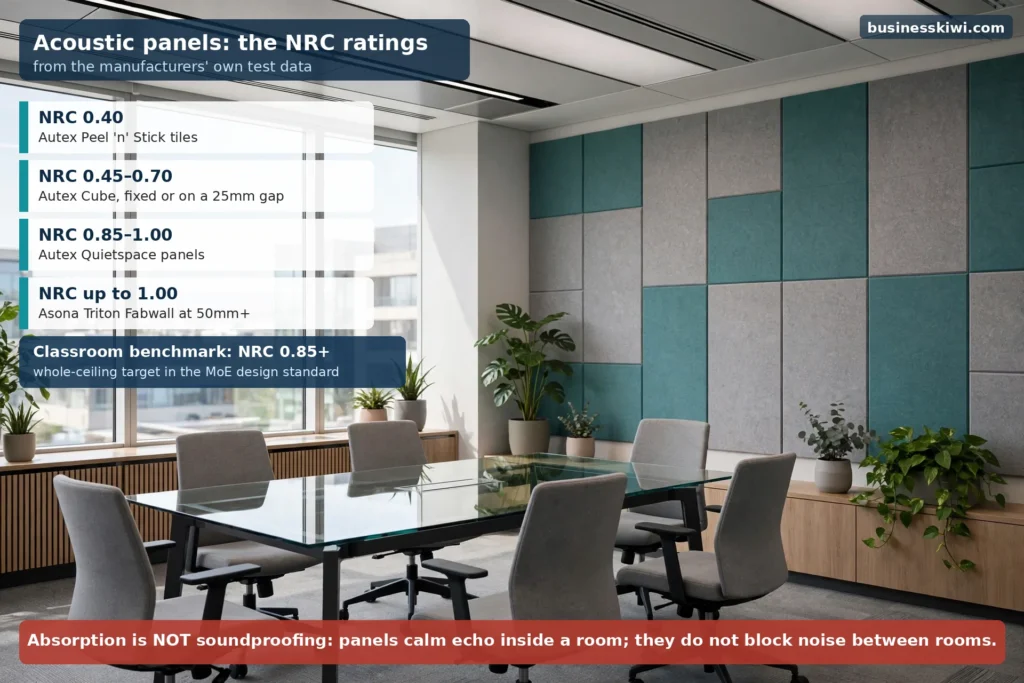
Two practical lessons follow. First, thickness drives performance, especially at low frequencies. Thin products absorb the top end of the spectrum and leave voices sounding boomy, because low frequencies pass straight through them. The Ministry of Education warns that absorbers need to be at least 10 mm thick and porous to be useful, and that thin felt-like materials of 2 to 3 mm sold by the roll only absorb very high frequency sound. Second, mounting changes the rating. Autex’s Cube data sheet lists its 12 mm panel at NRC 0.45 direct-fixed, and at 0.70 when the same panel is mounted with a 25 mm air gap behind it. Air gaps, suspension distance and what sits behind the panel all change the result, so an NRC figure only makes sense alongside the mounting tested.
Coverage matters as much as the rating
A panel rated NRC 1.00 still only absorbs the sound that reaches it. Treat a small patch of one wall in a big hard room and the rest of the room keeps reflecting, so the improvement is modest. This is why acoustic design starts with the large reflective surfaces, and the ceiling is usually the biggest uninterrupted one.
The Ministry of Education’s guidance for learning spaces is the clearest published NZ example. It advises treating the whole ceiling with a product of NRC 0.85 or higher: the ceiling is a large uninterrupted area, and treating it first goes a long way toward the required reverberation time. For gyms, its rule of thumb is wall absorption over an area of at least 20 percent of the ceiling area. It also suggests thick wall absorbers, 25 to 50 mm, placed low, at ear height.
Private projects come with no ministry rule of thumb, and this article will not invent one. The transferable principles: treat the ceiling or the largest wall surfaces first, spread treatment across more than one surface, not in one decorative patch, and expect diminishing returns once the obvious reflective areas are covered. Beyond a single room, an acoustic consultant will model the space and specify quantities, as commercial fit-outs normally do.
The panel types sold in NZ
PET polyester fibre panels
This is the default NZ product. The panels are made from polyester fibre, the same PET plastic family as drink bottles, and local ranges lean on recycled content. Autex Acoustics, manufacturing here, is the dominant brand. Its Quietspace Panel is 100 percent PET with at least 75 percent recycled content, in sheets of 1200 x 2400 mm and 1200 x 2700 mm and thicknesses of 25, 50, 75 and 100 mm, rated NRC 0.85 to 1.00 depending on thickness. Its thinner Cube comes in 12 mm and 24 mm sheets of 1220 x 2440 mm, rated NRC 0.45 and 0.70 in Autex’s data sheet, with a minimum recycled content of 60 percent.
Variations cover most decorative needs. Groove is a router-cut Cube panel with angled patterns, 12 or 24 mm thick, rated NRC 0.45 to 0.80. Lanes folds Cube into batten-like strips 300 mm wide, rated NRC 0.80 to 0.85, and needs no glue to fix. At the DIY end, Composition Peel ‘n’ Stick tiles are 600 x 600 mm self-adhesive tiles, 10 to 12 mm thick and rated NRC 0.40, for small rooms and home offices. Our plastic sheet guide covers PET and other plastics sold as sheet products in NZ.
Fabric-wrapped panels
Fabric-wrapped panels hide an absorptive core inside a decorative fabric face, so the surface reads as upholstery, not a technical product. Asona’s Triton Fabwall is the local benchmark: manufactured in New Zealand from a biosoluble glass wool absorber with an impact-resistant interlayer, wrapped in decorative fabrics. Thicknesses run from 25 mm to 300 mm, rated from NRC 0.85 at 25 mm to NRC 1.00 at 50 mm and above. Asona lists fire performance as Group 1-S, subject to the fabric selected: the wrap is part of the tested system, not a free choice after the fact. These panels are made to measure, aimed at offices, schools, libraries and healthcare interiors.
Timber slat panels
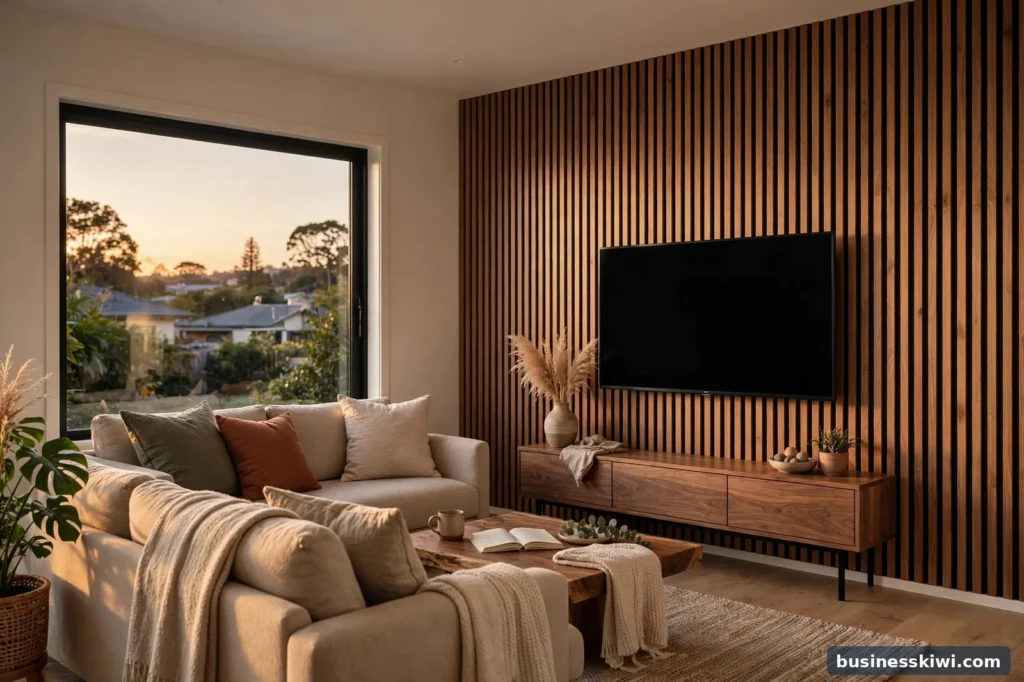
Slatted timber panels are the look of the moment: narrow battens with shadow gaps, usually over a dark backing. Be honest about where the absorption happens. Timber is hard and reflective. The battens scatter sound a little, but the absorptive work is done by the felt or fibre layer behind and between them, plus any cavity behind that.
A typical NZ-sold construction, from Profile Panels, is a real timber veneer face over an MDF core, with a PET polyester backing made from recycled bottles. Sheets are 600 mm wide and 21 mm thick, in lengths of 1200, 2700 and 3000 mm, joined with shiplap edges and fixed with screws through the backing felt, so the fixings disappear. The supplier quotes an NRC range of 0.3 to 0.9 and points to its installation guide for detail, underlining the earlier point: with slats, mounting and backing decide the result. Expect the lower end when a panel sits flat on a wall with only thin felt behind it.
Ceiling tiles, baffles, fins and rafts
Ceiling products divide into lay-in tiles for suspended grids and free-hanging elements for rooms with exposed structure. Asona’s Triton range covers the tile end: its 50 HD is a 50 mm glass wool ceiling panel rated NRC 0.95, available up to 1200 x 1200 mm, and it also carries a CAC rating for sound passing up and over a partition through a shared ceiling plenum. Autex’s Frontier system covers the hanging end: polyester fins and rafts in 2400 mm lengths on an adjustable channel and clip system, so height and spacing can be tuned to the room. Frontier pieces are rated as configurations rather than single sheets, with published raft NRC values of 0.75 to 0.95 depending on shape and spacing. Baffles and fins earn their place in high-ceilinged atria, gyms, hospitality venues and open-plan offices, intercepting sound on both faces while leaving structure and services visible.
Desk screens and partitions
Autex’s Vicinity desk screens are 100 percent PET panels that clamp to the desk edge without damage, with designs that wrap the front and sides of a workstation. Because a screen is a discrete object rather than surface coverage, manufacturers rate screens in sabins per unit, total absorption per item, rather than by NRC. Screens take the edge off nearby speech and add visual privacy; they will not fix an echoing room alone.
Fire performance: Group Numbers
Wall and ceiling linings in commercial buildings are regulated for fire behaviour, and acoustic panels count as surface finishes once fixed. NZ compliance uses a Group Number from 1 to 4, derived from the ISO 9705 full-scale room test. BRANZ explains the basis: the number reflects how long the lined room takes to reach flashover in the test, with Group 1 the best performing (no flashover during the 20 minute test) and Group 4 the worst (flashover in under 2 minutes). A suffix of S marks materials meeting a low smoke production threshold, giving ratings such as 1-S.
MBIE’s Acceptable Solution C/AS2 sets the maximum permitted Group Number by space and by whether the building is sprinklered. In an unsprinklered building, exitways and sleeping spaces where care or detention is provided must be Group 1-S. Other sleeping spaces outside household units, and crowd spaces, are limited to 2-S. All other occupied spaces allow up to Group 3. Sprinklers relax each step, with exitways moving to Group 2. C/AS2 also lists acoustic treatment within exitways specifically, at 1-S unsprinklered.
Two buying rules follow. First, in a commercial fit-out, check the Group Number of the exact product and finish supplied, not the brand headline, because ratings attach to specific constructions; Asona’s fabric caveat makes the same point. Second, homes are far less constrained: the surface finish controls in Building Code clause C3.4 do not apply to detached dwellings or within household units in multi-unit dwellings, so a Group rating is no legal hurdle in a typical house. Preferring products with published fire test results over untested imports is still sensible.
The mainstream NZ-made products sit at the top of the scale. Autex publishes Group 1-S under ISO 9705 across its Cube, Groove, Lanes and Frontier ranges; Asona lists Group 1-S for its Triton ceiling panels, and for Fabwall subject to fabric choice. A product with no published Group Number is the one to question.
The Building Code context: clause G6
Some buyers arrive at panels from the other direction: a noise problem between homes, which is Building Code clause G6 territory, Airborne and impact sound. Its functional requirement: building elements common between occupancies must be constructed to prevent undue noise transmission to the habitable spaces of household units. The performance numbers are STC and IIC. Clause G6.3.1 requires a Sound Transmission Class of no less than 55 for walls, floors and ceilings between occupancies, and G6.3.2 an Impact Insulation Class of no less than 55 for floors.
Those figures describe tested construction systems: the whole wall or floor build-up, with its mass, cavity, linings, isolation and sealing. BRANZ’s medium-density housing guidance notes that even Code-compliant construction can leave occupants dissatisfied, and suggests designing to STC 60 or more for good acoustic privacy in most situations. None of this is achievable by gluing absorptive panels to one face of a wall. Panels can take the harshness out of the room you occupy, but an inter-tenancy noise complaint is a construction problem with a construction answer, usually involving an acoustic engineer and building work, not a lining purchase.
Where panels earn their keep
Offices and meeting rooms. Open-plan offices accumulate speech noise until nobody can concentrate; meeting rooms lined with glass and plasterboard smear speech until video calls become hard work. Ceiling treatment plus one or two treated walls is the usual prescription, with desk screens at workstation level.
Classrooms and learning spaces. This is the one NZ setting with mandatory acoustic targets. The Ministry of Education’s school acoustics document sets maximum reverberation times for school projects, including 0.4 to 0.5 seconds for primary learning spaces under 300 cubic metres and 0.5 to 0.6 seconds for equivalent secondary spaces, measured unoccupied at mid frequencies.
Hospitality. Cafes and restaurants with concrete, glass and steel are loud by construction. Ceiling rafts and wall panels are the standard fix, added without rebuilding the room, protecting conversation at the table even when the venue is full.
Home theatres, music rooms and home offices. The goal is control: taming reflections so dialogue and music stay clear, and a video call voice from sounding like a bathroom recording. A modest area of mid-thickness panels on the ceiling or behind the listening position does most of the work.
Buying and installing in NZ
Commercial PET and glass fibre panels are generally sold per panel or per project through the manufacturer or its agents, with made-to-measure sizes common. Residential slat panels are sold per sheet, and Autex desk screens are sold in packs. Samples are worth ordering: colour and texture differ from screen images, and batches vary.
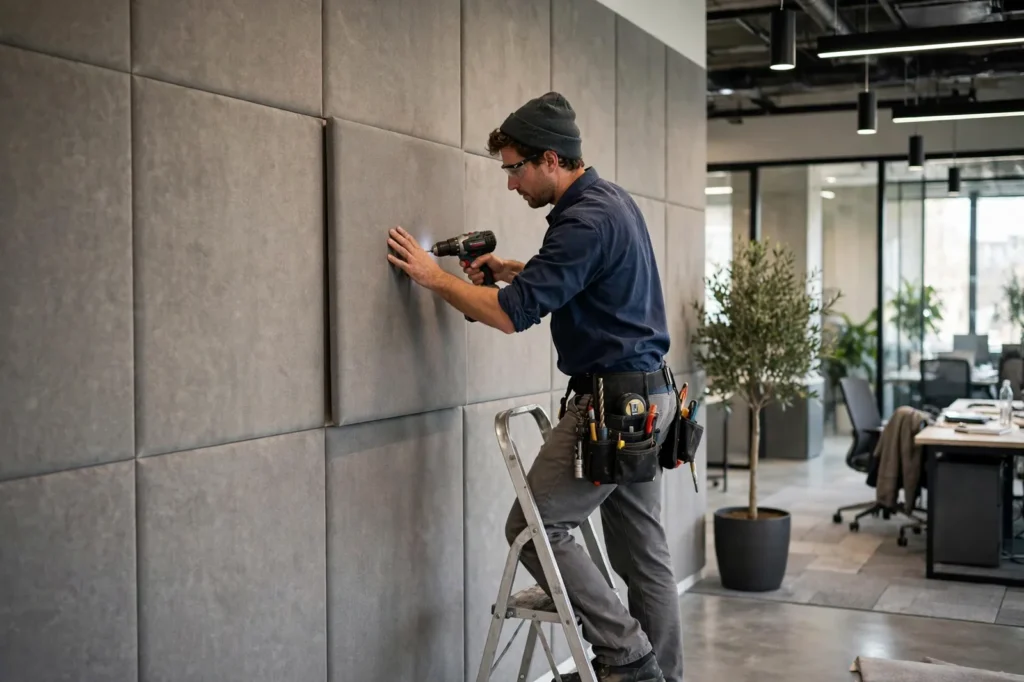
Installation methods follow the product. Direct-fix panels go up with adhesive or with mechanical systems such as Autex’s SpinFix mounts or Asona’s impaling plates and concealed split rails with Z clips. Peel-and-stick tiles suit small DIY jobs. Baffles and fins hang from the structure on channels, clips or rods, which is installer work once seismic restraint and services are involved. Slat sheets are screwed through their felt backing into the wall or battens.
A competent DIYer can handle tiles and slat sheets in a single room at home. Commercial work normally sits inside a fit-out contract, with an acoustic consultant or the manufacturer’s specification team setting quantities and placement before anything is ordered. Ordering panels first and working out coverage later is how budgets get wasted.
What they cost
Most commercial acoustic panels in NZ carry no public webpage price. Autex and Asona publish specifications, test results and fire ratings openly, but price is given on application through account managers, agents and installers, because much of the range is made to measure or fit-out supplied. Anyone quoting a single market rate per square metre for commercial panels is estimating; this guide will not.
The visible exception is the residential slat market, where NZ suppliers sell standard sheets online. Profile Panels, for example, listed its Slat Interior Acoustic Panelling in Natural Walnut (600 mm wide, 21 mm thick, timber veneer face, MDF core, PET backing) at these prices on 7 October 2026:
Check freight and the current listing before relying on these figures. A slat sheet also buys the least absorption per dollar of anything in this article: you pay for the timber look as much as the acoustics.
Material and thickness come first: thicker absorbers cost more to make and to freight. Coverage area is next, set by the room rather than preference. Fire rating matters commercially, since a tested Group 1-S system carries testing and compliance behind its price. Custom sizes, printing, cutting and fabric choices add cost. Then installation: adhesive-fixed tiles are cheap to put up, while suspended fins, baffles and made-to-measure fabric panels carry real labour. Budget for the installed result, not the panel price alone.
Frequently asked questions
Will acoustic panels stop noise from my neighbours?
No, not to any useful degree. Panels absorb sound within your room; they do not add the mass or airtightness that blocks sound passing through a wall or floor. Noise between homes is governed by the construction itself, covered by Building Code clause G6 with its STC 55 and IIC 55 requirements. Panels may make your room feel less harsh, but the neighbour’s television will come through much as before.
What NRC rating should I look for?
Match the rating to the job and the mounting. For ceilings in learning spaces, the Ministry of Education specifies NRC 0.85 or higher across the whole ceiling. For general office and home use, products in the 0.45 to 0.80 band are common and effective when enough area is covered. Thickness is the honest shortcut: a panel of 25 mm or more absorbs across a wider frequency range than a 10 mm tile, whatever the headline number says.
How many panels do I need?
There is no universal percentage, and be wary of any seller who offers one without seeing the room. Work from the largest reflective surfaces: ceiling first, then walls that face each other. The Ministry of Education’s school guidance treats the whole ceiling then adds wall treatment, with a gym rule of thumb of wall absorption equal to at least 20 percent of the ceiling area. A home office may need a few square metres; a restaurant needs a design. Commercial spaces should have quantities specified, not guessed.
Do acoustic panels meet NZ fire rules?
The mainstream NZ-made products do. Autex and Asona publish Group 1-S ratings under ISO 9705 for their main ranges, the most demanding finish category in MBIE’s C/AS2 table, required for exitways in unsprinklered buildings. What matters is the rating of the specific product and finish, so ask for the Group Number in writing. No published NZ fire test result is a gap, especially in a commercial building.
Can I install acoustic panels myself?
Some products are designed for it: peel-and-stick tiles, direct-fix panels with proprietary mounts, and timber slat sheets that screw through their backing. Suspended baffles and fins, full ceiling systems and made-to-measure fabric panels are installer work, and commercial projects need the fire documentation kept with the building records. If the room is a rental, adhesive fixing can damage linings; clip and screw systems are easier to make good when you leave.
Sources
- MBIE Building Performance: Acceptable Solution C/AS2 for Protection from Fire (Tables 4.3 and 4.4) and Building Code clauses C3.4 and G6, building.govt.nz
- BRANZ Build, “Compliance testing interior surface finishes” and “Soundproofing in medium-density housing”, buildmagazine.org.nz
- Ministry of Education, Designing Quality Learning Spaces: Acoustics, version 3.1, education.govt.nz
- Autex Acoustics product data: Quietspace Panel, Cube, Groove, Lanes and Frontier, autexacoustics.co.nz and autexglobal.com
- Asona product data: Triton Fabwall and Triton 50 HD, asona.co.nz
- Profile Panels, Slat Interior Acoustic Panelling product listing, profilepanels.co.nz
All product specifications, ratings and prices were checked on 7 October 2026.
Disclaimer
This article is general information about acoustic panels and NZ building rules, not acoustic engineering or legal advice. Product specifications, ratings and prices change, and fire and sound requirements depend on the specific building and its use. For commercial projects, school work or anything involving Building Code compliance, confirm the details with the manufacturer and an acoustic consultant before you buy.
More guides to building products, fit-outs and running a business are in our Business & Industry hub.