Plastic Sheet in NZ: Types, Thicknesses and What to Buy For Each Job
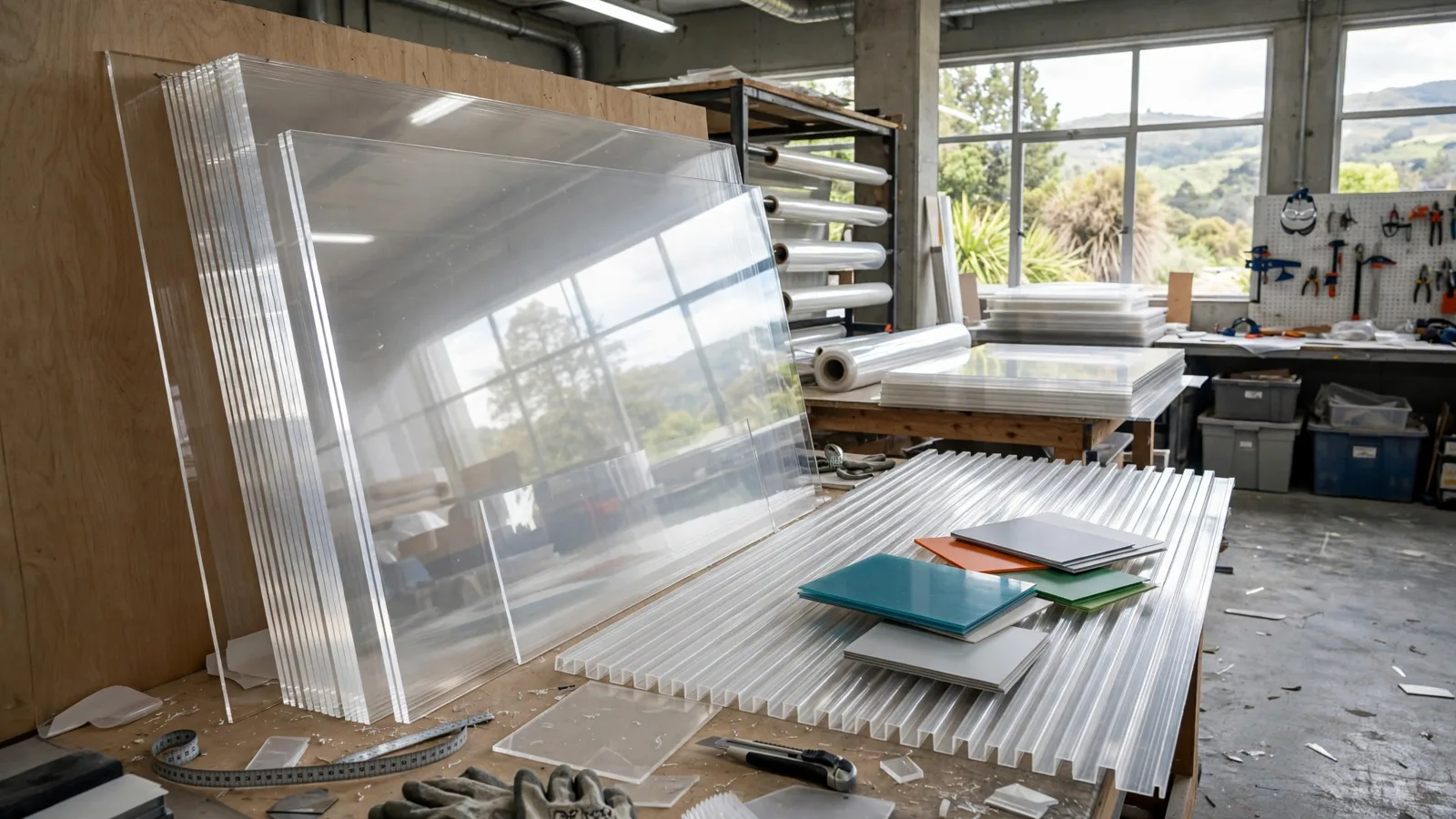
“Plastic sheet” sounds like one product. It is not. The sheets stacked at a plastics supplier cover at least seven different polymers, and they behave very differently once you cut, bend, heat or leave them in the sun. A sign that warps by Christmas, a machine guard that cracks around its screws, a greenhouse roof that goes milky in three summers: most failures trace back to the wrong polymer, not bad luck. This guide works through the main sheet plastics sold in New Zealand, what manufacturers’ own data says about each, and which jobs each suits.
Quick answer: which sheet for which job
- Signage and displays that must stay crystal clear: acrylic.
- A window or machine guard that keeps taking hits: solid polycarbonate.
- Greenhouse roofs, cloches and carport covers: twinwall polycarbonate.
- Cheap printed sign boards indoors: foam PVC. Short-life outdoor signs: fluted polypropylene.
- Guards and panels around chemicals: rigid PVC, or polypropylene for tanks and trays.
- Cutting boards, boat fit-out and wear strips: HDPE.
- A guard or screen needing a formed shape: PETG.
- Vacuum-formed housings, liners and interior trim: ABS.
The main sheet plastics, one by one
Acrylic (PMMA)
Acrylic, sold for decades under names like Perspex and Plexiglas, is the clarity benchmark. Plaskolite’s OPTIX datasheet puts light transmission at 92 percent, the highest of any common sheet plastic, and its density of 1.19 g/cm³ means a 3 mm sheet weighs 3.69 kg per square metre (PSP’s figure), roughly half the weight of glass the same thickness. Manufacturers rate its breakage resistance at around 17 times that of glass, a figure that pales beside the clear plastics below. Acrylic is stiff and takes a polish, but it is the brittle member of the clear family: in Plaskolite’s own falling dart comparison at 3.2 mm, acrylic failed at every impact energy tested while PETG and polycarbonate did not break.
Heat is the other limit. PSP rates its cast acrylic for service up to 80°C, with a Vicat softening point of 115°C, so keep it away from direct heat. It barely cold bends (PSP gives a minimum cold bending radius of 330 times the sheet thickness), so curves mean hot forming at 160–175°C. Outdoors it is the natural: acrylic is inherently stable in UV, and PSP backs the clear grade of its high-impact Resist acrylic with a 30 year warranty. PSP’s NZ range lists clear cast sheet from 3 mm to 50 mm thick in the standard 2440 × 1220 mm sheet, and up to 12 mm in the larger 3050 × 2030 mm size. Typical work: signage, display cases, splashbacks and boat windscreens.
Polycarbonate, solid sheet
Polycarbonate is the impact specialist. Palram’s datasheet for its PALSUN solid sheet (1–12 mm thick, density 1.2 g/cm³) records a falling weight impact strength of 158 joules at 3 mm and elongation at break above 90 percent, which is why the material dents and stretches instead of shattering. Light transmission is 89 percent at 3 mm, close to acrylic, and the service range is the widest of the clear sheets at −40 to +120°C, with a heat deflection temperature of 130°C. PALSUN UV2 carries a co-extruded UV protective layer on both faces; that layer matters, because unprotected polycarbonate yellows in sunlight. Standard sheet scratches readily, so hard-coated grades exist for high-wear glazing. This is the default material for machine guards, safety glazing, boat windows and any pane likely to be struck.
Polycarbonate, twinwall and multiwall
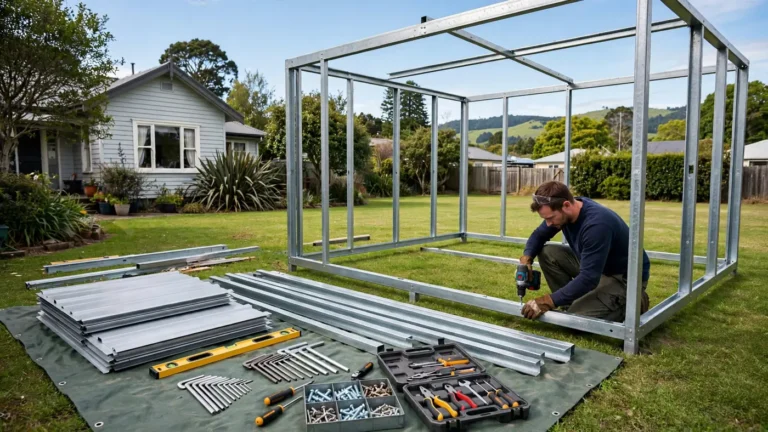
Twinwall sheet is two thin polycarbonate skins held apart by internal ribs, giving a stiff, light panel that insulates far better than solid sheet. Palram’s SUNLITE range runs 4, 6, 8 and 10 mm thick, weighing only 800 to 1,700 grams per square metre, with clear light transmission around 79–82 percent. Long-term service is −40 to +100°C. The panels cold bend along the ribs, with minimum radii from 700 mm at 4 mm up to 1,750 mm at 10 mm. Palram’s ThermaGlas documents state the co-extruded UV layer blocks 99.5 percent of UV radiation. Uses: greenhouse roofing, garden cloches, carports, pergola covers, and the small greenhouse lean-tos people bolt onto kitset sheds.
Rigid PVC
Clear rigid PVC is the chemical plant’s glazing. Palram’s PALCLEAR datasheet gives a density of about 1.4 g/cm³, light transmission of 85–87 percent at 3 mm in the water-clear grade, and a modest service range of 0 to +50°C with a heat deflection temperature of 62–65°C. In return it offers excellent chemical resistance and the best fire behaviour of the clear sheets: it is self-extinguishing and rated UL 94 V-0. Sheet sizes run from 1000 × 2000 mm up to 2000 × 3050 mm, in thicknesses from 1 mm up to 15 mm. Standard PALCLEAR is an indoor material; Palram sells a UV grade for outdoor use. Typical uses: machine guards and safety glazing where chemicals splash, fume cupboard panels, and printed signage.
Foam PVC
Foam PVC (often sold as foam board) is rigid PVC blown into a lightweight cellular core with smooth solid skins. Palram’s PALIGHT data puts density at 0.53–0.57 g/cm³, roughly 40 percent of solid PVC, in 3–10 mm thicknesses and sheets up to 2030 × 3050 mm. Service range is −10 to +55°C and it is also UL 94 V-0. The flat matte surface prints beautifully, which is why most indoor sign boards, exhibition panels and retail displays are foam PVC. It dents easily, and Palram warns that dark colours absorb heat outdoors and can warp the sheet as the foam core heats up. PSP’s PALBOARD data lists NZ Building Code fire ratings of Group 1 at 3 mm and Group 2 at 5 mm, relevant when foam board is used as an interior lining.
HDPE
High density polyethylene is the tough, slippery utility sheet. Manufacturer datasheets put its density at 0.95–0.97 g/cm³ and water absorption below 0.1 percent, so it shrugs off weather, water and most chemicals. SIMONA’s data for its HDPE sheet gives a tensile yield strength around 30 MPa, a melting point near 131°C and a low coefficient of friction (0.2), which is why it turns up as wear strips and trailer skids. Heat deflection is modest, around 75°C at light load. HDPE welds readily with hot air or extrusion welders, and food-grade stock is the standard material for commercial cutting boards. It is also sold as textured marine board for boat fit-out and outdoor cabinetry, where timber and plywood rot.
Polypropylene, solid and fluted
Polypropylene is the lightest common sheet plastic at 0.905 g/cm³ (SIMONA), light enough to float. NZ supplier Supply Services lists homopolymer PP sheet from 1 mm thick, with a long-term service range of −5 to +100°C and a melting point around 164°C, and notes that food contact grades meeting FDA requirements are available. Chemical resistance is outstanding and it welds well, so solid PP is the usual choice for chemical tanks, hydroponic trays and channels, and food processing equipment.
The fluted version, sold as Corflute, Correx and similar boards, is what real estate signs are made of. Manufacturer Corex lists gauges from 1.9 to 10.5 mm and weights from 300 to 2,000 gsm (a 450 gsm board is roughly 2.8 mm thick), standard sizes including 2440 × 1220 mm, an integrity range of −20 to +85°C, and a UV-stabilised option for outdoor use. Uses: signage, floor and wall protection during renovations, packaging, seedling trays and cheap garden cloches.
PETG
PETG is the former’s friend among the clear sheets: a glycol-modified PET that vacuum forms at 138–160°C, cooler than acrylic, and bends and die-cuts cleanly where acrylic would whiten or crack. Plaskolite’s VIVAK datasheet gives a specific gravity of 1.27, light transmission of 86 percent, tensile strength around 53 MPa, and sheet from 0.5 to 12.7 mm thick. Its heat deflection temperature of 69°C at 1.8 MPa load is the trade-off, so keep PETG away from heat. In Plaskolite’s falling dart comparison, VIVAK sheet did not break at impact energies that failed acrylic at every level. The resin is NSF listed and complies with FDA food contact requirements, per Plaskolite. Typical work: formed machine guards, medical and food trays, and protective screens.
ABS
ABS is an opaque engineering sheet bought for toughness and formability rather than looks. A manufacturer datasheet (ASYAPLAST) lists density at 1.04–1.05 g/cm³, notched Izod impact strength of 325 J/m, a heat deflection temperature of 97°C and a permissible service range of −50 to +70°C; its UL 94 rating is HB, so unlike PVC it does burn. Suppliers stock it mainly from 2 to 6 mm for vacuum forming, often with a grained “haircell” texture on one face. Acrylic-capped ABS adds a UV-stable gloss skin for outdoor parts. Standard ABS is otherwise an indoor material: vacuum-formed housings, vehicle and caravan interior panels, bath and shower surrounds, trays and liners.

Comparison table
Thickness and sheet sizes
Nearly everything in this guide traces back to a handful of sheet footprints. The standard is 2440 × 1220 mm, the old 8 × 4 ft sheet in metric dress, and most NZ suppliers stock it across materials. Larger formats, 3050 × 2030 mm and 2000 × 3050 mm, are common in acrylic, polycarbonate and PVC for signage and cladding where joins show. Many suppliers cut to size: factory edges are square, and you avoid paying for unusable offcuts.
Thickness is not just about strength. On clear sheet it changes light transmission and stiffness, and on twinwall and fluted sheet the gauge sets how far the panel can span between supports. Manufacturers publish span and load tables for roofing and cladding products, so work from those rather than guessing a thicker sheet “to be safe”.
Working with sheet plastic
Manufacturers’ fabrication guides agree on the basics. Cutting is done with fine-toothed panel blades in circular, table or jig saws; Plaskolite’s guide for layered polycarbonate specifies blades of 8–12 teeth per inch. Support the sheet fully, cut at a steady feed, and leave the protective masking film on until installation, since all of these plastics scratch easily.
Drilling and fastening cause most failures. Palram’s PALSUN technical guide is explicit: drill holes 2–3 mm oversize for thermal expansion, never use rivets, use neoprene or aluminium washers to spread the load, tighten moderately, and where possible let the sheet float in a frame like glass. The expansion is real: PSP quotes 5.0 mm per metre for acrylic and polycarbonate guides use the same rule of thumb, so a long sheet fixed tight at both ends will crack or bow as it warms.
Bending splits the family. Twinwall polycarbonate cold bends along its ribs to the radii given earlier. Acrylic effectively does not cold bend, so curves are strip-heated or oven-formed at 160–175°C; PETG forms cooler, at 138–160°C. Joining splits it too: acrylic and PVC take solvent cements well, while HDPE and polypropylene resist almost every adhesive and are joined by hot-air or extrusion welding instead. Clean with warm soapy water and a soft cloth; abrasive sponges damage polycarbonate’s UV coating. Wear eye protection when cutting or drilling, control dust, and follow the sheet maker’s fabrication guide for anything beyond trim-and-fit work.
Weathering and UV in New Zealand
New Zealand sunlight is the harshest most of these products will ever meet. NIWA puts the maximum summer UV Index at about 12 for most of the country, exceeding 13 in the far north, and values of 10 or more are classed as extreme. Acrylic shrugs it off, which is why it carries decade-scale warranties. Polycarbonate survives only because of its co-extruded UV layer: fit the marked UV side facing out, because the unprotected polymer underneath yellows and embrittles. Standard rigid PVC and standard fluted PP are indoor or short-life products unless you buy the UV-stabilised grade, and dark foam PVC overheats in direct sun. For HDPE and polypropylene, ask for a UV-stabilised grade for anything that lives outside permanently.
Safety glazing and building rules in brief
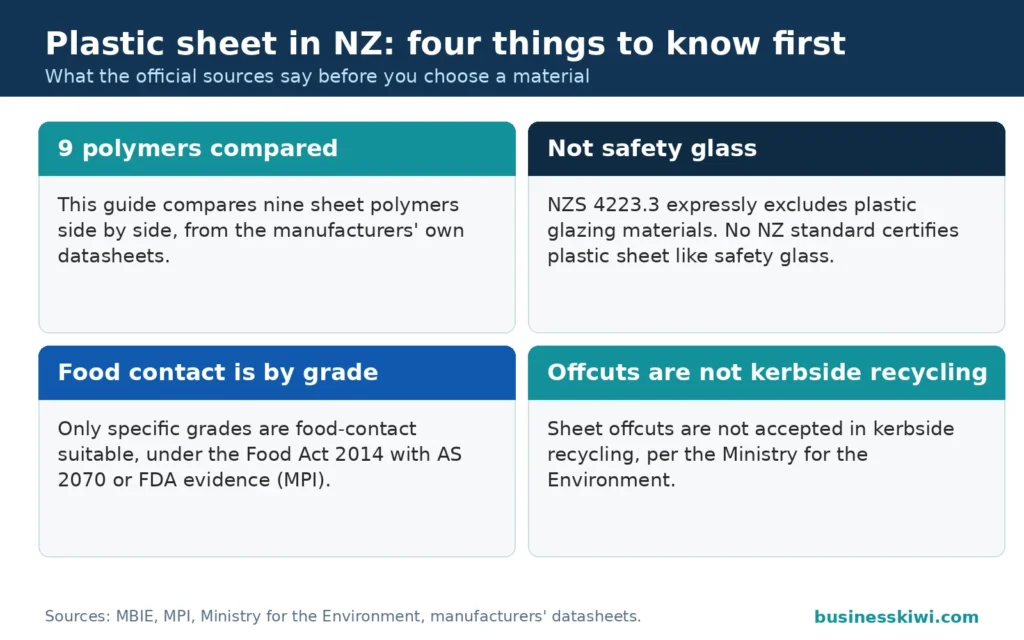
If plastic sheet is replacing glass in a building, the Building Code still applies even though the material is not glass. MBIE’s Building CodeHub records NZS 4223.3:2016, the human impact safety requirements for glazing, as a means of complying with Building Code clauses B1, F2 and F4. Its scope covers glazing within 2,000 mm of floor or ground level that is not protected from human impact, but expressly excludes plastic glazing materials. So there is no NZ glazing standard that certifies a plastic sheet the way safety glass is certified. Specifiers rely on the manufacturer’s impact data instead, and work in doors, low-level windows, barriers and wet areas may need building consent. Check with your local council or a licensed building practitioner before substituting plastic for glass where a fall is possible.
Food contact in brief
A polymer name is not a food safety approval; the grade is what counts. Under the Food Act 2014, NZ food businesses must make sure food contact materials do not make food unsafe, and MPI-accepted guidance treats materials meeting AS 2070-1999 (plastics for food contact use) or US FDA requirements as acceptable evidence. So buy by paperwork: Plaskolite states its VIVAK PETG resin complies with FDA food contact requirements, PSP lists its Resist acrylic as FDA approved, and NZ suppliers stock PP and HDPE in food contact grades. If a sheet has no food contact documentation, treat it as a non-food material, whatever the polymer.
Recycling and disposal
The resin code stamped on sheet tells you the family: 2 is HDPE, 3 is PVC, 5 is polypropylene, and 7 (“other”) covers polycarbonate and acrylic. Do not read too much into the chasing-arrows symbol, though. Since 1 February 2024, standardised kerbside recycling accepts only plastic bottles and containers numbered 1, 2 and 5; rigid sheet and offcuts are not kerbside items in any code, so keep them out of the recycling bin. Clean acrylic and polycarbonate offcuts are worth offering to a specialist plastics recycler, and Corex runs a take-back programme for fluted polypropylene. For the wider set of trade and materials references on this site, see the Business & Industry hub.
FAQs
What is the strongest clear plastic sheet?
Polycarbonate, by a wide margin. Palram’s datasheet records 158 joules of falling weight impact strength for 3 mm solid sheet, and the material stretches more than 90 percent before breaking, so it deforms instead of shattering. PETG sits in the middle; acrylic is the most brittle of the three.
Which plastic sheet is best for a greenhouse?
Twinwall polycarbonate. It is light (800–1,700 g per square metre), transmits about 80 percent of light in clear, insulates better than solid sheet or glass, and its UV layer is made for outdoor service. Choose the gauge, 4 to 10 mm, against the span between supports using the maker’s span tables.
Can I use acrylic for a kitchen splashback?
Yes, it is a common choice, but respect its heat limits. PSP rates cast acrylic for service up to 80°C, so it belongs on walls away from direct heat from hobs and toasters. Glass or stainless steel suits the strip directly behind a cooktop better.
Why has my polycarbonate cracked around the screws?
Almost always fixing stress. Polycarbonate moves about 5 mm per metre with temperature, so holes drilled at screw size, rivets, or screws wound down hard concentrate that movement until the sheet cracks. Palram’s fix: oversize holes by 2–3 mm, washers under the heads, moderate tightening.
What thickness of polycarbonate do I need for a machine guard?
There is no single mandated gauge: Palram sells solid sheet from 1 to 12 mm, and the right choice depends on the energy the guard has to stop, which is a machinery risk assessment, not a materials table. Take the manufacturer’s impact data (158 joules at 3 mm for PALSUN) to whoever is responsible for the guarding assessment.
Can offcuts go in my kerbside recycling bin?
No. Kerbside collections take plastic bottles and containers numbered 1, 2 and 5 only, and sheet plastic is none of those, whatever code is stamped on it. Keep offcuts for reuse, or pass clean material to a specialist recycler.
Sources
Manufacturer and supplier technical data: Plaskolite (OPTIX acrylic and VIVAK PETG datasheets and fabrication guides), Palram (PALSUN, SUNLITE, PALCLEAR, PALIGHT and ThermaGlas documents), PSP Limited NZ product data sheets, Supply Services NZ, SIMONA, Corex Plastics, Antalis, ASYAPLAST. Official sources: NIWA (UV Index information), MBIE Building CodeHub (NZS 4223.3:2016 record), MPI and FSANZ (food contact guidance), Ministry for the Environment (kerbside recycling standardisation).

Disclaimer
This article is general information drawn from manufacturers’ published data at the time of writing. Figures are typical values for the named products; grades vary between suppliers, so confirm specifications before ordering, and follow the manufacturer’s fabrication and safety guidance for any cutting, heating or forming work. Building work may require consent: check with your local council.