Financial Planning in NZ: What a Financial Planner Does, Costs and How to Choose One

The quick answer
A financial planner helps you turn a set of money goals into an ordered plan: what to save, where to invest, which insurance to hold, how to clear debt and how to be ready for retirement. In New Zealand, “financial planner” is a job description rather than a legal title. The regulated terms are “financial adviser” and “financial advice provider”, and anyone who gives regulated financial advice to retail clients must hold a Financial Advice Provider licence issued by the Financial Markets Authority (FMA), or be a financial adviser engaged by a business that holds one.
That licensing matters because it comes with legal duties. An adviser must put your interests ahead of their own, give advice that suits your situation, make sure you understand it, and tell you up front how they are paid. Before you hand over any money or personal details, you can check both the adviser and their provider on the Financial Service Providers Register (FSPR), a public register run by the Companies Office. If someone offering advice is not on it, walk away.
Planner, adviser or provider: the words that matter
Three labels float around this industry, and only two of them carry legal weight.
A financial advice provider is the licensed business. A provider might be a sole adviser working under their own licence, a small firm, or a large institution such as a bank or insurer. An individual financial adviser is a person who gives advice on behalf of a provider (or under their own licence). Providers can also engage nominated representatives, typically staff at larger organisations, who give advice within tighter limits set by the provider.
“Financial planner” sits outside that legal framework. Nothing stops a person using the term, so the word “planner” on a business card tells you nothing on its own. What counts is whether the person behind it is a registered financial adviser connected to a licensed provider, which is exactly what the FSPR check confirms.
One designation worth knowing is CFP, short for CERTIFIED FINANCIAL PLANNER. It is an international certification mark for financial planning, administered in New Zealand by Financial Advice New Zealand, the professional body for advisers and the local affiliate of the Financial Planning Standards Board. Advisers who hold it have met additional education, examination, experience and ethics requirements set for the designation, on top of the legal minimum every adviser must meet. Financial Advice New Zealand also runs a find-an-adviser directory, searchable by location and specialty, which Sorted points people towards as a starting point.
The older labels you may still see in print, such as authorised financial adviser (AFA) and registered financial adviser (RFA), belong to the earlier Financial Advisers Act regime. That regime has been replaced. The rules described in this article are the current ones, housed in the Financial Markets Conduct Act 2013 (the FMC Act) following the Financial Services Legislation Amendment Act 2019, with the newer licensing settings taking effect from March 2021 onwards.

What a financial plan covers
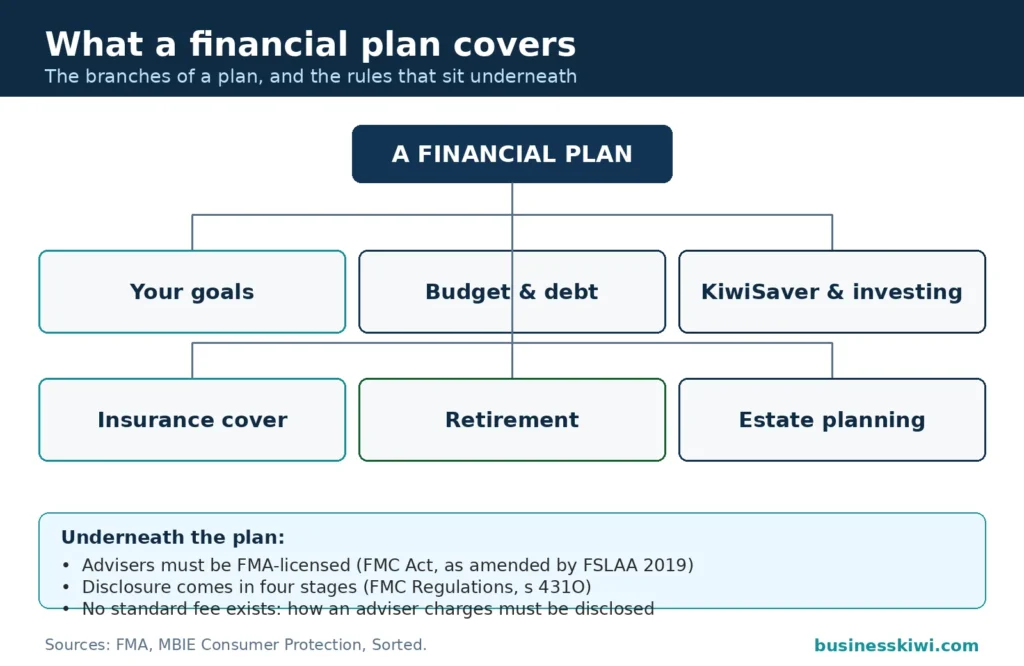
A proper plan looks at your money as one system rather than a pile of separate products. The components vary with your situation, but most plans work through the same territory.
Goals and cash flow. Everything starts with what you are trying to achieve and when: a first home, debt freedom, a comfortable retirement, helping children. The adviser maps your income, spending, assets and debts, because the plan has to be funded out of real cash flow, not wishful thinking.
KiwiSaver settings. For most working New Zealanders, KiwiSaver is their largest investment. A plan checks three settings that people often leave on defaults for years: the fund type (conservative through to growth, matched to your timeframe and tolerance for ups and downs), your contribution rate, and your prescribed investor rate (PIR), which is the tax rate applied to your fund’s earnings. Getting the fund wrong for your timeframe is one of the most common and most costly mistakes. Our guide to KiwiSaver funds explains how the fund types differ.
Investments beyond KiwiSaver. Managed funds, shares, term deposits and other products, chosen to fit the goal and timeframe rather than fashion. This includes how your money is spread across asset types, and what happens when markets fall.
Insurance cover. Life, income protection, trauma and health cover, sized against what your household actually needs if someone dies or cannot work. Insurance advice is also where commission payments are most common, which is why the disclosure rules below matter.
Debt. The order and speed of repayment: high-interest debt first, then the mortgage, and whether extra repayments beat extra investing in your situation.
Retirement planning. How much you are likely to have, how long it needs to last, and how you will draw it down once work stops. NZ Super forms the base for most people, with KiwiSaver and other savings on top.
Estate basics. A will, and enduring powers of attorney so someone you trust can act for you if you cannot. An adviser will flag these and check they exist and are current. The documents themselves are legal work, so expect to be sent to a lawyer to have them drawn up or reviewed.
Tax awareness. Planners work around the edges of tax: the right PIR, how investment income is taxed, and the tax side of selling a business or property. Detailed tax advice belongs with an accountant, and a good planner will say so.
How the advice process runs
First meeting and disclosure. Before advice begins, the provider must make certain information available to you. Disclosure happens in stages during the process, and it covers the provider’s licence status, the types of products they can advise on, any limits on the scope of their advice, the fees you may pay, any commissions or other incentives they receive, any conflicts of interest, and their complaints process. Some of this information is public, on the provider’s website or available on request, so you can read it before you even book a meeting.
Fact find. The adviser gathers the full picture: income, spending, assets, debts, existing policies and investments, your goals and how much risk you are comfortable with. Expect detailed questions. Vague answers produce vague plans.
Scope agreement. You and the adviser settle what the advice will and will not cover. A limited scope is legitimate, for example advice on insurance only, but the limits must be clear to you before you act on anything.
Statement of advice. The recommendations arrive in writing, with the reasoning, the costs, and any commissions or conflicts confirmed at the point the advice is given. Read it properly, including the parts about what the advice does not cover.
Implementation. If you go ahead, the adviser arranges the products or changes: a KiwiSaver switch, new insurance policies, an investment portfolio. Further fees or commissions may apply at this stage and must also be disclosed.
Ongoing reviews. Circumstances change. Income rises or stops, children arrive, health shifts, markets move. Many advisers offer an ongoing service with regular reviews for an ongoing fee. You are entitled to know exactly what that service includes before you agree to pay for it year after year.
Throughout, advisers must work to the Code of Professional Conduct for Financial Advice Services, which sets standards for ethical behaviour, client care, competence, knowledge and skill. Advice can also be delivered digitally through websites, apps and online services, and the same licensing and conduct rules apply.
What it costs: fee models and disclosure
There is no standard price for financial advice in New Zealand, and neither the FMA nor Sorted publishes a rate card, because none exists. What the law does instead is force the pricing into the open. An adviser must take reasonable steps to disclose all fees and costs associated with their advice, present them clearly, and confirm them when the advice is given. If an adviser is evasive about money, that alone is a reason to choose someone else.
In practice, advisers are paid in a handful of ways, often in combination:
- Direct fees charged to you. This might be an hourly rate, a fixed fee for preparing a plan, or a fee to implement the recommendations. Consumer Protection describes the usual patterns as fees from clients, commission from product providers, or a mix of both.
- A percentage of funds under advice. For investment advice, an ongoing fee calculated as a percentage of the money the adviser manages or advises on is common. The percentage matters more than it looks, because it is charged every year on the whole balance.
- Commission from a product provider. Common with insurance and mortgages. The provider pays the adviser when you take out a product, and you pay nothing upfront. The FMA is blunt about the catch: commission creates a conflict of interest, and it may mean you are offered a limited choice from only one provider’s range. Ongoing “trail” commission, paid by the provider for as long as you hold the product, is also common.
- Ongoing service fees. A regular fee for reviews and continued access to the adviser, sometimes bundled with the percentage fee above.
None of these models is automatically good or bad. A commission-paid insurance adviser may suit someone who could not otherwise afford advice, and a fee-only planner may suit someone with a large portfolio who wants product-neutral recommendations. What you are entitled to, in every case, is the full picture in writing: what you will pay, what the adviser receives from others, and what could influence their recommendations.
When people usually get advice
Advice tends to cluster around decisions that are large, hard to reverse, or both. Buying a first home raises questions about KiwiSaver withdrawals, mortgage structure and insurance at the same time. A redundancy payout or an inheritance lands a sum of money with no obvious home. Selling a business converts years of work into cash that suddenly needs a plan. Approaching 65 brings KiwiSaver decisions and the shift from saving to spending. Starting a family changes the insurance equation overnight. And sometimes the trigger is simpler: a nagging sense that money is drifting, several superannuation-style accounts scattered around, and no idea whether the current course leads anywhere acceptable.
You do not need to be wealthy to use an adviser. You do need a question big enough that a wrong answer would cost more than the advice.

How to choose one
Check the register first. Search the FSPR for the adviser and the provider they work for. Confirm the provider holds an FMA licence and the adviser is registered. Sorted suggests talking to at least three advisers before deciding, and looking for a fit in how they communicate and whether they take time to understand your situation.
Ask what they can advise on. Some advisers cover the full planning picture. Others are limited, by competence or by their licence arrangements, to one area such as mortgages or insurance, or to one provider’s products. Limited advice is not dishonest advice, as long as the limits are disclosed. It becomes a problem only when you mistake a product salesperson for a planner.
Ask how they are paid, early. Get fees, commissions and conflicts in writing. The disclosure documents exist for this purpose, so use them.
Check qualifications and designations. Every adviser must meet the competence standards in the Code of Conduct. Designations such as CFP signal further study and a professional body’s oversight. Membership of a professional body like Financial Advice New Zealand is another data point, though it is not a legal requirement.
Know the complaints route before you need it. If something goes wrong, complain to the provider first through its internal complaints process. If that does not resolve things, you can take the complaint to the provider’s approved dispute resolution scheme. Every provider must belong to one, the schemes are free for consumers, and they can investigate and award compensation. You can also raise concerns about an adviser’s behaviour directly with the FMA.
Red flags
The FMA’s warnings work with scam awareness gives a consistent picture of how people get burned. Watch for:
- Promised or “guaranteed” returns. Legitimate investments move up and down. The FMA notes that words like “guaranteed”, “secured” and “certain” in an offer can be deliberately misleading, and no adviser can promise a market return.
- Pressure to act now. Urgency is a sales tool and a scam staple. Good advice survives a week of thinking.
- No licence, no registration. Someone who cannot be found on the FSPR, or who discourages you from checking, is not someone to hand money to.
- Discouraging second opinions. The FMA lists discouraging people from seeking independent professional advice as a hallmark of dubious cold-call offers. A genuine adviser welcomes scrutiny.
- Borrowing to invest, glossed over. Using debt to invest magnifies losses as well as gains. If the risks are not discussed in plain language, the advice is incomplete.
- Payment oddities. Requests to send money to overseas or personal accounts, or through cryptocurrency, feature heavily in the FMA’s scam alerts.
The DIY route
Plenty of financial planning groundwork costs nothing. Sorted, the free and independent money guidance service run by Te Ara Ahunga Ora Retirement Commission, publishes tools that cover much of what a first plan involves: a budget planner, a debt calculator, a goal planner, an investor profiler to help you gauge your risk settings, a KiwiSaver fund finder that compares funds and shows the effect of fees, a savings calculator and retirement planning tools, including a retirement navigator for people nearing or in retirement. Working through those gives you a clear picture of your position, and it also makes any later conversation with an adviser shorter and sharper, because you arrive knowing your numbers.
FAQs
Is “financial planner” a protected title in NZ?
No. Anyone can describe themselves as a financial planner. The protected, regulated roles are “financial adviser” and “financial advice provider”, and giving regulated advice requires an FMA licence held by the provider, plus registration on the Financial Service Providers Register. Judge the person by the register, not the job title.
How much does a financial adviser cost in NZ?
There is no standard rate, and official sources do not publish one. Advisers charge in different ways: hourly or fixed fees, a percentage of funds under advice, commission from product providers, or a combination. What is fixed is the legal duty to disclose all of it. Before you commit, you should have the fees, commissions and any conflicts in writing.
How do I check that an adviser is legitimate?
Look them up on the Financial Service Providers Register. The adviser should appear as a registered financial adviser, linked to a financial advice provider that holds an FMA licence. The provider’s disclosure information, usually on its website, confirms its licence status, what it can advise on, and how it is paid.
What is the difference between a financial adviser and a financial advice provider?
The provider is the licensed business that is legally responsible for the advice service. The adviser is the individual who gives the advice, working for or engaged by that provider. When you check the register, you are looking for both: the person’s registration and the provider’s licence.
What can I do if the advice turns out badly?
Complain to the provider first, using its internal complaints process, which it must tell you about. If you cannot resolve it, take the complaint to the provider’s approved dispute resolution scheme. Membership of a scheme is compulsory for providers, the service is free for you, and schemes can investigate and award compensation. Serious misconduct can also be reported to the FMA.
Sources
Financial Markets Authority, Getting advice, fma.govt.nz. Financial Markets Authority, Financial Advice Provider licensing, fma.govt.nz. Financial Markets Authority, Financial Services Legislation Amendment Act 2019 (the new financial advice regime), fma.govt.nz. Financial Markets Authority, scam warnings and alerts, including guidance on investment scam warning signs and misleading advertising of investment products, fma.govt.nz. Sorted (Te Ara Ahunga Ora Retirement Commission), Find a financial adviser to help you invest, sorted.org.nz. Sorted, Calculators and money tools, sorted.org.nz. Consumer Protection (MBIE), Financial advice, consumerprotection.govt.nz. Ministry of Business, Innovation and Employment, Regulations setting out disclosure requirements in the new financial advice regime (overview). Financial Planning Standards Board, affiliate listing for Financial Advice New Zealand, fpsb.org. Insurance and Financial Services Ombudsman Scheme, Financial Advice Providers and Advisers, ifso.nz.
For more guides for Kiwi businesses and households, see the Business & Industry hub.
Disclaimer
This article is general information about how financial planning and financial advice work in New Zealand. It is not financial advice, and it does not take your personal circumstances into account. Product fees, tax settings and regulations change, so check current details with the provider or adviser concerned, and consider advice from a licensed financial adviser before making significant financial decisions.