KiwiSaver Hardship Withdrawals: Who Qualifies, Evidence and the Process

KiwiSaver is built to stay locked away until you buy a first home or reach retirement, so getting money out early is deliberately difficult. Significant financial hardship is one of the few grounds that can open the account before then, and it comes with a strict legal test, a pile of paperwork, and a decision that is not yours or even your provider’s to make alone. This guide explains what counts as significant financial hardship, what evidence you will be asked for, how the application process runs, what part of your balance you can actually take out, and what an early withdrawal costs you by age 65.
Quick answer
You may qualify for a KiwiSaver hardship withdrawal if you cannot meet minimum living expenses, cannot pay the mortgage on the home you live in and the lender is moving to enforce it, need to pay for medical treatment or palliative care for yourself or a dependant, need to modify your home because of disability, or face funeral costs for a dependant. You apply to your KiwiSaver provider with detailed evidence, including a statutory declaration about your assets and debts. Your scheme’s supervisor makes the final decision. If approved, you can withdraw only your own and your employer’s contributions plus investment returns. Government contributions stay in your account, and the amount released is limited to what is needed to relieve the hardship.
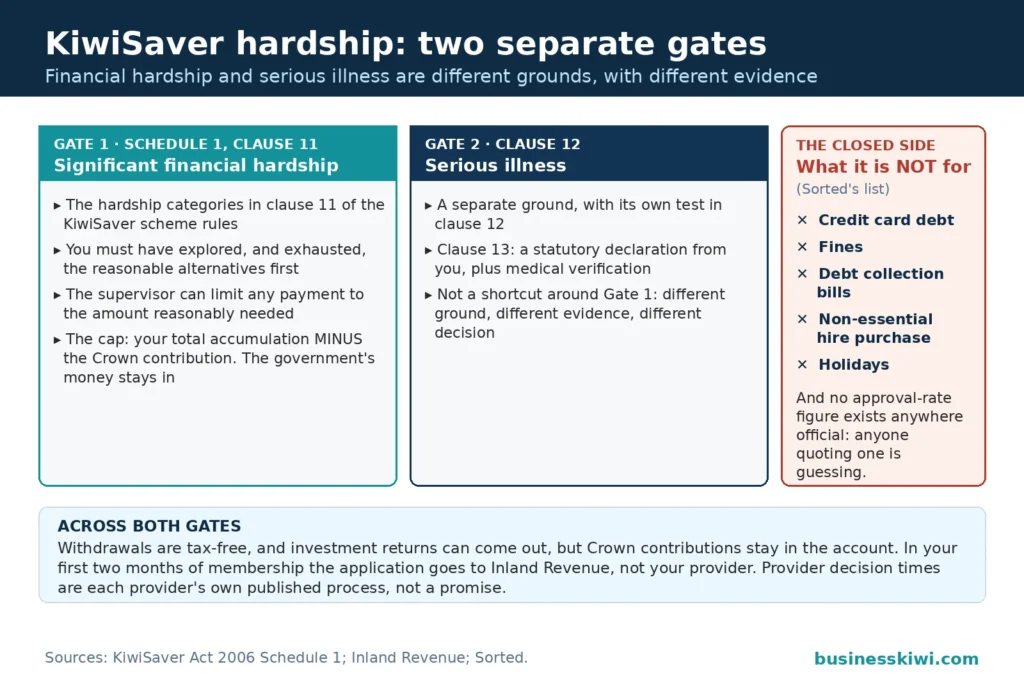
What counts as significant financial hardship
The legal definition sits in the KiwiSaver scheme rules set out in Schedule 1 of the KiwiSaver Act 2006, and Inland Revenue (IRD) publishes the same list in plain language on its website. Significant financial hardship means significant financial difficulties arising from one or more of these situations:
- You cannot meet your minimum living expenses.
- You cannot meet mortgage repayments on your principal family home, and the mortgagee is seeking to enforce the mortgage.
- You need to modify your home to meet special needs arising from a disability affecting you or a dependant.
- You need to pay for medical treatment for an illness or injury affecting you or a dependant.
- You need to pay for palliative care for yourself or a dependant.
- You need to pay the funeral costs of a dependant.
- You are suffering from a serious illness (a separate withdrawal ground also exists for serious illness, covered later in this guide).
Providers describe minimum living expenses in fairly consistent terms. ANZ’s hardship guide, for example, treats them as covering basic food and groceries, mortgage, rent or board payments, utility bills such as power, water and phone, basic transport and basic clothing. The emphasis is on the essentials of staying housed, fed and connected, not on maintaining your previous standard of living.
Two parts of the test catch people out. First, the hardship must be happening now, or be likely to happen. Second, the decision maker has to be satisfied that you have explored and exhausted reasonable alternative sources of funding before KiwiSaver money is released. That requirement is written into the scheme rules, and it shapes the whole application: you will be asked what savings you have used, what other help you have sought, and why those options are not enough.
What does not qualify
Hardship withdrawals are aimed at keeping you afloat, not at clearing your balance sheet. Sorted, the personal finance site run by the Commission for Financial Capability, lists the kinds of spending that hardship withdrawals are not for: credit card debt, fines and infringement notices, debt collection agency bills, hire purchase debt for non-essential items, holidays, and travel to visit a sick relative. ANZ’s guide makes similar points, noting that minimum living expenses do not include paying debts off in full or credit card debt relating to non-essential spending.
That distinction matters in practice. If your income covers your essential bills but you are carrying an expensive credit card balance, a hardship application is unlikely to succeed, because the test is about meeting minimum living needs rather than being debt free. Likewise, wanting a house deposit, topping up savings, or getting ahead on a mortgage that is not in enforcement territory will not meet the definition. Approval statistics are not something providers publish in a standard form, and no official figure exists for your personal chances, so treat any website quoting approval rates with caution.
Who decides: your provider and the supervisor
A common misunderstanding is that your KiwiSaver provider decides your application. In most schemes, the provider collects and checks your application, then sends it to the scheme’s supervisor, an independent company whose role is to look after members’ interests. The supervisor makes the final decision. Sorted describes the same arrangement: the provider takes in the application and refers it to the supervisor, which approves it if it fits the criteria. For restricted KiwiSaver schemes, the manager performs this role instead.
The supervisor applies the scheme rules. It must be reasonably satisfied that you are suffering, or are likely to suffer, significant financial hardship, and that reasonable alternative sources of funding have been explored and exhausted. It can approve a smaller amount than you asked for, limited to what it considers necessary to relieve the particular hardship. There is no right to your full balance.
One timing point from IRD is worth knowing. If you are within the first two months of your KiwiSaver membership, you apply to IRD rather than to a provider. After that, everything runs through your provider.
What you can and cannot withdraw
The scheme rules cap a hardship withdrawal at the value of your account excluding the Crown contribution component. In practice that breaks down as follows.
IRD summarises the position on its hardship page: if your application is accepted, you can only withdraw your own and your employer’s contributions. Sorted puts it slightly more fully, noting that the money you can take out comes from your contributions, your employer’s contributions and your investment returns, while government money stays behind.
There is a second limit on top of the first. Even where the money is technically available, the supervisor may direct that the withdrawal be limited to a specified amount that, in its opinion, is required to alleviate the hardship. QuayStreet’s application form gives a practical example of how this plays out: an approved amount will generally cover the shortfall in your minimum living expenses for three months, plus an amount to pay approved overdue bills or arrears. Other supervisors apply the same principle in their own way. Expect help measured in weeks or a few months of essential costs, not a full clear-out of the account.
Your membership continues after a hardship withdrawal. Your account stays open, contributions can keep flowing, and you can apply again later if hardship continues, although each application needs its own evidence.
Sorted also confirms that KiwiSaver withdrawals are not taxed when paid out, including hardship withdrawals.

The evidence you will need
Applications are evidence heavy, and incomplete paperwork is the most common cause of delay. Provider checklists differ in detail but cover the same ground. ANZ’s application form asks for:
- The completed application form.
- A statutory declaration about your assets and liabilities, signed by you and witnessed by someone authorised to take statutory declarations, such as a Justice of the Peace or a solicitor. The scheme rules require this declaration as part of every hardship application.
- Certified identification.
- Bank statements for the last three months for all accounts held by you and your partner, including joint and business accounts.
- Overdue bills and evidence of arrears, recent enough to show the outstanding balance and your regular minimum payments. ANZ asks for these to be less than 60 days old, covering things like utility bills, store cards, credit cards, personal loans, car loans and finance company loans.
- Confirmation of your living arrangements and what you owe: a letter from your mortgage provider if you own your home, or a tenancy agreement or certified letter from your landlord if you rent or board.
- Documents for any household member who contributes financially to running your home, where applicable.
Where your hardship rests on a medical matter, expect it to be verified. The scheme rules allow the decision maker to require medical evidence supporting anything asserted in the application, and to require other documents to be verified as well. Westpac’s form notes that applications are assessed on your total household income, assets and expenses, which is a fair summary of how supervisors approach the decision: it is the household position, not just your personal bank account, that is weighed up.

How the process works, step by step
The sequence is broadly the same across providers, even though forms and portals differ.
- Contact your provider for its hardship application form and checklist. Some providers, including ANZ and Westpac, publish the form on their websites; others will send it after you call.
- Complete the form and gather the supporting documents on the checklist. Getting bank statements, arrears letters and certified ID together before you submit saves weeks of back and forth.
- Sign the statutory declaration in front of an authorised witness.
- Submit everything to your provider. The provider checks the documents, contacts you if anything is missing, and cannot progress the application until it has what it needs.
- The provider passes your application to the supervisor, which assesses it against the scheme rules and makes the final decision.
- You are notified of the outcome. If approved, payment is made to the bank account you nominated on the application form.
Stated timeframes vary by provider, and all of them depend on your application being complete. ANZ says it aims to pay an approved withdrawal within 20 business days of receiving the application, while noting it can take longer if further information is needed. QuayStreet advises applicants to expect an outcome within 15 business days, with the same caveat about the supervisor requesting more information. Booster describes a faster pipeline on its form: an assessment within two business days once all documents are in, an approval process of two to three business days, then three to five business days for payment to reach your bank account. Pie Funds allows up to 15 working days for review and processing. The honest summary is that a complete application is usually measured in weeks, not days, and missing documents are the main reason it stretches out.
Another point providers are consistent about: approval is not guaranteed, and the amount is not negotiable in the way a loan might be. If your application is declined or reduced, you can ask for the reasons, supply better evidence if your circumstances or paperwork were incomplete, and use your scheme’s complaints process if you believe the rules were misapplied.
Alternatives to try before you apply
Because the legal test requires alternative funding sources to be explored and exhausted, working through these options is not just sensible, it is part of qualifying.
A savings suspension. If contributions are part of the squeeze, you can pause them. IRD explains that you can apply for a savings suspension within your first 12 months of membership if you are experiencing, or are likely to experience, financial hardship. After your first 12 months, you can apply regardless of your financial situation. Sorted notes suspensions run from three to 12 months, freeing up cash in the short term without touching your balance. Sorted also points to a temporary contribution rate reduction, which lowers your contribution rate to 3 percent for three to 12 months if you want to keep something flowing in.
Work and Income help. Sorted’s hardship guide lists support that people often overlook: Temporary Additional Support where weekly costs exceed income, food grants for immediate grocery needs, and advance payments of benefit for those eligible for ongoing support. Work and Income can sometimes help people who are working, not only beneficiaries.
Free financial mentoring. MoneyTalks, the free helpline Sorted promotes, connects you with financial mentors by phone, text, email or live chat, and you can use it anonymously. A mentor can help you build the budget picture a supervisor will want to see, and may find options you have missed.
Talk to your lenders. As Sorted notes, you have a legal right to ask for changes to loan repayments when you face unforeseen hardship, and lenders have obligations to consider those requests under the Credit Contracts and Consumer Finance Act 2003. A mortgage payment holiday or restructured loan may solve the problem without raiding your retirement savings. This is also worth weighing against expensive short term borrowing: our guide to same day loans explains the real cost of fast credit when money is tight.
No-interest and low-interest loans. Sorted mentions community lending such as Good Loans, run by Good Shepherd, as a lower cost alternative for bills and essential costs in some situations.
Whichever mix you use, keep records of what you tried. Supervisors ask what alternatives you explored, and being able to show the answers strengthens your application if you do need to proceed.
Serious illness is a separate ground
Hardship and serious illness are often confused, and the scheme rules do list serious illness as one of the circumstances that can amount to significant financial hardship. But there is also a standalone serious illness withdrawal with a different, narrower test.
Under the scheme rules, serious illness means an injury, illness or disability that leaves you totally and permanently unable to work in a job you are suited for by your experience, education or training, or that poses a serious and imminent risk of death. The application still goes through your provider, and medical evidence is central: the decision maker can require the medical matters in your application to be verified.
The practical differences are significant. A hardship withdrawal is capped at your balance excluding government contributions, and limited to the amount needed to relieve the hardship. A serious illness withdrawal is assessed against the medical test instead, and scheme documents describe it as allowing withdrawal of some or all of your savings, up to the value of your account. If your situation involves a life changing diagnosis or the end of your working life, ask your provider about the serious illness ground specifically rather than assuming hardship is the only path.
The long term cost of taking money out early
A hardship withdrawal solves an immediate problem by creating a future one. Money taken out at 35 or 45 is not just the dollars on the day; it is those dollars plus every year of investment returns they would have earned until you turn 65. You also cannot put the government contribution portion back later, and most people do not voluntarily replace what they withdrew.
A simple illustration shows the scale. Imagine you withdraw $10,000 at age 35, and imagine your remaining balance then earned a steady 4 percent a year after fees and tax for the 30 years until you turn 65. That $10,000 would have grown to roughly $32,400 by 65, so the withdrawal costs you about $22,400 of retirement savings on top of the $10,000 itself. At 45 the same $10,000 has only 20 years to grow, and at the same assumed rate it would reach roughly $21,900, meaning a cost of about $11,900 in forgone growth.
These figures are arithmetic illustrations using round numbers and an assumed return, not a forecast and not any provider’s projection. Real returns move around, and your fund choice matters. If you are weighing up fund types while you rebuild, our KiwiSaver funds guide explains how the main fund categories differ. The point of the illustration is simply that early withdrawals are expensive in retirement terms, which is exactly why the law treats them as a last resort and why the alternatives above are worth exhausting first.
Frequently asked questions
Who makes the final decision on a hardship withdrawal?
Your scheme’s supervisor makes the final decision for most KiwiSaver schemes. Your provider collects your application, checks the documents and forwards it, but the supervisor assesses it against the scheme rules and decides whether it qualifies and how much can be released.
How much of my KiwiSaver balance can I withdraw for hardship?
At most, your balance excluding government contributions: your own contributions, your employer’s contributions and investment returns can be withdrawn, while member tax credits and the $1,000 kickstart stay in your account. The supervisor can also limit the payment to the amount it considers necessary to relieve your hardship, which is often well below the maximum.
Can I use a hardship withdrawal to pay off my credit card or other debts?
Generally no. Sorted and provider guides are clear that hardship withdrawals are not for credit card debt, fines, debt collection bills or hire purchase debt for non-essential items. The withdrawal is meant to cover minimum living expenses and specific listed costs, such as medical treatment or a dependant’s funeral.
How long does a hardship application take?
It depends on the provider and on whether your evidence is complete. Providers state their own timeframes on their forms: ANZ aims to pay within 20 business days of receiving an application, QuayStreet expects to advise an outcome within 15 business days, and Pie Funds allows up to 15 working days for review and processing. Requests for extra information are the main cause of delay.
Is a hardship withdrawal taxed?
No. Sorted confirms that KiwiSaver withdrawals, including hardship withdrawals, are paid out tax free. Your contributions were made from taxed income, and investment earnings are taxed inside the fund, but there is no further tax on the withdrawal itself.
Sources
Inland Revenue, Getting my KiwiSaver savings for significant financial hardship, ird.govt.nz
New Zealand Parliamentary Counsel Office, KiwiSaver Act 2006, Schedule 1 KiwiSaver scheme rules, legislation.govt.nz
Commission for Financial Capability, Applying for a KiwiSaver hardship withdrawal, sorted.org.nz
ANZ New Zealand, Significant Financial Hardship Guide and Application Form, anz.co.nz
QuayStreet Asset Management, Withdrawal Request: Significant Financial Hardship, ctfassets.net
Booster, Booster KiwiSaver Scheme Significant Financial Hardship Withdrawal Form, documents.booster.co.nz
Westpac New Zealand, KiwiSaver Financial Hardship Withdrawal Application, westpac.co.nz
Pie Funds, Hardship Withdrawal Form, piefunds.co.nz
Disclaimer
This article is general information about how KiwiSaver significant financial hardship withdrawals work in New Zealand. It is not personalised financial advice, and it does not take your individual circumstances into account. Eligibility and amounts are decided by your scheme’s supervisor based on your evidence. If you are in financial difficulty, consider talking to a free financial mentor through MoneyTalks or a licensed financial adviser before applying.
For more guides on KiwiSaver, loans, tax and everyday money decisions, see the Finance section on BusinessKiwi.