Flat Insurance in NZ: Insuring a Flat, Unit or Granny Flat

A flat looks simple enough from the street. Two or three homes under one roof, a shared driveway, maybe a common wall with the neighbours. Insurance is where the simplicity ends, because a flat is rarely insured the way a standalone house is. Who has to insure the building depends on the legal structure underneath the home: whether the building is your problem alone, one you share with the other owners on the land, or one that belongs to a body corporate.
That structure matters more than the building itself. Get it wrong and you can end up duplicating someone else’s policy, or worse, assuming the building is insured when your part of it is not. This guide works through the main structures and the gaps flat owners and renters most often miss.
Quick answer
In a unit title development, the body corporate insures the buildings and the owner insures their own belongings and anything the body corporate policy does not reach. In a cross lease, every owner part-owns every building on the land, so the building risk is shared and the owners need their cover to work together. A standalone flat on its own fee simple title is insured much like a house, by its owner. A renter never insures the building: a renter insures their contents and their legal liability, and the landlord’s policy does not cover the tenant’s belongings.
First, what counts as a flat?
New Zealand uses “flat” loosely, and the word covers several different legal arrangements. A flat might be half of a converted old house, a unit in a purpose-built block, a townhouse, or a granny flat behind the main house on the same title. The building style tells you very little. The title tells you almost everything, because it sets out who owns the land, who owns each building on it, and therefore who carries the insurance obligation.

Unit title flats and apartments
Under a unit title, you own your unit and a share in the common property, such as driveways, gardens, lifts and lobbies, alongside the other owners. Buying a unit makes you a member of the body corporate automatically, as MBIE’s Unit Titles Services explains.
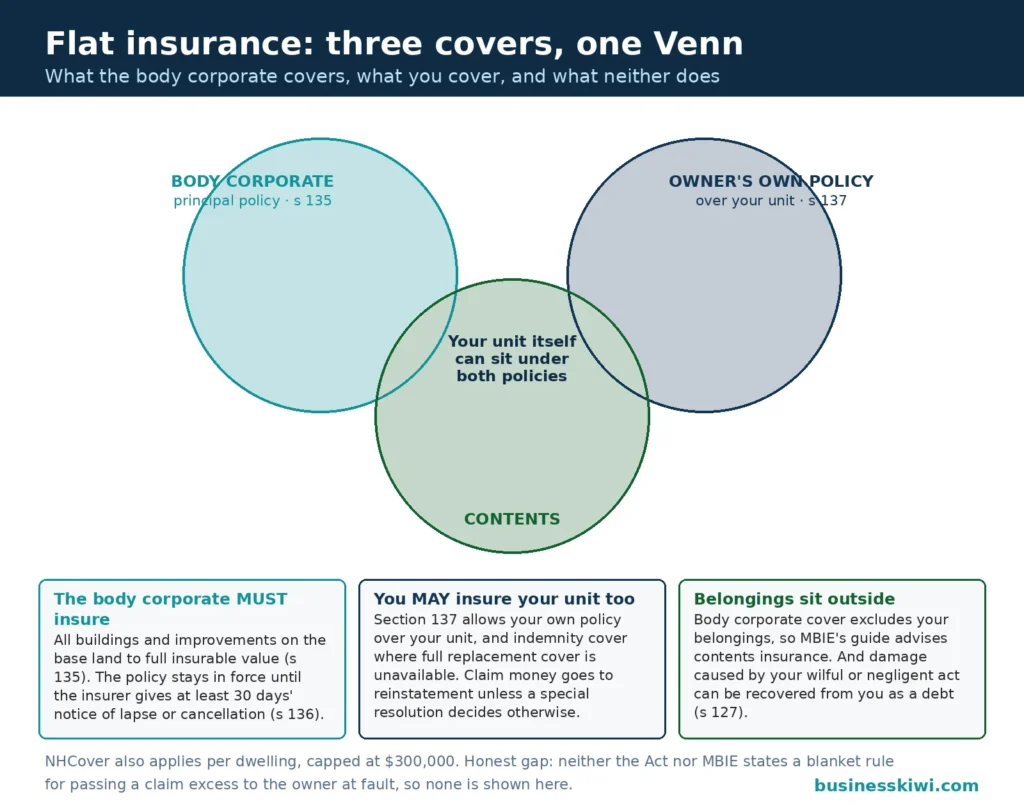
Insurance is a legal duty here, not a choice. Section 135 of the Unit Titles Act 2010 requires the body corporate to insure and keep insured all buildings and other improvements on the land to their full insurable value. The body corporate must also hold any other insurance the law requires, and it must tell its insurer about additions or structural alterations before work starts, whether the body corporate or a unit owner is doing the work.
Section 136 adds two protections owners rarely think about. The principal policy cannot simply lapse: it stays in force until the insurer serves notice of lapse or cancellation, dated no earlier than 30 days after service. And money paid out under it must go to reinstating the development, unless the body corporate decides otherwise by special resolution.
Owners pay for this cover through their levies, which MBIE’s guide notes cover regular costs including insurance. Behind the full insurable value figure sits an insurance valuation: the sum insured has to reflect what the buildings would cost to reinstate. The body corporate must also maintain a long-term maintenance plan covering at least 10 years (at least 30 years for developments of 10 or more units, reviewed every 3 years). Asking your body corporate for a copy of its insurance documents is a sensible first step, as MBIE’s guide suggests.
Two exceptions are worth knowing. Section 137 confirms the Act does not stop a unit owner taking out their own policy over their unit, so owners can add cover the body corporate policy does not give them. And where every unit is standalone, the body corporate may, by special resolution, require each owner to insure the improvements within their own unit boundaries instead, while still insuring common property improvements itself. Section 137 also allows indemnity cover where full replacement cover is not available in the market, a recognition that some older or higher-risk buildings cannot get full cover at any price.
Cross-lease flats
A cross lease is the structure behind many of New Zealand’s older blocks of flats, and it is the one that surprises owners most. As Settled, the Real Estate Authority’s consumer site, explains, buying a cross-lease property makes you a part owner of every building on the land, not just the one you occupy. Each owner holds a registered lease, usually for 999 years, over their flat, and the title includes a flats plan showing each building’s footprint.
Because every owner has an interest in every building, a fire or a burst pipe in your neighbour’s flat is partly your loss too. There is no body corporate to hold one policy for the whole site unless the owners create that arrangement themselves. The Insurance Council of New Zealand (ICNZ) warns that attached homes without a body corporate structure cause real problems at claim time: if some units are uninsured, or units are insured to different levels with different insurers, claims become complicated and repairs stall. Its advice is to talk to an insurer early, before purchase, about how the whole site will be insured. Coordinated cover, with all owners insured consistently and each aware of what the others hold, is the practical answer. Our cross lease guide covers the title itself in more depth.
The flats plan carries its own insurance risk. LINZ’s cadastral survey guidelines explain that a cross lease becomes defective when alterations or additions are made to the buildings shown on the plan and no new plan is deposited: the building no longer matches the lease area, creating a defect in the title. Insurers ask hard questions after a loss when a building does not match its title paperwork, and fixing the plan later requires a new survey and a subdivision consent. Comparing the flats plan against the buildings as they stand, and asking your lawyer about any mismatch, is basic housekeeping before you buy.
Fee simple flats and converted houses
Some flats sit on their own fee simple title: a terraced home, a duplex half with its own title, or a small standalone flat on its own section. These are insured like any other house, by the owner, under a house policy with a sum insured set to the cost of rebuilding. The house insurance guide covers choosing that cover and setting sums insured, and nothing in this article replaces it. The flat-specific point is narrower: where two homes share a wall or roofline but sit on separate titles, each owner’s claim can still affect the other, because repairing one side often means working on fabric both homes depend on. That is why knowing your neighbour is insured, and to a similar standard, has real value.
Converted houses need one extra check. Where a single house has been split into flats but never subdivided, there is one title and one owner, and the whole building is insured under that owner’s policy as a single property; the tenants insure only their own contents. Problems start when a flat has been created informally, without the insurer being told how the building is actually used: an insurer pricing one household is not pricing two tenancies, and undisclosed multi-tenancy is exactly the mismatch that surfaces after a fire.
Granny flats and minor dwellings
A granny flat or minor dwelling usually sits on the same title as the main house and cannot be sold separately, so it is normally insured as part of the main property rather than as a property of its own. Insurers’ own wordings show how this works: MAS, for example, defines the insured house in its wording as each dwelling or domestic outbuilding owned by you within the boundaries of the property’s address, so a second dwelling on the same property falls under the one house policy.
Two cautions follow. First, the sum insured has to include the cost of rebuilding the minor dwelling as well as the main house; a policy priced on the house alone leaves the granny flat uninsured for the difference. Second, whether the flat is occupied by family or rented changes the risk being priced, and renting it out is a change of use the insurer needs to know about. ICNZ has also pointed out that whether a granny flat meets the definition of a dwelling under the Natural Hazards Insurance Act 2023 affects its natural hazards cover and levy. If your granny flat has its own tenancy, landlord cover of the kind described below is the usual route.

What body corporate cover does not cover
The body corporate policy is a building policy. Knowing where it stops is most of what a unit owner needs to understand.
It does not cover your belongings. MBIE’s short guide is blunt about the consequence: owners should hold contents insurance because body corporate insurance does not cover their own belongings. Furniture, unfixed appliances, clothing, electronics and everything else inside your unit is yours to insure.
It does not automatically capture everything you improve inside your unit. The Act requires the body corporate to be told about additions and structural alterations before work begins, so the insurer knows about them. Renovate a kitchen or bathroom without telling the body corporate and its insurer, and the improvement risks sitting outside the insured picture. Notify the body corporate, in writing, before the work starts.
It does not pay your rent or your mortgage while you cannot live in the unit. The Act’s insurance duty is about insuring buildings and improvements; it is not a loss of rent or alternative accommodation promise to individual owners. An investor owner whose tenant has to move out after a fire has no rental income protection from the body corporate policy, and an owner-occupier has no temporary accommodation benefit from it either. Those covers, where they exist, sit in policies owners arrange personally.
One natural hazards point belongs here, because it works differently in multi-unit buildings. NHCover, provided under the Natural Hazards Insurance Act 2023, applies to the dwelling and, proportionately, to the parts of the building that are common or joint property, such as a roof or foundations, according to the Natural Hazards Commission’s NHCover Insurers’ Guide (March 2025). NHCover is calculated for each residential building and capped at $300,000 per dwelling; the private policy then responds above that cap up to the sum insured, where it provides top-up cover. In a block, the natural hazards layer is shared across the building in a way it never is for a standalone house.
Then there is the excess. Body corporate policies carry one, and owners reasonably ask whether the owner whose unit caused the damage can be made to pay it. The Act sets no blanket excess rule. What it provides, in section 127, is a recovery mechanism: where the body corporate does repair work it is required or authorised to do, and that work was made necessary by a wilful or negligent act or omission, or a breach of the Act, the operational rules or regulations, by a unit owner or their tenant, lessee, licensee or invitee, the expense is recoverable from that owner as a debt, with reasonable collection costs. MBIE’s guide reflects the same principle: a body corporate may recover repair costs from an owner who caused the damage that made the work necessary. How a claim excess is allocated in practice often turns on the body corporate’s own rules and the facts of the claim, so an owner whose leaking appliance floods the unit below should expect the question, and should hold liability cover of their own.
The owner’s own policies
Contents cover. Every unit owner needs it, for the belongings reason above and for one more: contents policies carry the owner’s personal legal liability cover. If your washing machine hose bursts and ruins the ceiling of the unit below, the claim that reaches you is a liability claim, and it is your contents policy, not the body corporate’s building policy, that is built to answer it. AA Insurance, for example, sets the legal liability cover under its contents policy at up to $2 million. Setting a contents sum insured means adding up replacement cost at today’s prices, not what you paid years ago; ICNZ’s guide for flatters and renters warns against guessing low, because a low sum insured caps what you can recover. Policies also commonly let you specify high-value items individually, so check how yours treats jewellery, bikes and electronics above its standard limits.
Landlord cover where the flat is tenanted. If you rent out your flat, the cover picture changes again. Where you own the building itself (a fee simple or cross-lease flat, or a granny flat), landlord cover is a house policy with tenancy-specific features, described on insurers’ own pages. Tower’s landlord policy, as an example, includes cover for deliberate damage caused by tenants or their guests up to $20,000, loss of rent for up to eight months where the home is made uninhabitable by damage covered under the policy while tenanted, and a separate loss of rent benefit of up to eight weeks for events such as eviction for unpaid rent or a tenant leaving without required notice, with deductions including an additional excess of one week’s rent. AA Insurance offers optional landlord contents cover for items a landlord provides for tenants’ use, such as furniture, curtains, blinds and appliances that are not plumbed or wired in, paying market value or repair cost up to the sum insured the landlord chooses.
For a unit title flat, the building itself stays with the body corporate, so a tenanted unit owner is arranging the parts around it: contents cover for any furniture they provide, liability cover, and whatever loss of rent protection is available for units, checked directly with the insurer, because landlord house policies are written around a building the policyholder insures.
MBIE’s unit titles guide notes that a unit owner who rents out their unit must include an insurance statement in all new tenancy agreements. Tenancy Services explains what that means in practice: landlords must state whether the property is insured and the excess amount, and that a copy of the policy is available to the tenant on request.
Renters and flatmates
If you rent a flat, the building is never your insurance problem. It is also never your protection. Consumer Protection’s preparing-to-rent guidance lists insurance among a renter’s start-up costs, describing contents insurance to cover your belongings and personal liability insurance to protect you if you or another tenant damage the house. AA Insurance puts the other half plainly: a landlord’s insurance covers the rental property and whatever contents the landlord owns in it, and does not include cover for you or your belongings. With no contents policy of your own, no one else’s policy replaces what you lose.
Contents insurance for a renter covers your belongings against events such as fire, theft and accidental damage, at the flat and, under AA Insurance’s policy as an example, while they are temporarily away from home elsewhere in New Zealand. It also covers your legal liability, which matters in a flat more than almost anywhere: the damage a renter is most likely to cause is to the landlord’s property and to neighbours. AA Insurance describes one more benefit worth knowing: if the home you rent is damaged and you have to move out, its contents policy covers the increase in rent above what you usually pay for up to four weeks, along with temporary storage of your belongings.
Flatmates need separate policies. ICNZ’s guide to insurance for flatters and renters is direct on this: your contents insurance covers you and your belongings only, and your flatmates need their own insurance for the things they own. AA Insurance says the same of its own policy: it does not cover a flatmate’s belongings, and its liability cover protects the policyholder, not flatmates. A single policy in one flatmate’s name leaves the others uninsured for both their property and their liability. The student exception ICNZ notes is narrow: some parents’ contents policies extend limited cover to children in halls of residence or boarding school. Worth checking before buying a duplicate policy, and worth not assuming once you move into a flat.
Your liability for damage to the rental. Tenancy Services publishes the position under the Residential Tenancies Act, as reset by the Residential Tenancies Amendment Act 2019, which took effect on 27 August 2019 after the courts, in the Osaki line of cases, had left tenants largely shielded by their landlord’s insurance. If a tenant carelessly damages the rental, their liability is capped at the lower of four weeks’ rent or the landlord’s insurance excess (for income-related rents, four weeks’ market rent or the excess, whichever is lower). If the damage is intentional, the cap does not protect the tenant, and Tenancy Services notes that insurers cannot pursue tenants for damage costs on the landlord’s behalf unless the damage was intentional or resulted from an act or omission that is an imprisonable offence. Contents insurance is how most tenants cover that capped liability: AA Insurance notes that under its contents policy, a tenant held liable pays no more than their policy excess, because the liability cover responds to the rest.
Claims and neighbours
The classic flat claim is water. A flexi-hose lets go, a header tank overflows, a bath runs over, and the water goes where water always goes: down, into the flat below. Who claims on what follows the structure of the cover. Building damage in a unit title development goes to the body corporate’s insurer, because the body corporate holds the building policy. Damage to each household’s belongings goes to that household’s own contents policy. The person whose appliance or plumbing caused the loss faces the liability side: their contents policy’s liability cover is the usual route, and the body corporate also has the section 127 recovery right described earlier where its repair costs were made necessary by someone’s negligence or wilful act. Small leaks are their own trap: Tower’s landlord policy treats hidden gradual damage from an internal pipe, hose or tank as a limited benefit (up to $2,000 in its wording), a reminder that slow leaks found late are covered far less generously than sudden ones. Tell your insurer, and your body corporate in a unit title development, early, while the damage is still small.
What flat insurance costs
No insurer publishes a flat-specific price list, and this article is not going to invent one. Premiums are quote-based: an insurer will price a brick ground-floor unit in a small block differently from a unit in an older converted house, and body corporate premiums reach owners through levies rather than a personal policy. What you can control is the quality of the information you give the insurer: title type, construction, who else insures the site, and whether the flat is tenanted all change the quote.
Frequently asked questions
Does the body corporate insure what is inside my unit?
No. The body corporate insures the buildings and improvements under its principal policy, and MBIE’s Unit Titles Services advises owners to hold contents insurance because body corporate insurance does not cover your own belongings.
My flat is on a cross lease. Can I just insure my own flat?
You can hold a policy, but you part-own every building on the land, and ICNZ warns that attached homes insured separately, to different levels with different insurers, produce messy and delayed claims. Coordinate with the other owners so the whole site is insured consistently, and confirm arrangements before you buy.
I rent a flat. Does my landlord’s insurance cover my stuff?
No. Consumer Protection lists contents insurance as a cost renters should budget for themselves, and insurers such as AA Insurance confirm their landlord cover protects the property and the landlord’s own contents, not the tenant’s belongings or liability.
If I carelessly damage my rental, what can I be charged?
Tenancy Services publishes the cap: the lower of four weeks’ rent or the landlord’s insurance excess, for careless damage. Intentional damage sits outside the cap. Contents insurance with legal liability cover is the standard way tenants protect themselves against that capped amount.
Is a granny flat covered by the house policy automatically?
Usually it is insured as part of the main property because it shares the title, and insurer wordings such as MAS’s define the insured house to include each dwelling within the property’s boundaries. It is properly covered only if the sum insured includes its rebuild cost and the insurer knows how it is used, especially if it is rented out.
Sources
Unit Titles Act 2010, sections 127, 135, 136 and 137 (legislation.govt.nz). MBIE Unit Titles Services, Short Guide to Unit Titles (unittitles.govt.nz). Settled (Real Estate Authority), cross lease ownership guide (settled.govt.nz). Land Information New Zealand, Cross lease CSDs (linz.govt.nz). Insurance Council of New Zealand, guide to insurance for flatters and renters, and multi-unit buildings release (icnz.org.nz). Tenancy Services, Residential Tenancies Amendment Act 2019 (tenancy.govt.nz). Natural Hazards Commission, NHCover Insurers’ Guide, March 2025 (naturalhazards.govt.nz). Consumer Protection, Preparing to rent (consumerprotection.govt.nz). Tower Insurance, Landlord Insurance (tower.co.nz). AA Insurance, renters’ questions (aainsurance.co.nz). MAS, house policy wording (mas.co.nz).
Disclaimer
This article is general information about how insurance for flats and units is structured in New Zealand. It is not insurance advice, and it does not recommend any policy or insurer. Policy wordings, limits and exclusions vary, and examples drawn from one insurer’s pages describe that insurer’s cover only. Check the actual wording and your own circumstances before buying, renewing or relying on cover.
For more guides on protecting your money and your home, see the Finance hub.