House Insurance NZ

For most New Zealand households the house is the biggest asset they will ever own, and house insurance is the contract that stands between a fire, a burst pipe or an earthquake and a bill nobody could pay out of savings. Yet it is also one of the least read documents in the filing cabinet. Many owners could not say what their sum insured is, and fewer still could explain how natural disaster cover actually works.
This guide works through the whole policy in plain language: what it covers, what it leaves out, how the sum insured is calculated, how the Natural Hazards Commission scheme sits underneath your private policy, what landlords need on top, why premiums move, and how claims and complaints work. It sits alongside our other Finance, Tax & Money guides on the cost of owning property.
Quick answer
House insurance pays to repair or rebuild your home after sudden, accidental damage such as fire, storm, flood or burglary-related damage, up to a maximum figure called the sum insured. You choose that figure, and it is meant to equal the full cost of rebuilding your home on a cleared site, including demolition and professional fees. It is not the market value of your property and it is not the rateable value.
Every policy on a residential home also carries natural hazards cover from the Natural Hazards Commission Toka Tū Ake (the agency formerly known as EQC). That cover, called NHCover, pays up to $300,000 plus GST per dwelling towards rebuilding after certain natural hazards, and your private insurer covers the rest up to your sum insured. You fund NHCover through a levy built into your premium.
House insurance covers the building. Your furniture, appliances and belongings need a separate contents policy.
What house insurance covers
A standard house policy covers the physical structure of the home and the permanent fixtures that come with it. Depending on the wording, that usually means:
- The house itself, including built-in appliances such as ovens and heat pumps that form part of the building
- Garages and other permanent outbuildings
- Decks, driveways, paths and fences
- Retaining walls, usually up to a limit set in the policy rather than the full sum insured
- Swimming pools and other fixed structures, again often subject to their own limits
The events covered are sudden and accidental ones. Fire and explosion, storm and flood damage, lightning, impact by vehicles or falling trees, vandalism and damage caused by burglars forcing entry are typical examples. Most policies also include a legal liability benefit, covering you if you are legally liable for accidental damage to someone else’s property, and many include temporary accommodation cover if damage leaves the house unliveable, covered in more detail below.
Cover for natural hazards works differently, because the first slice of it comes from the government scheme rather than your insurer. That is explained in the NHCover section below.
One point worth fixing in your mind early: a mortgage lender will require house insurance as a condition of the loan, but the policy protects you, not the bank. If the house burns down and the sum insured is too low, the shortfall belongs to the owner.
What it usually does not cover
Exclusions cause more disputes than anything else in house insurance, and the Insurance & Financial Services Ombudsman (IFSO) returns to the same handful again and again.
Gradual damage is the big one. Insurance is built for sudden and accidental events. Damage that creeps in over months or years, such as a slow leak behind a shower that rots the framing, a rusting roof, mildew or deterioration from poor maintenance, is generally excluded. The IFSO makes the point bluntly: people often discover the damage suddenly, but if the cause was gradual, the claim can still be declined. Some insurers offer a limited gradual damage benefit as an add-on, with a modest cap and strict conditions. It rarely covers the full cost of a serious leak repair.
Other common exclusions and limits include:
- Wear and tear, and defects in workmanship or materials
- Damage from insects, vermin and pets, beyond any small specific benefit in the wording
- Intentional damage by you or someone living in the house
- Damage while the home is under construction or major renovation, unless you have arranged specific cover for the work
- Losses while the house is left unoccupied for a long stretch, commonly beyond a set number of days in the wording, unless the insurer has agreed in writing
- Business use of the home beyond what the policy allows
- The land itself, apart from the limited land cover under NHCover described below
Two obligations sit behind all of this. You have a duty to tell your insurer everything that could affect its decision to cover you, when you apply, when you renew and when you claim. The IFSO warns that claims are declined and policies cancelled every year because information was untrue or incomplete. Insurers also expect you to take reasonable care of the property: a house left unsecured or visibly neglected can put a claim at risk.
Sum insured explained
Older homeowners who talk about replacement cover are remembering a different system. Before the Canterbury earthquakes, most house policies in New Zealand were open-ended total replacement policies: the insurer promised to rebuild the house, whatever it cost, and carried the risk of getting the estimate wrong. The Insurance Council of New Zealand (ICNZ) records that as a consequence of those earthquakes, most insurers switched in 2013 from open-ended policies to sum insured policies, bringing New Zealand back into line with most other countries.
Under a sum insured policy, you and the insurer agree a maximum figure in advance. If the house is destroyed, the insurer pays to repair or rebuild it up to that figure, including the associated fees, and not a dollar more. If the real rebuild cost is higher, you fund the difference or rebuild something smaller. That change moved the estimation risk from the insurer to the homeowner, which is why the sum insured is the most important number on your policy schedule.
What the figure has to include
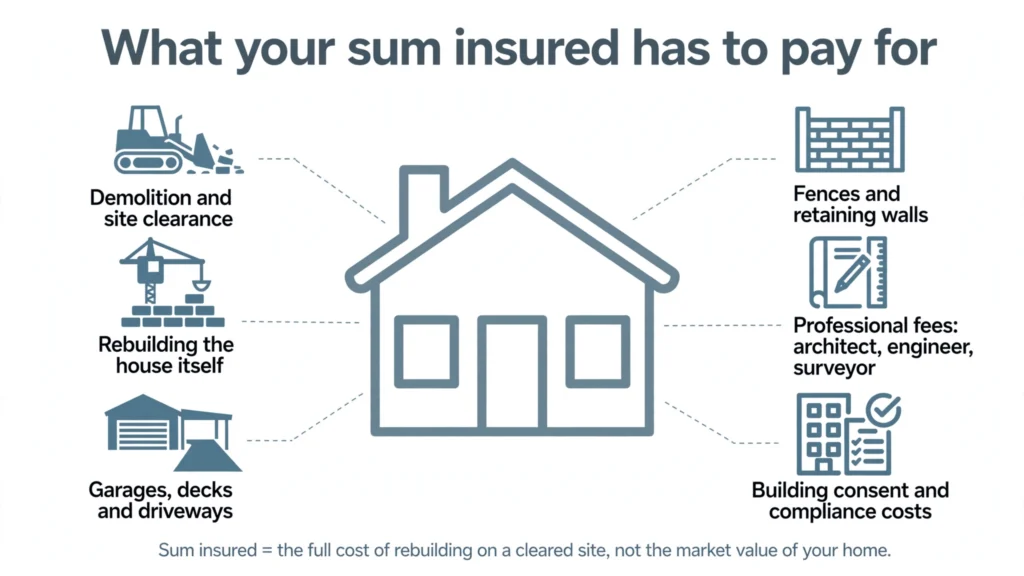
The IFSO defines the sum insured as the cost of rebuilding your home on a cleared site. In practice the number needs to cover:
- Demolishing what is left and clearing the site
- Rebuilding a house of the same size and standard, using current building methods and materials
- Garages, sheds and other insured structures
- Driveways, fences, decks and retaining walls
- Professional fees: architects, engineers, surveyors, project management
- Building consent and other compliance costs
Note what is missing from that list: the land. Land value is not insured under a house policy, which is why the sum insured in an expensive suburb can be far lower than the price the property would sell for. The rateable value is no guide either, because it blends land and buildings for council rating purposes.
How to work yours out
You are responsible for setting the figure. There are three ways to approach it, in increasing order of reliability.
Use your insurer’s rebuild calculator. Most insurers provide a free online calculator that builds an estimate from your floor area, construction type, age, quality of finish and features such as decks and retaining walls. These tools draw on building cost data (the best known is the Cordell Sum Sure calculator, a commercial tool many insurers license). A calculator is only as good as the answers fed into it, so measure your floor area properly and declare the extras.
Get a professional valuation. For a large, older or architecturally designed home, or one with expensive retaining walls and site works, ICNZ and the IFSO both suggest a registered valuer or quantity surveyor. The estimate costs money upfront and is the strongest evidence you can hold if a claim is ever disputed.
Review it every year. Insurers usually index the sum insured at renewal by an average construction cost figure. Averages do not know about your renovation or your new deck. Check the figure at every renewal and after any significant work on the house.
An illustrative example shows why this matters. Take a home where a proper rebuild estimate comes to $850,000 once demolition, fees and site works are included, but the policy still carries a sum insured of $700,000 set years earlier and only ever indexed. If that house is destroyed, the most the policy can pay is $700,000. The remaining $150,000 is the owner’s problem, at exactly the moment they can least afford it. Those numbers are invented to show the arithmetic, but the mechanism is real, and it is the most common way New Zealand homeowners end up underinsured. Setting the figure too high is less dangerous but still wasteful: insurers will not pay more than the actual rebuild cost, so an inflated figure means premium paid for cover you can never use.

Natural disaster cover and the NHC levy
New Zealand does something few other countries do: it builds a layer of government natural disaster insurance into every residential house policy.
The Natural Hazards Commission Toka Tū Ake administers the scheme under the Natural Hazards Insurance Act 2023, which replaced the old Earthquake Commission Act from 1 July 2024. Cover under the old law was called EQCover. The current cover is NHCover, and many people still know the agency by its old name, EQC.
How NHCover attaches to your policy
You do not buy NHCover separately and you cannot opt out of it while insuring your home. If you hold a fire insurance policy on a residential building with a New Zealand insurer, NHCover comes with it automatically, and your insurer collects the levy on the Commission’s behalf as part of your premium. When disaster strikes, you claim through your insurer, which assesses and manages the NHCover claim for the Commission alongside your private claim.
What NHCover pays for buildings
For residential buildings, NHCover covers damage from:
- Earthquake
- Landslide
- Volcanic activity
- Hydrothermal activity
- Tsunami
- Fire caused by one of those hazards
The building cover cap is $300,000 plus GST per dwelling, per event. If the damage costs less than the cap, NHCover meets it (less the claim excess). If it costs more, your private insurer pays the rest, up to your sum insured. In a multi-unit building the cap applies per dwelling, so a block of four flats carries four caps. Note that the cap has sat at $300,000 for years while building costs have climbed, so the private top-up is now the larger part of any serious rebuild. Your sum insured still has to cover the full rebuild cost.
The levy
NHCover is funded by the Natural Hazards Insurance levy inside your house insurance premium. The levy is set in law at 16 cents for every $100 of NHCover building cover. Because that cover is capped at $300,000, the most the levy can reach is $480 a year plus GST for a dwelling, and most insured homes pay at or near that maximum.
A second government levy sits in the same premium. The Fire and Emergency New Zealand levy helps fund the fire service and is charged on insurance policies that cover property against fire. For homeowners it is also capped: the maximum annual levy on a residential property is $107.40 from 1 July 2026, down from $119.50. Between the two levies and GST, government charges make up a noticeable slice of every house insurance bill before the insurer’s own premium is added.
Land cover: limited, and different
NHCover also includes land cover, and this is where expectations most often outrun reality. The scheme covers defined areas of residential land: the land under the home, land within eight metres of it, and land forming or supporting the main accessway within 60 metres, along with certain retaining walls, bridges and culverts.
Land is covered for a wider set of hazards than buildings, including storm and flood damage. But the payment is a contribution, not full cover. The Commission pays the lesser of the repair cost or the land cover cap, which is calculated from the value of the damaged area, with specific limits inside it: retaining walls are capped at $50,000 plus GST in total, and bridges and culverts at $25,000 plus GST. The Commission itself stresses that land cover is partial protection designed to keep the scheme affordable, and it cannot be topped up with private insurance.
A flat excess applies to NHCover claims under the current Act: $500 per insured home for a building claim, and $500 for a land claim.
Policy types and add-ons
Most house policies sold today are sum insured replacement policies, as described above. ICNZ’s consumer guidance notes houses can also be insured on other bases, and you may still come across:
- Full replacement policies, where the insurer rebuilds to the same floor area without a preset dollar cap. A small number remain on the market, increasingly for fire and other non-earthquake events rather than as an open-ended promise for every peril.
- Indemnity value policies, which pay the depreciated value of what was lost rather than the rebuild cost. These are more common for older or run-down properties, and they will not fund a like-for-like rebuild.
Around that core, policies differ in their built-in benefits and optional extras. The ones worth comparing carefully are:
- Temporary accommodation. If an insured event makes your home unliveable, most house and contents policies include a temporary accommodation benefit. ICNZ describes it as a separate benefit with its own dollar limit, rather than part of your sum insured. You generally need your insurer’s approval before incurring costs, and related costs such as meals, travel and letting fees are usually not covered. Keep every receipt.
- Gradual damage extension. A limited add-on with some insurers that pays towards hidden water damage from a leaking pipe or appliance, subject to conditions and a cap. It is not a maintenance fund, and it will not cover damage the insurer considers preventable.
- Excess choices. A higher excess lowers the premium, a lower excess raises it. Some policies also carry special excesses, for example for natural hazards or for claims involving tenants.
- Accidental damage extensions and specified items belong mainly to contents insurance, a separate policy from house insurance. Bundling the two with one insurer is common and often cheaper, but the covers, sums insured and excesses remain distinct. A house policy will not replace your furniture, electronics or jewellery, apart from fixtures that form part of the building, such as a built-in oven.
Landlords and rental properties
A standard owner-occupier policy does not automatically suit a tenanted house, and insurers need to know a property is rented. Landlord cover is usually a house policy with specific additions:
- Loss of rent, if the property becomes uninhabitable after an insured event, and under some wordings if a tenant defaults or leaves without paying
- Deliberate or malicious damage by tenants, usually an optional extra with its own excess and conditions, often including regular documented property inspections
- Landlord’s contents and chattels, such as curtains, carpets and appliances supplied with the tenancy
- Methamphetamine contamination cover, which varies widely between insurers and has been a recurring source of disputes, as IFSO case notes show
Tenancy law interacts with insurance in one way every landlord should know. Tenancy Services requires an insurance statement in every new tenancy agreement, stating whether the property is insured and, if so, the excess on any policy relevant to the tenant’s liability for damage, plus a statement that a copy of the policy is available on request. If a tenant or their guest damages the property through careless behaviour, the tenant’s liability is capped at four weeks’ rent or the insurance excess, whichever is lower. Intentional damage is different: the tenant can be liable in full.
The practical points: tell your insurer the property is tenanted, keep up the inspections your policy requires, and get the insurance statement right. Skipping any of the three is a common reason landlord claims go wrong.
What affects the cost
There is no standard price for house insurance in New Zealand, and no official source publishes a typical premium, because the number would mislead. Two houses on the same street can carry very different premiums. The main drivers are:
- Location and natural hazard risk. Earthquake, flood, coastal and landslide risk are priced property by property. Insurers have moved steadily towards risk-based pricing, so a low-lying coastal home and a hill suburb home no longer subsidise each other the way they once did.
- The sum insured. A higher rebuild figure means more cover and a higher premium. This is one driver you control, and cutting it to save premium is the most expensive saving available, as the example above shows.
- Construction and age. Timber weatherboard, brick, concrete block and modern builds all price differently, as do older homes with older wiring and plumbing. Heritage features and unusual construction push costs up.
- The excess you choose. Volunteering a higher excess is one of the few clean ways to reduce premium without reducing cover.
- Claims history. The IFSO notes that claims history feeds into premium decisions across insurance types, and house insurance is no exception.
- Levies, GST and reinsurance. The NHC levy and Fire and Emergency levy are fixed by law and sit on top of the insurer’s price. Behind the scenes, insurers also buy reinsurance on global markets, and the cost of that cover after major disasters here and overseas flows through to household premiums.
- Security and risk features. Monitored alarms, deadlocks and similar features can help at the margin with some insurers.
The honest way to manage cost is to compare like-for-like policies every year or two, adjust the excess, and keep the sum insured accurate rather than low.
Making a claim
When something happens, the sequence is much the same across insurers.
- Make the property safe and prevent further damage where you safely can. Emergency repairs to keep water out are expected. Permanent repairs should wait for the insurer’s go-ahead.
- Tell your insurer promptly. For theft or burglary, report it to the Police as well. Policies set out your obligations at claim time, and delays or missing information make everything slower.
- Document everything. Photograph damage before you clean up, keep damaged items where practical, and keep receipts for emergency spending and temporary accommodation.
- The insurer assesses. Depending on the size of the claim, that may involve a loss adjuster, a builder’s scope of works, or specialist reports for earthquake, flood or land damage. If natural hazards are involved, your insurer handles the NHCover part with the Commission at the same time.
- Settlement. Claims are settled by repair, rebuild or cash payment up to the applicable limits, less the excess. If you take cash for a destroyed home, check the wording: some policies pay indemnity value until you actually rebuild.
Most general insurers belong to ICNZ and subscribe to its Fair Insurance Code, which sets minimum standards for how they deal with customers, including at claim time. The code is a floor for behaviour, not a promise that every claim will be paid.
If you are unhappy with an outcome, complain to the insurer first, through its internal complaints process. If it is not resolved, you can go to the insurer’s independent dispute resolution scheme. For most house insurers that is the Insurance & Financial Services Ombudsman Scheme, free for consumers, which can investigate declined claims, settlement amounts and service. The IFSO cannot take a complaint until the insurer has had its chance and deadlock has been reached.
How to compare policies
Price differences between insurers are real, but the wording differences matter more on the day you claim. Compare these points before the premium:
- Is it a sum insured policy, and what exactly does the sum insured need to include under that wording?
- What are the limits for retaining walls, swimming pools and other special features?
- What is the temporary accommodation limit, and how long does it run?
- Is there a gradual damage benefit, and what is its cap?
- What excesses apply, including any special excesses for natural hazards, floods or tenant damage?
- How long can the house sit unoccupied before cover is affected?
- For landlords: are loss of rent and deliberate damage by tenants included or optional, and what inspection conditions apply?
The same discipline applies to your other big policies. Comparing car insurance in NZ on wording rather than price alone, for example, saves the same kind of claim-day grief. And while you are reviewing the household’s cover, it is worth asking what happens to the mortgage and the bills if the earner cannot work, which is where income protection insurance fits into the picture.
Common mistakes
- Insuring for market value or rateable value. Both include land or rating assumptions. Neither is a rebuild cost.
- Accepting the default sum insured and never checking it. Default figures are built from averages. Architect-designed homes, big decks, retaining walls and quality finishes all push the real cost above the average.
- Letting the figure drift. A renovation adds rebuild cost from the day it is finished. Tell your insurer and lift the sum insured at the same time.
- Assuming gradual damage is covered. It is the exclusion behind a large share of declined house claims. Fix leaks early and maintain seals and flashings.
- Not telling the insurer material facts. A house becoming a rental, sitting empty, or going under major renovation can all affect cover.
- Skipping the policy schedule at renewal. The schedule is what the insurer thinks your house is: floor area, construction, features. Errors there become errors in your cover.
Frequently asked questions
Is house insurance compulsory in New Zealand?
No law requires you to insure your house. In practice, every mortgage lender requires it as a condition of the loan, usually in place from the day you take ownership. If you own your home outright, insurance is your choice, and your risk.
What is the difference between house insurance and contents insurance?
House insurance covers the building: the structure, permanent fixtures and fittings, and insured structures such as garages and fences. Contents insurance covers the things you would take with you if you moved: furniture, appliances that are not built in, electronics, clothing and personal belongings. They are separate policies with separate sums insured, though most households hold both with the same insurer.
How much of my premium is the NHC levy?
The Natural Hazards Insurance levy is 16 cents per $100 of NHCover building cover. Since building cover is capped at $300,000 per dwelling, the levy tops out at $480 a year plus GST, which is where most insured homes sit. It is collected by your insurer as part of your premium and passed to the Natural Hazards Commission.
Does house insurance cover flood damage?
Generally yes for the building itself: flood is a standard insured event under private house policies. The government scheme is different. NHCover does not cover buildings for storm or flood damage at all, only land, within its land cover limits. Your private policy carries the building flood risk, one reason flood-prone properties have seen sharp premium increases under risk-based pricing.
What happens if my sum insured is too low after a total loss?
The insurer pays up to the sum insured and no further. You either fund the gap yourself, rebuild a smaller or simpler house within the payout, or take the cash settlement and make a different decision, such as selling the land. There is no mechanism that tops the figure up after the event.
Can I insure my rental property on a standard house policy?
You need to tell the insurer the property is tenanted, and most landlords take a landlord policy or a house policy with landlord extensions. That adds things a standard policy does not promise, such as loss of rent and cover for deliberate damage by tenants, with conditions such as regular inspections. Tenancy law also requires an insurance statement in the tenancy agreement, including whether the property is insured and the excess that applies.
Who do I complain to if my claim is declined?
First to your insurer, through its internal complaints process. If that reaches deadlock, take the complaint to the insurer’s dispute resolution scheme. For most house insurers that is the Insurance & Financial Services Ombudsman Scheme, a free and independent service. Complaints about NHCover decisions can also go through the NHCover dispute resolution arrangements described by the Natural Hazards Commission.
Sources
- Natural Hazards Commission Toka Tū Ake, Natural Hazards Insurance Act 2023 (changes from EQCover to NHCover, building cover cap, land cover limits, claim excesses): https://www.naturalhazards.govt.nz/about-nhc/how-we-work/natural-hazards-insurance-act-2023/
- Natural Hazards Commission Toka Tū Ake, NHCover Insurers’ Guide, March 2025 (levy rate and calculation, how NHCover applies): https://www.naturalhazards.govt.nz/assets/Publications-Resources/NHCover-Insurers-Guide-March-2025.pdf
- Natural Hazards Commission Toka Tū Ake, NHCover scheme offers partial coverage for land damage, August 2025: https://www.naturalhazards.govt.nz/news/nhcover-scheme-offers-partial-coverage-for-land-damage/
- Insurance Council of New Zealand, House & Contents Insurance: Sum Insured Explained: https://www.icnz.org.nz/individuals/house-contents/
- Insurance Council of New Zealand, Consumer guide to replacement vs indemnity insurance: https://www.icnz.org.nz/wp-content/uploads/2023/01/Consumer_guide_to_replacement_vs._indemnity_insurance_v1.0.pdf
- Insurance Council of New Zealand, Annual Review 2013 (the switch from total replacement to sum insured policies): https://www.icnz.org.nz/wp-content/uploads/2023/01/icnz-annual-review-2013.pdf
- Insurance Council of New Zealand, Insurance advisory for people affected by the Nelson fires (temporary accommodation benefit): https://www.icnz.org.nz/industry/media-releases/insurance-advisory-for-people-affected-by-nelson-fires/
- Insurance & Financial Services Ombudsman Scheme, House and Contents Insurance (sum insured, gradual damage, disclosure, complaints): https://www.ifso.nz/information/home-and-contents
- Consumer Protection (MBIE), Your rights compared (house insurance covers built-in appliances such as ovens): https://www.consumerprotection.govt.nz/help-product-service/electronics-and-appliances/your-rights-compared
- Tenancy Services (MBIE), tenancy agreement and landlord compliance guidance (insurance statement requirements): https://www.tenancy.govt.nz/assets/forms-templates/landlord-compliance-checklist.pdf
- Beehive (Office of the Minister of Internal Affairs), Fire and Emergency New Zealand final levy rates confirmed, 18 December 2024: https://www.beehive.govt.nz/release/fire-and-emergency-new-zealand-final-levy-rates-confirmed
This article is general information about how house insurance works in New Zealand. It is not personalised financial advice, and it does not replace your policy wording, which is the contract that decides any claim. Policy terms, limits and exclusions differ between insurers and change over time. For advice on your own situation, talk to a licensed financial adviser or your insurer.