Property Management Business for Sale: NZ Rules, Costs and How to Buy One
Property Management Business for Sale: NZ Rules, Costs and How to Buy One
The short answer
A property management business for sale in New Zealand is usually a rent roll for sale. The rent roll is the list of properties the business manages, the owners who pay for that management, and the tenancies that sit underneath it. When you buy the business, you are buying that list, the fee income it produces, the staff and systems that run it, and the obligations that come with it. You are not buying the properties themselves. What changes hands is the right to manage them and to collect the fees for doing so.
This guide explains what you are buying, how these businesses are valued, what the law requires, what to check before you sign anything, and what the purchase usually costs on top of the price. It is general information, not legal or financial advice. A purchase of this size needs a lawyer and an accountant who have done rent roll deals before.
What you are actually buying
A property management business has four parts, and a buyer needs to understand each one before talking about price.
The first part is the rent roll. This is the portfolio of managed properties, usually counted as the number of properties under management, together with the owners they belong to. A roll of 258 properties might belong to 187 owners, as in one Bay of Plenty listing, because some owners hold more than one rental. The roll is the asset. Everything else in the business exists to service it.
The second part is the management agreements. Each owner has signed an agreement that sets out the fee, the services included, how the agreement can be ended, and what happens if the business is sold. These agreements are the legal foundation of the income. If an agreement lets the owner leave on short notice, or if it cannot be transferred to a new owner, the income it represents is worth less.
The third part is the people and systems. A rent roll is run by property managers and administrators using software that holds the tenancy records, the rent ledger, the inspection history and the maintenance log. The software, the documented processes and the staff who know the owners and tenants keep the roll together after the sale.
The fourth part is the obligations. A property management business collects rent, holds money on behalf of owners, lodges bonds, arranges repairs, runs inspections and makes sure tenancies comply with the Residential Tenancies Act 1986. When you buy the business, you take on those obligations from the day you settle, including any problems the previous owner left behind.
How a property management business makes its money
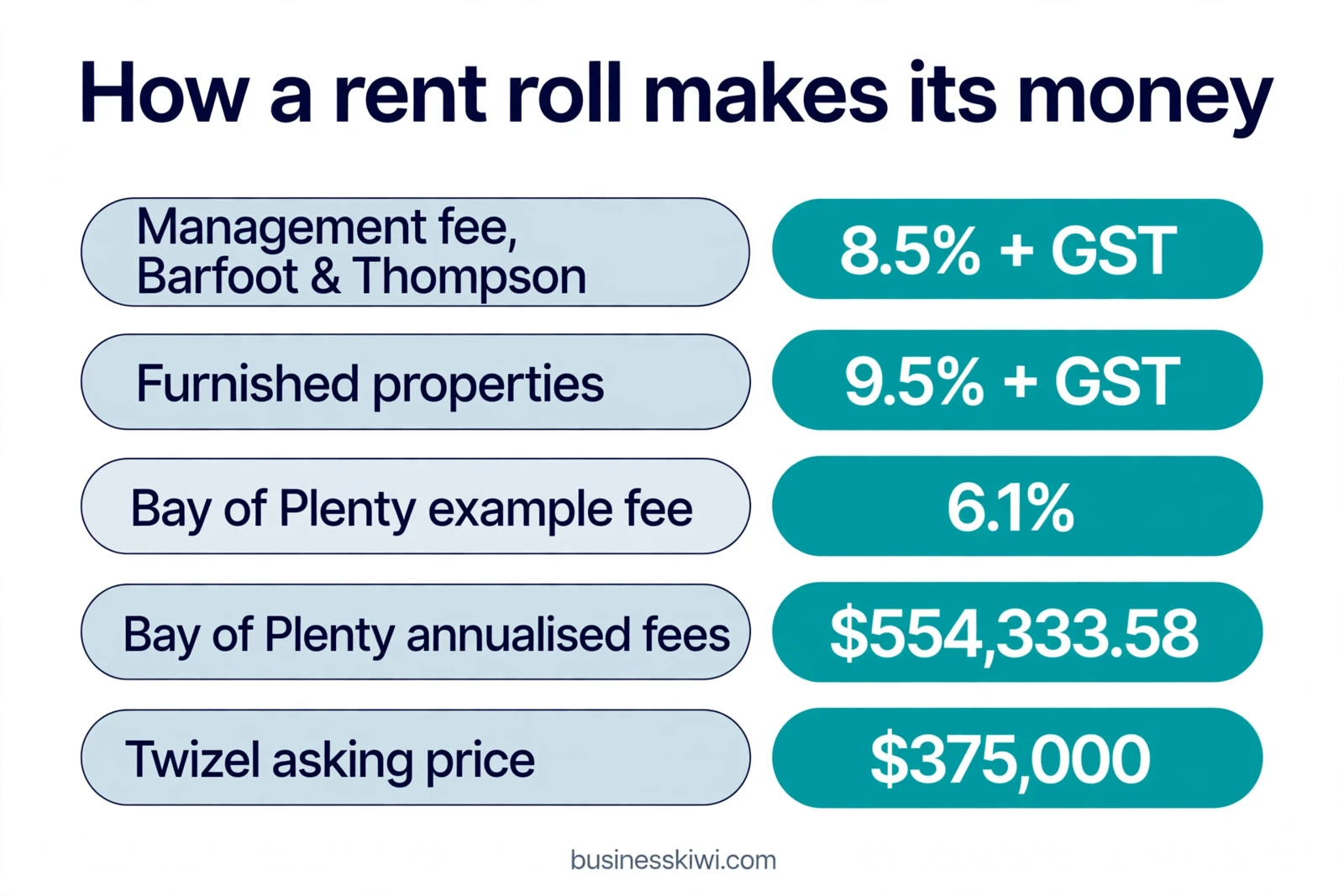
Most of the income is a management fee charged as a percentage of the rent collected, usually on the rent actually received, not on the rent that was due, so empty properties and unpaid rent earn the business nothing. The percentage varies by firm, city and the level of service. As an example, Barfoot and Thompson states on its own landlord page that its full property management service costs 8.5 percent plus GST of all money collected, and 9.5 percent plus GST if the property is furnished. That is one firm’s published fee, not a market rate.
On top of the management fee, most businesses charge extra fees for extra work.
| Income stream | How it usually works | What to check |
|---|---|---|
| Management fee | A percentage of rent collected, charged weekly or monthly | The percentage, whether it is charged on rent received or rent due, and how many properties pay a discounted rate |
| Letting fee | A fee for finding and placing a tenant, often one or two weeks’ rent | Whether the business still charges it, and who pays it |
| Inspection and report fees | A set fee for routine inspections and written reports | Whether inspections are done on schedule, and whether the fee is in the management agreement |
| Maintenance coordination | A fee or margin on arranging repairs and tradespeople | Whether the fee is disclosed to owners |
| Additional services | Fees for Healthy Homes assessments, tribunal applications, insurance claims and similar work | Whether the income is regular or one off |
How rent rolls are valued
Rent rolls are not usually valued the way other businesses are valued. A broker listing for a 258 property rent roll in the Bay of Plenty states the point plainly: rent rolls are typically valued based on projected annualised management fee income, rather than on EBITDA. EBITDA is earnings before interest, tax, depreciation and amortisation, and it is the usual starting point for valuing many small businesses. For a rent roll, the fee income is the starting point instead.
The usual method is to take the annualised management fee income, the fees the roll would earn over a full year at current rents and fee rates, and apply a multiple to it. The multiple is not a fixed number. It changes from city to city and from roll to roll, and it reflects the quality of the roll. A specialist rent roll broker, Hamish Turner and Associates, states on its own site that rent rolls are valued by assessing 14 varied factors together with comparable sales, and that multipliers change from city to city. The factors include the average rent, the fee, the number and spread of owners, the arrears and vacancy levels, and the strength of the management agreements.
Because there is no published standard multiple, never accept a valuation multiple without seeing the comparable sales behind it. Ask the broker which rent rolls have sold recently in the same city, at what multiple, and how the roll being sold compares with them. If the broker cannot show comparable sales, get an independent valuation from a valuer or broker who has sold rent rolls in that city.
Three examples from live listings show the range. They are asking prices and listing figures, not a guide to what any roll is worth.
The first is a 258 property rent roll in the Bay of Plenty, listed by LINK Business Brokers: 258 managed properties, 187 property owners, an average weekly rent of $687.71, average management fee income of 6.1 percent, and projected annualised management fees of $554,333.58. The asking price is not published and is available only from the broker.
The second is a holiday home management business in Twizel, also listed by LINK Business Brokers: 105 homes under management, a mix of 24 long term rentals and short term holiday rentals, an asking price of $375,000, and a stated return on investment of about 25 percent. That is a different kind of business from a residential rent roll, and the price reflects the holiday pool as well as the long term rentals.
The third shows the smaller end of the market. A premium Auckland rent roll listed on Trade Me offered about 70 properties with annual management fees of more than $200,000, with the price on application.
None of these examples tells you what a roll is worth. They show why the fee income, the average rent and the fee percentage matter more than the number of properties alone. A roll of 70 properties at high rents can earn more than a roll of 150 properties at low rents.
The law you are buying into: licensing today
At the time of writing, residential property managers in New Zealand do not need a licence. Real estate agents, branch managers and salespeople must be licensed under the Real Estate Agents Act 2008, and section 6 of that Act says a person must not carry out real estate agency work unless licensed or exempt. Property management on its own is not licensed work under that Act. That means, in practice, almost anyone can set up as a property manager.
That position is changing. The Residential Property Managers Bill was introduced in Parliament on 18 August 2023 and proposed a licensing regime for residential property managers and residential property management organisations, with the Real Estate Authority as the regulator. The Bill went to select committee, and the model has since changed.
The current proposal, set out by the Ministry of Housing and Urban Development, is a lighter registration model rather than a licensing model. Under it, residential property managers and residential property management organisations would have to register, be at least 18 years old, meet minimum education or experience requirements, renew every two years, and appear on a public searchable register. Registered organisations would have to hold all client funds in accounts separate from their operating funds, keep full and accurate records for at least seven years, follow a code of conduct, and meet continuing professional development requirements. A Registrar and a Disciplinary Tribunal would handle complaints and discipline. The Ministry of Business, Innovation and Employment would administer the Regulatory Authority and the Ministry of Justice the Tribunal.
As at November 2026, no Bill for this registration model had been introduced to Parliament, and the Ministry states that the timing will depend on the government’s legislative priorities and the availability of drafting resource. Plan on the basis that registration is coming, without knowing exactly when or in what final form. Check the Ministry’s page before signing, and make sure the sale agreement deals with what happens if new requirements arrive during the handover period.
Trust accounts and client money
Client money is the sharpest risk in a property management purchase. The business collects rent every week, holds it briefly, deducts its fee, and pays the balance to owners. If that money is mixed with the business’s own money, or if the records are poor, the buyer can inherit a shortfall that is expensive and difficult to fix.
For licensed agencies, the Real Estate Authority sets out the trust account rules clearly. Every agency must ensure any money received in respect of a real estate transaction is deposited in a designated trust account. All money received for a real estate transaction must be held in the trust account and cannot be paid to any person for 10 working days after the date it is received, unless all parties authorise early payment in writing or a court orders it. That is section 123 of the Real Estate Agents Act 2008. Trust account records must be kept for at least seven years from the date of the last transaction, under the Real Estate Agents (Audit) Regulations 2009, and trust accounts must be audited.
An unlicensed property management business is not covered by those Real Estate Authority trust account rules. The proposed registration regime would require registered organisations to hold all client funds in separate accounts from operating funds. Until that regime exists, the protection for owners and tenants depends on the business’s own systems, its accounting, and the terms of its management agreements. Treat this as a due diligence priority, not a detail.
Ask for the trust account or client account bank statements for the last 12 months, the reconciliation for the most recent month, and the auditor’s report if the business has one. Check that the client account balance matches the sum of what is owed to owners, that rent is paid out on the promised day, and that no client money has been used to pay the business’s own bills. If the business cannot produce a clean reconciliation, that is a reason to pause the purchase, not a reason to accept a discount and carry on.
Tenancy law the business must run every day
A property management business lives inside the Residential Tenancies Act 1986. The buyer takes on the job of making sure every tenancy in the roll complies with that Act from the first day after settlement.
Tenancy agreements must be in writing, and must include the names and contact details of the landlord and tenants, the property address, the tenancy start date, the bond and rent amounts, how rent is paid, a list of chattels, the end date for a fixed term tenancy, and a signed healthy homes compliance statement. If the property is managed by a property manager, the names of both the owner and the property management company should be on the agreement as landlord. If the owner is not on the agreement, the property manager takes on all the landlord’s responsibilities, and could be held responsible for Tenancy Tribunal orders in favour of the tenant, for paying any monetary orders, and for the actions or non actions of the owner.
Bonds are capped. A landlord can ask for a general bond of no more than four weeks’ rent. Since 1 December 2025, a landlord who consents to a pet can also ask for a separate pet bond of no more than two weeks’ rent, with only one pet bond at a time. The bond must be lodged with Tenancy Services within 23 working days of receiving it. Failing to lodge a bond on time is against the law.
Rent can only be increased once every 12 months, and the landlord must give the tenant at least 60 days’ written notice. There is no legal cap on the amount, but the increase must not be above market rent.
Healthy Homes is now a settled obligation. There are five healthy homes standards: heating, insulation, ventilation, moisture ingress and drainage, and draught stopping. All private rentals have had to comply with the standards since 1 July 2025. Kainga Ora and registered community housing provider homes had to comply by 1 July 2024. Landlords who do not meet the standards can face exemplary damages of up to $7,200. Check the Healthy Homes compliance statement and the supporting records for every property in the roll.
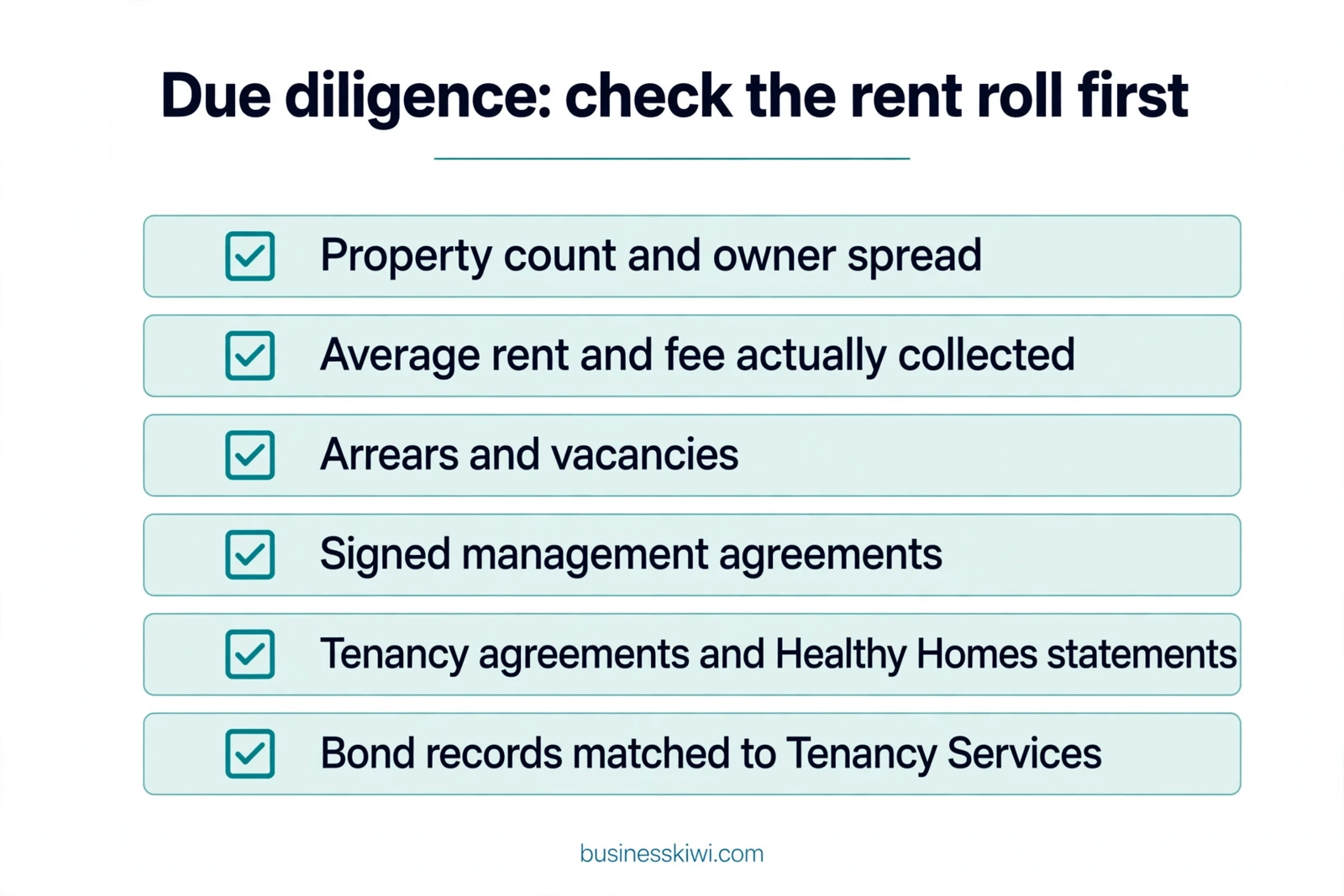
What to check in due diligence: the rent roll itself
Due diligence is the process of checking that what the seller says about the business is true. Business.govt.nz describes it as checking that what the owner says is true: pending court cases, asset ownership, contracts, key staff, and customer and supplier loyalty.
For a rent roll, the roll itself is the first thing to check.
| Check | What to look for | Why it matters |
|---|---|---|
| Property count and owner spread | The number of properties, the number of owners, and how many properties the largest owners hold | A roll where one owner holds 40 properties is worth less than a roll spread across many owners |
| Average rent and fee | The average weekly rent, the fee percentage, and the fee actually collected after discounts | These two numbers drive the annualised fee income, which is the basis of the valuation |
| Arrears and vacancies | The arrears list, the vacancy rate, and how long properties sit empty | High arrears or long vacancies mean fee income is lower than the rent roll suggests |
| Management agreements | The signed agreement for every property, including the fee, the term, the notice period and the assignment clause | If agreements cannot be transferred, or owners can leave on 30 days’ notice, the income is not secure |
| Tenancy agreements | A signed tenancy agreement and healthy homes compliance statement for every tenancy | Missing agreements or compliance statements are a liability the buyer inherits |
| Bond records | The bond lodged for every tenancy, matched to Tenancy Services records | Unlodged or incorrect bonds can lead to Tribunal orders against the new owner |
| Inspection and maintenance history | The inspection schedule, the reports, and the outstanding maintenance list | Overdue inspections and a backlog of repairs mean costs and complaints after settlement |
| Complaints and Tribunal history | Any complaints, Tenancy Tribunal applications, orders or exemplary damages | A roll with a history of Tribunal orders may have owners and tenants who leave soon after the sale |
| Owner intentions | Whether owners were told about the sale, and whether any have said they will leave | Owners who were not told, or who are unhappy, are the most likely to leave during handover |
A specialist rent roll broker states that due diligence for a rent roll purchase typically takes about 10 working days. A large or messy roll will take longer, and a buyer should not agree to a shorter period to win the deal. The sale and purchase agreement should include a due diligence condition that lets the buyer walk away, or renegotiate the price, if the checks turn up problems.
What to check: money, contracts and people
Ask your accountant to review at least three years of financial statements, the year to date management accounts, GST returns, the rent ledger, and the bank statements for the client account and the operating account. Ask your accountant to check trends and the grounds for any financial forecasts in the sales documents. Compare the books with the rent ledger and the bank statements, to see whether the fee income claimed is the fee income actually received.
Goodwill is the part of the price that is not tied to physical assets. Business.govt.nz puts it simply: goodwill is the health of the business, and if it has a strong customer base, a great reputation and high turnover, expect to pay more for it. In a rent roll, most of the price is goodwill, because the physical assets are usually modest: computers, office furniture, a lease and the software. That makes the checks on owner loyalty and staff retention more important, because goodwill disappears if the owners leave.
The contracts to read are the management agreements with owners, the employment agreements with staff, the lease for the office, the software licences, and any franchise or brand agreement. If the business operates under a franchise or a national brand, check whether the franchise agreement allows a change of owner, what fees it charges, and whether the buyer must meet the franchisor’s conditions. If the business is a company, the seller must tell the Companies Office about any director or shareholder changes.
Business.govt.nz advises checking who the key staff are, how much they know about operations, and whether they are likely to leave after the sale. In a rent roll, the property managers hold the relationships with owners and tenants. If the best property manager leaves, owners often follow. Ask which staff will stay, whether their employment agreements transfer, what leave entitlements are owed, and whether any staff have disputes in progress. The sale and purchase agreement should say whether the buyer takes over the employment of existing staff. If it does not, the buyer can negotiate new employment agreements, and the seller must handle any redundancies before handover.
The buying process, step by step
Most rent roll sales follow the same sequence.
First, find the business. Rent rolls are usually listed with a business broker, and the listing will show the number of properties, the location and sometimes an asking price. Some listings show no price. A buyer will usually need to sign a confidentiality agreement before receiving the information memorandum, the detailed sales document with financials and commentary.
Second, register interest and appoint advisers. Business.govt.nz advises appointing an adviser to talk to the owner’s representative, since this makes a buyer more credible. Ask the owner why they are selling and compare that reason with the financial picture in the sales documents. A buyer should have a lawyer and an accountant in place before making an offer, not after.
Third, make an offer, usually as a sale and purchase agreement, or as a term sheet that leads to one, with conditions for due diligence and finance. The price is usually split between the rent roll, any physical assets, and goodwill, and the split matters for tax, so ask your accountant about the allocation before signing.
Fourth, carry out due diligence, verifying the rent roll, the money, the contracts and the people, as set out above. A specialist broker states that due diligence for a rent roll typically takes about 10 working days. Settlement typically occurs on the first business day of a given month, which suits a rent roll because rent is collected on a monthly cycle.
Fifth, settle and hand over. On settlement, the buyer pays the agreed price, the management agreements transfer or are novated to the buyer, the client account arrangements change hands, and the seller introduces the buyer to owners and tenants. Many rent roll sales include a retention period of three to six months, during which part of the price is held back and is only paid if the rent roll stays above an agreed size. Agree in advance how the roll will be measured and what happens if it falls below the agreed level.
Sixth, tell the owners and tenants. Owners who learn about a sale from a letter with no introduction are more likely to leave than owners who are told in advance by the seller and introduced to the buyer. The handover letter should be agreed with the seller before settlement, not drafted afterwards.
Costs beyond the purchase price
The asking price is not the total cost of buying. A buyer should budget for the following on top of it.
Legal fees for the sale and purchase agreement, the due diligence review, the transfer of management agreements, and advice on the regulatory position. The buyer’s lawyer should give an estimate first.
Accounting fees for reviewing the financials, advising on the price allocation, and advising on GST and income tax. Business.govt.nz notes that a sale and purchase agreement should state whether the sale is GST inclusive or exclusive, and that the rate of GST on the sale could be 15 percent or zero. The buyer’s accountant should review the agreement before signing. A buyer who needs finance should also budget for valuation and lending fees.
Working capital for the first months, to pay staff, rent, software and insurance before the fee income settles into a steady pattern, and to cover any shortfall if owners leave during handover.
Insurance, including professional indemnity and public liability insurance. The Property Institute of New Zealand states that its members must hold public liability insurance, and a buyer should confirm the cover is in place from day one.
Software and systems costs, including the property management software licence and any cost of moving the data to the buyer’s own systems. Part of the price may also be held back for three to six months under the retention clause.
The handover: keeping owners and tenants
Most rent rolls lose some properties after a sale, because owners do not know the buyer, their property manager leaves, or the handover is handled badly. A buyer can reduce that loss, but cannot remove it.
The handover works best when the seller stays involved for a short period, introducing the buyer to owners and attending meetings with the largest owners. The length of that period, and what the seller is paid for it, should be in the sale and purchase agreement.
Tenants need to be told too. The tenant’s rights do not change when the business is sold, and the tenancy agreement continues on the same terms. The buyer should write to tenants with the new contact details.
Red flags that should stop you
Some problems can be fixed with a lower price or a longer handover. The following are reasons to walk away, or to get independent advice before going any further.
The client account does not reconcile. If the money in the client account does not match what is owed to owners, or if the seller cannot produce a reconciliation, the buyer may be inheriting a shortfall. Do not accept a promise to fix it later.
Management agreements are missing, unsigned or untransferable. If a large share of the roll has no signed agreement, or the agreements do not allow transfer to a new owner, the income is not secure.
Bonds have not been lodged. If bonds are sitting in the business bank account instead of with Tenancy Services, or if the bond records do not match, the buyer inherits the liability and the Tribunal risk.
Healthy Homes records are missing. If the business cannot show a compliance statement and supporting records for each property, the buyer inherits properties that may not comply, with exemplary damages of up to $7,200 at stake.
The seller will not let you talk to owners or staff. A seller who blocks access to owners or staff is hiding something.
The price depends on a multiple the broker cannot support. If the broker cannot show comparable rent roll sales in the same city at a similar multiple, the price is a guess, not a valuation.
Buying versus building a rent roll
Buying is not the only way to own a rent roll. The alternative is to build one from scratch, by winning owners one at a time. Building is slower and cheaper in cash, but it takes years to reach the size of a roll that can be bought, and it carries the cost of marketing, of working without fee income while the roll grows, and of competing with established firms for every new owner.
Buying gives the buyer fee income from day one, an established brand and systems, and staff who know the work. It also gives the buyer the previous owner’s problems, the risk that owners leave, and a price that includes goodwill the buyer must protect. Business.govt.nz notes that buying an existing business lets a buyer skip the precarious start up phase. Those advantages are real, but they are only worth the price if the due diligence confirms them.
A buyer who is choosing between the two should ask a simple question: does the roll being sold earn its price in fee income, after allowing for the owners who will leave, the staff who will need replacing, and the work needed to bring the compliance records up to standard? If the answer is not clear from the information memorandum, the buyer does not yet have enough information to make an offer.
For more on property and starting a business, browse the Real Estate section.
Frequently asked questions
Do I need a licence to buy a property management business?
No licence is required at the time of writing. Residential property managers do not need a licence under the Real Estate Agents Act 2008, which licenses real estate agents, branch managers and salespeople. A registration regime has been proposed by the Ministry of Housing and Urban Development, but no Bill had been introduced to Parliament as at November 2026. If the business also sells houses, that work must be done by a licensed agent.
How much does a property management business cost?
There is no standard price. Rent rolls are usually valued on their projected annualised management fee income, with a multiple that varies by city and by the quality of the roll. Examples from live listings: a 105 home holiday management business in Twizel was listed at $375,000, a 258 property Bay of Plenty rent roll was listed with the price available only from the broker, and a 70 property Auckland rent roll was listed with the price on application. Get an independent valuation based on comparable sales in the same city.
How are rent rolls valued?
They are typically valued on projected annualised management fee income rather than on EBITDA. A broker takes the fees the roll would earn over a full year at current rents and fee rates, and applies a multiple that reflects the quality of the roll. A specialist broker states that 14 factors are assessed together with comparable sales. Ask the broker to show the comparable sales behind any multiple.
What happens to the management agreements when the business is sold?
It depends on the wording of each agreement. Some agreements allow the business to transfer or assign its rights to a new owner. Others require the owner’s consent, or allow the owner to end the agreement if the business is sold. A buyer should read every management agreement and confirm which ones transfer automatically, which need consent, and how much notice an owner must give to leave. Agreements that cannot be transferred, or that allow an owner to leave on short notice, reduce the value of the roll.
Do I need Overseas Investment Office consent as an overseas buyer?
Usually not for a rent roll on its own. Overseas persons need consent to invest in sensitive New Zealand land or in significant business assets, which Land Information New Zealand defines as a business or assets valued at more than $100 million. Buying a rent roll involves no purchase of land. An overseas buyer should still get legal advice.
What happens to the bonds when the business is sold?
Nothing changes for the tenant. Bonds are held by Tenancy Services, not by the property management business, and they stay with the tenancy when the business changes hands. The buyer should still check the bond records for every tenancy as part of due diligence. An unlodged bond is a liability the buyer inherits.
Can I raise the management fee after buying?
Only within the terms of each management agreement. The fee is set by the agreement between the business and each owner, and the buyer steps into those agreements on the terms as written. A buyer who wants to raise fees must check the notice and variation clauses in each agreement.
This guide is general information only. It is not legal, financial or tax advice. Buying a business is a major financial decision, and the rules for property managers are changing. Get advice from a lawyer and an accountant who have handled rent roll purchases, and check the current position with the Ministry of Housing and Urban Development, the Real Estate Authority and Tenancy Services before you sign anything.