Selling Your House Privately in NZ: The Full Process, the Legal Bits and the Honest Trade-Offs
Selling a house without an agent is legal in New Zealand, and plenty of owners do it. The appeal is obvious. You skip the commission, you deal with buyers yourself, and you stay in control of every decision.
What you do not skip is the process itself. Pricing, marketing, paperwork, disclosure and settlement all still have to happen. They land on you instead of an agent.
The short answer
Yes, you can sell your own home privately in NZ. You do not need a licence to sell property you own yourself.
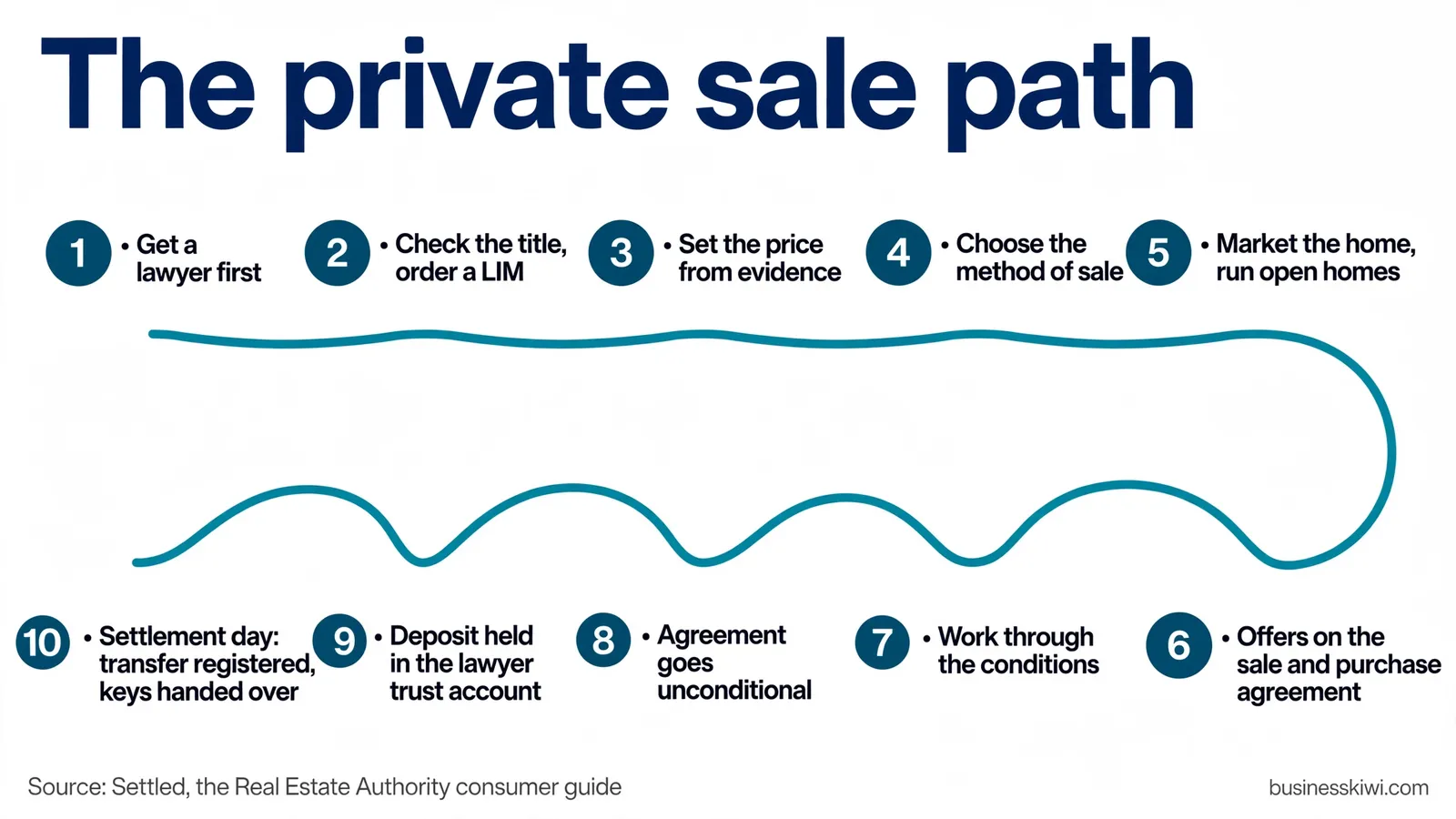
Three things are not optional, even in a private sale. A lawyer or conveyancer should prepare or check the sale and purchase agreement before anyone signs it. The buyer’s deposit must sit safely in a trust account, which in a private sale means your lawyer’s. And you must tell buyers about known problems with the property. Hiding an issue can undo the sale later.
What an agent does that you take on yourself
A good agent earns their commission in four main ways. They price the home against the local market. They market it, including through print publications and specialist websites that private sellers cannot advertise on. They run viewings and negotiate with buyers. They manage the offers, the paperwork and the deadlines.
Sell privately and every one of those jobs is yours. You field the calls and the tyre-kickers. You host strangers in your home. You negotiate face to face with buyers who may push hard. You carry the legal risk if an offer is written up badly.
The trade-off cuts both ways. You know your home better than any agent, and you can sell its features first-hand. You keep control of timing and negotiation, and if the sale goes smoothly you keep the commission, usually calculated as a percentage of the sale price.
One protection disappears. Buyers who deal with a licensed agent can complain to the Real Estate Authority if something goes wrong. In a private sale REA cannot help with disputes about the sale itself. Private sales also sit outside the Consumer Guarantees Act and the Fair Trading Act, unless the seller trades properties as a business. Both sides have less backup, which is why the paperwork matters so much.
Before you list: title, LIM and disclosures
Start with the record of title, the official record of who owns the land. It also shows interests that affect it, such as easements, covenants and rights of way. Your lawyer can check it for anything a buyer will trip over later.
Next, order a LIM. A Land Information Memorandum is a report from your local council summarising the information it holds on the property on the day it is produced. A LIM covers drainage, zoning, rates owing, and building and resource consents. It also flags special land features such as erosion or flooding risk.
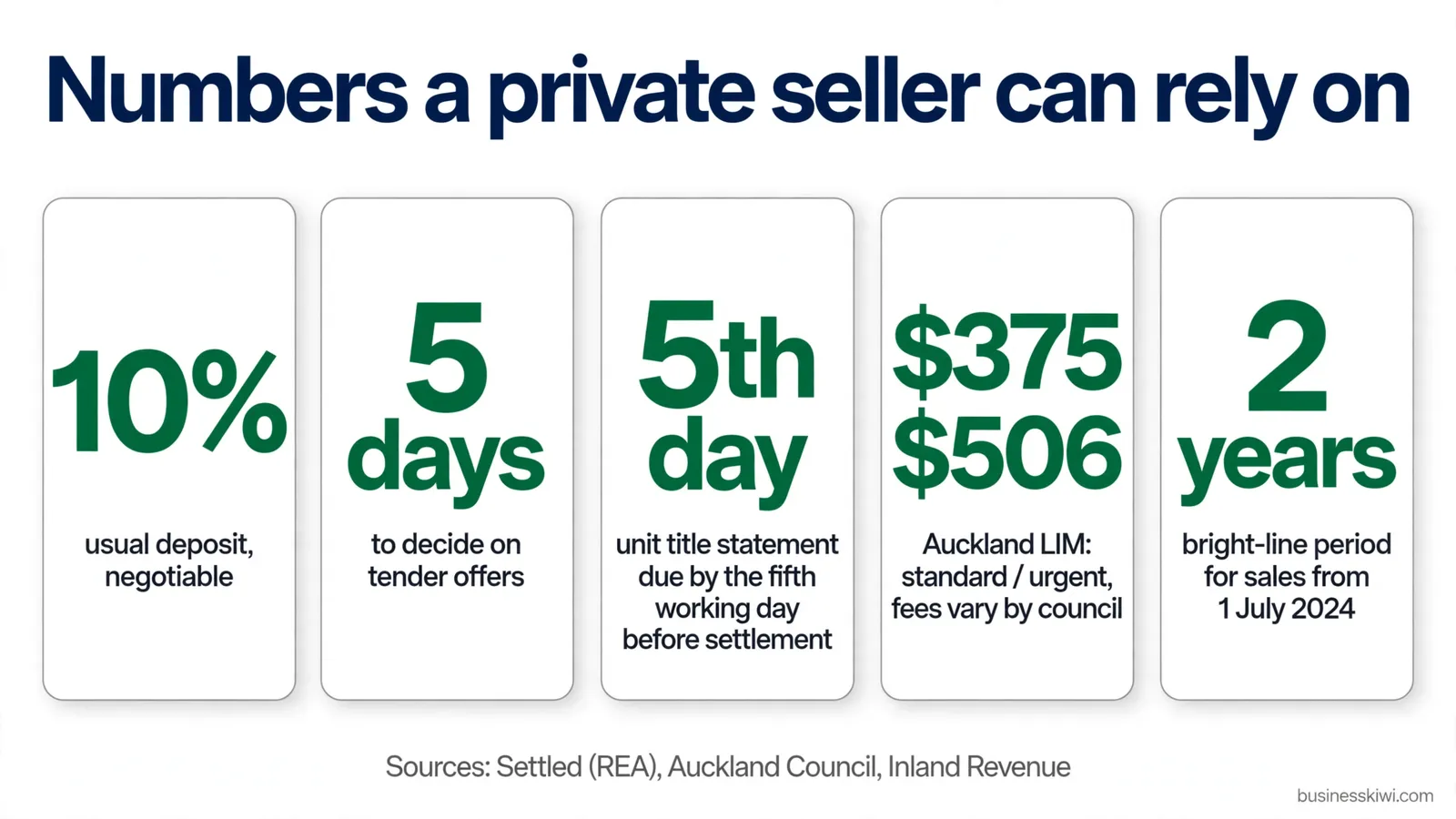
A LIM only shows what the council knows about. Work the council was never told about will not appear. Even so, serious buyers will ask for one or order their own, so a current LIM speeds things up. Fees vary by council. As an example, Auckland Council charges $375 for a standard LIM (ten working days) or $506 for an urgent one (three working days).
Disclosure is the part sellers most often get wrong. You must share information you know that may be relevant to a buyer. Settled, the Real Estate Authority’s consumer site, gives examples: weather-tightness problems, boundary issues, unconsented alterations, and the impact of proposed developments nearby.
You do not have to advertise the bad news. But buyers who are clearly interested may need to be told. If you mislead a buyer, they may be able to cancel the sale, renegotiate a lower price, or take you to court for damages. That applies even if you honestly believed what you said was correct. Unsure whether something needs disclosing? Ask your lawyer before you market the property, not after.
Unit title sales carry extra duties. You must give buyers a signed pre-contract disclosure statement before the agreement is signed, and a pre-settlement statement no later than the fifth working day before settlement. Missing or wrong statements let the buyer cancel or delay settlement.
Choosing a method of sale
Private sellers usually pick one of three methods.
An advertised price, often called sale by negotiation, is the simplest. You set an asking price or enquiry range, and buyers offer when they are ready. There is no deadline. You can accept, reject or counter any offer.
A deadline sale markets the property for a set period with an advertised end date. Buyers can offer at any time, and you can accept early if an offer is good enough. Listings may say “unless sold prior”, warning buyers the home can sell before the deadline.
A tender means buyers submit confidential written offers by a set date, on a tender document, which is a form of sale and purchase agreement. If the tender runs to its deadline, you generally have up to five working days to decide which offer, if any, to accept. You do not have to take the highest one.
Auction is the fourth method, but it normally runs through an agent and an auctioneer, so private sellers rarely use it.
Pricing the home without an agent
Pricing is the hardest job in a private sale. Price too high and the listing goes stale. Price too low and the commission you saved disappears into the discount.
Settled suggests three anchors. The first is your rating value, or RV, the value your council uses to set your rates. It is updated every few years, may lag the market, and misses recent improvements that did not need consent. Treat it as a reference point, not an answer.
The second anchor is recent sales near you. Settled notes you can research local sale prices online, although some services are not fully up to date. Compare like with like: a renovated four-bedroom home tells you little about your unrenovated three-bedroom unit.
The third option is to pay for certainty. A registered valuer will inspect the property and produce a valuation weighing up local sales, the property type, its features and its construction. The fee varies with the level of detail. Find one through the Property Institute of New Zealand.
Agents will also give you a free market appraisal, based on a visit and recent comparable sales. Settled is clear that an appraisal does not oblige you to list with that agent, so many private sellers collect one as a cross-check.

Marketing and open homes
Without an agent, your reach is smaller. Agents can advertise in print publications and on specialist websites closed to private sellers. You will rely on the public listing websites, social media, a sign outside the house, and word of mouth.
Good photos matter more than almost anything else in the listing. Clean, declutter and fix the small visible faults first. Write the listing around facts a buyer can verify: floor area, title type, consent history, school zones if you are sure of them. Advertising claims become part of what the buyer relies on, so keep them accurate.
Open homes are your job too. Set fixed times, tidy the house, and keep a record of who came through. Have the LIM, the title and your disclosure notes ready for serious viewers. Expect blunt questions and low offers in person.

Offers and the sale and purchase agreement
Every offer should land on a sale and purchase agreement, the legal contract for the sale. It sets out the price, the deposit, any conditions, the chattels included and the settlement date.
In a private sale, your lawyer or conveyancer should prepare the agreement, or at least check it before you sign. The standard form is the one published for the industry by The Law Association (formerly the Auckland District Law Society) with the Real Estate Institute. Your lawyer can supply it. Never sign a buyer’s home-made contract without legal review.
Conditions are where private sellers get caught. A conditional agreement has conditions that must be met by a set date. Common ones cover finance, a building report, a LIM and the sale of the buyer’s own home. Each needs a clear deadline and a clear test for how it is satisfied. Vague conditions create arguments later.
Read every counter-offer change before you initial it. Initialing means you agree. If the buyer wants something unusual, such as a long settlement or access before settlement, get your lawyer’s view first. Once both sides have signed and the conditions are met, the agreement binds you. There is no cooling-off period.
From signed agreement to settlement day
The buyer’s deposit is usually paid when the agreement is signed, or when it goes unconditional, depending on what the agreement says. Settled puts the usual deposit at around 10 percent of the purchase price, although the amount is negotiable. In a private sale there is no agency trust account, so your lawyer or conveyancer holds the deposit in their trust account until the agreement becomes unconditional.
While conditions are being worked through, your lawyer handles the legal side. Expect identity checks, because lawyers, conveyancers, agents and banks must verify identity under anti-money laundering law. You will also complete a land transfer tax statement, a Land Information New Zealand form that goes with most transfers. It records whether the land has a main home on it and, unless an exception applies, your IRD number and tax residency. Your lawyer sends it in with the transfer.
If you have a mortgage, your lawyer arranges for it to be repaid and discharged from the title at settlement, using the sale proceeds. If the property is tenanted and the buyer wants vacant possession, giving the tenant proper notice is your job, and the agreement should say the property is tenanted.
On settlement day, the buyer’s lawyer sends the balance of the price to your lawyer. The transfer is completed electronically through Landonline, the LINZ system, and the change of ownership is recorded on the register of titles. Your lawyer also notifies the council. You hand over every key, garage remote and alarm code. Move out before settlement day if you can: a late vacancy can leave you paying compensation.
Buyers usually walk through the home once more shortly before settlement. Our pre-settlement inspection guide explains what they check and what happens if something has changed.
Tax: the bright-line rule at guide level
Most people selling their own home pay no tax on the sale. There is one exception to check before you sign anything. Under Inland Revenue’s bright-line test, profit on a residential property is taxable if you sell within the bright-line period, unless an exclusion applies. For property sold on or after 1 July 2024, that period is two years. The clock generally starts when the title was transferred to you, and ends when you sign a binding sale and purchase agreement.
The main home exclusion keeps most owner-occupiers outside the test, provided your use of the property meets the criteria. Business premises and farmland are excluded too, as are inherited properties.
Selling outside the two years does not guarantee a tax-free sale. Other land rules still apply, and tax can bite if you bought intending to sell, or if you have a pattern of buying and selling. A taxable bright-line sale goes in your tax return on an IR833 form.
If any of this is close to your situation, talk to a tax adviser before you list. The agreement date, not settlement, ends the two years, so advice after signing can come too late.
What selling privately costs
You avoid commission, usually the largest single cost of selling. But a private sale is not a free sale. Budget for these costs instead:
- Legal fees. Your lawyer or conveyancer prepares or checks the agreement, holds the deposit, and runs settlement. Agree the fee and scope up front.
- A LIM. A few hundred dollars, based on the Auckland example above. Your council’s fees will differ.
- Marketing. Listing fees on public websites, photography if you hire a photographer, and a sign. Providers set these fees and they change over time.
- A registered valuation, if you choose one. The price varies with the detail involved.
- Your time. Viewings, open homes, negotiation and paperwork can run to dozens of hours.
Do not shortcut the lawyer to save money. Conveyancing is the one cost that protects you if something goes wrong.
Watch-outs that catch private sellers out
Selling for someone else. You may sell your own property without a licence. Selling on behalf of someone else is real estate agency work, and doing it unlicensed breaches the Real Estate Agents Act 2008. If the home belongs to a relative or a trust, get legal advice on how the sale is structured.
The old agency agreement trap. If your home was listed with an agency, or still is, read the agreement before selling privately. If the agent introduced your buyer, the agency may still claim commission, even if you did all the work yourself.
Disclosure mistakes. The expensive errors are silence and guesswork. Guessing a repair fixed a leak, or saying nothing about unconsented work, can lead to cancellation, a price cut or court. Disclose in writing and keep a copy.
Signing before legal review. Once signed and unconditional, the agreement binds you. A buyer-friendly condition or an impossible settlement date cannot be undone because you misread it. The lawyer checks the agreement before you sign, every time.
Deposit handling. Never let a deposit reach your personal account. Keep every dollar in your lawyer’s trust account until the agreement is unconditional.
More property guides: browse the Real Estate section for the rest of our property guides.
Frequently asked questions
Is it legal to sell my own house privately in New Zealand?
Yes. Owners can sell their own property without a licence and without an agent. What you cannot do is sell someone else’s property for them as a business. That is real estate agency work, and it needs a licence under the Real Estate Agents Act 2008.
Do I still need a lawyer if I sell privately?
In practice, yes. Settled advises getting legal advice whether you sell with an agent or privately. Your lawyer prepares or checks the agreement, holds the deposit in trust, and runs settlement through Landonline.
How much do I save by not using an agent?
You save the commission, which agents usually charge as a percentage of the sale price. No official source publishes a typical percentage, so be wary of exact savings claims. You still pay for legal work, a LIM and marketing, and a lower sale price can eat the saving. The real saving is commission avoided at a price you are happy with.
What problems do I have to tell buyers about?
Anything you know that could matter to a buyer. Settled’s examples include weather-tightness issues, boundary problems, unconsented work, and planned developments affecting the property. Mislead a buyer, even by accident, and they may cancel the sale, renegotiate the price or claim damages in court.
How much deposit should I ask for, and where does it go?
Around 10 percent of the price is usual, but it is negotiable, and the agreement sets when it is paid. In a private sale the money goes to your lawyer or conveyancer, who holds it in trust until the agreement becomes unconditional. Never hold the deposit yourself.
Can I sell privately while my home is listed with an agency?
Be careful. If an agency agreement is still in place, commission may be payable under its terms. The same risk applies if an agent introduced the buyer earlier and you later sell to that buyer privately. Check the agreement and take legal advice first.
Will I pay tax when I sell my home?
Usually not, if it is your main home and you have owned it a while. The bright-line test taxes profit on residential property sold within two years, for sales on or after 1 July 2024, unless an exclusion such as the main home exclusion applies. Other land sale rules can also apply, so check your position with an adviser before you sign. The agreement date ends the two years.
The bottom line
A private sale swaps money for work and risk. You keep the commission. In return you price the home, market it, face the buyers and carry the legal detail.
The sellers who do it well treat it like a project. They sort the title and LIM early, disclose problems in writing, price from evidence rather than hope, and put a lawyer in place before the first offer arrives. Do that, and selling privately is a realistic way to sell a straightforward home. If the property has title issues, consent problems or a complicated history, that is exactly when professional help earns its money.
Sources
- Settled (Real Estate Authority), “Selling privately”
- Settled (Real Estate Authority), “Deciding to sell with an agent or privately”
- Settled (Real Estate Authority), “Planning to sell”
- Settled (Real Estate Authority), “Understanding the sale and purchase agreement when selling”
- Settled (Real Estate Authority), “Receiving and making counter offers”
- Settled (Real Estate Authority), “Buying by negotiation”
- Settled (Real Estate Authority), “Buying with an agent or privately”
- Settled (Real Estate Authority), “Settling on settlement day when selling”
- Settled (Real Estate Authority), “What is a LIM report?”
- Inland Revenue, “The bright-line test”
- Land Information New Zealand (LINZ), “Land transfer tax statements”
- Auckland Council, “Consenting and property information fees and charges” (2025/26 schedule)
This article is general information about selling a house privately in New Zealand. It is not legal, tax or financial advice for your situation. Property sales are binding contracts with real money at stake, so talk to a lawyer or conveyancer before you sign anything, and to a tax adviser if the bright-line test might apply to you.