Business Insurance NZ

Business insurance in New Zealand is not one policy. It is a bundle of separate covers, each responding to a different kind of bad day: a customer injured on your premises, a fire in the stockroom, a prosecution after a workplace incident, a ransomware attack that locks up your bookings system.
That is why comparing business insurance nz quotes by premium alone goes wrong so often. Two policies with the same name can have different definitions, different exclusions, different limits and different excesses, and the differences only show up at claim time. This guide explains what each core cover does, which covers the law requires and which it does not, what drives the premium, and how to compare policies on wording rather than price. It is part of our wider Finance guides.
Quick answer
- Almost no business insurance is legally compulsory in NZ. Injury is the big exception to the overseas pattern: ACC is a compulsory, no-fault scheme funded by levies, so NZ has no general compulsory employers’ liability regime.
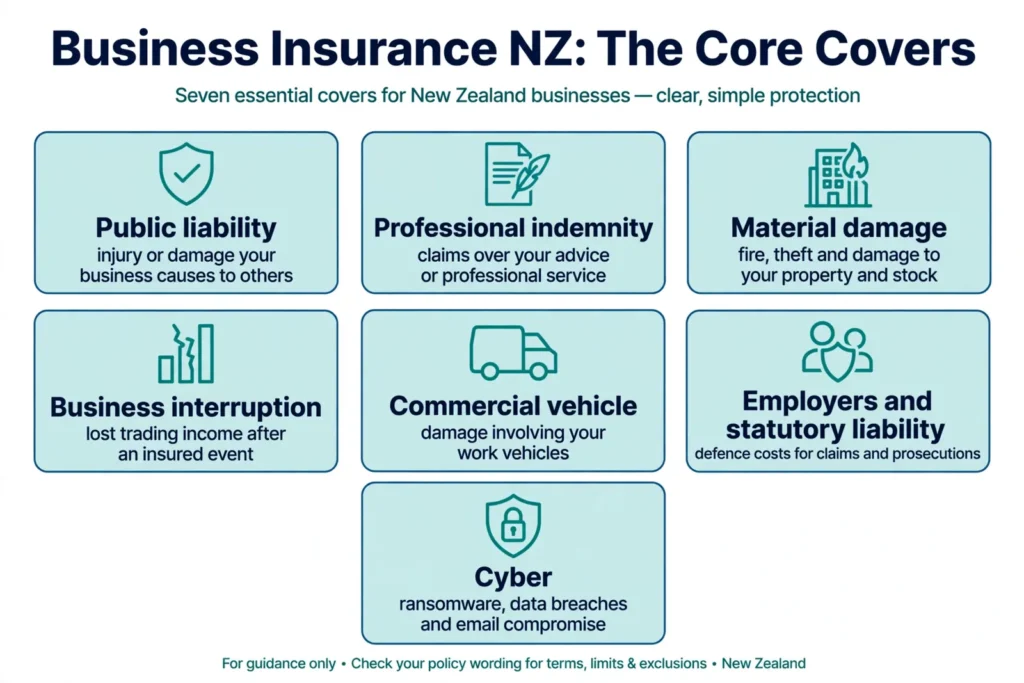
- The covers most businesses end up comparing are public liability, material damage, business interruption, commercial vehicle, statutory liability, employers liability, professional indemnity (for advice-based work) and cyber.
- Even where the law does not require it, contracts often do: landlords, head contractors, lenders and clients routinely demand evidence of cover, especially public liability.
- Compare policies on definitions, exclusions, limits and sublimits, excess, and whether cover is claims-made or occurrence-based, and set limits from your worst realistic loss rather than the premium. Price comes last.
Start with ACC, because it changes everything
New Zealand’s accident compensation scheme is the reason business insurance here looks different from Australia, the UK or the US. ACC is a compulsory no-fault scheme. As ACC itself puts it, if you are injured in New Zealand, ACC can help, no matter who you are or how the injury happened. Cover extends to visitors as well as residents.
Employers fund the work side through the ACC Work levy, paid on wages and salaries. Business.govt.nz notes the levy depends on the business description (its classification unit), payroll size and claims history, and that employers also deduct the Earners’ Levy from employees’ pay through PAYE. The levies are compulsory, not optional insurance you can shop around for.
The interplay that matters is this. Because ACC covers personal injury, people generally cannot sue a business for compensatory damages over a covered injury. That is why NZ has no general requirement for employers to hold employers’ liability insurance: the main risk it would cover is already handled by ACC.
But ACC has edges, and the edges are where liability insurance earns its keep:
- ACC covers injury only. It does not cover illness, age-related conditions, most emotional harm without physical injury, or damage to property.
- ACC does not pay your legal defence costs if you are prosecuted after an incident.
- Courts can still award exemplary damages in exceptional cases involving outrageous conduct, despite the general bar on suing.
- If a sole trader is off work with an illness rather than an injury, ACC pays nothing, which is why many self-employed people pair ACC with income protection insurance rather than assuming they are covered.
What is legally required, and what is not
Short answer: no NZ law requires a business to hold public liability, material damage, business interruption or other standard commercial covers, and vehicle insurance is not compulsory either. Injury on public roads is covered by ACC, funded through the Motor Vehicle Account levies built into registration and fuel, so motor policies here are about property damage, not injury.
What is compulsory sits around the edges:
- ACC levies, as above.
- Health and safety duties under the Health and Safety at Work Act 2015. These are duties, not insurance requirements, and one point is absolute: fines and infringement fees under the Act cannot be paid by insurance. WorkSafe’s official guide to the Act confirms insurance cannot pay HSWA fines or infringement fees (section 29), that offering such a policy is an offence, and that insurance can cover court-ordered reparation instead.
- Contractual requirements. A commercial lease, a head contractor, a franchise agreement, a lender or a council permit may require specified covers and limits. For many small businesses these contracts, not the law, are what make public liability effectively non-negotiable.
- Professional obligations. Some professional bodies require practising members to hold professional indemnity cover: a condition of the profession, not a general law for all businesses.

The core covers, one by one
Public liability
Public liability responds when your business activities cause injury to a member of the public or damage to someone else’s property, and you are legally liable. In NZ the injury side is narrower than overseas because ACC picks up most personal injury, so the practical weight of this cover sits on property damage and legal defence costs: the delivery driver who reverses into a client’s fence, the plumber whose failed joint floods the unit below.
Landlords commonly require tenants to hold it, and principal contractors commonly require it of subcontractors, often with a stated minimum limit. When you compare policies, look at the limit, any sublimits, and exclusions for work you actually do. A cheap policy that excludes your main activity is not cheap.
Professional indemnity (brief overview)
Professional indemnity covers claims that your advice, design, or professional service caused a client a financial loss: the engineer whose specification fails, the IT consultant whose migration wipes a database, the marketer whose campaign breaches someone else’s rights. It is the central cover for advice-based businesses and a minor one for most others. It is written on a claims-made basis (explained below), and continuity of cover matters. BusinessKiwi covers professional indemnity in depth in a separate guide in this series, so here it is enough to know where it fits.
Material damage
Material damage covers physical loss or damage to your insured property: buildings if you own them, fit-out, plant and machinery, tools, stock and contents.
Two things decide whether this cover works at claim time. The first is the sum insured. For buildings and fit-out it should reflect the full cost of reinstating what you have, not the purchase price and not a guess. The second is underinsurance wording. Many material damage policies contain an average clause, which scales a claim down if the property was insured for less than its full value. Insuring a $800,000 rebuild for $500,000 does not just cap your payout at $500,000; under an average clause it can reduce even a partial-loss claim proportionally. Note that the government natural hazards scheme, NHCover, covers homes only. Commercial premises sit entirely in the private market, so this policy is your whole plan for earthquake and storm damage.
Business interruption
Business interruption covers the trading loss that follows an insured material damage event. If a fire closes your premises for three months, material damage rebuilds the fit-out; business interruption replaces the gross profit you lose while you cannot trade, and can pay increased costs of working, such as renting temporary premises.
The settings that matter are the indemnity period (12 months is common; 24 months suits long rebuild or consenting timelines) and how gross profit is defined and calculated in the wording. An indemnity period that ends before your premises are realistically rebuilt is the interruption version of underinsurance.
Commercial vehicle
Commercial motor cover mirrors personal motor insurance. Third party covers damage you cause to other people’s vehicles and property, third party fire and theft adds those two perils for your own vehicle, and comprehensive covers damage to your vehicle as well. The levels work as they do for a private car, which our car insurance NZ guide covers in detail.
The business-specific questions sit elsewhere: who is allowed to drive, whether tools and signwriting are covered, and whether the policy covers vehicles used for hire or delivery work. A work ute insured on what is effectively a private-use basis is a recurring claim problem.
Employers liability and statutory liability
Employers liability responds to claims by employees for personal injury that falls outside ACC cover. This is a gap cover, not a main event, because ACC covers most workplace injuries: work-related conditions ACC excludes and mental harm outside ACC’s settings sit in this territory, along with defence of exemplary damages claims. It is voluntary: NZ’s ACC scheme is precisely why there is no compulsory employers’ liability regime here.
Statutory liability covers the cost of defending prosecutions and legal proceedings for unintentional breaches of the many Acts that govern business life (health and safety, resource management, building, fair trading), and can cover court-ordered reparation and other penalties where the law allows them to be insured. The boundary matters: HSWA fines and infringement fees can never be insured, as WorkSafe’s guidance confirms. What the cover buys you is the defence and the reparation, often the larger costs in a serious incident anyway.
Cyber
Cyber insurance responds to attacks and data incidents: ransomware that encrypts your systems, a compromised email account used to divert a customer’s payment, a breach that exposes client records. Policies typically combine first-party costs (forensic investigation, data restoration, notification, business interruption from the outage) with third-party liability if clients or regulators come after you.
Two comparison points matter. Serious privacy breaches carry notification duties under the Privacy Act 2020, so check whether the policy funds breach response and notification support, and check the security conditions. Many cyber policies require basics such as multi-factor authentication and regular backups, and a claim can run into trouble if those were not in place.
How insurers set the premium
No insurer publishes standard business premiums, which is why this guide quotes none. Business.govt.nz notes that what you pay depends on the kind of cover and the size of your business. Behind that, pricing follows the risk you present:
- Industry and activity. A roofing contractor and a bookkeeper present very different liability and injury risks, so they are priced differently.
- Turnover, wages and headcount. Liability and interruption premiums are commonly calculated from declared turnover or wage roll, adjusted at renewal if the real figures differ. Keep declared figures consistent with your books and your GST returns (see our GST registration guide).
- Sums insured and limits. Higher limits and full reinstatement values cost more. This is the premium lever owners most often pull the wrong way.
- Location. Natural hazard exposure, flood risk, and local rebuild costs feed into material damage pricing.
- Claims history. Prior claims push premiums up, in commercial insurance just as ACC levies respond to claims experience.
- Excess and risk management. A higher excess lowers the premium. So, sometimes, do demonstrable controls: alarms, sprinklers, secure tool storage, driver policies, documented health and safety systems.
How to compare policies properly
The Insurance Council of New Zealand (ICNZ) gives the right starting point in its insurance health check: compare like for like, checking the same cover types and levels are in both. It also notes that NZ insurers must be licensed by the Reserve Bank, hold reserves and disclose their credit ratings, so an insurer’s financial strength is checkable, and that a broker acts as your agent and is paid commission, which is worth understanding upfront.
Work through these points for each quote:
- What event triggers the cover? Read the insuring clause, not the brochure summary.
- What is excluded? Exclusions for your core activities, for faulty workmanship (most liability policies cover the damage faulty work causes, not the cost of redoing the work itself), for pre-existing issues and for unoccupied premises are where comparisons are won and lost.
- What are the limits and sublimits? The headline limit matters less if the activity you need sits under a small sublimit.
- What excess applies to each kind of claim? Excesses often differ between claim types on the same policy.
- Is the policy claims-made or occurrence-based? Material damage is occurrence-based: the policy in force when the event happens responds. Most liability covers, including professional indemnity, statutory liability and cyber, are claims-made: the policy in force when the claim is made responds, usually with a retroactive date limiting how far back the work can date from. Letting a claims-made policy lapse, or swapping without protecting continuity, can leave old work uninsured despite years of premiums.
- For business interruption, does the indemnity period match your realistic rebuild and reconsenting timeline, and is gross profit defined the way your accountant would calculate it?
- Does the insurer stand behind the Fair Insurance Code? ICNZ members commit to the Code for general insurance, and policies covered by it carry the Code logo.
Package policies by industry
Most small businesses buy these covers as a package: insurers bundle material damage, interruption, liability and motor for particular trades. Packages differ between insurers, so the bundle names mean less than the wording, but the shape of a sensible package varies by industry:
- Trades and construction: public liability (often required before you set foot on site), tools and plant cover, commercial vehicle, statutory liability, and contract works cover for projects in progress (sometimes arranged by the head contractor).
- Retail and hospitality: material damage with stock cover, business interruption, public liability for customers on the premises, and deterioration of stock or money cover in some packages. In hospitality, a kitchen fire or a failed chiller is an interruption claim waiting to happen.
- Professional services: professional indemnity at the centre, cyber close behind, plus material damage for office fit-out and equipment, and management liability in some packages.
- Home-based businesses: do not assume your house policy covers work gear, business visitors or liability from work you do. Home policies are written for domestic risk, so tell your insurer about the business use and take out the commercial covers you need.
Claims and complaints
When something happens, notify your insurer or broker early, even if you are unsure whether it will become a claim. Late notification is a self-inflicted wound on liability policies in particular. Document everything: photos, invoices, incident notes, names of anyone involved. Do not admit liability at the scene; pass demands and legal letters to your insurer promptly, because defence is part of what you bought.
If a claim or complaint goes wrong, complain to the insurer first; ICNZ’s Fair Insurance Code commits member insurers to handling complaints to set standards and timeframes. If you reach deadlock, the Insurance and Financial Services Ombudsman (IFSO) investigates complaints against its participating insurers free of charge. IFSO’s process gives the provider up to two months to resolve the complaint internally before IFSO takes it on, and its decisions turn on the policy contract and the law: as IFSO itself notes, it cannot add cover that is not in your policy or rewrite exclusions after the event. FSCL is the other main scheme for financial services complaints; your insurer’s complaints information names the scheme it belongs to. If you do not accept an IFSO decision, your legal options, including the Disputes Tribunal and the courts, remain open.
Common mistakes that surface at claim time
- Underinsuring the building or fit-out to save premium, then meeting the average clause on a partial-loss claim.
- Setting a 12-month interruption indemnity period on premises that would take longer than that to rebuild and reconsent.
- Treating liability limits as a formality, then signing a contract that requires a higher limit than the policy has.
- Letting a claims-made policy lapse or switching insurers without checking the retroactive date, leaving past work uncovered.
- Describing the business loosely at application. Insurers price and cover the business you described, not the one you run.
- Assuming ACC makes workplace incidents financially painless, then discovering defence costs and reparation after a prosecution are yours to fund without statutory liability.
- Buying on price without reading exclusions, which is the comparison error this whole guide exists to prevent.
FAQs
Is business insurance compulsory in New Zealand?
No general law requires it. ACC levies are compulsory, and contracts, leases, lenders and professional bodies often require specific covers, but the covers themselves are a business decision.
ACC covers injuries, so why would I need liability insurance?
Because the gaps are real: property damage is not covered by ACC at all, injury claims outside ACC settings still occur, and prosecution defence costs after an incident sit outside ACC entirely.
Can insurance pay a health and safety fine?
No. WorkSafe’s guidance on the Health and Safety at Work Act confirms that fines and infringement fees cannot be insured and that offering such cover is an offence under section 29. Insurance can pay for your defence and for court-ordered reparation.
What is the difference between public liability and professional indemnity?
Public liability is about your activities causing injury or property damage to others. Professional indemnity is about your advice or professional service causing a client financial loss. Many businesses need the first; advice-based businesses usually need both.
How much cover do I need?
There is no official standard figure; anyone quoting one without seeing your contracts is guessing. Start from your contractual minimums, then test the limit against the worst plausible claim: a serious property loss you could cause, or a full rebuild of your premises plus a year or more of lost trading.
My claim was declined. What can I do?
Complain to the insurer in writing first. If you reach deadlock, take the complaint to the insurer’s dispute resolution scheme, usually IFSO or FSCL, which is free. The scheme will test the decision against your policy wording and the law.
Sources
- Business.govt.nz, Prepare for unexpected events (insurance in continuity planning): https://www.business.govt.nz/operations/prepare-for-unexpected-events
- Business.govt.nz, ACC levies for business: https://www.business.govt.nz/tax-and-money/guide-to-business-tax/acc-levies
- Business.govt.nz, Laying the groundwork for good governance (getting insured, limits of any single policy): https://www.business.govt.nz/strategy-and-performance/governance/laying-the-groundwork-for-good-governance
- ACC, What we do (no-fault cover, and what ACC cannot cover): https://www.acc.co.nz/about-us/who-we-are/what-we-do
- ACC, What your levies pay for (Work Account and Motor Vehicle Account): https://www.acc.co.nz/about-us/our-levies-2/what-your-levies-pay
- WorkSafe New Zealand, Introduction to the Health and Safety at Work Act 2015, special guide (section 29: fines cannot be insured, reparation can): https://www.worksafe.govt.nz/dmsdocument/824-introduction-to-the-health-and-safety-at-work-act-2015-special-guide
- Consumer Protection (MBIE), Car insurance (motor cover types and how policies respond): https://www.consumerprotection.govt.nz/help-product-service/cars/paying-registering-insuring-car/car-insurance
- Insurance Council of New Zealand, Insurance health check (comparing like for like, insurer licensing, broker commissions): https://www.icnz.org.nz/individuals/insurance-health-check/
- Insurance Council of New Zealand, About the Fair Insurance Code: https://icnz.org.nz/individuals/about-the-code
- Insurance and Financial Services Ombudsman, Making a complaint (process and timeframes): https://www.ifso.nz/complaints
- Insurance and Financial Services Ombudsman, What we can and can’t do: https://www.ifso.nz/pages/what-we-can-and-cant-do
Disclaimer
This article is general information about how business insurance works in New Zealand. It is not financial advice and does not recommend any insurer, broker or policy. Cover, exclusions and pricing vary between insurers and policies, and the policy wording is what governs any claim. For advice on your situation, talk to a licensed financial adviser or insurance broker, and read the full wording before you buy.