NZ Mortgage Rate Predictions: What the Forecasts Actually Say

Every few weeks another headline lands telling mortgage holders that rates are about to rise, fall, or stay stuck. Behind most of those headlines sits a forecast, usually about one number: the official cash rate. If you have a home loan rolling off a fixed term this year, it is natural to want a straight answer about where rates are heading. The honest version is less tidy than the headlines. A small number of forecasting teams publish rate predictions in New Zealand, they currently disagree with each other by a wide margin, and every one of them has revised its view at least once this year.
This article explains what a mortgage rate prediction really is, who publishes the ones that matter, and what those forecasters are saying as at 7 October 2026. It also covers why predictions change so often, and how to use them when you are deciding whether to fix, float, or split your loan, without treating any forecast as a promise.
Quick answer
- A mortgage rate prediction is almost never a forecast of your bank’s advertised rate. It is a forecast of the OCR, plus a view on the wholesale swap rates that banks use to price fixed loans.
- The OCR is 2.75 percent, set on 2 September 2026. The Reserve Bank’s next decision is on 28 October 2026 (Reserve Bank of New Zealand).
- Published bank forecasts agree the OCR is likely to rise further from here, but they disagree about how far. As at early October 2026, ASB’s published tables peak at 3.25 percent, ANZ expects 3.5 percent, BNZ expects 3.75 percent, and Westpac’s published tables reach 4.00 percent by the end of 2027. Kiwibank has taken a more cautious line and has not published a higher peak figure in the commentary we read.
- Fixed mortgage rates move before the OCR does. They are priced off swap rates, which already reflect what markets expect to happen next.
- Every forecast in this article is date-stamped, because these numbers move. Treat any prediction as a planning tool, not a timetable.
What a mortgage rate prediction actually is
Three separate layers sit between a Reserve Bank decision and the rate on your loan statement.
The first is the OCR itself. It is the interest rate attached to the accounts commercial banks hold with the Reserve Bank, and it anchors every other interest rate in the economy. When the OCR changes, floating mortgage rates usually follow within days or weeks. The Reserve Bank’s own explainer puts it plainly: when the OCR changes, interest rates on things like mortgages, loans and savings accounts often change too.
The second layer is the wholesale swap market. When a bank offers you a two-year fixed rate, it typically hedges that loan in the swap market, so the two-year swap rate is a big input into the price of the most popular fixed terms. Swap rates are set by traders, not by the Reserve Bank, and they move on expectations. If traders become convinced the OCR will be higher next year, swap rates rise today, and fixed mortgage rates follow even though the OCR has not moved at all.
The third layer is the bank itself: its funding costs, its appetite for new lending, and how hard it wants to compete for your business that month. The Reserve Bank lists factors like these when it explains why banks set their own rates, and one of them is where the bank thinks the OCR is going next.
This layering explains a pattern that confuses many borrowers. The September 2026 Monetary Policy Statement noted that higher wholesale interest rates had already led to a comparable increase in bank mortgage and business lending rates. In other words, the home loan rates on offer today already contain a large dose of forecast. If the OCR rises exactly as much as the market expects, fixed rates may not move much when it happens, because the rise was priced in months earlier. What moves rates is the surprise: a rise that is bigger, faster, or more persistent than expected.
What the Reserve Bank publishes
The most important forecast in the country comes from the Reserve Bank itself. Four times a year it releases a Monetary Policy Statement with full economic projections, including a projected path for the OCR, published as a quarterly average track. In between, it holds Monetary Policy Reviews, which deliver a decision and a shorter statement without a fresh set of projections. There are seven scheduled decisions in 2026, rising to eight a year from 2027 as inflation data moves to a monthly release.
The remaining decisions this year are:
- 28 October 2026: Monetary Policy Review
- 9 December 2026: Monetary Policy Statement, with a new OCR track
- Then 10 February 2027 (Review) and 17 March 2027 (Statement)
The track is a central projection, built on the Bank’s current view of the economy. It is not a commitment, and the Bank says so. In the September 2026 Statement, the Committee agreed its central projection for the OCR was appropriate, judged that the OCR may need to increase further if the economy evolves as expected, and stated directly that the future OCR path is not pre-determined. It also said the September increase reduced the risk of having to raise the OCR by more later.
Two other points from that Statement are worth knowing. First, the Bank expects inflation to return to its 1 to 3 percent target band by mid-2027 and to reach the 2 percent midpoint later in 2027. Second, the Committee was not of one mind: four members saw upside risks to inflation, while two saw the risks as balanced. When you read that “the Reserve Bank thinks” something, remember it is a committee of six weighing the same data and reaching slightly different conclusions.

What the banks currently forecast
Bank economics teams publish their own OCR forecasts, and reading several side by side is the fastest way to see how much genuine uncertainty there is. Here is where the published views sat as at 7 October 2026, in each bank’s own documents.
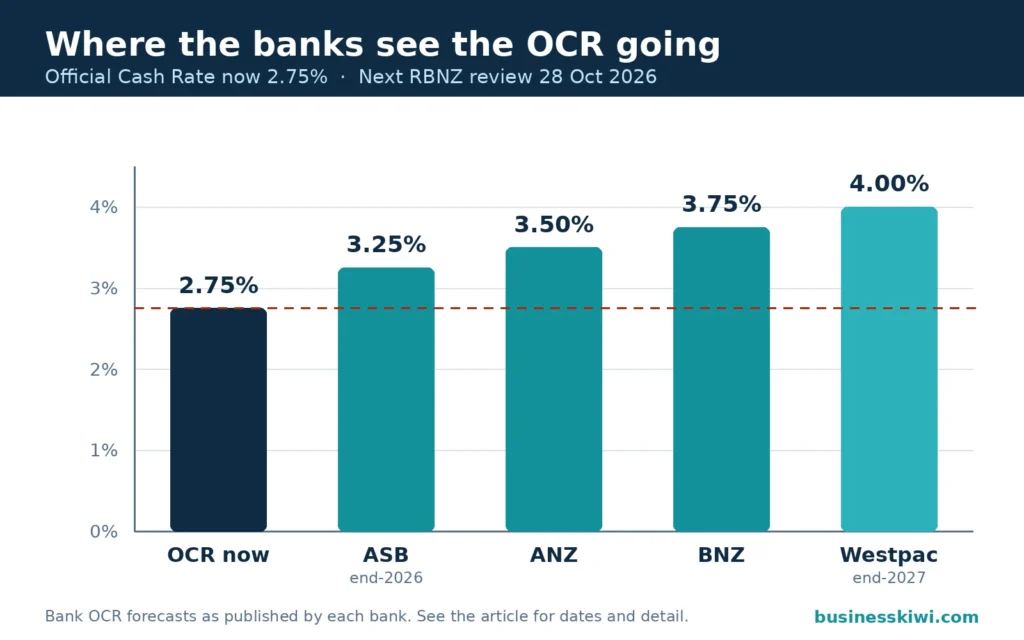
ASB: 3.25 percent by the end of 2026. ASB’s published forecast tables (Economic Weekly, July 2026) show the OCR reaching 3.25 percent by the end of 2026 and staying at that level through 2027. The same tables put the two-year swap rate at around 3.55 to 3.60 percent, which is the wholesale rate most relevant to two-year fixed pricing.
ANZ: three more rises, to 3.5 percent. ANZ’s Property Focus for September 2026 states that it expects the Reserve Bank to deliver three more increases of 0.25 percentage points, taking the OCR to 3.5 percent. The same edition expects house prices to keep drifting slightly lower in the near term, with only a modest rise in 2027.
BNZ: rises at every meeting, to 3.75 percent. In a research note dated 17 September 2026, BNZ’s head of research wrote that the Bank now had no choice but to raise the cash rate in October, and that BNZ’s track had increases of 0.25 percentage points at each meeting until the OCR reaches 3.75 percent. Two weeks earlier, on 3 September, BNZ had expected the Reserve Bank to hold in October and resume in December. The call was changed after stronger than expected economic data, which tells you something about how quickly these forecasts move.
Westpac: 3.00 percent this year, 4.00 percent by the end of 2027. Westpac’s published forecast tables (Weekly Commentary, August 2026) show the OCR at 3.00 percent by the end of 2026 and 4.00 percent by the end of 2027, the highest endpoint of any of the big banks. Its tables also have the two-year swap rate rising to 3.95 percent by December 2026.
Kiwibank: the cautious voice. Writing on the day of the September Statement, Kiwibank’s economists noted that the Reserve Bank’s updated OCR track was almost the same as in May, and read the tone as wait and see, with a lower chance of an October move. They emphasised the spare capacity in the economy and a weak jobs market, which in their view limits workers’ ability to win big pay rises and so limits second-round inflation. Kiwibank did not put a higher peak number on the OCR in that commentary.
Line those up and the spread is striking: peak forecasts from 3.25 percent to 4.00 percent, from teams looking at the same economy. The difference is not trivial for a household budget. As simple arithmetic, every 0.25 percentage points that flows through to the rate on a $500,000 loan is roughly $1,250 a year in interest. A 0.75 point gap between the lowest and highest peak forecasts is about $3,750 a year on that loan size, if it fully flowed through to your rate.
Why predictions are so often wrong
Forecasts are conditional statements. Each one quietly assumes a path for oil prices, the exchange rate, government spending, the weather, and the world economy. Change an assumption and the forecast changes with it. The year 2026 has been a live demonstration.
Nobody’s January forecast included a Middle East conflict pushing fuel prices sharply higher. By the time Stats NZ released the June quarter CPI on 21 July 2026, annual inflation had jumped to 4.1 percent, with petrol prices up 27.5 percent over the year the largest single contributor. Strip out fuel and the picture was much calmer: the Reserve Bank notes that annual inflation excluding vehicle fuels fell to 2.9 percent in the June quarter, inside the target band. Forecasters were not wrong about the domestic economy so much as blindsided by a war.
You can watch the revisions happen in the banks’ own archives. ANZ’s Property Focus in January 2026 expected the first OCR increase in December 2026. By April, ANZ expected rises starting in July. By September, it expected three more rises taking the OCR to 3.5 percent. BNZ changed its October call within a fortnight in September. These are not signs of incompetence. They are what honest forecasting looks like when the data keeps moving.
Two structural problems make accuracy even harder. First, the Reserve Bank must set policy for an economy it can only see in the rear-view mirror: it notes that a change in the OCR can take around 18 months to flow fully through the economy, so decisions are aimed at where inflation will be well over a year from now. Second, some risks are simply unforecastable at any horizon. A general election on 7 November 2026 sits in the middle of the current forecast window, and several bank teams cite the policy uncertainty around it as a reason their numbers could shift.
The right conclusion is not that forecasts are useless. It is that a forecast is a statement about risks and probabilities wearing the clothes of a single number. Read it that way.

How to use a forecast when fixing your loan
A forecast is most useful when you run it against your own budget rather than treating it as a tip.
Start with the bad case, not the base case. Take the highest published peak, currently Westpac’s 4.00 percent by the end of 2027, and ask whether your household could absorb repayments if rates moved that way. If the answer is comfortably yes, you have room to chase the cheapest option. If it is no, certainty has a value that does not show up in a rate comparison table.
Floating buys flexibility. A floating rate moves with the OCR, in both directions. It usually allows unlimited extra repayments without penalty, which suits people expecting a lump sum or an irregular income. The cost of that flexibility is that you wear every increase as it happens.
Fixing buys certainty, at a price set by the market. A fixed rate locks your payment for the term. Because fixed rates are priced off swap rates, the expected OCR rises are already in today’s fixed offers. Fixing is therefore less a bet that rates will rise, and more insurance against them rising by more than the market expects.
Splitting spreads the decision. Many borrowers divide a loan across two fixed terms, or between fixed and floating. That way no single re-fix date resets the entire loan at whatever rate happens to be on offer that week. It does not beat the market. It reduces the damage when your timing is unlucky.
Know the cost of changing your mind. If you break a fixed term early, your bank may charge a break fee, sometimes called an early repayment cost. Broadly, it reflects the gap between your fixed rate and current wholesale rates for the time left on your term. If rates have risen since you fixed, the fee is often small or nil. If rates have fallen a long way, it can be substantial. The exact figure depends on your loan and the day you ask, so get it in writing from your bank before you act on any plan that involves breaking a term.
Switching is an option at re-fix time. When a fixed term ends you can move lenders without a break fee. Some banks offer mortgage cash back deals to win switchers, usually with conditions about how long you stay. If you switch mid-term instead, weigh any cash offer against the break fee and legal costs first.
Remember the servicing test. Lenders assess new applications at interest rates above the one you will actually pay, to check you could cope with rises. A forecast path pointing up can therefore trim how much you can borrow even before the OCR itself moves.
None of this is personal advice. A forecast can inform the decision, but the right structure depends on your income, your job security, and how much payment shock you can absorb. A mortgage adviser, or your own bank, can run the numbers for your situation.
What to watch instead of the headlines
If you want to know where mortgage rates are going, these are the releases that actually move them.
The decision calendar. The next two dates are 28 October 2026 (a Review, no new forecasts) and 9 December 2026 (a Statement, with a fresh OCR track). Fixed rate offers often shift in the days around these announcements.
Inflation data. The September quarter CPI, due from Stats NZ in late October, lands shortly before the 28 October decision. Fuel drove the June quarter’s 4.1 percent annual result, while non-tradeables inflation, the domestic component, eased to 3.4 percent. Whether the September number shows the fuel effect fading or spreading will matter more than any single economist’s opinion.
The labour market. The Reserve Bank is watching wages and jobs for signs that higher fuel costs are turning into broader price rises. September quarter labour market statistics are due in early November, ahead of the December Statement. The Bank currently describes unemployment as elevated, particularly for young people.
The December track itself. When the new OCR track is published on 9 December, compare it with September’s. A track that shifts up tells you the Bank sees more work to do, and swap rates, then fixed mortgage offers, usually react within hours.
Swap rate moves between decisions. You do not need a trading screen. When news reports say wholesale or swap rates have jumped, fixed rate offers typically follow within days. That is your early warning that re-fix offers are about to change.
Forecasts will keep changing, because the economy keeps changing. The borrowers who cope best are not the ones who find the most confident prediction. They are the ones who know which numbers matter, check them on a schedule, and choose a loan structure they can live with across the whole range of published views. For more on the building blocks, see our Finance hub.
FAQs
Will mortgage rates go up in 2026?
On the published forecasts, yes, probably. Every major bank expects the OCR to rise further from its current 2.75 percent, and floating rates would follow. Fixed rates are trickier, because they already price in expected rises. They would mainly climb if the Reserve Bank raises the OCR by more, or faster, than markets currently expect.
What is the OCR now, and when does it next change?
The OCR is 2.75 percent, set on 2 September 2026. The next scheduled decision is the Monetary Policy Review on 28 October 2026, followed by a full Monetary Policy Statement on 9 December 2026 (Reserve Bank of New Zealand).
Why did fixed rates change when the OCR did not?
Because fixed rates are priced from wholesale swap rates, which move on expectations about future OCR decisions. The Reserve Bank itself points out that banks may change their mortgage rates based on where they think the OCR is heading, even if the OCR has not changed.
How high could the OCR go, according to forecasters?
The published peaks as at 7 October 2026 range from 3.25 percent (ASB) to 3.75 percent (BNZ), with Westpac’s tables reaching 4.00 percent by the end of 2027. The Reserve Bank’s own September track was described by BNZ’s economists as implying one more increase before the end of the year. None of these are guarantees, and all of them will be revised.
Should I fix for a long term now?
That depends on your budget and how much a payment rise would hurt, not on any single forecast. Longer terms cost more today but remove re-fix risk for longer. Shorter terms are cheaper now but expose you to whatever rates are doing when the term ends. Splitting the loan across terms is a common middle path. This is general information only; an adviser can model your own figures.
Where can I read the forecasts myself?
The Reserve Bank publishes its Monetary Policy Statement and OCR track free on its website, four times a year. ANZ, ASB, BNZ, Westpac and Kiwibank all publish economics commentary and forecast tables on their own websites. Reading two or three side by side gives a better sense of the range than any single headline.
Sources
- Reserve Bank of New Zealand, The official cash rate (OCR), rbnz.govt.nz, read 7 October 2026: OCR 2.75 percent from 2 September 2026, next update 28 October 2026, how the OCR influences mortgage and savings rates.
- Reserve Bank of New Zealand, Monetary Policy Statement, September 2026, rbnz.govt.nz: decision to raise the OCR to 2.75 percent, OCR track discussed qualitatively, inflation outlook, wholesale rates flowing through to mortgage rates.
- Reserve Bank of New Zealand, OCR decision dates and Financial Stability Report dates to February 2028, rbnz.govt.nz: decision calendar for 2026 and 2027.
- Stats NZ, Consumers price index: June 2026 quarter, stats.govt.nz, released 21 July 2026: annual inflation 4.1 percent, quarterly rise 1.5 percent.
- ANZ, Property Focus, September 2026 edition, anz.co.nz: forecast of three more OCR increases to 3.5 percent.
- ASB, Economic Weekly forecast tables, July 2026 editions, asb.co.nz: OCR forecast of 3.25 percent by the end of 2026.
- BNZ Research, Stephen Toplis, 17 September 2026, and Outlook for Borrowers, Stuart Ritson, 3 September 2026, bnz.co.nz: forecast of increases at each meeting to 3.75 percent.
- Westpac New Zealand, Weekly Commentary forecast tables, August 2026, westpac.co.nz: OCR forecasts of 3.00 percent by the end of 2026 and 4.00 percent by the end of 2027.
- Kiwibank, Kiwi Economics commentary on the September 2026 Monetary Policy Statement, kiwibank.co.nz: reading of the OCR track and spare capacity in the economy.
Disclaimer
This article is general information about how mortgage rate forecasts work in New Zealand, based on the sources listed above as at 7 October 2026. It is not financial advice, and it does not take your personal circumstances into account. Forecasts are opinions about an uncertain future and are revised frequently; neither BusinessKiwi nor the forecasters cited can guarantee where interest rates will go. Talk to your bank or a licensed mortgage adviser before making decisions about fixing, floating, breaking, or switching a home loan.