Renting in Auckland: Rents, Tenancy Rights and How to Find a Rental

Auckland is the largest rental market in New Zealand, and it can feel like the most complicated. Rents vary street by street, the rules have changed twice in the last two years, and a tenancy that starts well can still go wrong over a bond form or a missed notice period. This guide pulls together what Tenancy Services, the government tenancy regulator run by the Ministry of Business, Innovation and Employment (MBIE), publishes about renting in Auckland: what rents actually look like on official bond data, how to find and secure a place, the money rules, your rights during the tenancy, the new pet rules, and how to end a tenancy or resolve a dispute.
The quick answer
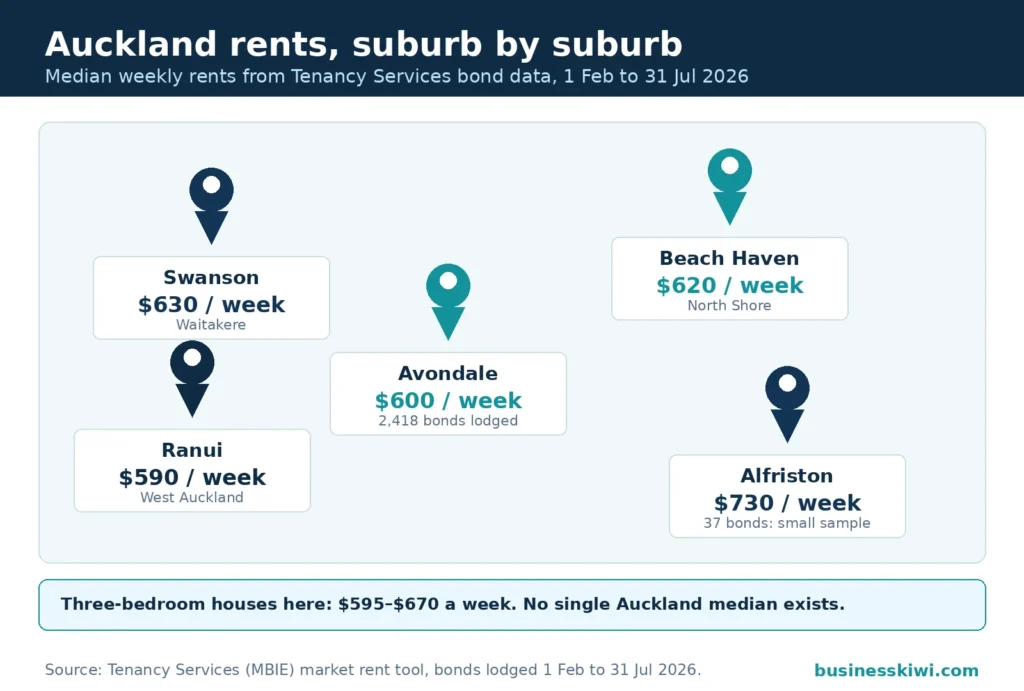
Tenancy Services works out market rents from the bonds lodged with it, and its market rent tool puts the median weekly rent in many Auckland suburbs somewhere between roughly $590 and $730 for the six months from 1 February to 31 July 2026. Avondale recorded a median of $600 a week across 2,418 active bonds, Beach Haven $620, Ranui $590, Swanson $630 and Alfriston $730, although Alfriston had only 37 active bonds, so small areas swing around more. There is no single Auckland figure that captures the city, so check your suburb and property type in the Tenancy Services market rent tool before you agree to anything.
The money rules are simpler. A landlord can ask for a bond of up to four weeks’ rent, and no more than two weeks’ rent in advance. Letting fees and key money are banned. Once you are in, your rent can only go up once every 12 months, with at least 60 days’ written notice. Since 1 December 2025 you can also ask to keep a pet, and your landlord can only refuse on reasonable grounds, although they can charge a separate pet bond of up to two weeks’ rent.
How Auckland rents are measured
Every figure in this guide comes from bonds. When a tenancy starts, the landlord must lodge the bond with Tenancy Services, and Tenancy Services uses that flow of real, current tenancies to build its market rent statistics. The tool is updated monthly and shows the previous six months of bond data, excluding the most recent month. For each area it publishes the number of active bonds and the lower quartile, median and upper quartile weekly rent, broken down by dwelling type (house, flat, apartment, room, boarding house) and by bedroom count.
Two things follow from that method. First, the median is the middle rent: half of tenancies in the area cost more, half cost less. It is a better guide than an average, because a handful of very expensive homes would pull an average up without telling you anything about a typical tenancy. Second, the data describes tenancies that have actually been signed, not the asking prices on listings. Asking rents and achieved rents are not the same thing, especially at the top of the market.
The tool also has limits. Areas with few bonds produce jumpy medians, and the six month window means the figures lag sudden shifts. Tenancy Services itself cautions that the data is a useful guide but should not be the only thing you rely on when judging whether a rent is fair.
What Auckland rents look like in practice
The pattern across the areas published for February to July 2026 is consistent. Family houses in established suburbs sit in the mid hundreds per week, smaller places cost less, and the inner west and North Shore differ less than people expect.
A three bedroom house is the workhorse of the Auckland market. In Avondale the median for a three bedroom house was $650 a week, with a lower quartile of $570 and an upper quartile of $710. Beach Haven on the North Shore was almost identical, with a three bedroom house median of $650. Ranui in West Auckland recorded $595 for a three bedroom house, Green Bay $648, and Sunnyhills in East Auckland $670. Four bedroom houses step up noticeably: Avondale’s median was $765, Beach Haven’s $750, and Alfriston’s $850.
Smaller homes cost less but not proportionally less, which is why cost per bedroom falls as houses get bigger. A one bedroom flat in Avondale had a median of $370 a week, and a two bedroom flat $470. Rooms are at the bottom of the market: a one bedroom room tenancy in Beach Haven had a median of $163 a week, and in Ranui $176. Those room figures help explain why flatting, covered later in this guide, remains the default first step for many Aucklanders.
Treat these as orientation, not quotes. Your suburb, the dwelling type and the bedroom count all move the number, and the current six month window in the market rent tool is the figure to rely on when you are actually comparing a specific property.

Finding a rental, step by step
Searching and viewings
Most Auckland rentals are advertised online or through property management companies, and many landlords work through a manager rather than dealing with tenants directly. At a viewing, check the things that are expensive or miserable to discover later: water pressure, signs of damp or mould, whether windows open, what heating is installed, and how the section and parking actually look. A landlord can only collect your name and contact details at the viewing stage, so if someone asks for detailed personal information before you have even applied, that is out of step with the Privacy Commissioner’s rental guidance.
Auckland’s size cuts both ways. Travel time matters more than distance, so test the commute from the property at the time you would actually travel if you can. Areas also differ in stock: apartment buildings cluster in and around the central city, while standalone houses dominate the outer suburbs, and the bond data above shows that in your likely rent.
Applying
Landlords usually ask applicants to complete a pre-tenancy application form. Tenancy Services publishes the standard approach, and the Privacy Act 2020 sits behind it: a landlord may only collect personal information they actually need to choose a tenant and run the tenancy. Expect to give your name and contact details, proof of identity, references, the number of people who will live at the property, and whether you have pets. With your consent, a landlord can run a credit check on a preferred applicant.
There are clear limits. A landlord must tell you why information is being collected, what it will be used for and who it will be shared with, and they cannot use it for anything else. They should not be collecting information that has no bearing on the tenancy, such as your religion or how you spend your income. Discrimination is unlawful: under tenancy law, a landlord cannot refuse you a tenancy, or treat you differently once you are in one, for reasons that breach the Human Rights Act 1993, such as your race, religion, family status or disability. If it happens, you can take the matter to the Tenancy Tribunal or the Human Rights Commission.
The tenancy agreement
Once you are chosen, you sign a tenancy agreement. Tenancy Services provides a standard agreement, and landlords can use their own as long as it includes the legally required information and nothing that contradicts the Residential Tenancies Act 1986. Agreements include statements about insulation, insurance and healthy homes compliance, covered below. Read the whole document before signing, and keep a copy. Anything in an agreement that tries to contract out of the Act cannot be enforced against you.
You will be offered either a fixed-term tenancy, which runs for a set period, or a periodic tenancy, which continues until someone gives proper notice. The differences matter most at the end of the tenancy, and they are covered in the ending section below.
Bond and moving in
The landlord can require a bond of up to four weeks’ rent. They must give you a receipt and lodge the bond with Tenancy Services within 23 working days of receiving it. You should get confirmation from Tenancy Services that the bond has been lodged; Tenancy Services suggests chasing the landlord if nothing has arrived within six weeks. If the rent later goes up, the landlord can ask you to top the bond up so it still equals the agreed number of weeks at the new rent.
Before you move your furniture in, do a proper walk-through with the landlord or property manager. Tenancy Services recommends an initial inspection together at the start, with both parties completing and signing the property inspection report that forms part of its tenancy agreement template. Photograph every room, note existing marks and damage, and make sure the report records them. That report, and the final one at the end, largely decide whether bond deductions become an argument later.

The money rules
Upfront costs are capped. Alongside the bond (maximum four weeks’ rent), a landlord can ask for no more than two weeks’ rent in advance, and paying rent in advance simply means you are always ahead by that amount: one week in advance if you pay weekly, two if you pay fortnightly. So the most you should ever hand over at the start is six weeks’ worth of rent, four as bond and two in advance, and many landlords ask for less bond than the maximum.
Some charges are simply prohibited. Letting fees have been banned since 12 December 2018: a letting agent or solicitor cannot charge you for granting a tenancy, and that ban extends to fees for renewing or extending one. If a landlord uses an agent, the landlord pays the agent. Key money is also banned. Key money is any payment other than rent and bond that a landlord demands in return for granting or changing a tenancy. The one exception is an option fee, money paid to hold a property while you decide, which is capped at one week’s rent and must be refunded or put towards rent if you go ahead.
During the tenancy, the cost split is straightforward. Tenants pay for what they use, such as power, internet and any metered water charges. The landlord covers the costs of owning the property itself, including rates and insurance.
Rent arrears have a process, and it escalates slowly enough that acting early matters. If you fall behind, the landlord can serve a 14-day notice to remedy, requiring the arrears to be paid or an arrangement made. If rent reaches 21 days in arrears, or a notice goes unremedied, the landlord can apply to the Tenancy Tribunal to end the tenancy and recover what is owed. Tenancy Services runs a FastTrack process for straightforward arrears cases where both sides have already reached an agreement that needs formalising. The practical advice from every official source is the same: talk to your landlord before a missed payment becomes a notice, because a payment plan recorded early is far easier than a Tribunal application later.
Your rights during the tenancy
Healthy homes standards
The healthy homes standards set minimum requirements in five areas: heating, insulation, ventilation, moisture ingress and drainage, and draught stopping. In plain terms, your rental must have a fixed heater that can heat the main living room to the required standard, ceiling and underfloor insulation where it can reasonably be installed, opening windows and extractor fans where the standards require them, gutters and drainage that keep moisture out of the house, and unreasonable gaps and holes draught-proofed.
The long phase-in is finished. Boarding houses had to comply from 1 July 2021, Kāinga Ora and registered community housing providers by 1 July 2024, and every private rental in the country had to comply by 1 July 2025. There is no remaining grace period: if your Auckland rental does not meet the standards now, the landlord is in breach of the Residential Tenancies Act and can face financial penalties of up to $7,200. New and renewed tenancy agreements must include a compliance statement setting out how the property measures up, so check that statement before you sign, and keep it.
Repairs, maintenance and quiet enjoyment
The landlord must provide the property in a reasonable state of repair and keep it that way throughout the tenancy, and must make sure the property meets building, health and safety requirements. Your side of the bargain is to tell the landlord about damage or needed repairs as soon as you notice them, since small leaks in an Auckland winter become big problems quickly. If the landlord does not act on a repair you have reported, that is a breach you can escalate through the disputes process below.
You are also entitled to quiet enjoyment of the property: the landlord must not interfere with your reasonable peace, comfort or privacy. That right is the legal backbone behind the entry rules. It also means the landlord cannot impose agreement clauses that effectively take it away, such as bans on visitors.
Entry and inspections
A landlord cannot simply let themselves in. For a formal inspection, the rules are precise: inspections can happen between 8am and 7pm, notice must be given at least 48 hours ahead and no more than 14 days ahead, and inspections cannot happen more than once every four weeks. You do not have to be home, but you are entitled to be there if you want to be. Different notice applies for other kinds of entry, such as repairs, and a landlord can enter immediately in a genuine emergency, but the inspection limits above are fixed and a pattern of excessive visits can breach your quiet enjoyment as well.
Rent increases
Your landlord can raise the rent, but only within a tight frame. An increase cannot take effect within 12 months of the start of the tenancy, or within 12 months of the last increase. The landlord must give at least 60 days’ written notice stating the new amount and the date it starts. During a fixed term, rent can only be increased if the agreement allows for it. The law does not cap the size of an increase, but a tenant who believes the new rent substantially exceeds what similar properties in the area are rented for can apply to the Tenancy Tribunal to have it reviewed, and the bond data in the market rent tool is exactly the evidence that matters in that argument.
Keeping a pet: the rules from 1 December 2025
The pet provisions of the Residential Tenancies Amendment Act 2024 came into force on 1 December 2025, and they change the starting position. You still need your landlord’s consent to keep a pet, unless the tenancy agreement already allows it, but the landlord can now only withhold consent on reasonable grounds. They can attach reasonable conditions to a consent, and one of those conditions can be a pet bond.
The pet bond is capped at two weeks’ rent, and only one pet bond can be charged per tenancy, however many pets you have. It sits on top of the general bond, it must be identified as a pet bond in the paperwork, and it is lodged with Tenancy Services like any other bond. It cannot be charged for a disability assist dog, and no pet bond is payable if there is no pet at the property. In return for the easier consent path, tenants carry full responsibility for pet damage: all tenants named on the agreement are liable for pet-related damage beyond fair wear and tear, and the pet bond can be applied to that damage at the end of the tenancy, or to other costs such as arrears if you agree or the Tribunal orders it.
Timing matters. If your pet was already living with you, with the landlord’s agreement, before 1 December 2025, you do not need to ask for consent again and the landlord cannot start charging a pet bond for that animal or add new conditions. The new consent and bond machinery applies to pets that arrive on or after that date.
Ending a tenancy
Notice periods changed on 30 January 2025, when the termination provisions of the Residential Tenancies Amendment Act 2024 took effect. For a periodic tenancy, the current settings are these.
As a tenant, you can end a periodic tenancy with 21 days’ notice, down from 28 days under the previous settings. As a landlord, you have two routes. You can end a periodic tenancy with 90 days’ notice and no reason at all, the so-called no-cause termination that the 2024 Act restored. Or you can give 42 days’ notice on specified grounds: the owner or a family member needs the property as their principal place of residence, the property has been sold unconditionally with vacant possession required, or the property is needed for the landlord’s employees or contractors, where the agreement supports that use.
Fixed-term tenancies now roll over. When a fixed term ends, the tenancy automatically becomes periodic unless a tenant or landlord gives notice to end it between 90 and 21 days before the end date, with no reason needed, or both parties agree something else, such as a fresh fixed term. If your fixed term expires on or after 1 May 2025, these rules apply to you even if the tenancy started earlier.
Two protections are worth knowing. A landlord cannot end a tenancy early within a fixed term just because they want to; outside the conversion window, ending a fixed term early generally needs agreement or a Tribunal order. And a termination notice given because you exercised your rights, for example by asking for repairs or involving Tenancy Services, can be challenged as retaliatory. You have up to 12 months from the notice to apply to the Tribunal, and if you apply within 28 working days you can also ask for the notice to be cancelled.
When a tenancy ends, the bond comes back through Tenancy Services. Both sides sign a refund form, or one side can apply if they cannot agree, and the Tribunal decides disputed claims. Leaving the property reasonably clean and tidy, with rent paid to the end date, keeps that process boring, which is what you want.
If things go wrong: mediation and the Tenancy Tribunal
Most disputes are sorted out by talking, then by Tenancy Services mediation, and only then by the Tenancy Tribunal. Mediation is free once you have applied and is run by Tenancy Services mediators; agreements reached there can be sealed as a mediator’s order, which makes them enforceable. FastTrack Resolution is a quicker channel for money matters where the parties have already agreed, common with rent arrears.
If mediation does not settle it, the Tribunal hears the case. Applying costs $29, paid by the applicant, although the Tribunal can order the other side to reimburse the fee if you succeed, and Work and Income may be able to help with the fee if you are on a benefit. You apply online through Tenancy Services, and the Tribunal can deal with bond disputes, arrears, damage, unlawful charges, retaliatory notices, healthy homes breaches and most other arguments under the Act. Flatmate disputes, discussed below, do not belong here; they go to the Disputes Tribunal instead.
Renting as a new arrival
If you have just moved to New Zealand, the process is the same, with a couple of practical wrinkles. Landlords will ask for proof of identity as part of an application, and references from overseas are usually accepted where local ones do not exist yet. For a fixed-term tenancy, a landlord may also check that you have the legal right to remain in New Zealand for the term, which is one of the few immigration-related questions the Privacy Commissioner’s guidance contemplates. A tenancy agreement is between you and the landlord; your visa status does not change your rights under the Residential Tenancies Act once the tenancy exists, and Tenancy Services information is available in multiple languages if English is not your first language.
Budget for the upfront costs in New Zealand dollars and in the order they fall due: rent in advance (up to two weeks) and bond (up to four weeks) are normally paid before or at the start of the tenancy. Work and Income offers bond grants and rent support for eligible people, limited to tenancies covered by the Act.
Tenants, flatmates and boarding houses
Auckland runs on flatting, so be clear about which legal box you are in. A tenant is someone who has signed a tenancy agreement with the landlord. Tenants are covered by the Residential Tenancies Act, and they are jointly responsible for the whole rent and any damage, not just their own share. If one tenant in a group stops paying, the landlord can pursue the others for the shortfall.
A flatmate is someone who lives at the property without signing the agreement with the landlord, for example where an existing tenant finds someone to fill a spare room, or a homeowner rents a room in the house they live in. Flatmates are not covered by the Act. Their arrangements with the tenant or homeowner are a private contract, and disputes go to the Disputes Tribunal rather than the Tenancy Tribunal. Tenancy Services publishes a flat or house sharing agreement template, and getting the arrangement in writing, including how bond money and bills are handled, prevents most of the classic fallings-out.
Boarding houses are different again. In a boarding house you rent a room, usually with shared facilities, and boarding house tenancies are covered by the Act but under their own set of rules: the landlord can set house rules (with at least seven days’ written notice of changes), inspections need at least 24 hours’ notice rather than 48 and run between 8am and 6pm, rent increases need 28 days’ notice, and a bond above one week’s rent must be lodged with Tenancy Services within 23 working days. Boarding houses had to meet the healthy homes standards from 1 July 2021, earlier than other rentals.
Renting while you save
For many Auckland tenants the rental is a staging post rather than a destination, and the years spent renting are when a first home deposit gets built. The discipline that helps is knowing the actual buy-in numbers for your situation rather than a headline percentage: how much deposit you need, what low-deposit routes exist, and how lenders treat your income are covered in our guide to home loan deposits. One habit transfers directly from renting to buying: paperwork. The inspection reports, rent records and bond confirmations you keep as a tenant are the same kind of evidence trail you will rely on when you are checking a property of your own, right through to the pre settlement inspection just before a purchase completes.
Frequently asked questions
What is the median rent in Auckland?
It depends on the suburb and the property type, and Tenancy Services deliberately publishes it that way. For the six months from February to July 2026, area medians included $600 a week in Avondale, $620 in Beach Haven, $590 in Ranui, $630 in Swanson and $730 in Alfriston, all from bonds actually lodged. For the place you are looking at, search the suburb and bedroom count in the Tenancy Services market rent tool, which is updated monthly.
How much bond can a landlord charge in Auckland?
Up to four weeks’ rent, and it must be lodged with Tenancy Services within 23 working days, with a receipt given to you. If you later get consent for a pet (for a pet that arrives on or after 1 December 2025), the landlord can also charge a separate pet bond of up to two weeks’ rent, only one per tenancy.
Can my landlord put the rent up whenever they like?
No. Rent can only increase once every 12 months, counting from both the start of the tenancy and the last increase, and you must get at least 60 days’ written notice of the new amount and start date. In a fixed term, an increase is only possible if the agreement provides for one.
Can my landlord end my tenancy without a reason?
For a periodic tenancy, yes, since 30 January 2025 a landlord can give 90 days’ notice without stating a reason. Shorter 42-day notices require a specified ground, such as the owner or their family moving in. A notice given in retaliation for you exercising your rights can still be challenged at the Tenancy Tribunal. Fixed-term tenancies cannot be ended early this way.
Can I keep a dog or cat in an Auckland rental?
Since 1 December 2025, you can ask, and your landlord can only refuse on reasonable grounds. They may set reasonable conditions, including a pet bond of up to two weeks’ rent. You are liable for any damage your pet causes beyond fair wear and tear. Pets that were already approved before 1 December 2025 do not need new consent and cannot attract a pet bond.
What can I do if my landlord will not fix anything?
Tell the landlord in writing and keep a copy. If repairs are not done, or there is another breach such as a healthy homes failure or too-frequent inspections, you can apply to the Tenancy Tribunal: the application fee is $29, mediation is usually offered first, and the Tribunal can order the work done and award compensation or exemplary damages for unlawful acts.
Sources
All figures and rules in this guide are from Tenancy Services (MBIE), tenancy.govt.nz, checked on 7 October 2026: the market rent tool and its bond data for February to July 2026; the healthy homes compliance pages; the bond and pet bond pages, including the pet rules from 1 December 2025; the law changes and termination pages reflecting the Residential Tenancies Amendment Act 2024; the rent increase guidance; the inspections page; the letting fees and key money page; the pre-tenancy applications and flatting pages; and the Tenancy Tribunal application pages. The Privacy Commissioner’s rental guidance (privacy.org.nz) informed the section on application information.
Disclaimer
This guide is general information about renting in Auckland, based on official sources checked on 7 October 2026. It is not legal advice, and tenancy law and rent data change. For your own situation, check tenancy.govt.nz, which carries the current rules, forms and the market rent tool, or get advice from a tenancy adviser or lawyer.
For more property guides, see our Real Estate hub.