The Bright-Line Test in NZ: Work Out Whether Your Property Sale Is Taxed


The quick answer
The bright-line test is Inland Revenue’s mechanical tax on quick property turnarounds. If you sell residential land and your bright-line end date falls within the bright-line period of your start date, the profit is taxed as income, whatever your reason for selling. It makes no difference whether you meant to flip the place or had a change of plans.
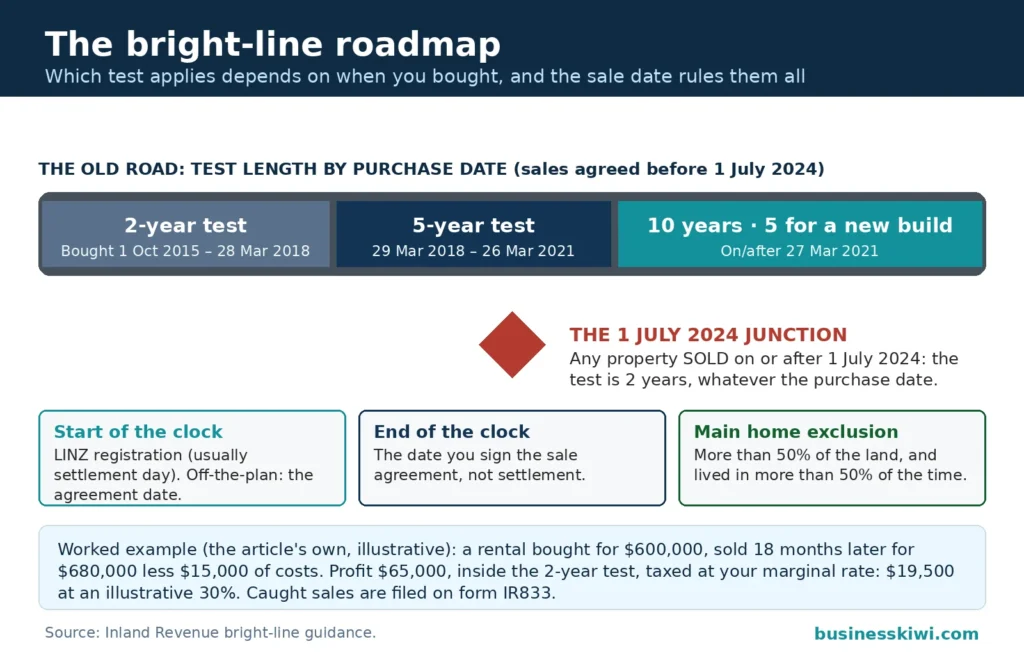
For any property sold on or after 1 July 2024, the period is 2 years. One point catches people out: the 2 years runs from dates Inland Revenue defines, which are not always the dates you would pick. For a standard purchase the clock starts when the title is registered to you, not when you signed the agreement, and it stops the day you sign a binding agreement to sell, not on settlement day.
No calculator can decide this for you, because the answer turns on your dates and your use of the property. But the test is a sequence of five checks, and you can work through them with a calendar and your agreements.
Step 0: Is it residential land at all?
Bright-line only applies to residential land. Inland Revenue treats land as residential if it has a dwelling on it, if you have an arrangement to build a dwelling on it, or if a dwelling could be built on it under the district plan rules. Bare sections in residential zones are caught. Land does not need to have been rented out, or even used, to qualify.
Two kinds of land sit outside the test entirely: land used predominantly as business premises, and farmland, including land capable of being used as farmland. If your property is genuinely one of those, bright-line is not your problem, although other tax rules may still be. The test also follows NZ tax residents overseas: selling a residential property in another country does not escape it.
Step 1: Find your bright-line start date
Your start date depends on how you acquired the property. For the common cases, Inland Revenue uses these dates:
- Standard purchase: the date the transfer of the property is registered to you with Land Information New Zealand (LINZ). That is usually settlement day, not the day you signed the purchase agreement.
- Off-the-plan purchase: if you bought relying on a land development or subdivision being completed, your start date is the date you entered into the sale and purchase agreement. This is the great exception, and it matters for new builds, as the third worked example below shows.
- Land you subdivided yourself: the original registration date of the undivided property, so subdividing does not restart your clock.
- Change of trustee: the new trustee takes the original trustee’s start date.
- No registration before you sell: the date you acquired an interest in the property.
- Property overseas: the date the transfer is registered to you under the foreign law.
Write your start date down. Everything else is measured from it.
Step 2: Find your bright-line end date
The end date is the finish line, and for a standard sale it is earlier than most people expect: the date you enter into a binding sale and purchase agreement. Settlement day is irrelevant for this step. A sale agreed on 28 June and settled on 30 July ends on 28 June.
Other disposals have their own dates. If you gift the property, the end date is the date the gift was made. A mortgagee sale uses the date the property is disposed of by or for the mortgagee, usually settlement. A compulsory acquisition by the Crown, a local authority or a public authority uses the date of acquisition. Anything else uses the date you disposed of the property, and if more than one type applies, Inland Revenue says to use the earliest date.
Step 3: Work out which period applies
If you are selling now, this step is short. For property sold on or after 1 July 2024, the bright-line period is 2 years, full stop. It does not matter when you bought. Inland Revenue simply asks whether your end date is within 2 years of your start date. If it is, move on to the exclusions in Step 4. If it is not, bright-line does not tax your sale.
The longer periods you still hear about, 10 years and 5 years, belong to sales that were agreed before 1 July 2024. They matter if you are reviewing an old sale or amending a past return. For those sales, the date you acquired the property, meaning the date you entered into a binding agreement to buy it, decided the period:
Note that for an older sale, the agreement date selects the period, while the period itself is still measured between the start and end dates in Steps 1 and 2. And the new build distinction in the last row no longer needs to be separated out for sales from 1 July 2024. A new build sold today gets exactly the same 2-year test as any other property.
Step 4: Check the exclusions
A sale inside the period escapes tax if an exclusion applies. Work through them in this order.
Your main home
The main home exclusion is the one most sellers rely on. Your main home is the property you live in for most of the time, and you can only have one. If you have more than one property, it is the one you have the greatest connection to, judged on things like how much time you live in each home, where your immediate family lives, where your belongings are kept, and where your social and work ties are strongest.
To claim the exclusion under the current test, you must pass both of these tests:
- The area test: you used more than 50 percent of the property’s area as your main home. The area includes the yard, gardens and garage, so it is the whole section, not just the floor area of the house.
- The time test: you lived in the property as your main home for more than 50 percent of the bright-line period.
If either figure is exactly 50 percent or less, the exclusion does not apply at all, and there is no partial credit for the part that was your home. Inland Revenue’s own example makes the point: use 40 percent of a property as your home and rent out the other 60 percent as a flat, and the exclusion is simply unavailable when you sell.
Intention does not count. You must actually have lived there, and it must have been you, the owner, living there: the exclusion will not apply where only a family member used the property as their main home. Gaps are allowed, though: renting the place out for a few weeks while you are on holiday, or in the lead-up to settlement, does not break the exclusion, as long as your total time using it as your main home exceeds the time it was used for anything else.
If you built the home, the construction period is ignored when the time test is applied. Inland Revenue looks at your use before construction began and from completion through to the sale. Construction includes the design phase, and is usually treated as complete when the code compliance certificate is issued.
There are also limits on repeat use. You cannot claim the exclusion if you have already used it twice in the previous 2 years, and it is unavailable where you, or a group of people acting together, have a regular pattern of buying and selling main homes. The exclusion can apply to a home held in a trust, but only in defined circumstances, broadly where the property was the main home of a beneficiary and of the trust’s principal settlor (or the principal settlor has no other main home).
Note that sales agreed before 1 July 2024 used different main home criteria again, varying with when the property was acquired, so check the criteria applied at the time if you are reviewing an old sale.
Business premises and farmland
Land used predominantly as business premises is excluded, as is farmland. A home office or a business run from a spare room will not turn a house into business premises; the business use has to be predominant.
Inherited property and deceased estates
The bright-line test does not apply if you inherited the property, or if you are the executor or administrator of a deceased estate selling estate property. The transfers down the chain are protected too: from the deceased person to the executor, and from the executor to the beneficiary, are not taxed under bright-line, and a later sale by the beneficiary is also outside the test. Keep the paperwork that shows where the property came from, because the exemption belongs to that inherited property.
Rollover relief: relationship property, associates and restructures
Some transfers are not sales in substance, and for those the law rolls the tax position over instead of taxing the transfer. Where rollover relief applies, the person transferring the property is not taxed at the time, and the new owner is treated as having bought it at the same time and for the same price as the previous owner. The clock keeps running from the original start date, and the gain is measured from the original cost when the property is eventually sold outside the arrangement.
Rollover relief is available for property transferred under a relationship property agreement, for inherited property and deceased estates as described above, and for transfers under a resident’s restricted amalgamation of companies. Since 1 July 2024 it also covers transfers between associated persons, provided they have been associated for at least 2 years before the transfer. Inland Revenue’s associated persons list includes companies with 50 percent or more common ownership, a company and a person holding 25 percent or more of its voting interests, two relatives within two degrees of blood relationship, and a range of trust relationships. Relief under these rules can only be claimed once in any 2-year period for a property, counted from the first transfer.
One warning from Inland Revenue, because it surprises families: rollover relief does not extend to parents helping their children buy a first home. If parents co-own a property and later sell their share to their children, the bright-line test applies to that sale.
Step 5: If bright-line catches you, what is taxed?
If your end date is within the period and no exclusion or relief applies, the profit is income. The calculation starts with your sale price, takes off what the property cost you, and takes off the allowable costs of buying, improving and selling it, such as legal fees, the agent’s commission, and capital improvements. What is left is the net profit, taxed at your marginal income tax rate on top of your other income for the year. Our tax rates guide sets out the current brackets if you want to see which rate the profit would land in.
Inland Revenue gives the sale its own paperwork. You complete a Bright-line property sale information form, IR833, for the property, and your share of the net profit goes into your income tax return in the Net bright-line profit box, inside the Income and expenses from residential property question. An IR833 is required even if the sale also appears in financial statements or an IR10. If Inland Revenue thinks you have had a bright-line sale, it may flag the property in myIR with the title, address, start date and end date pre-filled. Check those dates rather than assuming they are right, because the responsibility for the return sits with you. A profit of any size will also usually put you into provisional tax territory, worth planning for.
Losses are treated asymmetrically, and deliberately so. If you sell at a loss inside the period, you cannot claim that loss against your salary, wages, rental income or any other income. A bright-line loss is ring-fenced: it can only be offset against net income from other taxable property sales, in the same year or a future year, and is carried forward until you have such a profit to absorb it. Do not put a bright-line loss in your tax return. Inland Revenue instructs sellers to keep their own record of bright-line losses, so keep the IR833 workings and sale documents with your tax records.
One related point, briefly. Interest deductibility is a separate set of rules from bright-line, but the two are often confused. Under the current settings, interest on money borrowed for a residential rental property can be claimed in full from 1 April 2025 onwards. That affects your annual rental returns, not the bright-line calculation itself. For completeness: property affected by a North Island adverse weather event and sold to a Crown or local authority is not taxable under the test.

Three worked examples
The dates and figures in these examples are invented to show the workings. Your own dates will differ, and dates are the whole game here.
Example A: A rental sold after 18 months
You sign an agreement to buy a rental property in March 2025. It is a standard purchase, so your start date is the day the title is registered to you, 10 April 2025. You sign a binding agreement to sell on 10 October 2026, exactly 18 months later.
Work the steps. It is residential land. The sale is after 1 July 2024, so the period is 2 years, and your end date falls within it. The property was tenanted throughout and never your home, so no exclusion applies. Bright-line taxes the profit.
You sold for $680,000. You paid $600,000, and your allowable costs of buying and selling came to $15,000. The profit is $680,000 minus $600,000 minus $15,000, which is $65,000, added to your other income and taxed at your marginal rate. Purely as an illustration, if the whole profit were taxed at a marginal rate of 30 percent, the tax on it would be $19,500. In practice the profit may straddle two brackets, which is why the real figure belongs in your return, not in a rule of thumb.
Example B: A main home bought in 2023 and sold in 2026
You sign an agreement to buy a house on 15 June 2023 and the title is registered to you on 10 July 2023. You live in it as your only home the whole time. You sign an agreement to sell on 20 May 2026.
Because the sale is on or after 1 July 2024, the current 2-year test applies. Your end date is more than 2 years after your start date, so bright-line does not apply to this sale at all. The main home exclusion is never even needed.
It is worth seeing how different the answer could have been. Had you signed the sale agreement before 1 July 2024, the old rules would have applied, and a property acquired in June 2023 carried a 10-year period. A sale agreed in, say, June 2024 would have been well inside that period, and only the main home exclusion would have stood between you and tax on the profit. The exclusion would very likely have applied here, since the property was your home throughout, but the exclusion, not the calendar, would have been doing the work.
Example C: A new build bought off the plan in 2022
You sign an agreement on 20 August 2022 to buy a townhouse off the plan. Because the purchase depends on the subdivision and build being completed, your start date is the agreement date, 20 August 2022, not the later settlement date. The code compliance certificate is issued in 2023, you settle, and tenants move in. You sign an agreement to sell on 15 September 2026.
Under the rules as they stood before 1 July 2024, this was the situation the 5-year new build period was designed for: a qualifying new build acquired on or after 27 March 2021 carried a 5-year period, so a sale agreement signed before 1 July 2024, within 5 years of acquisition, could have been taxed. But your sale is in 2026. Sales on or after 1 July 2024 are tested under the 2-year rule, and new builds are not separated out any more. Your end date is more than 4 years after your start date, so bright-line does not tax this sale. The trap is assuming the old 5-year period still governs a property bought in 2022. It does not, because the date that chooses the period is the sale date, not the purchase date.
Common traps
Counting from the wrong dates. The most expensive mistake is measuring 2 years between settlement dates. For a standard purchase the clock starts at registration of the transfer, and it stops the day you sign the sale agreement. An off-the-plan purchase reverses the first of those: the clock starts at the agreement. Get the two dates right before anything else.
Assuming the main home exclusion is a blanket pass. It has two more-than-50-percent tests, and both are all or nothing. A large section where much of the land sits with a rented minor dwelling, or a home rented out for more than half the period before you move in, can fail outright. Flatmates and boarders inside your own home differ from a separately rented unit, but the area test counts the whole property, and borderline cases deserve advice before you sign.
Trusting the old periods. Older articles still describe 5-year and 10-year tests as if they were current. They apply only to sale agreements entered into before 1 July 2024. If you are selling now, the period is 2 years.
Transferring property inside the family and assuming nothing happened. A change in co-ownership shares is a disposal of the share that changed hands, and the clock resets only for that share. Rollover relief helps in defined cases, but it does not cover parents selling a share to their children.
Thinking that outside bright-line means tax-free. Bright-line is one rule among several. Inland Revenue is explicit that other property rules still apply after the period ends, including tax where you bought intending to sell, where you have a pattern of buying and selling or building and selling homes, or where you are associated with a property dealing, developing or building business. Passing this test only clears you of this test.
Frequently asked questions
How long is the bright-line period now?
For property sold on or after 1 July 2024, it is 2 years, measured from your start date to your end date. The 5-year and 10-year periods only apply to sales agreed before 1 July 2024.
Does bright-line apply to my main home?
Generally no, if you pass both main home tests: more than 50 percent of the property’s area used as your main home, and living there as your main home for more than 50 percent of the period. If either test fails, the exclusion is lost entirely. It is also unavailable if you have already used it twice in the previous 2 years.
I bought off the plan. When does my clock start?
On the date you entered into the sale and purchase agreement. Off-the-plan purchases are the exception to the usual rule that the period starts when the title is registered to you at settlement.
What happens if I sell at a loss inside the bright-line period?
The loss is ring-fenced. You cannot offset it against wages, salary, rental income or other income, only against net income from other taxable property sales, and any unused amount is carried forward. Do not include the loss in your tax return; keep your own record of it, as Inland Revenue directs.
Do I have to tell Inland Revenue about the sale?
If bright-line applies, yes. Complete an IR833 for the property and include your share of the net profit in your income tax return. Inland Revenue may pre-populate the sale in myIR, but checking it is your responsibility.
Sources
- Inland Revenue, The bright-line test, ird.govt.nz
- Inland Revenue, Start and end dates, ird.govt.nz
- Inland Revenue, Exclusions to the bright-line test, ird.govt.nz
- Inland Revenue, Property sold before 1 July 2024, ird.govt.nz
- Inland Revenue, Ownership transfers and rollover relief, ird.govt.nz
- Inland Revenue, Transfers of deceased estate and inherited property, ird.govt.nz
- Inland Revenue, Completing your income tax return and IR833, ird.govt.nz
- Inland Revenue, Understand the property rules, ird.govt.nz
Disclaimer
This article is general information about the bright-line test, based on Inland Revenue’s published guidance as at October 2026. It is not tax advice. Property tax is highly fact-specific: your dates, your use of the property, your ownership structure and the other land sale rules can all change the answer, and passing the bright-line test does not by itself make a sale tax-free. Before signing a sale agreement, check your position with Inland Revenue’s property tax decision tool and take advice from a qualified accountant or tax adviser.
More guides for property owners and investors are in our Real Estate hub.