Buying Bullion in Christchurch: Gold and Silver Dealers, Pricing and Checks

Quick answer
Christchurch buyers have three practical routes: visit a specialist bullion dealer with premises in the city, buy from a vault provider that sells metal and stores it on the same site, or order from a dealer elsewhere in New Zealand for insured courier delivery to Christchurch. Smaller purchases also happen through coin shops, jewellers and second-hand dealers. Whichever route you choose, the checks are the same: confirm the business on the Companies Register, understand what the Financial Service Providers Register does and does not tell you, expect to show photo identification, agree how the price will be fixed before you pay, and decide on storage first.
This article covers the local layer only. For how bullion pricing works across New Zealand, the GST treatment of fine metal and the tax position when you sell, read the national guide first.
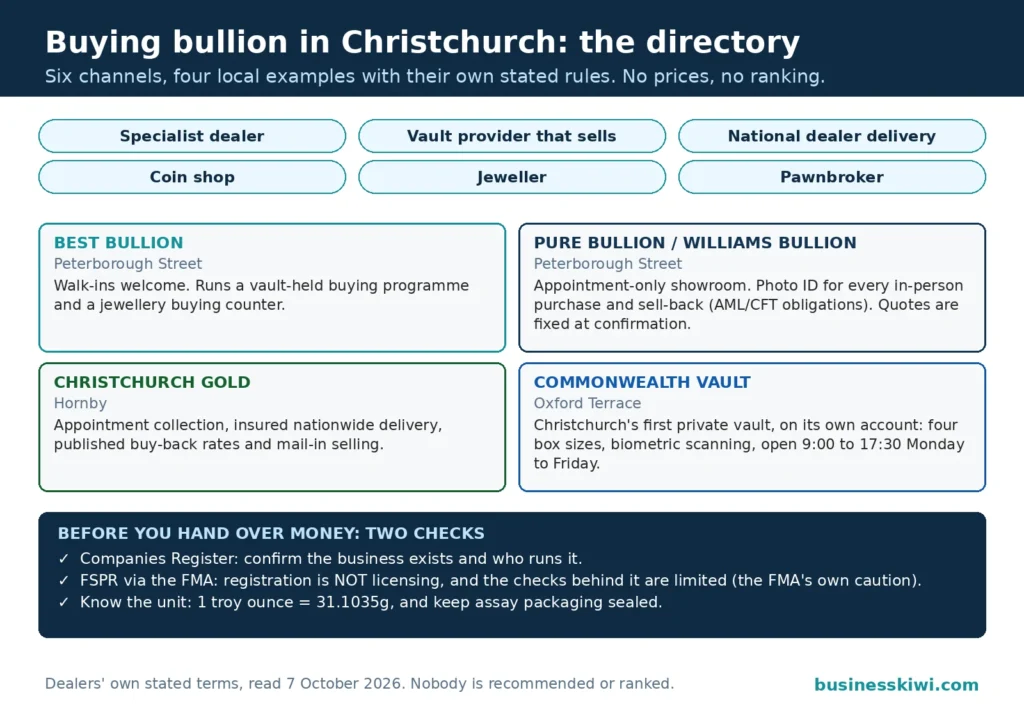
The Christchurch buying channels at a glance
Not every seller does the same job. A specialist dealer holds investment bars and coins as its main business. A jeweller is set up first for jewellery, with bullion as a side line. A pawnbroker trades in pre-owned goods of many kinds, so any bullion on the shelf has usually come in over the counter rather than from a mint.
Specialist dealers with a Christchurch presence
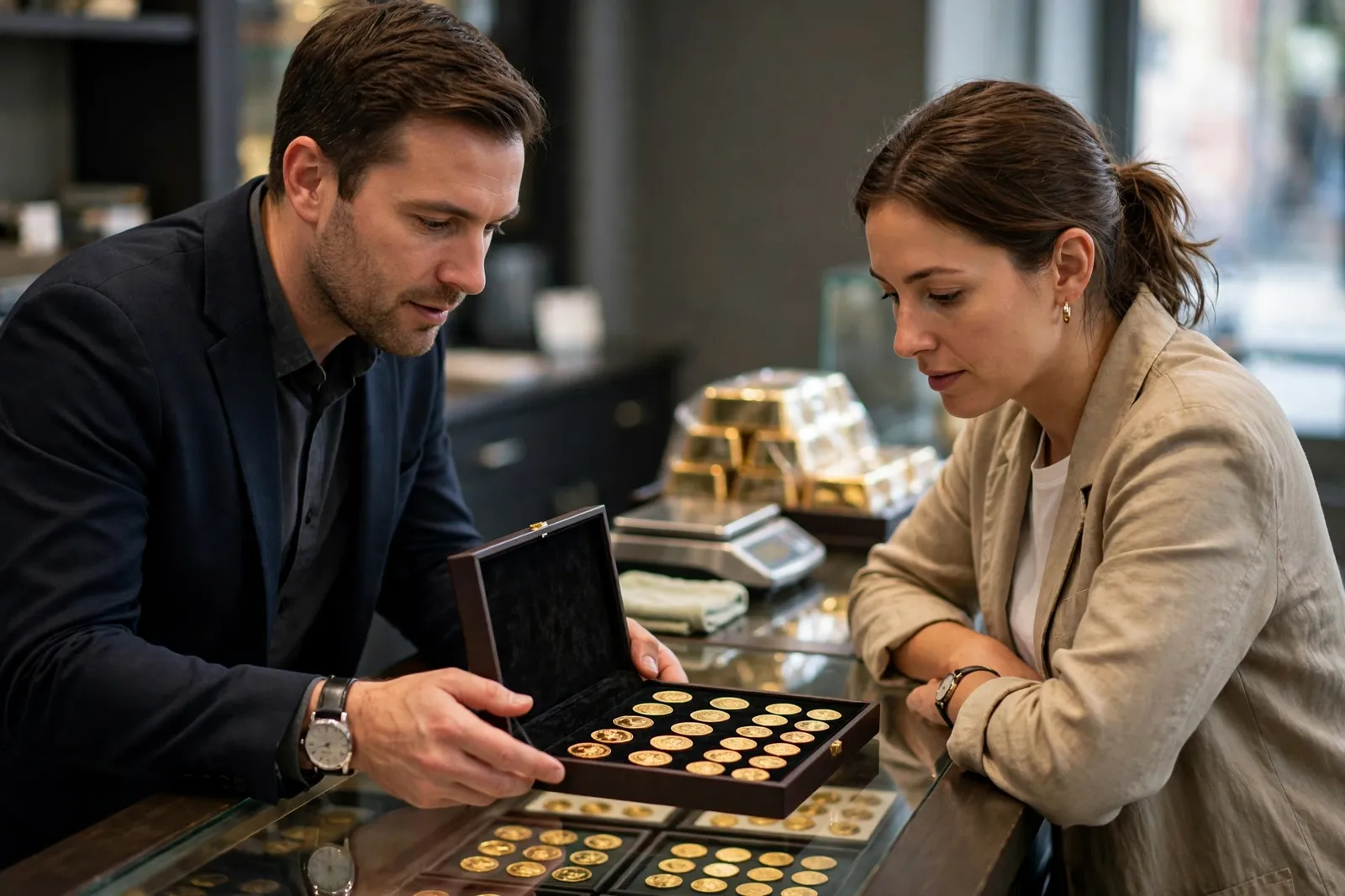
The clearest local option is a dealer whose own website confirms a Christchurch address and a bullion range. Three examples show how differently these businesses can be set up. None is recommended over another here.
One central city dealer, Best Bullion, gives its address on its own site as a mezzanine floor on Peterborough Street and says walk-in visits are welcome without an appointment. Its site describes nationwide shipping alongside collection from Christchurch, and promotes a vault-held programme for buyers who want to own metal without storing it themselves, described on the site as carrying no annual storage fees. The same business runs a buying counter for old or broken jewellery and scrap gold.
A second business at the same Peterborough Street address, trading as Pure Bullion and also as Williams Bullion online, works the opposite way. Its site says the showroom runs by appointment only, with weekday appointments as standard and after-hours or weekend times on request. Orders are otherwise handled through its online store, with insured and tracked delivery anywhere in New Zealand, and local pickup for confirmed in-stock items. Two dealers can share a street address and still run very different visiting rules, so check the dealer’s own site before travelling.
Out in Hornby, Christchurch Gold describes itself on its own site as a specialist gold and silver bullion dealer based in that suburb, working by appointment-based collection, online ordering, or insured delivery nationwide. It says its listings track live market rates, that it publishes buy-back rates alongside live prices, and that customers can estimate a selling payout with an online calculator before locking in a quote.
The vault provider that sells as well as stores
Commonwealth Vault sits in a different category because storage came first. Its own site lists a Christchurch location on Oxford Terrace, in a heritage building completed in 1925 for the Public Trust and since earthquake strengthened and restored. The company sells bullion as well as renting safe deposit boxes, so a buyer can purchase metal and hold it in the same building, and its Christchurch page describes the vault as the first private vault facility in the city.
Coin shops, jewellers and second-hand dealers
Coin dealers handle bullion coins alongside collectable issues, and their pricing can include a collectability element a pure bullion dealer would not charge. Some jewellers stock small bars or coins and most will buy gold over the counter, although their core trade is jewellery, so do not expect a full weight range or published buy-back rates. Pawnbrokers and second-hand dealers occasionally hold pre-owned coins and bars. That trade operates under the Secondhand Dealers and Pawnbrokers Act 2004, and New Zealand Police material on the Act explains that dealers in this space must be licensed and keep records of specified goods they buy. Licensing is a baseline, not a quality mark, and a second-hand purchase needs slower checking.
How local prices are shown, and what to pin down
Christchurch dealers price off the live spot market with a product premium on top, and the national guide explains that structure. The local task is narrower: pin down how a given seller will fix your price before money moves.
Christchurch Gold’s own frequently asked questions describe spot as the live wholesale price for metal not yet made into a product, and explain that retail items are priced at spot plus a premium covering costs such as refining, minting, packaging, transport and insurance. The same material notes that buy-back pricing typically sits at spot less a small spread. Pure Bullion’s appointment page states that quotes are fixed against the current New Zealand dollar spot price at the moment of confirmation. Commonwealth Vault instead gives the buyer one hour to confirm a purchase at its quote.
A displayed price moves until the dealer confirms it, so ask: is the screen price live or indicative, at what moment does my price lock, and who carries the difference if the market moves in between? Keep the confirmation stating the product, weight, quantity and total in New Zealand dollars.
Product choice feeds into price too. Pure Bullion’s gold buying material notes that one large bar usually costs less per gram than several small pieces, while smaller pieces are easier to buy gradually and to sell in part later.

Verifying a local seller before you visit
A physical address proves a business can be found, not that it is what it claims to be. Two public registers, used together, give a much better picture, and both checks take minutes.
The Companies Register check
Search the Companies Register, maintained by the Companies Office, for the trading name and any company name the dealer gives you. Confirm that a matching company exists, that it is still registered rather than removed, and that the details line up: registered office, directors and New Zealand Business Number where one is quoted. A business that cannot be found at all, or whose quoted number belongs to a different company, has some explaining to do.
That warning is not hypothetical. The Financial Markets Authority’s warnings list includes an entity calling itself Capital Gold Investment, which the FMA says falsely claimed to be a New Zealand company while using the business number of another company that had been removed from the register, and was withholding client funds. A register search would have exposed the borrowed number quickly. Do the search yourself rather than accepting a screenshot sent by the seller.
The FSPR check, and its limits
Next, look at the Financial Service Providers Register, usually shortened to FSPR. The FMA explains that the register lists people, businesses and organisations offering financial services in New Zealand, and can show a provider’s business address, the services it offers, any licence or authorisation status, and which dispute resolution scheme it belongs to. Retail financial service businesses must belong to an independent dispute resolution scheme, which gives you somewhere to take an unsettled complaint.
Read the FMA’s caution just as carefully. Registration involves only limited criminal checks at application stage and no other assessment. Being on the FSPR does not mean a business is licensed or regulated by the FMA, and it does not even confirm the business is based in New Zealand. Recovering money from an unlicensed provider is very unlikely if things go wrong, particularly an overseas one, as the FMA puts it. Use the register as a factual check, never as a seal of approval.
The premises check
Finish by verifying that you could visit. A specialist should be findable at the address on its own site, contactable on a local phone number, and clear about whether visits are walk-in or by appointment. Appointment-only premises are common for security reasons and are not a red flag. Vagueness is: a mailbox address, a refusal to meet, or pressure to deal only through messaging apps and offshore payment channels should end the conversation.
Buying in person: identification, payment and inspection
Identification and anti-money laundering checks
Expect to prove who you are. Pure Bullion’s appointment page states that visitors should bring current photo identification, either a New Zealand driver licence or a passport, and explains that the requirement comes from its obligations under the Anti-Money Laundering and Countering Financing of Terrorism Act 2009. The same page says larger transactions may need additional verification, flagged in advance, and covers all in-person purchases and sell-backs. Commonwealth Vault describes the same gateway: setting up a bullion account requires a visit with photo identification before payment options are discussed. Bring the physical document, and do not be offended by questions about the source of funds on a large purchase.
Payment methods and timing
Payment options are narrower than in ordinary retail. Commonwealth Vault lists bank transfer and Eftpos once an account is set up. Ask whether the dealer releases metal on proof of transfer or only once funds have cleared. Confirm the sequence before the visit: identification first, payment confirmed, then metal handed over. A seller who wants an irreversible payment sent to an unfamiliar account before identity checks or a confirmed product should be treated with great caution.
Inspecting and testing the product
The advantage of buying in person is seeing the item before it is yours. Check the weight and fineness markings against what you ordered: bullion is traded in troy ounces, with one troy ounce equal to 31.1035 grams, and Christchurch Gold’s own material notes that fine weight and purity are stamped or certified by the mint. Minted bars commonly arrive sealed in assay packaging carrying the weight, fineness and a serial number. Keep that packaging intact. A sealed bar is easier for the next dealer to accept, while an opened bar may need testing before anyone will quote on it.
Coins deserve a slower look. Check the mint name, year, weight and purity markings, and ask whether the coin is a standard bullion issue or a collectable release carrying a premium you may not recover on resale.
Collection, delivery and ordering from further afield
Many Christchurch buyers mix routes: a first purchase in person, then online orders afterwards.
Pure Bullion states that its orders are fully insured and tracked, sent from its Christchurch base in discreet packaging, with a signature required on delivery for high-value orders, and that Christchurch pickup is available. Christchurch Gold likewise offers insured, discreet courier shipping throughout New Zealand. Commonwealth Vault offers a third path: delivery once an order is complete, collection from a vault by arrangement after payment is verified, or placement directly into its storage. If an item is out of stock, the company says it will advise the delivery timing.
Ordering from a national dealer works on the same principles. New Zealand Mint, based in Auckland, describes its pricing as the live global spot price plus a product premium, and offers a buy-back service priced on live global rates with settlement typically within one business day. Morris and Watson, the long-established refiner, notes on its own site that bullion coins generally carry higher premiums than cast bars, partly because collectors want them too. An out-of-town order should still arrive insured, tracked, plainly packaged and signed for, and you should know before paying whether delivery is included or added at checkout.
Storage options in and around Christchurch
Decide on storage before you buy. A single coin and a kilogram of silver present very different problems, and silver takes up far more room per dollar of value than gold.
Vault and safe deposit storage in the city
The most developed local option is Commonwealth Vault’s Christchurch facility on Oxford Terrace. Its own site describes a few thousand safe deposit boxes inside a vault with biometric scanning, an on-site guard and round-the-clock remote surveillance. Boxes come in four sizes, from a mini box at 59 by 110 by 530 millimetres up to a large box at 230 by 230 by 530 millimetres, and clients can either rent or purchase one. Published hours are 9.00am to 5.30pm, Monday to Friday.
Dealer-held storage is the alternative. Best Bullion’s vault-held programme keeps the metal with the dealer rather than in a box you control. These arrangements are convenient, but they concentrate your trust in one business, so read the terms properly: whether your holding is allocated to you as specific bars and coins, how it is insured, how you can inspect or withdraw it, what it costs each year, and what happens to your metal if the business fails.
Home storage, in general terms
Plenty of owners keep modest holdings at home. A home safe slows an opportunist thief; it does not protect against a targeted burglary, and a safe that is not properly fixed down can simply be taken away. Tell as few people as possible what you hold, keep records and photographs of serial numbers stored separately from the metal, and check your contents insurance position in writing, because standard policies commonly limit cover for items of this kind.
Selling back in Christchurch
A holding is only liquid if someone will buy it at a fair, transparent price on the day you want to sell. The same Christchurch businesses that sell metal generally run a buying side too. Check the sell-back path before your first purchase, not years later.
At Pure Bullion, the published process is to bring the bullion in by appointment, where the dealer verifies it, weighs it and quotes on the spot against the live New Zealand dollar spot price. Verification comes before the quote, so a figure given over the phone can move once the item is examined. Christchurch Gold publishes buy-back rates and offers two completion routes, a private appointment or a mail-in service, with an online calculator giving an initial estimate before a quote is locked in. Best Bullion’s buying counter focuses on jewellery, silverware and scrap gold, where it says items are assessed and paid for at market rates on the same day. Selling bars back to the dealer who sold them, still sealed, is normally the cleanest transaction, because provenance is easy to establish.
Wherever you sell, bring photo identification and your purchase invoice if you have it, and ask whether the quote is fixed at acceptance or set by the spot price when the dealer verifies the metal. If you post metal, use only the address published on the dealer’s own site, and send tracked and insured.
Where bullion sits in a wider portfolio
Physical metal pays no interest and no dividends, its value rests entirely on what the next buyer will pay, and the premium on the way in plus the spread on the way out mean the spot price has to move in your favour before you are ahead. It is best sized deliberately rather than accumulated by impulse at a showroom counter. Readers weighing that balance will find the broader context in our guide to investing in NZ. This article takes no view on how much metal anyone should own.
One tax pointer belongs here and no more. Under Inland Revenue’s guide IR546, a dealer’s sale of fine metal is an exempt supply for GST, with fine metal defined by fineness thresholds that include gold at not less than 99.5 percent. Jewellery and lower-fineness items sit outside that position. The full GST and income tax treatment is covered in the national guide linked at the top of this article.
Questions to ask, and red flags to walk away from
Bring a short list of questions to any first transaction. Is the price live, and at what moment does it lock? What is the total in New Zealand dollars, including delivery? Is the item in stock here, or ordered in after I pay? What identification do you need, for buying and for selling back? Will you buy this exact product back, and how is that price set on the day? If I store with you, is my holding allocated, insured and withdrawable, and what does storage cost each year?
The red flags are consistent. A seller who refuses identification checks is cutting a legal corner that puts you at risk too. Guaranteed returns, pressure to decide within minutes, prices far below every other dealer, payment demanded to a personal or offshore account, and a business that cannot be found on the Companies Register all point the same way. So does the pattern behind several FMA warnings: an operation borrowing the name or business number of a legitimate company to look established. Walk away, and if a seller starts inventing release fees or blocking withdrawals, stop paying, keep every record, and report the matter.
Frequently asked questions
Can I buy bullion in person in Christchurch, or is it all online?
Both routes exist. Some dealers welcome walk-in visits, others work strictly by appointment, and vault-based sellers build the visit into their account process. Every dealer mentioned here also sells for delivery. Check the arrangement on the dealer’s own site before you travel.
What identification do I need to buy or sell bullion in Christchurch?
Take current photo identification, meaning a New Zealand driver licence or a passport in physical form. Dealers describe this as part of their obligations under anti-money laundering law, and it applies to purchases and sell-backs. Larger transactions can trigger extra verification, which a reputable dealer will explain in advance.
How is the price of a bar or coin in a Christchurch shop actually set?
The price is built from the live spot price plus a premium for that product, covering making, packaging, transport, insurance and the dealer’s costs. Prices move until the dealer confirms yours, and confirmation rules differ: one local dealer fixes quotes at confirmation, another gives buyers a short window to confirm. Always establish the total and the locking moment before you pay.
Where can I store bullion in Christchurch if I do not want it at home?
The main local option is a safe deposit box at a private vault facility in the central city, where boxes in several sizes can be rented or purchased inside a guarded, monitored vault. Some dealers also offer to hold metal under a storage programme. Compare the two on allocation, insurance, access hours, withdrawal process and annual cost, in writing, before your metal goes in.
How do I sell bullion back in Christchurch?
Contact the dealer first and book a valuation if the business works by appointment. The dealer verifies and weighs the metal, and the quote is set against the live spot price at that time, so an earlier estimate can change after inspection. Sealed bars with their assay packaging and your original invoice make verification faster. Some dealers also accept metal by insured post, and identification is required for sell-backs just as it is for purchases.
Sources
Best Bullion, Homepage and Christchurch buying and collection information, bestbullion.co.nz
Christchurch Gold, Homepage and frequently asked questions, christchurchgold.co.nz
Christchurch Gold, Buy Gold and Silver, christchurchgold.co.nz
Pure Bullion, Homepage, purebullion.co.nz
Pure Bullion, Book an Appointment, williamsbullion.co.nz
Pure Bullion, Buy Gold collection and frequently asked questions, williamsbullion.co.nz
Commonwealth Vault, How to Buy Bullion, commonwealthvault.co.nz
Commonwealth Vault, Safety Deposit Boxes Christchurch, commonwealthvault.co.nz
Financial Markets Authority, Disputes and consumer protection, fma.govt.nz
Financial Markets Authority, Warnings and alerts, fma.govt.nz
Inland Revenue, GST plus (IR546), ird.govt.nz
Morris and Watson, Gold and Silver Bullion FAQs, morrisandwatson.com
New Zealand Mint, Homepage and bullion services, newzealandmint.com
New Zealand Police, New secondhand goods laws will help reduce property crimes, police.govt.nz
Disclaimer
This article is general information about buying and selling bullion in Christchurch. It is not financial advice, it does not recommend any dealer or product, and it is not tailored to your circumstances. Bullion prices move constantly and can fall as well as rise, and premiums and buy-back spreads affect what you actually receive. Verify prices, terms and storage arrangements with the dealer concerned, and consider independent professional advice before committing significant money.
More money guides are collected in the Finance section.