School Lunches in NZ: Ka Ora Ka Ako, Online Ordering and What Parents Pay
Quick answer
Some New Zealand children get a free lunch at school every school day through Ka Ora, Ka Ako, the Healthy School Lunches programme run by the Ministry of Education. The programme is targeted rather than universal across the country. It aims to reach the 25 percent of students who face the greatest socioeconomic barriers, identified through the Ministry’s Equity Index, and every child at a participating school is offered the lunch. If your child’s school is not in the programme, lunch usually means a lunchbox from home, a school canteen or tuck shop, or a paid online ordering service such as Ezlunch, where you order and pay in advance and the food is delivered to the school. Which options you have depends entirely on your school, so the school office is always the first place to check.
What Ka Ora, Ka Ako is
Ka Ora, Ka Ako is the Healthy School Lunches programme. The name speaks to the idea behind it: being well and nourished puts a child in a better place to learn. The Ministry of Education puts it plainly: children develop and learn better when they are not hungry, and some children in New Zealand do not always get enough to eat.
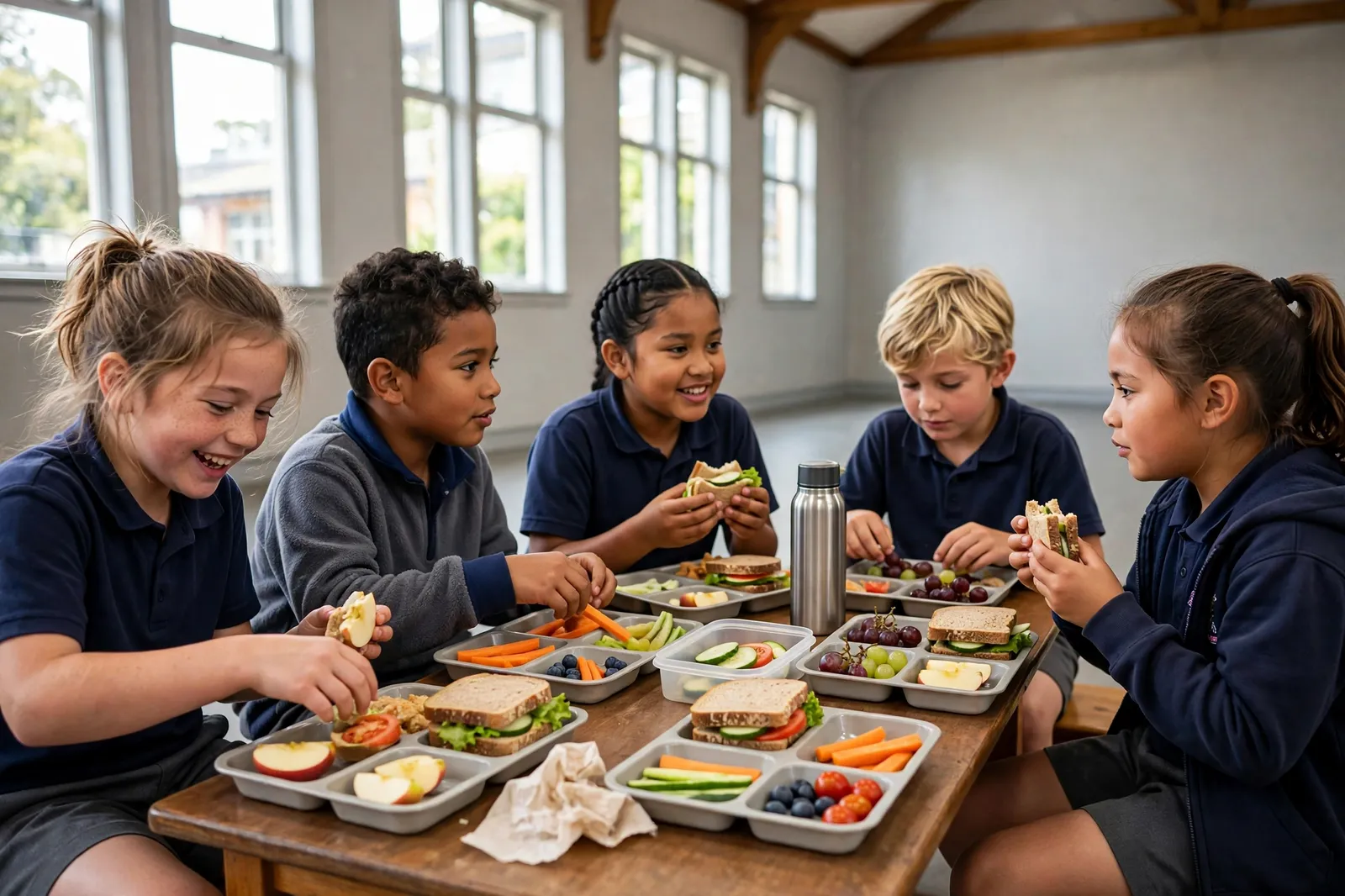
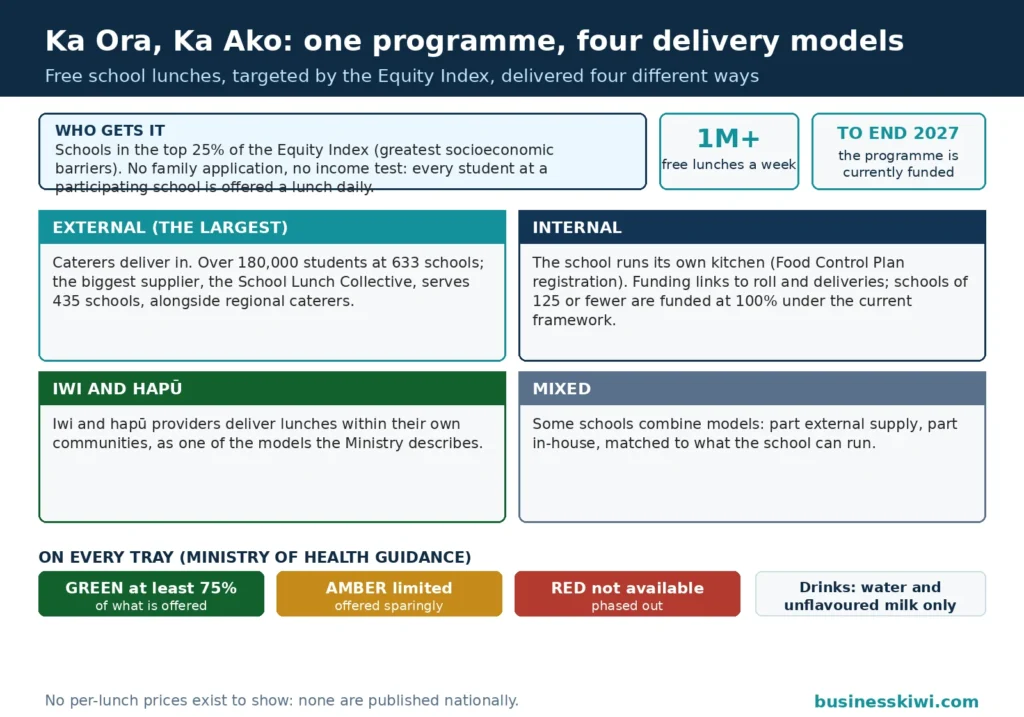
The programme provides a nutritious lunch, free of charge to families, on every school day at participating schools and kura. It is a school-level programme, not an individual benefit. Parents do not apply for it, there is no family income test, and no child at a participating school is singled out. The Ministry describes the intent as students eating together as a school, with every student offered a meal rather than only those who arrived without one. That universal offer inside each participating school is deliberate: it avoids stigma.
According to the Ministry, the programme currently provides more than a million free lunches every week across the schools and kura taking part, and it is funded until the end of 2027. Programme settings have changed over time and may change again, which is why this guide sticks closely to what the Ministry publishes now.

Who gets it: eligibility and how schools are chosen
Eligibility sits with the school, not the family. The Ministry uses the Equity Index to decide which schools to include. The Index estimates the extent to which students at a school face socioeconomic barriers to achievement, drawing on factors in children’s lives and communities.
Funding is limited, and the Ministry says it aims to reach the top 25 percent of students in the schools and kura that need the most support. In practice:
- The Ministry uses the Equity Index to decide which schools need to be included to reach those students, and to work out which schools may need extra funding and resources.
- The Equity Index is reviewed every year. When the review shifts the picture, schools that were not in the programme before may be invited to join.
- A school that was receiving lunches but slips below the 25 percent threshold does not lose them. The Ministry confirms those schools stay in the programme.
- Joining is an invitation process. A school cannot simply opt itself in outside the targeting, and a family cannot enrol a child individually at a school that is not participating.
Once a school is in, the offer covers the whole school. Every student is offered a lunch each school day, whether or not they also bring food from home, and children remain free to eat their own lunchbox instead. Many schools still run a reduced canteen alongside the programme. Dietary needs and allergies are handled through the school, which passes requirements on to whoever makes the lunches. The Ministry publishes a list of participating schools and kura, so checking that list, or asking the school office, is the reliable way to find out whether free lunches are part of the school day.
How the lunches are made and delivered
The Ministry describes a range of delivery models, because a large urban secondary school and a small rural primary have very different facilities.
The external model
In the external model, an outside supplier prepares the lunches and delivers them to the school each day. The school keeps the supplier updated with student meal requirements through an ordering system, including how many standard meals and special dietary meals are needed. Suppliers must meet the programme’s nutrition standards and an agreed price point, follow sustainability practices, and report back to the Ministry under their service agreements.
This is the largest model. The Ministry’s external model page states that over 180,000 students across 633 schools receive lunches this way. The biggest single supplier named on that page is the School Lunch Collective, listed against 435 schools nationwide. Around it sits a spread of regional caterers, including Montana Group in parts of Auckland and Waikato, Ka Pai Kai Aotearoa in Bay of Plenty, Star Fresh in Wellington, the University of Canterbury Student Association in Christchurch, and chains such as Pita Pit and Subway covering groups of schools in several regions. A further 17 suppliers serve specialty schools.
Menus sit with the supplier and the school. Suppliers tell schools what is on the menu each week and provide the nutritional information and ingredients. Parents who want to know what is being served should ask the school, because menus differ from school to school.
The internal model
Some schools make the lunches themselves. In the internal model the school runs its own kitchen, buys ingredients, plans menus, organises the staff, and serves lunch to its own students. A variation the Ministry calls the internal partnership model has one school with a kitchen, the head school, preparing lunches for another local school as well and managing the whole service for it.
Running a kitchen is a serious undertaking, and the Ministry is clear that the model does not suit every school. Internal schools must meet the same nutrition standards as external suppliers, meet health and safety requirements, and register a Food Control Plan. Their responsibilities cover kitchen maintenance, food safety monitoring, staff management, finances and reporting, and waste. Internal schools are funded directly by the Ministry under a funding agreement, with funding linked to roll size and the average number of lunches delivered. Smaller schools of 125 students or fewer are funded at 100 percent regardless of delivery numbers, under a framework the Ministry says was introduced in Term 2 2026.
Iwi and hapū providers, and mixed arrangements
The Ministry’s pages also recognise iwi and hapū providers as part of the programme’s delivery picture, with resources and waste guidance produced for that model alongside the internal model. In practice some schools blend arrangements too. The Ministry notes that a school might make its own lunches on some days and use another provider on others. From a parent’s seat, the model matters less than the result: a lunch arrives for your child each school day, and the school is your contact point for menus, dietary needs and any problems.

What students receive, and the nutrition standards behind it
Every meal in the programme has to meet nutrition standards the Ministry developed in consultation with the Ministry of Health, schools and nutrition stakeholders. Two practical requirements apply to every lunch: each meal must meet a minimum weight, and each meal must include a required amount of vegetables or salad. Vegetables sometimes appear inside sauces and mixed dishes, a familiar trick for making them appealing to children who would pick around them on a plate.
Beyond those programme standards sits the wider official guidance for school food. The Ministry of Health’s Healthy Food and Drink Guidance for Schools sorts food and drink into three colour categories:
- Green items are the nutritious core: mostly whole and less processed foods from the four food groups, lower in saturated fat, salt and added sugar. The guidance says green items should make up at least 75 percent of what a school provides.
- Amber items have some nutritional value but are more processed and not meant to be everyday fare. Schools are advised to keep them limited and not let them dominate a canteen menu.
- Red items have poor nutritional value, are typically high in saturated fat, salt or added sugar, and are often highly processed. The guidance says they should not be available at school, or should be phased out under the school’s own plan.
The same guidance sets drink expectations: water and unflavoured milk are the drinks schools should offer, with no sugar-sweetened drinks. It applies to food a school provides or sells, including food from external suppliers, and it does not govern what families put in a lunchbox. Schools use it when writing their own food and drink policies, so it shapes canteen menus well beyond the free lunch programme.
Allergies, intolerances and special diets
This is the part of the programme parents of children with dietary needs care about most, and the Ministry addresses it directly. Lunch providers must offer safe options for all children, including those with allergies and intolerances and those whose diets follow ethical or religious requirements. The Ministry gives vegetarian and vegan students and students who eat halal food as everyday examples.
The practical chain works like this. Parents tell the school about a child’s allergy or special diet. In the external model, the school orders special dietary meals for those students as part of its regular requirements to the supplier. In an internal school, the kitchen plans around the needs it knows about. One boundary is worth knowing: special dietary meals are for genuine dietary needs, not for likes and dislikes, so a child who simply prefers different food will generally be offered the standard menu.
Two habits will help. Raise dietary needs at enrolment and whenever they change, rather than assuming the information follows your child between schools. And if a reaction or a near miss happens, tell the school the same day. Schools and suppliers can only act on information they actually hold.
If your school is not in the programme
Most New Zealand schools sit outside Ka Ora, Ka Ako, because the programme targets the quarter of students facing the greatest barriers. Lunch at those schools rests on three familiar pillars, often in combination.
Lunchboxes
The lunchbox is still the default for most families, and there is no national rule about what goes in one. The Ministry of Health guidance described above deliberately excludes food children bring from home, so lunchbox contents are a family decision.
Canteens and tuck shops
Many schools run a canteen or tuck shop selling food at morning tea and lunch, operated by the school itself, by parent volunteers, or by an outside operator. What is sold, and at what price, is set locally. Schools writing canteen policies are encouraged to use the Ministry of Health guidance, which pushes menus toward green items and treats water and plain milk as the standard drinks.
Paid online ordering
The third option is online lunch ordering. Services such as Ezlunch let parents order from a menu set for their school, pay online, and have the food delivered to the school at lunchtime. For busy households it replaces both the lunchbox and the canteen queue on the days it is used. The next section explains how it works.
How online lunch ordering works
Online ordering platforms sit between three parties: your family, a local food provider such as a café, bakery or caterer, and the school. The school signs up to the service and agrees which providers supply it and on which days. Families only see the menus of the suppliers attached to their school, so a neighbouring school may have completely different options and delivery days.
Ezlunch is the service most parents will meet, and it now also handles families who previously ordered through Lunchonline. Lunchonline’s own site tells its former schools, suppliers and parents that ordering and account management have moved to Ezlunch through Kindo, with balances transferred for families using the same email address, while suppliers, menus and days of service stayed the same. Ezlunch describes itself on its own site as delivering to more than 550 New Zealand schools through more than 180 local cafés and caterers, figures it publishes as its own.
The routine, as Ezlunch and its Kindo help centre describe it, runs like this:
- Create a Kindo account and add your children, selecting their school. One account covers the whole family, including children at different schools that use the service.
- Top up the account or pay at checkout. Kindo accounts can be topped up by debit or credit card, with fees applying to card top-ups, or by bank transfer.
- Choose items from your school’s menu for the day you want. You can order for a single day or for multiple days ahead, up to a whole term in advance.
- Order before the cut-off. Ezlunch promotes ordering before 9am, and its help centre is more precise: the cut-off is 9am on the delivery day or the usual cut-off time for your school’s service, because cut-offs vary by provider. Check your own school’s menu rather than assuming 9am always applies.
- The provider makes the food fresh that day and delivers it to the school, labelled for your child, ready to collect at lunchtime.
Absences and changes are the question every parent asks eventually. Under Kindo’s published help guidance, you can change an order at any time up until the cut-off on the delivery day. Changing means cancelling the order in your account and placing a new one, and cancelled funds return to your Kindo account for the next order. After the cut-off the order cannot be changed, because the provider has already started preparing food for that day. So if your child wakes up sick, cancel before the cut-off whenever you can.
What parents pay
At a Ka Ora, Ka Ako school, families pay nothing for the programme lunch. It is funded by the Ministry, with no charge or levy attached.
Where parents pay is the commercial ordering route. Here this guide has to be straight with you: Ezlunch does not publish a single national price list that can be quoted cleanly. Menus and prices are set per school by its contracted providers, and they vary by item, provider and town. A sushi day, a bakery day and a hot meal day at the same school can all carry different prices.
That means the honest answer to “what does an ordered lunch cost” is: whatever your school’s menu in your Kindo account shows on the day. Expect to pay per item rather than per set lunch at many schools, with drinks and snacks priced separately from mains. Because the school chooses the providers, prices are also a legitimate topic to raise with the school if a service feels poor value.
Free programme vs paid ordering at a glance
Food safety: the rules sitting around school food
The Ministry states that Healthy School Lunches providers must follow the same safety standards as any other commercial food provider. Food safety in New Zealand is governed by the Food Act 2014, administered by the Ministry for Primary Industries. Businesses that make or sell food generally have to operate under a Food Control Plan or a national programme, register, and be checked by a verifier, with the precise category depending on the food and how it is handled.
That framework reaches into schools in a few concrete ways:
- Internal model schools, which run their own kitchens for the free programme, must register a Food Control Plan as one of the Ministry of Education’s stated requirements.
- A café or caterer supplying either the free programme or a paid ordering service is a commercial food business and sits under the Food Act like any other caterer.
- A school-run canteen that prepares and sells food is also providing food commercially and needs to meet the applicable registration and plan requirements.
Day-to-day handling matters as much as registration. Within the free programme, schools are responsible for keeping food safe during the school day, storing meals held for a still-hungry student properly, arranging a safe place for surplus meals to be collected, and telling suppliers when lunches are not needed, for example on public holidays, teacher-only days or closures. Untouched surplus lunches are picked up by suppliers, and leftover meals are not to be shared outside the school. If you have a food safety concern about a school lunch, raise it with the school first.
Making the most of whichever system your school has
A few practical steps help under any arrangement:
- Confirm which system your school uses before the term starts, and whether it changes at intermediate or secondary level.
- Put dietary and allergy information in writing to the school, and update it when anything changes.
- If you use online ordering, set the account up before you need it in a hurry, and note your school’s cut-off time and delivery days.
- Keep a simple backup plan for missed cut-offs and forgotten lunchboxes.
- Remember that lunch programmes only run on school days. Our guide to NZ school holidays sets out term dates for planning around breaks, and parents looking for learning support at home may also find our times tables guide for NZ families useful during term time.
Frequently asked questions
Is Ka Ora, Ka Ako available at every school?
No. The programme is targeted using the Equity Index and aims to reach the 25 percent of students facing the greatest socioeconomic barriers. Schools are invited to join as the index is reviewed each year. Your school office can confirm whether your school is included.
Do parents pay anything for the free school lunches?
No. At a participating school the lunch is funded by the Ministry of Education and provided free to every student who wants one. There is no application by families and no charge.
My child has a serious allergy. How are special diets handled?
Tell the school. Programme providers must provide safe options for children with allergies and intolerances and for ethical or religious diets such as vegetarian, vegan and halal. The school passes requirements to its supplier or kitchen, which provides special dietary meals for genuine needs rather than taste preferences.
How do I order a paid lunch online, and what if my child is away?
Create an account with the service your school uses, such as a Kindo account for Ezlunch, add your child and their school, then order from that school’s menu before the cut-off, which is 9am on the day for many services but varies by provider. If your child is away, cancel before the cut-off and the funds return to your account.
What does an ordered lunch cost?
Prices are set by each school’s contracted providers and published in the menu inside your ordering account, so there is no single national price. Check your own school’s menu for current per-item prices, and remember drinks and snacks are often priced separately.
Sources
Ministry of Education, Healthy School Lunches Programme, education.govt.nz
Ministry of Education, Which schools and kura have Healthy School Lunches, education.govt.nz
Ministry of Education, About the external delivery model, education.govt.nz
Ministry of Education, About the internal delivery model, education.govt.nz
Ministry of Health, Healthy Food and Drink Guidance: Schools, health.govt.nz
Ezlunch, Ezlunch homepage and school information, ezlunch.co.nz
Lunchonline, Lunchonline homepage (move to Ezlunch notice), lunchonline.co.nz
Kindo, Ezlunch help articles: What is Ezlunch, Join Ezlunch, and Can I change my child’s lunch order, support.mykindo.co.nz
Disclaimer
This article is general information for parents and caregivers, not advice about any individual child or school. Programme settings, funding periods, delivery arrangements and provider terms change over time, and every school runs its own canteen, ordering and dietary processes. Check current details with your school and on the Ministry of Education’s website.
More guides for parents and caregivers are in our Jobs and Education section.