NZ School Holidays 2026: Dates, Terms & Planning Guide
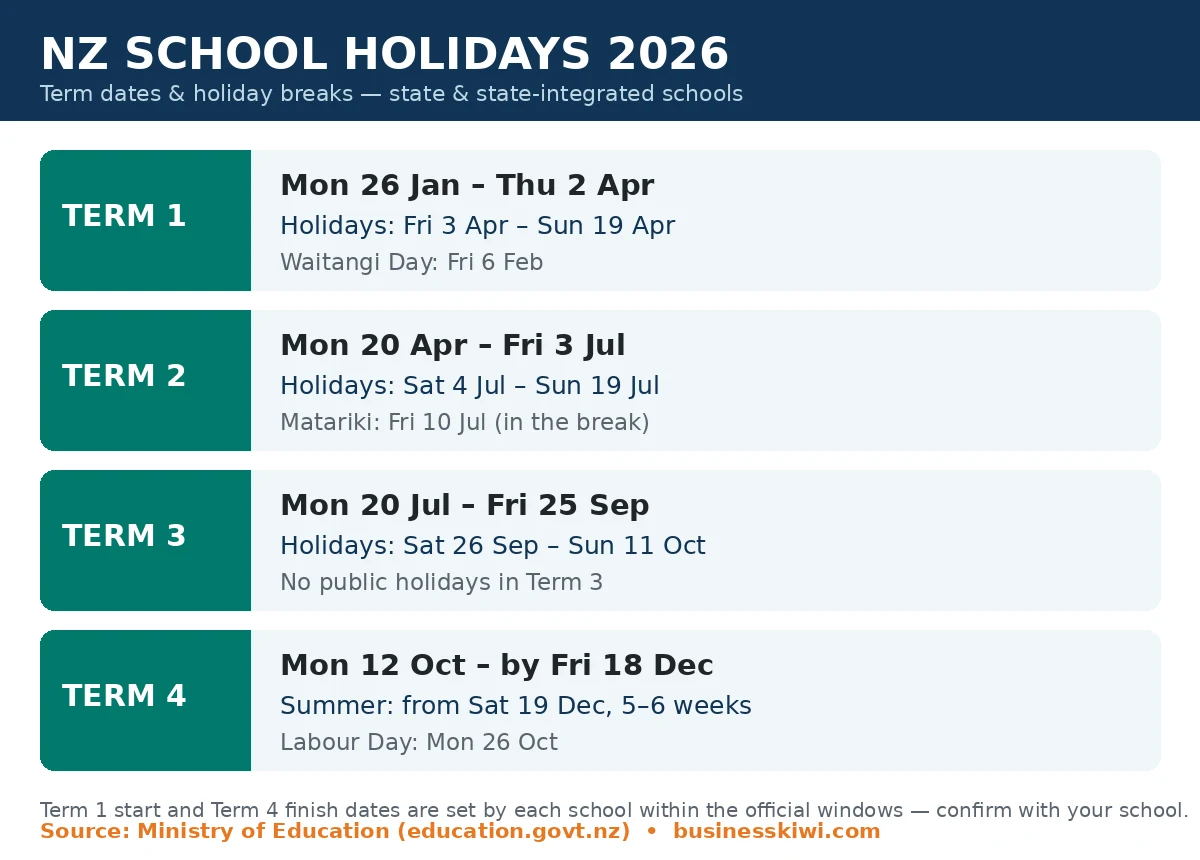
If you are booking leave, arranging childcare or planning a family trip, the dates that matter are the four term breaks set by the Ministry of Education. For state and state-integrated schools, the 2026 school holidays are Friday 3 April to Sunday 19 April (Term 1 break), Saturday 4 July to Sunday 19 July (Term 2 break), Saturday 26 September to Sunday 11 October (Term 3 break), and the summer holidays, which start no later than Saturday 19 December and run for five to six weeks. The full term dates are in the table below, but note that Term 1 start dates and Term 4 finish dates vary slightly from school to school, so always confirm those two with your own school.
2026 term dates at a glance
| Term | Starts | Ends | Public holidays during term |
|---|---|---|---|
| Term 1 | Between Monday 26 January and Monday 9 February | Thursday 2 April | Waitangi Day: Friday 6 February |
| Term 2 | Monday 20 April | Friday 3 July | ANZAC Day: Saturday 25 April (observed Monday 27 April); King’s Birthday: Monday 1 June |
| Term 3 | Monday 20 July | Friday 25 September | None |
| Term 4 | Monday 12 October | No later than Friday 18 December | Labour Day: Monday 26 October |
2026 school holiday dates
| Holiday break | Starts | Ends | Public holidays in the break |
|---|---|---|---|
| Term 1 holidays | Friday 3 April | Sunday 19 April | Good Friday (3 April), Easter Monday (6 April), Easter Tuesday (7 April, a school holiday) |
| Term 2 holidays | Saturday 4 July | Sunday 19 July | Matariki: Friday 10 July |
| Term 3 holidays | Saturday 26 September | Sunday 11 October | None |
| Summer holidays | No later than Saturday 19 December | Five to six weeks, until school reopens in late January/early February 2027 | Christmas Day and Boxing Day fall in this break |
Term by term: what to expect in 2026
Term 1: up to 10 weeks
Term 1 is the flexible one. Schools choose their own start date any time between Monday 26 January and Monday 9 February 2026, but every state and state-integrated school finishes on Thursday 2 April, the day before Good Friday. Waitangi Day (Friday 6 February) is the only public holiday inside the term, although some schools will also close for their regional anniversary day, which falls in this period for several regions. Because the holidays begin with Easter, the Term 1 break effectively starts on Good Friday.
Term 2: 11 weeks
Term 2 is the longest term of 2026, running from Monday 20 April to Friday 3 July. It contains two public holidays: ANZAC Day falls on Saturday 25 April, in the first week of term, and is observed on Monday 27 April, when schools close; and King’s Birthday on Monday 1 June gives families a mid-term long weekend. The winter break that follows, 4–19 July, includes Matariki on Friday 10 July, a good anchor for a mid-winter trip, as the public holiday lands in the middle weekend of the holidays rather than at either end.
Term 3: 10 weeks
Term 3 runs from Monday 20 July to Friday 25 September, with no public holidays at all. It is the most uninterrupted stretch of the school year, which makes it the term where teacher-only days and school events are most noticeable when they do occur. The spring break is 26 September to 11 October.
Term 4: up to 10 weeks
Term 4 starts on Monday 12 October and schools must finish no later than Friday 18 December; many finish a few days earlier, and secondary schools often close earlier than primary schools because they have a slightly lower minimum opening requirement for the year. Labour Day (Monday 26 October) is the term’s public holiday, and senior secondary students will also have exam leave in November, which is set by each school rather than by the Ministry. The summer holidays then run for five to six weeks.
Why your school’s dates may differ slightly
The Ministry sets the framework, not an identical calendar for every school. Terms 2 and 3 are fixed nationwide, but schools choose their Term 1 start date within the official window and their Term 4 finish date, provided they meet the minimum number of half days open for instruction: 378 half days in 2026 for primary, intermediate and specialist schools, and 376 for secondary and composite schools. Schools use that flexibility to fit in local events, anniversary days and teacher-only days. Two neighbouring schools can legitimately start a week apart in January, so the dates in this guide are the official framework; your school’s newsletter or website is the final word for your family.
Teacher-only days in 2026
Alongside the public holidays, schools close on teacher-only days, when staff work on curriculum and assessment but students stay home. For 2026, the Minister of Education granted schools curriculum half-days (widely taken as two full teacher-only days) to support the rollout of the refreshed curriculum. There are no set national dates: each school chooses its own, and many attach them to long weekends to reduce disruption (Friday 29 May, immediately before King’s Birthday weekend, was a popular choice). Teacher-only days are otherwise only allowed outside term time unless the Minister authorises them, which is what the 2026 curriculum days are. Your school must notify its dates in advance. Check the school calendar before booking leave around long weekends, because a “three-day weekend” for parents is sometimes a four-day weekend for children.
Early childhood and private schools
The dates above are statutory for state and state-integrated schools and kura. Early childhood is different: some kindergartens and ECE services choose to follow the school terms, but full-time daycare services usually stay open through the school holidays and close only over Christmas. Govt.nz notes that early learning services generally follow the same terms and holiday dates as state schools, but “generally” is doing real work in that sentence. Confirm your service’s own closure dates, especially for the Christmas period and any staff-only days.
Private (independent) schools are not bound by the Ministry’s term dates at all. Most broadly follow them, but they can start and finish on different days and can even open on Easter Tuesday, which is a school holiday for state schools. If your child attends a private school, use this guide for a rough shape of the year only and rely on the school’s published calendar.

Planning around the 2026 holidays
More guides for families and educators are in our Jobs & Education section.
Book leave early for the fixed points. Because Terms 2 and 3 start and end on the same dates nationwide, the July and September/October breaks are when every family in the country wants to travel at once. Flights, ferries and holiday parks price accordingly. The Term 1 break is slightly softer because Easter anchors it, but Good Friday through Easter Tuesday is peak demand.
Use the long weekends inside term. You do not always need a full term break to get away. King’s Birthday (1 June), Labour Day (26 October) and Matariki (10 July, inside the Term 2 holidays) are the obvious ones, and Waitangi Day falls on a Friday in 2026, creating a long weekend early in Term 1, subject to when your school actually starts.
Sort holiday programmes before the term ends. School-based and community holiday programmes run during each of the three mid-year breaks and usually open enrolments several weeks ahead; popular ones fill. If you work through the holidays, treat the programme booking as the first job once term starts, not the last job before it ends. Programmes vary widely in hours, age range and cost, so compare what is actually offered locally rather than assuming last year’s arrangement still runs.
Coordinate two schools, two calendars. Families with children at different schools (common when one child is at secondary and another at primary) can find Term 1 start dates and Term 4 finish dates a week apart, plus different teacher-only days. Lay both schools’ calendars side by side in January and mark the mismatches; those are the days that catch families out.
Watch the end of the year. Term 4 finishing dates are the least predictable of all. If you are booking a December holiday, “no later than Friday 18 December” is the guarantee. Your school may finish earlier, but do not book travel before that date on the assumption it will.
FAQs
When do NZ school holidays start in 2026?
The first break of the year starts on Friday 3 April 2026 (Good Friday) and ends on Sunday 19 April, with Term 2 beginning on Monday 20 April. There are three further breaks: 4–19 July, 26 September–11 October, and the summer holidays from mid-to-late December.
When does Term 1 2026 start?
There is no single national start date. Each school starts between Monday 26 January and Monday 9 February 2026 and finishes on Thursday 2 April. Check your school’s confirmed start date. Siblings at different schools may start on different days.
Is Matariki a school holiday in 2026?
Matariki is a public holiday on Friday 10 July 2026, and in 2026 it falls inside the Term 2 school holidays (4–19 July), so schools are closed anyway. Families get the public holiday in the middle of the break rather than as an extra long weekend during term.
What is Easter Tuesday and why is school closed?
Easter Tuesday (7 April 2026) is a school holiday for state and state-integrated schools, but it is not a national public holiday. Most workplaces are open. Parents who work that day need childcare even though it sits inside the Term 1 break. Private schools may choose to open on Easter Tuesday.
Do all schools have the same teacher-only days?
No. For 2026 the Ministry granted schools curriculum days to support the refreshed curriculum, but each school sets its own dates and must tell parents in advance. Many schools chose dates attached to long weekends, such as the Friday before King’s Birthday.
When do the 2026 summer holidays end?
The summer break lasts five to six weeks from your school’s closing date in December. Schools reopen for Term 1 2027 between Thursday 28 January and Wednesday 3 February 2027, depending on the school.
Are these dates the same for private schools and preschools?
Not necessarily. Private schools set their own terms and holidays, and early childhood services vary. Many follow school terms, but full-time daycare usually remains open during term breaks and closes over Christmas. Always check with the school or service.
Sources
Ministry of Education: School terms and holidays dates: https://www.education.govt.nz/school-terms-and-holidays-dates
New Zealand Government (Govt.nz): School terms in NZ: https://www.govt.nz/browse/education/school-and-college/school-terms-and-holidays/
Dates are the Ministry of Education’s official 2026 dates for state and state-integrated schools. Individual schools set their own Term 1 start and Term 4 finish dates within the official windows, so confirm those with your school.