Teacher Salary NZ: Pay, Salary Range & Career Information

Teacher pay in New Zealand is more predictable than in most jobs, because almost every teacher in a state or state-integrated school is paid from the same national pay scale. Whether you teach five-year-olds in Invercargill or physics in Whangārei, your base salary comes from the Unified Base Salary Scale for Trained Teachers, set out in the primary and secondary teachers’ collective agreements.
The short answer: a trained, certificated teacher in 2026 earns between $62,862 and $105,686 a year in base salary, depending on qualifications and experience. Where you sit in that range is decided by a salary assessment when you start, and you then climb one step a year until you reach the top step allowed for your qualifications. Units and allowances for extra responsibilities are paid on top.
Teacher salary at a glance
Primary and secondary teachers share the same base scale, so the ranges below apply to both sectors. The main difference is where a new graduate starts: most beginning secondary teachers hold a subject degree, which places them a step higher than a beginning primary teacher whose only qualification is a teaching degree.
| Position on the scale | Primary teacher | Secondary teacher |
|---|---|---|
| Starting salary, beginning teacher | $62,862 (step 1) | $62,862–$65,685 (step 1–2, depending on qualifications) |
| Typical entry with a subject degree | Step 2: $65,685 | Step 2: $65,685 |
| Mid-career (step 6) | $82,230 | $82,230 |
| Top of scale, no subject/specialist qualification | $100,368 (step 9) | $100,368 (step 9) |
| Top of scale, with subject/specialist qualification | $105,686 (step 10) | $105,686 (step 10) |
Base salary only, at the rates in force from 28 January 2026 (secondary) and 2 April 2026 (primary). The next increase applies from 28 January 2027, when the scale runs from $64,119 to $107,886. Units and allowances are extra.

The full teacher pay scale NZ
The unified scale has ten steps. Your entry step and your maximum step are both set by your qualification group (explained below), and the steps in between are reached through annual progression.
| Step | Who enters / tops out here | Salary from Jan–Apr 2026 | Salary from 28 Jan 2027 |
|---|---|---|---|
| 1 | Entry: certificated teacher, no subject/specialist qualification at level 7+ | $62,862 | $64,119 |
| 2 | Entry: subject/specialist level 7 qualification, or level 8 teaching qualification | $65,685 | $66,999 |
| 3 | Entry: subject/specialist level 8 (e.g. honours, postgraduate diploma) | $68,251 | $69,616 |
| 4 | Entry: subject/specialist level 9 (master’s or doctorate) | $72,548 | $73,999 |
| 5 | $77,224 | $78,768 | |
| 6 | $82,230 | $83,874 | |
| 7 | $88,276 | $90,042 | |
| 8 | $93,234 | $95,099 | |
| 9 | Maximum for teachers with no subject/specialist qualification | $100,368 | $102,475 |
| 10 | Maximum for all other qualification groups | $105,686 | $107,886 |
[[GRA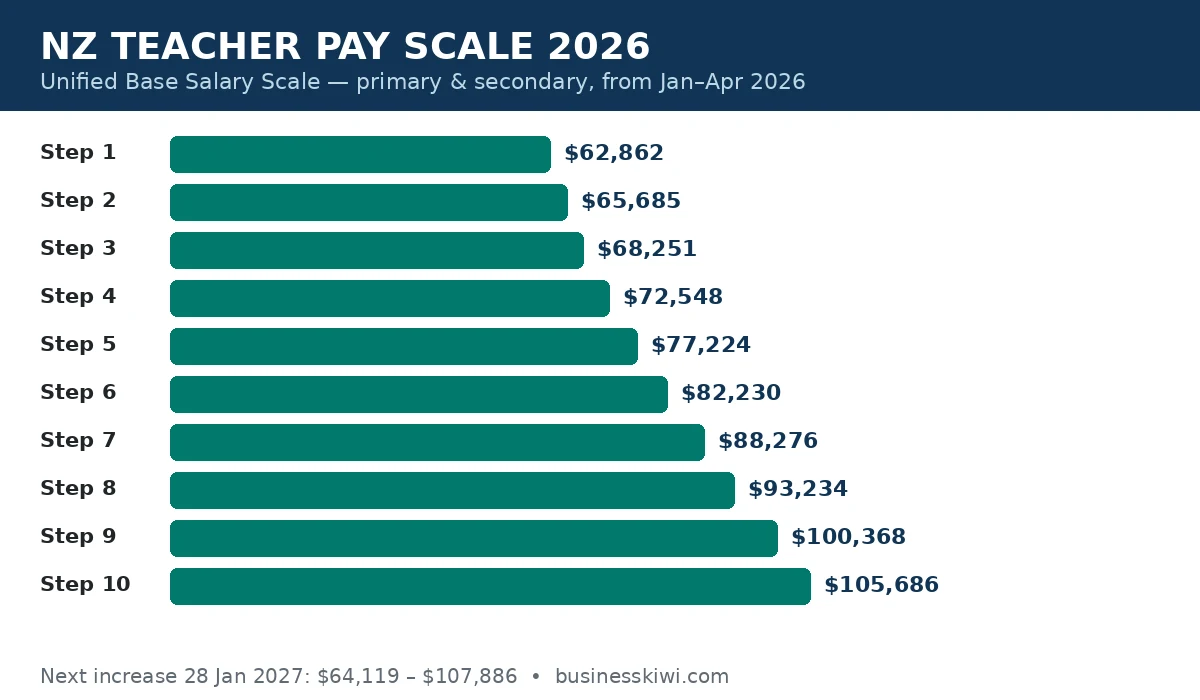
These figures are identical in clause 3.2 of the Primary Teachers’ Collective Agreement 2026–2028 and clause 4.1.1 of the Secondary Teachers’ Collective Agreement, both negotiated with the Ministry of Education | Te Tāhuhu o te Mātauranga, by NZEI Te Riu Roa for primary teachers and PPTA for secondary teachers.
How the step scale works
Your starting step is assessed, not negotiated. When you are appointed, a salary assessment looks at your qualifications, any recognised previous teaching service, and relevant work experience from before teaching. A career-changer with years of recognised experience in their subject area can start several steps up the scale rather than at step 1.
You move up one step per year. Progression is annual, provided your principal attests that you meet the professional standards for your level of experience. If standards are not met, progression can be deferred while a support programme is put in place. It is not an automatic entitlement regardless of performance, but in practice most teachers progress each year.
You stop at your qualification group’s ceiling. This is the part many beginning teachers miss. A teacher whose highest qualification is a teaching degree, with no separate subject or specialist qualification, progresses to step 9 ($100,368) and stays there. To unlock step 10, and to have started higher in the first place, you need a subject or specialist qualification recognised in a higher group. Completing further study later moves you to at least the entry step of your new group, so mid-career postgraduate study can lift both your ceiling and your pay.
Part-time teachers are paid pro-rata on the same scale, based on their full-time equivalent (FTTE) load. A teacher on step 10 working 0.6 FTTE, for example, is paid about $2,432 gross a fortnight at 2026 rates, against roughly $4,053 a fortnight full-time, the agreements’ own worked example. Teachers are paid fortnightly, including across term breaks that fall within their employment.
Qualification groups in plain English
The agreements label the groups Q1–Q5 in the primary sector and G1–G5 in the secondary sector, but the definitions are effectively the same. Only groups 3 to 5 matter for certificated teachers:
- Group 3 (Q3/G3): you hold a current practising certificate from the Teaching Council of Aotearoa New Zealand, but no subject or specialist qualification at level 7 or above on the NZ Qualifications Framework. A Bachelor of Teaching on its own usually lands here. Enter at step 1, maximum step 9.
- Group 3+ (Q3+/G3+): you also hold a subject or specialist level 7 qualification, such as a bachelor’s degree in your teaching subject, a graduate diploma, or a level 8 initial teacher education qualification. Most secondary teachers are here, because a subject degree is the normal route into secondary teaching. Enter at step 2, maximum step 10.
- Group 4 (Q4/G4): a subject or specialist level 8 qualification (honours degree or postgraduate diploma), two level 7 subject qualifications, or a level 9 teaching qualification. Enter at step 3, maximum step 10.
- Group 5 (Q5/G5): a subject or specialist level 9 qualification: a master’s degree or doctorate. Enter at step 4, maximum step 10.
If you trained overseas, your qualifications must be recognised by NZQA against the NZ Qualifications Framework before they count for salary purposes, and you still need registration and a practising certificate from the Teaching Council to be paid on the trained scale. Teachers working under a Limited Authority to Teach (LAT), who are not yet qualified teachers, are paid on a separate, lower untrained scale.
Units, allowances and leadership pay
Base salary is only part of total pay for the many teachers who take on extra responsibility. The main additions are:
Management units (secondary). Secondary teachers are paid for leadership, pastoral, administrative or task-specific responsibilities through units. Each permanent or fixed-term unit is worth $5,500 a year from 28 January 2026 (clause 4.3.2 of the secondary agreement). A head of department on step 10 holding two units, for example, earns $105,686 + $11,000 = $116,686 before any allowances.
Units (primary). Primary teachers are also paid in units, historically worth less than secondary units. Under the 2026–2028 primary agreement the unit value is $5,100 from 2 April 2026, rising to $5,250 from 28 January 2027 and to $5,500 from 2 October 2028, at which point primary and secondary unit values match (clause 3.10).
Middle and senior management allowances (secondary). Teachers with designated curriculum or pastoral management responsibilities can also receive a Middle Management Allowance, and assistant and deputy principals a Senior Management Allowance, each worth $2,400 a year from 28 January 2026 (up from $2,000).
Deputy and assistant principals (primary) are paid at the top step of the base scale for their qualification group: step 9, or step 10 if they hold a subject/specialist qualification, plus whatever units their position carries (clause 3.10.8). Principals themselves are paid under separate principals’ agreements based mainly on school size, and sit outside this scale.
Service/qualification increment (secondary). A secondary teacher who has spent three years on their maximum step can qualify for an additional $2,000 a year (clause 4.9), subject to conditions including further qualification or te reo Māori competency requirements for some groups, and it is generally not payable while holding permanent units.
Adding it up: a primary teacher at the step 9 maximum with one unit earns $100,368 + $5,100 = $105,468, and experienced teachers holding several units in either sector commonly earn total pay well into the $110,000s and beyond, without leaving the classroom-based scale.
What teachers actually earn on average
Scale figures describe positions, not people, so it also helps to look at what the workforce actually earns. Ministry of Education workforce data for the 2024 school year put average total remuneration, base salary plus allowances, excluding KiwiSaver and other superannuation, at $94,354 for primary teachers and $100,933 for secondary teachers.
Those averages sit high on the scale for two reasons: a large share of the workforce is experienced and at or near its maximum step, and the averages include the units and allowances described above. A beginning teacher should expect to start at the entry figures in the table, not at the average. To see what a step salary means after tax, estimate your take-home pay with our income tax calculator.
ECE teacher pay: how it compares
Early childhood education works differently, and the honest answer is “it depends where you work”.
Kindergarten teachers are covered by their own collective agreement, and that agreement contains the same Unified Base Salary Scale: kindergarten teachers have pay parity with school teachers as a structural feature of their agreement, not as a favour from their employer.
Teachers in education and care services (most other ECE centres) are in a different position. There is no single collective agreement setting their pay. Instead, the Ministry of Education runs a pay parity opt-in funding scheme: services choose one of four minimum salary scales: called base, parity, extended parity and full parity, attest through their funding return that they pay their certificated teachers at least that scale, and receive funding rates to match. Only a service that has attested to the full parity scale is funded to pay the full kindergarten-equivalent steps. Teachers in services on lower scales, or that have not opted in, can be paid noticeably less than school teachers for the same qualifications, and government settings, including a two-year moratorium on services moving up to higher parity scales after the July 2025 funding period, mean the gap does not close automatically. If you are comparing an ECE job offer with a school job, ask the service which parity scale it has attested to.
Relief teacher pay
Relief work follows the school terms, see the NZ school holidays 2026 dates for when schools are closed. Short-term relief (day relief) teaching is paid by the day, using a formula in both collective agreements: 1/190th of the annual salary for your step, for each day worked, inclusive of holiday pay.
In practice, at current rates that means:
- A reliever assessed at step 1 earns $62,862 ÷ 190 = about $331 a day.
- The rate is capped at step 6, so the most a short-term reliever can be paid is $82,230 ÷ 190 = about $433 a day, however experienced they are.
- Hourly-paid relief work uses 1/950th of the annual salary per hour (about $87 an hour at the step 6 cap), and no reliever can be paid for less than two hours in a day.
Relievers progress a step after each 190 days (or 950 hours) of relieving service, subject to satisfactory performance. Once a relieving engagement runs beyond three weeks, the teacher becomes a long-term reliever and is paid the normal salary for the position instead of the daily formula.
Career progression in teaching
Pay progression and career progression are linked but not identical. The typical path looks like this:
- Beginning teacher: provisionally certificated, working towards full certification over the first two years, paid at your assessed entry step.
- Experienced classroom teacher: fully certificated, climbing the steps annually to your group’s maximum (step 9 or 10). This is where most teachers spend most of their career, and most of their pay growth comes from step progression plus scale increases from collective bargaining.
- Teacher with units: taking on curriculum leadership, pastoral care, mentoring or specialist responsibilities, paid through units and management allowances on top of base salary.
- Senior leadership: senior teacher, head of department/faculty, assistant or deputy principal, with pay built from the top of the base scale plus units.
- Principal: a separate role and separate pay framework, based largely on the size and characteristics of the school.
Two levers lift pay at any stage: completing a higher subject or specialist qualification (which can raise both your entry logic and your ceiling) and taking on unit-bearing responsibilities. Neither requires leaving teaching. The biggest single jump for many teachers is the steady run from step 1 to step 10, worth over $42,000 a year between the current starting and top rates.
Frequently asked questions
Do primary and secondary teachers get paid the same in NZ?
Yes, both are paid from the same Unified Base Salary Scale, with identical step values. The practical differences are in the extras: secondary units have historically been worth more (primary unit values catch up to $5,500 by October 2028), and secondary teachers are more likely to enter at step 2 because a subject degree is the standard route into secondary teaching.
How much does a beginning teacher earn in NZ?
At current rates, a beginning teacher with a teaching degree only starts on step 1: $62,862. A beginning teacher with a subject degree (group 3+) starts on step 2: $65,685. Prior recognised experience can place a beginning teacher higher still, because starting steps are set by salary assessment, not by age or graduation date alone.
How long does it take to reach the top of the teacher pay scale?
Roughly one step per year of satisfactory service. A teacher entering at step 1 in group 3 reaches their step 9 maximum after about eight years of progression. Teachers in groups 3+, 4 and 5 have one further step available, to step 10. Remember the scale itself also moves: the whole scale lifts again on 28 January 2027, to a $64,119–$107,886 range.
Are teachers paid during the school holidays?
Teachers other than short-term relievers are salaried staff: they are paid fortnightly across the year, including term breaks that fall within their employment, with annual holiday pay calculated under the agreements. Short-term relievers are the exception: their daily rate is inclusive of holiday pay, and they are only paid for days actually worked.
How much do relief teachers get paid per day in NZ?
Between about $331 and $433 a day at current rates, depending on the step the reliever has been assessed at, with the top rate capped at step 6 of the scale. The exact rule is 1/190th of the annual salary for your step, per day worked, including holiday pay.
Does a master’s degree increase a teacher’s salary?
It can. A subject or specialist master’s degree places a teacher in qualification group 5, which means entering at step 4 ($72,548) rather than step 1 or 2, and keeps the step 10 maximum available. A master’s in a non-subject area may not count. The qualification must be a subject or specialist qualification recognised against the NZ Qualifications Framework.
Where can I check the official teacher pay scale?
The scale is published in the collective agreements themselves: clause 3.2 of the Primary Teachers’ Collective Agreement 2026–2028 (NZEI Te Riu Roa) and Part 4 of the Secondary Teachers’ Collective Agreement (PPTA), both available through the Ministry of Education. Your own step placement is confirmed by salary assessment when you are appointed to a position.
The bottom line
Teacher salary in NZ is set by a single national scale: $62,862 to $105,686 in base salary at current rates, with your position fixed by qualifications and experience and reviewed step by step each year. To estimate any individual teacher’s pay, you need three things: their qualification group, their step, and any units or allowances attached to their role. Get those three right and the agreements give you the exact figure; there is no negotiation over base salary in state and state-integrated schools, which makes teaching one of the most transparent pay structures in the New Zealand workforce.
Sources
- Primary Teachers’ Collective Agreement 2026–2028, clauses 3.1–3.3, 3.8, 3.10, Ministry of Education: https://web-assets.education.govt.nz/s3fs-public/2026-04/Primary%20Teachers%27%20Collective%20Agreement%20-%202026-2028.pdf?VersionId=PL3n1L1v9BrCXwq20mzm6B_HtTVlS9xa
- Secondary Teachers’ Collective Agreement, Part 4: Remuneration (clauses 4.1–4.4, 4.9), PPTA: https://ppta.org.nz/collective-agreements/secondary-teachers-collective-agreement-stca/part-4-remuneration?1
- Teacher and Principal Workforce data (2024 remuneration averages), Ministry of Education: https://assets.workforce.education.govt.nz/s3fs-public/2025-05/Teacher%20and%20Principal%20Workforce%20latest%20data%20at%2015%20April%202025.pdf?VersionId=KukQXynkRsvv6xN_xkoSzz2i.F2j3zEY
- Kindergarten Teachers’, Head Teachers’ and Senior Teachers’ Collective Agreement 2026–2028 (clause 3.2, Unified Base Salary Scale), Ministry of Education: https://web-assets.education.govt.nz/s3fs-public/2026-06/Kindergarten%20Teachers%27%20Collective%20Agreement%202026-2028.pdf?VersionId=gK82agtHGevO9C1r1OMa1FQId1.6mMX7
- Pay parity opt-in scheme for education and care services, Ministry of Education: https://www.education.govt.nz/education-professionals/early-learning/funding-and-financials/pay-parity-opt-scheme-education-and-care-services
Pay figures are base salary under the collective agreements named above and were current when checked in October 2026. The next scheduled scale increase takes effect on 28 January 2027. This article is general information about how teacher pay is structured, not financial advice.