ECE Pay Parity in NZ: How It Works and What Teachers Are Paid

Two teachers finish the same degree, build the same years of classroom experience, and end up paid thousands of dollars apart. For a long time in New Zealand early childhood education, which of those teachers you were depended on the type of service you worked in. Kindergarten teachers were paid on a collective agreement scale. Teachers doing essentially the same work in education and care centres, the services most people call childcare, often were not.
Pay parity is the government scheme designed to close that gap. It sets minimum salary scales for certificated teachers in education and care services, benchmarked against the kindergarten teachers’ pay scale, and pays services higher funding when they agree to meet those minimums. It is voluntary, it has four levels, and the details matter: which scale your service has chosen, which qualification group you sit in, and how your experience is counted all change what you should be paid.
This guide explains how the scheme works, the salary steps currently published by the Ministry of Education, who is covered and who misses out, and what teachers and centre owners should check.
Quick answer
- Pay parity is an opt-in funding scheme for education and care services, including hospital-based services. Services choose one of four minimum salary scales: base, parity, extended parity or full parity. The higher the scale, the higher the government funding rate the service receives.
- The scales are built from the Kindergarten Teachers, Head Teachers and Senior Teachers’ Collective Agreement (KTCA) pay scale. The Ministry of Education states the current steps are based on that agreement as at December 2023.
- On the full parity scale published in the ECE Funding Handbook, a certificated teacher’s minimum salary runs from $57,358 at step 1 to $96,820 at step 11. Management steps reach $115,123.
- The attestation rules cover permanently employed certificated teachers. Kindergartens, home-based services, playcentres and kōhanga reo sit outside the scheme.
- Your personal step is set by three things: your qualification group, your recognised service, and any previous relevant work experience. You then progress one step after each 2,080 hours of work, provided you are assessed as meeting the Teaching Council standards.
What pay parity means
Start with who counts as a certificated teacher. For pay parity purposes, you need a New Zealand ECE or primary teaching qualification, or an overseas qualification NZQA has assessed as comparable, plus a current practising certificate from the Teaching Council of Aotearoa New Zealand. Teachers who gained registration through the Teaching Council’s discretionary pathway with an ECE or primary endorsement also qualify. A secondary teaching qualification on its own does not meet the criteria.
Kindergarten teachers reached pay parity with primary school teachers many years ago, and their salaries are set through the KTCA. School teachers’ pay is set through their own collective agreements (see our guide to teacher salary for how those scales work). Education and care teachers had no equivalent collective coverage across the sector, and many were paid well below the kindergarten scale, sometimes barely above the minimum rates their employers were required to attest to for funding.
Pay parity does not force every centre onto the kindergarten scale by law. Instead, the government offers a bargain. If a service promises to pay all of its permanently employed certificated teachers at least the amounts on one of the parity salary scales, the Ministry pays that service a higher funding rate. The salary scales are therefore funding conditions with real teeth, rather than a statutory wage floor: a service that claims the funding and does not pay the salaries can have its funding rate adjusted and money recovered.
How the scheme works: opt-in, attestation and funding
A service joins the scheme through its RS7 funding return. Three times a year, for the March, July and November funding rounds, the service selects a minimum salary scale and signs an attestation confirming it has paid all of its employed certificated teachers at least the minimum salary amounts for that attestation period. The attestation periods run October to January (for the March round), February to May (July round) and June to September (November round).
The four scales work like a ladder:
- Base requires paying at least step 1 only.
- Parity requires paying steps 1 to 6.
- Extended parity requires paying partial steps 1 to 11, plus a partial management step.
- Full parity requires paying the full steps 1 to 11, plus the full management steps.
Each scale has a matching set of funding rates. A service’s funding band also depends on the proportion of its regulated staff hours that are worked by certificated teachers, so the attestation and the staffing mix work together. A service that does not attest to paying at least step 1 is funded at the lowest 0 to 24 percent base funding band.
Two further mechanics are worth knowing. First, the scales are base pay only. Bonuses and non-cash benefits cannot be counted towards the minimums. Second, employer KiwiSaver contributions generally cannot be counted towards the minimum salary either. The one exception is at the base scale, where a service attesting only to step 1 may count employer KiwiSaver contributions if the teacher and employer have agreed to that.
Services can choose to move up a scale when they are already paying at that level, and they can opt out by contacting the Ministry. Neither move is free of consequence: if a service drops to a lower funded scale or is found not to have met the conditions for an entire funding period, the Ministry can adjust its funding rate and recover funding in the next payment. Since the July 2025 funding round, a two-year moratorium has also stopped services currently attesting at the parity or extended parity scales from moving up to a higher scale, although moving down remains possible.

The parity salary steps
The table below sets out the minimum salaries published in Appendix 4 of the ECE Funding Handbook, at the amounts in force since 1 December 2023. Salaries are annual amounts for a 40-hour week. The indicative hourly rate is the annual salary divided by 2,080 hours, which is how part-time and hourly pay is worked out.
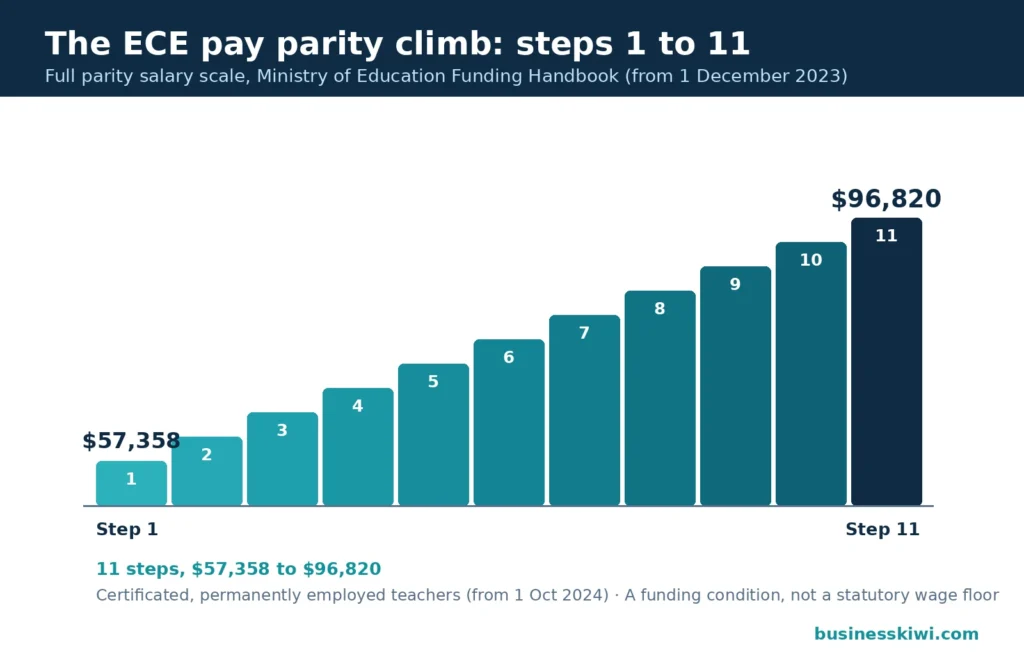
Steps 1 to 6 are identical on the parity, extended parity and full parity scales. The differences appear from step 7 up, where extended parity pays partial amounts and full parity pays the complete kindergarten-aligned steps. The base scale is step 1 alone.
Certificated teachers in designated management positions have their own steps. On the full parity scale these are K2 at $101,120 ($48.62 an hour), K3 at $106,427 ($51.17) and K4 at $115,123 ($55.35). K2 covers the person in charge of a service, typically a centre manager; K3 covers those managing K2 staff; K4 covers those managing K3 staff. Extended parity has a single partial management step of $85,457. Roles such as assistant manager or second-in-charge do not count as management positions for these steps, although those teachers must still be paid on the teacher scale.
Where you enter, and how far you can go
Your qualification group sets both your entry step and your ceiling:
- P1, P2 and P3 (practising certificate held, but no subject or specialist qualification at level 7 or above): enter at step 1, maximum step 10.
- P3+ (a level 7 subject or specialist qualification, such as a graduate diploma or an honours teaching degree): enter at step 3, maximum step 11.
- P4 (a level 8 qualification, such as an honours degree or postgraduate diploma, or two level 7 subject qualifications): enter at step 4, maximum step 11.
- P5 (a level 9 masters or doctorate): enter at step 5, maximum step 11.
Recognised service then moves you up from your entry step. Recognised service covers work as a certificated teacher in licensed early childhood services, as a head or senior teacher in a kindergarten, and teaching in state or state-integrated schools, and it is credited in full. Previous relevant work experience, things like teacher aide work, untrained teaching in a licensed centre, or education roles in the public sector, counts at half rate if it happened within the last 10 years, and can add at most two steps. It is the teacher’s job to give the employer the evidence for all of this.
After placement, progression is one step for every 2,080 hours worked, roughly a year full-time, as long as you are assessed as meeting the Teaching Council standards for your practising certificate. If you improve your qualification and your pay sits below the entry step for the new group, you move up to that entry step. Improving your qualification group does not, by itself, lift you past steps you have not reached through service.
One temporary change matters for new starters. From 1 July 2025 to 30 June 2027, services in the scheme may set the starting step themselves for newly certificated teachers and for certificated teachers new to the New Zealand ECE sector, provided they pay at least step 1. During that window they do not have to credit qualification groups, recognised service or previous experience for those teachers. Progression after starting still applies.
Who is covered and who is not
The attestation covers permanently employed certificated teachers, full-time or part-time, working in teaching or management roles at an education and care or hospital-based service that has opted in. From 1 October 2024 the Ministry has defined “all employed” for the minimum salary scales as permanent staff only.
That definition leaves clear gaps:
- Casual, fixed-term and agency teachers, including most relievers, are excluded from the attestation minimum. A service does not breach its funding conditions by paying a casual reliever less than the scale. Hours worked in those roles still count towards a teacher’s recognised service if they later take a permanent job. Where the Early Childhood Education Collective Agreement (ECECA) applies to an employer, it sets its own reliever rates, calculated as the relevant step salary divided by 2,080.
- Uncertificated teachers and kaiako are not on the parity scales at all. Their pay is set by their employment agreement and any collective agreement that covers them. The ECECA, for example, sets a minimum of $24.32 an hour for unqualified kaiako from 1 July 2025 for employers it covers. Everyone is at least protected by the adult minimum wage.
- Kindergarten teachers are not in the scheme because they do not need to be. Kindergartens are funded at a separate rate, do not attest, and their teachers are employed under the KTCA, the very agreement the parity scales are modelled on.
- Home-based services, playcentres and kōhanga reo are outside the scheme entirely, as are teachers whose centre has chosen not to opt in at any level.
Pay parity vs the old ECE minimum rates
Before parity, the funding system had a single minimum salary attestation: one flat amount that a service had to pay its certificated teachers to access the standard funding rates, regardless of experience. That minimum was $49,862, and it rose to $51,358 on 1 July 2021. A teacher with ten years of experience could lawfully be paid the same floor as a beginner.
The worked comparison shows what changed. Take an experienced teacher placed at step 6. Under the old flat minimum, a service could pay her $51,358 and still meet its funding conditions. Under the parity scale, the minimum for step 6 is $71,869, which is $20,511 a year more. At the top of the full parity scale, step 11 pays $96,820, some $45,462 above the old flat floor. Even the entry point moved: step 1 itself rose to $57,358 from 1 December 2023, $6,000 above the 2021 minimum.
The trade-off is that the higher minimums only bite where a service opts in, and the funding that comes with them does not always cover the full extra payroll cost. That tension explains both the scheme’s staged rollout and why some services remain at base or parity level.

What it means for teachers
Check three things. First, confirm whether your service has opted in, and at which scale. The Ministry publishes the list of services in the scheme on Education Counts after each funding period, showing the scale each service attested to. Second, work out your own step: your qualification group, plus recognised service, plus any half-credit for relevant experience in the last decade. Third, compare that step’s salary with your payslip, remembering that the scale is a minimum for a 40-hour week and your pay should be pro-rated if you work fewer hours, with the hourly rate preserved.
If the numbers do not line up, raise it with your employer first. The Ministry is explicit that disagreements about qualification groups, recognised service or relevant experience are employment relations matters between you and your employer, and that it will not intervene. Its pay parity guide directs teachers who need employment advice to Employment New Zealand. Keep your own records of hours worked, because progression depends on reaching 2,080 hours per step and on being assessed as meeting the Teaching Council standards.
When you apply for a new role, bring the evidence with you: qualifications, practising certificate history and a clear record of your service. Setting that history out well in your application and NZ CV template style documentation makes it much harder for a new employer to under-place you, and under the rules it is your evidence that determines your starting step.
What it means for service owners
Opting in is a financial decision with a long tail. The funding uplift arrives per funding period, but the salary commitment compounds: every teacher progresses a step roughly every year, so the payroll cost of attesting at full parity in 2026 is not the cost you will carry in 2028. The Ministry’s own guide advises owners to project their salary budget several years ahead before opting in, and to factor in where each teacher will sit on the scale over time.
The compliance load is real but defined. You attest three times a year through the RS7. You must keep a staff record and staff hour count, and keep records that verify the salary each certificated teacher is paid and how their initial and current step was determined. If an audit or check finds you did not meet the conditions for the whole attestation period, your funding rate is adjusted and the difference recovered. The current moratorium also limits strategy: services sitting on the parity or extended parity scales cannot move up until it lifts, so the scale you held after the July 2025 round is broadly the scale you keep for now.
Brief history and current state
Pay parity arrived in stages. The minimum salary attestation was lifted to $51,358 on 1 July 2021, and the opt-in scheme itself began on 1 January 2022, with opted-in services paying the first five steps of the kindergarten scale. Step 6 joined the parity scale on 1 January 2023, alongside the extended parity option covering partial steps 7 to 11 and a partial management step. On 1 November 2023 the scales were restructured into the current four, and full parity, the complete steps 1 to 11 plus full management steps, became available. The salary amounts were then updated on 1 December 2023 to the figures in the table above, aligned to the kindergarten agreement as at that date.
Since then the settings have tightened in places. The “all employed” definition was narrowed to permanent staff from 1 October 2024. The July 2025 changes gave services temporary flexibility over starting steps for brand-new teachers and froze upward movement between scales for two years. The amounts themselves, as published in Appendix 4 of the ECE Funding Handbook, remain the December 2023 figures.
FAQs
Is pay parity compulsory for early childhood centres?
No. It is a voluntary funding scheme. A service chooses whether to attest, and at which scale. The consequence of not attesting to at least step 1 is funding at the lowest base band, not a legal penalty, and teachers’ pay at a non-participating service is governed by their employment agreements and general employment law.
What is the starting salary for a certificated ECE teacher?
Step 1 is $57,358 a year, or $27.58 an hour, on every parity scale. Where you actually start can be higher: a P3+ teacher enters at step 3 ($61,948), a P4 teacher at step 4 ($64,133) and a P5 teacher at step 5 ($67,794), before recognised service is added. Note the temporary rule to 30 June 2027 letting services set starting steps for newly certificated teachers, with step 1 as the floor.
Do relievers get pay parity rates?
Not through the funding scheme. Since 1 October 2024 the attestation covers permanently employed certificated teachers only, so casual and fixed-term relievers sit outside the minimum salary condition. A collective agreement such as the ECECA may still set reliever rates for the employers it covers.
Are kindergarten teachers part of pay parity?
No. Kindergartens have their own funding rate and do not attest. Their teachers are paid under the Kindergarten Teachers’ Collective Agreement, which is the benchmark the ECE parity scales are built from.
How do I move up the salary steps?
You progress one step after completing 2,080 hours of work, provided you are assessed as meeting the Teaching Council standards. The hours do not all need to be at one service. Gaining a higher qualification can also lift you to the entry step of a higher qualification group if your current pay is below it.
My centre pays me below my step. What can I do?
Check the scale your service has attested to on the Education Counts list, gather your qualification and service evidence, and raise it with your employer. Step and pay disputes are employment relations matters. The Ministry will not intervene, and its guide points teachers needing advice to Employment New Zealand.
Does full parity mean ECE teachers now earn exactly what school teachers earn?
Not exactly. The full parity minimums mirror the kindergarten teachers’ scale as at December 2023, and kindergarten pay is itself aligned with primary teacher pay. But these are minimums for funding purposes, collective agreements differ in their allowances and conditions, and employers can always pay above the scale. For more education pay and career guides, see the Jobs & Education hub.
Sources
- Ministry of Education, Pay parity opt-in scheme for education and care services: https://www.education.govt.nz/early-childhood/people-and-employment/pay-parity-opt-in-scheme/
- Ministry of Education, ECE Funding Handbook, Chapter 3-B-2, Education and care services: https://www.education.govt.nz/education-professionals/early-learning/funding-and-financials/ece-funding-handbook/3-b-teacher-led-services/3-b-2-education-and-care-services
- Ministry of Education, ECE Funding Handbook, Appendix 4, Minimum salary scales: https://www.education.govt.nz/education-professionals/early-learning/funding-and-financials/ece-funding-handbook/appendix-4
- Ministry of Education, ECE Funding Handbook, Chapter 9-6, Attestation of certificated teachers’ salaries: https://www.education.govt.nz/education-professionals/early-learning/funding-and-financials/ece-funding-handbook/chapter-9-completing-the-rs7-return/9-6-attestation-of-certificated-teachers-salaries
- Ministry of Education, Pay Parity Guide for ECE teachers and service providers, March 2024: https://web-assets.education.govt.nz/s3fs-public/2024-08/Pay-Parity-Guide-for-ECE-teachers-and-service-providers.pdf
- Ministry of Education, Changes to the Pay Parity Opt-in Scheme, 1 July 2025 to 30 June 2027 (PDF): https://web-assets.education.govt.nz/s3fs-public/2025-09/1%20July%202025%20-%2030%20June%202027%20changes%20to%20the%20ECE%20Pay%20Parity%20Opt%20in%20Scheme.pdf
- Beehive, Major step to pay parity for early learning teachers, 12 May 2021: https://www.beehive.govt.nz/release/major-step-pay-parity-early-learning-teachers
- Beehive, Pay parity pathway for early learning teachers confirmed, 15 September 2021: https://www.beehive.govt.nz/release/pay-parity-pathway-early-learning-teachers-confirmed
- Kindergarten Teachers, Head Teachers and Senior Teachers’ Collective Agreement 2023–2026: https://web-assets.education.govt.nz/s3fs-public/2024-09/Kindergarten%20Teachers%27%20Collective%20Agreement%202023-2026.pdf
- Early Childhood Education Collective Agreement of Aotearoa New Zealand (ECECA): https://www.nzeiteriuroa.org.nz/assets/downloads/ECECA-final-unsigned-for-distribution.pdf
Disclaimer
This article is general information about the pay parity scheme as published by the Ministry of Education, including the minimum salary scales in Appendix 4 of the ECE Funding Handbook at the amounts effective from 1 December 2023. It is not legal, employment or financial advice. Individual pay depends on your employment agreement, any collective agreement that covers your workplace, and your employer’s attestation. Check the ECE Funding Handbook for the current rules, and contact Employment New Zealand or an employment adviser for advice about your own situation.