NZQA Exams: NCEA Timetable, Rules and Results Guide
For most New Zealand secondary students, the school year ends in an exam hall. The NCEA external exams run by the New Zealand Qualifications Authority (NZQA) are where a year of learning is tested under the same conditions for everyone, and the results feed into NCEA certificates, course endorsements and university entrance. If you are sitting exams in 2026, or supporting someone who is, this guide gathers the essentials in one place: the confirmed dates, how assessment and marking work, the rules that catch students out, digital exams, special assessment conditions, what happens when illness strikes, fees, and how results and reviews work.
When the 2026 NZQA exams run
NZQA has confirmed that the 2026 end-of-year examination timetable for NCEA and New Zealand Scholarship runs from Tuesday 10 November to Friday 4 December 2026. The dates were pushed back a week from what was first signalled, to give schools more teaching time in Term 4 and students more time to prepare. Sessions are held in the morning, starting at 9.30am, and in the afternoon, starting at 2.00pm.
Two regional anniversary days fall inside the season and have no exams scheduled: Canterbury Anniversary Day on Friday 13 November, and Westland Anniversary Day and Chatham Islands Anniversary Day on Monday 30 November.
The full timetable, subject by subject and level by level, is published on the NZQA website. Your own entries matter more than the general timetable, though. Your NZQA learner account shows the standards you are entered for, and your exam admission slip lists every external exam you are sitting. Check the slip as soon as it arrives and tell your school straight away if anything on it is wrong, because a wrong entry can mean the wrong paper waiting for you on the day. Families planning around the season may find our guide to NZ school holidays and term dates useful for seeing how the exam block fits the rest of Term 4.
How NCEA exams and assessment work
Every NCEA subject is broken into standards. Each standard covers a defined skill or body of knowledge and carries a set number of credits. Some standards are assessed internally, by your teachers during the school year. Others are assessed externally by NZQA at the end of the year, either in a timed exam or through a portfolio or submission, as happens in subjects such as Visual Arts, Design and Visual Communication and Technology.
Achievement standards are graded Not Achieved, Achieved, Merit or Excellence. Passing a standard at Achieved, Merit or Excellence earns its credits; a higher grade does not earn more credits, but it does count towards endorsements. Unit standards, common in vocational subjects, are graded Achieved or Not Achieved only.
Each NCEA certificate, at Level 1, 2 or 3, requires 80 credits in total: 60 credits at that level or above, plus a 20-credit literacy and numeracy co-requisite made up of 10 literacy credits (or Te Reo Matatini) and 10 numeracy credits (or Te Pāngarau). The co-requisite only has to be met once, and it then counts for every level. Credits can be gathered over more than one year, so a certificate does not have to be completed in a single season.
Strong performance is recognised through endorsements. A certificate is endorsed with Merit or Excellence when 50 or more credits at that level or above are gained at Merit, or at Excellence for an Excellence endorsement. Within a single course, 14 credits at Merit or Excellence in one year, including at least 3 credits from internal assessment and 3 from external assessment, earns a course endorsement.
Marking is done by NZQA markers working to an assessment schedule, using grade score marking. Each answer earns a score, and the score ranges that turn those scores into grades, called cut scores, are set once marking is under way and published for each standard. That is why a raw score does not translate neatly into a grade.
Digital exams
A growing share of NZQA exams are sat on a computer rather than on paper, and the balance keeps shifting. In 2026, where a Level 1 exam is offered digitally, students sit it on a computer, and a paper version is available only where an exception has been approved. At Levels 2 and 3, schools decide which subjects they offer digitally, so check with your school which of your exams will be on screen.
You log in to a digital exam with the same NZQA learner account you use to check entries and results, so learn your username and password well before November. Bring a fully charged device, run NZQA’s device readiness check in advance, and work through the practice activities so the platform feels familiar. If you are sitting a language listening exam or Te Reo Rangatira, bring headphones that work with your device.
If something goes wrong mid-exam, put your hand up and tell the supervisor. You can switch to paper between standards, but each standard has to be completed one way or the other, and once you move to paper you cannot switch back to the screen for that standard. Digital responses are marked online, and you can view your marked digital exam in your learner portal once results are out.

Exam day: what to bring and the rules that matter
Take your admission slip to every exam. It stays face up on your desk, and it carries your National Student Number (NSN) and exam code, which match you to the right room, desk and answer booklets. Never write on it. If you lose it, reprint a copy from your learner portal or ask your school’s Principal’s Nominee for one; a replacement has to be signed by the Principal’s Nominee before you can sit.
Arrive at least 20 minutes before your session starts. If you arrive more than 30 minutes after the official start, you will not be allowed in without NZQA approval, and turning up late does not earn you extra time at the end.
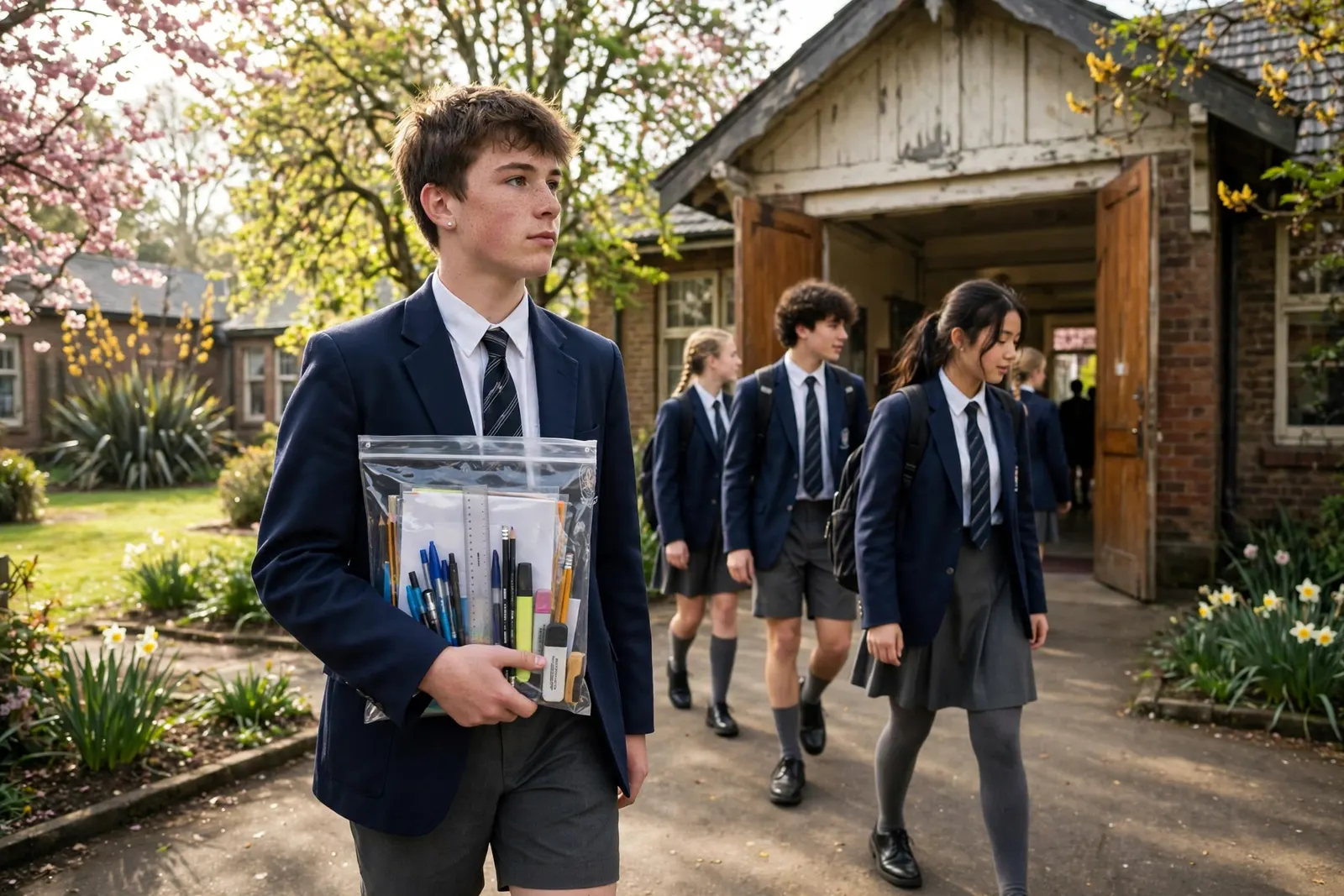
Bring your own equipment in a clear plastic bag or clear pencil case: black or blue pens, and, for subjects that allow them, up to two approved calculators with their memories cleared and checked. Write in pen, because answers in pencil may not scan properly and might not be seen by the marker. You cannot borrow equipment from anyone during the exam.
Phones, watches and notes are banned from your desk. Any electronic device has to be switched off and sealed inside your emergency evacuation pack, a clear bag that sits under your chair and stays untouched unless a supervisor gives permission or there is an evacuation. The pack is the place for your phone, keys, money, medicines and travel pass. Photo ID is required if you are sitting a Scholarship exam, or your exams at a school that is not your own.
In the room, follow the supervisors’ instructions, do not talk or communicate with other candidates, and note that you cannot leave during the first 45 minutes or the last 15 minutes of an exam. Breaking the rules can be investigated as a breach and can put your results at risk. If two of your exams land at the same time, that is an exam clash: tell your Principal’s Nominee as soon as you spot it, not on the day.
If something goes wrong: derived grades
A derived grade is an evidence-based grade that NZQA may award when you cannot sit an exam, or your performance is seriously affected, by something temporary and outside your control. Common grounds include a temporary acute illness or injury, such as gastroenteritis, COVID-19, measles or a broken arm; a traumatic or deeply distressing experience; or a sudden, significant worsening of a long-term illness in the week before your first affected exam. Students selected to represent New Zealand in sport, culture or academics can also qualify, but that route needs NZQA pre-approval well in advance.
The grade itself comes from evidence your school already holds, usually your result in a formal practice exam for that exact standard. Schools submit these grades to NZQA before the exam season, which is why practice exams deserve to be taken seriously. A derived grade cannot make up for missed learning or a lack of preparation, and ordinary exam stress, minor colds and family holidays do not qualify.
Apply through your school’s Principal’s Nominee as soon as possible, with independent evidence such as a doctor’s note covering the exam dates, and no later than two weeks after your last affected assessment. If your application is approved and you sit the exam anyway, you keep the higher of the exam grade and the derived grade. Derived grades are not available for New Zealand Scholarship, because Scholarship is a competitive award.
There is also a safety net for large-scale events. When an event such as an earthquake, severe weather or a major disruption affects a whole school or region, NZQA can declare derived grades at scale, the process once known as unexpected event grades. Students do not apply individually; the school provides its quality-assured practice grades and NZQA awards the better of the two grades, just as it does for individual applications.
Special assessment conditions
Special assessment conditions (SAC) exist for students with an ongoing need that would otherwise get in the way of showing what they know. That includes specific learning difficulties such as dyslexia, sensory or physical impairments, medical conditions and mental health needs.
Depending on the need and the evidence, NZQA can approve a reader, a writer or typist, computer use, rest breaks, extra time, separate accommodation, enlarged papers or special papers such as braille, a signer for students who are Deaf or hard of hearing, or assistive technology. Applications are made by your school to NZQA with supporting evidence, so raise it with the school early in the year rather than in October. Some help is restricted where it would change the skill being assessed: in a languages exam, for instance, a reader can read the instructions and the English text but not the language being tested, and a writer is not available for some Visual Arts and design standards.
Ongoing conditions belong in the SAC process rather than the derived grade process, although a sudden flare-up of a condition close to an exam can be considered for a derived grade as well.
Fees
For domestic students, entering NCEA and New Zealand Scholarship costs nothing. NZQA makes no charge for domestic student entry.
International fee-paying students are treated differently: a standard annual fee applies to their NCEA and Scholarship entries. Schools pay the fee to NZQA and recover it through their own invoicing, so the charge reaches families through the school rather than as a bill from NZQA. Ask your school for the current amount, since it is the school that will invoice you.
Results, reviews and reconsiderations
NCEA results are released through your NZQA learner login in January. You can view your assessed exams in the portal from late January; booklets are no longer posted back. Scholarship results and assessed Scholarship papers follow in February. When your results land, check them against your marked work. Your Record of Achievement lists everything you have gained, and certificates can be requested through the portal. If you have finished short of the credits you need, talk to your school early about your options.
If you think something has gone wrong, there are two different checks, and choosing the right one matters.
A review is a free check that everything in your booklet or portfolio was marked, and that your results were recorded and transferred correctly. No re-marking happens in a review, so it suits missing content, mismatched totals or a grade that does not line up with the published cut scores.
A reconsideration is a full re-mark of your answers against the original assessment schedule. Your grade cannot go down as a result. It costs $20.40 per NCEA standard and $30.70 per Scholarship standard, and the fee is refunded if your grade changes. The fee is waived when a parent or caregiver receives a Work and Income or StudyLink benefit, or when family income would qualify for a Community Services Card.
Apply through your learner portal, and talk to your teacher first: they can help you judge how close your score was to the next grade boundary. Do not write on or alter your answer booklets once you get them, because booklets that contain pencil work or correcting fluid are not eligible for a reconsideration, and Level 1 and 2 Visual Arts standards cannot be reconsidered at all. Applications close on a date NZQA sets for each cycle, a few weeks after results are released, so do not sit on the decision.
A final word
Exam season is demanding, but it is well mapped: the dates are set, the rules are published, and there are processes for illness, disruption and extra support. Know your entries, prepare steadily, and ask your school early about anything in this guide that applies to you. For more guides on study, school and next steps after NCEA, browse our Jobs & Education hub.
Sources
- NZQA, 2026 Examination Timetable dates and intra-year Assessment Timetable (Circular A2025/12): https://www2.nzqa.govt.nz/about-us/publications/newsletters-circulars/assessment-matters/a2025-12/
- NZQA, NCEA levels and certificates: https://www2.nzqa.govt.nz/ncea/about-ncea/ncea-levels-and-certificates/
- NZQA, Learner Information Sheet: external assessment rules and instructions for learners: https://d2u4q3iydaupsp.cloudfront.net/uploads/d9cde1c9-e0e6-4443-ad67-f0590242378c.pdf
- NZQA, Derived grades: https://www2.nzqa.govt.nz/ncea/ncea-for-teachers-and-schools/managing-national-assessment-in-schools/derived-grades/
- NZQA, Derived grades at scale for unexpected events: https://www2.nzqa.govt.nz/ncea/ncea-for-teachers-and-schools/managing-national-assessment-in-schools/derived-grades/available/at-scale/
- NZQA, Special Assessment Conditions support for some student needs: https://www2.nzqa.govt.nz/ncea/ncea-for-teachers-and-schools/fair-access/available/some-needs/
- NZQA, Paying fees for international fee-paying candidates: https://www2.nzqa.govt.nz/ncea/ncea-for-teachers-and-schools/managing-national-assessment-in-schools/managing-school-data/fees-for-international-candidates/
- NZQA, NCEA reviews and reconsiderations: https://www2.nzqa.govt.nz/ncea/student-assessment-hub/ncea-results/reviews-and-reconsiderations/
- NZQA, New Zealand Scholarship reviews and reconsiderations: https://www2.nzqa.govt.nz/ncea/understanding-secondary-quals/nz-scholarship/nz-scholarship-results/nz-scholarship-reviews-and-reconsiderations/