Reading Levels and Ages NZ: Examples, Activities & Free Learning Guide
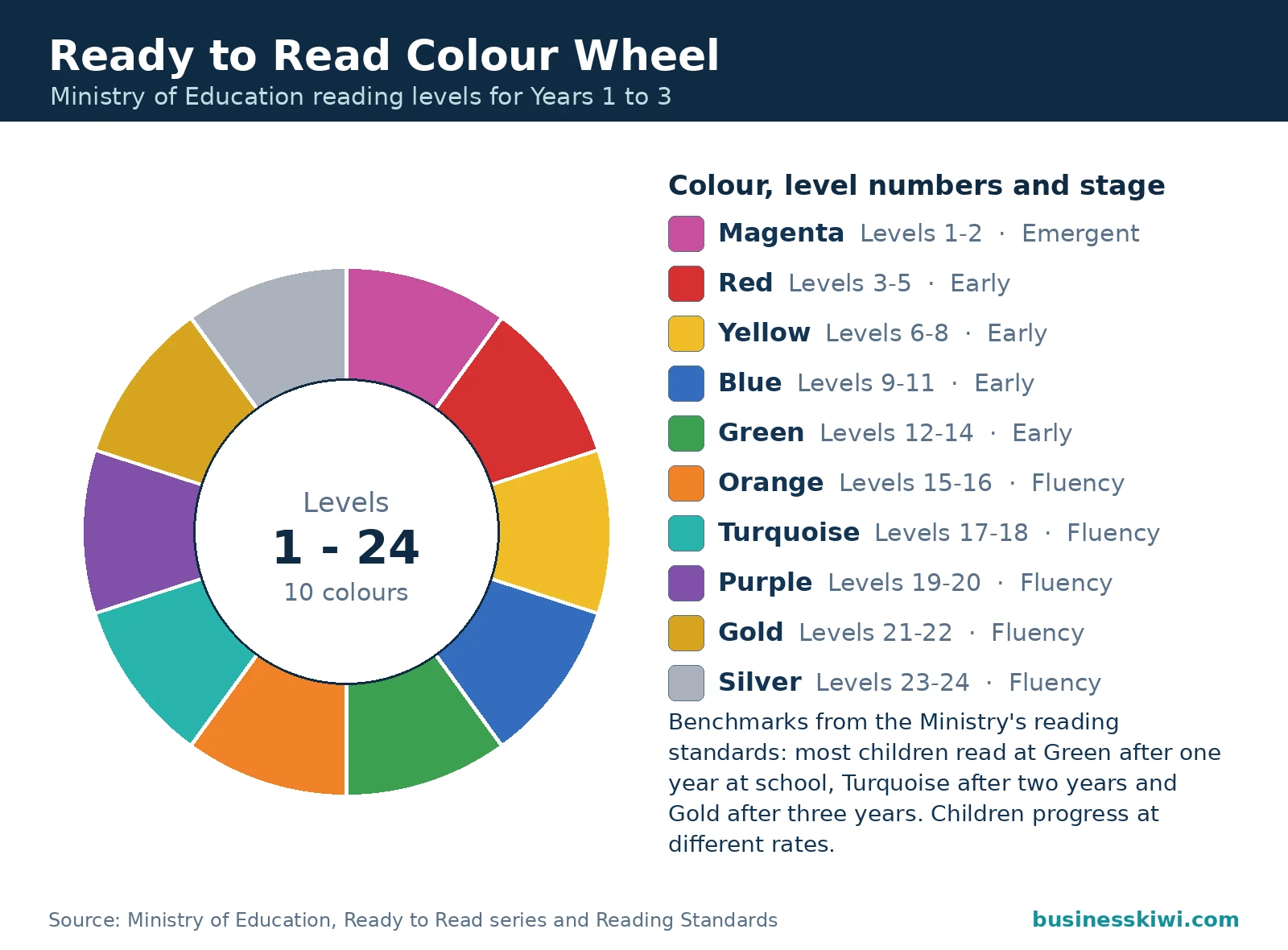
Reading levels in NZ, in brief: New Zealand’s core reading series for Years 1 to 3 is Ready to Read. Its books are levelled on a colour wheel that runs from Magenta (levels 1–2) through Red, Yellow, Blue and Green, then on to the fluency colours Orange, Turquoise, Purple and Gold (levels 21–22), with Silver beyond that. The Ministry’s long-published benchmarks say most children read at Green after one year at school, Turquoise after two years, and Gold after three years. Because Kiwi kids start school on or just after their fifth birthday, those points land at roughly ages six, seven and eight. They are guides, not deadlines.
Your child brings home a reading book with a coloured circle on the back cover. The teacher mentions a colour, maybe Magenta, Green or Turquoise, and you nod along. Then you get home and wonder what that colour actually means. Is your child on track?
This guide answers those questions in plain language. It explains the Ready to Read colour wheel that New Zealand primary schools use in Years 1 to 3, which colours children usually reach after one, two and three years at school, how teachers assess reading, and what you can do at home at each stage.
Everything here comes from Ministry of Education sources. Where the Ministry gives a range or talks about what children typically do, this guide keeps that wording. Reading development varies a lot from child to child, and the Ministry says so itself.
The colour wheel at a glance
Every Ready to Read book carries the colour wheel on its back cover. The wheel starts with Magenta at the top, at 12 o’clock, and moves clockwise. Magenta is the emergent stage, where children are just beginning. Red, Yellow, Blue and Green are the early levels. Orange, Turquoise, Purple, Gold and Silver are the fluency levels, where reading becomes smoother and more independent.
Each colour also has sub-levels. Green, for example, splits into Green 1, Green 2 and Green 3. That gives teachers small steps to work with, so a child can move up within a colour before the colour itself changes.
What each stage actually means
A level is not a grade or a pass mark. It describes the kind of text a child can handle with teaching support. As children move around the wheel, the books quietly get harder in several ways at once. They get longer, the sentences get more complex, and more of the meaning sits between the lines, so readers have to infer rather than just decode.
Emergent: Magenta
At Magenta, children are learning how books work. They hold the book the right way up, turn pages in order, and match their voice to the words. Texts are very short and the pictures do much of the storytelling. A child at Magenta is building the foundations: letter names and sounds, a handful of high-use words, and the idea that print carries meaning.
Early: Red to Green
Through Red, Yellow and Blue, children link letters to sounds and start solving unfamiliar words instead of waiting to be told. Books stay short and supportive, with familiar settings and repeated language.
Green is a milestone. The Ministry describes Green texts as up to about 300 words, with one storyline or topic and generally familiar contexts. New features appear, such as diagrams and speech bubbles. Children reading at Green use punctuation to phrase their reading, notice when something does not make sense, and fix mistakes themselves. Under the reading standards the Ministry published, a child meeting the standard after one year at school could read seen Green texts with at least 90 percent accuracy.
Fluency: Orange to Gold and beyond
From Orange onwards, the focus shifts from learning to read towards reading to learn. Turquoise texts run to roughly 300–500 words. They include labelled diagrams, inset photographs and bold print for topic words, and more of the content is implied rather than stated. Gold texts may have more than 500 words and can be read over more than one session. Their settings may sit outside a child’s direct experience, with shifts in time and place.
After Gold and Silver, children move on to Junior Journals, CHAPTERS and School Journals, which carry reading through the rest of primary school.
Where do ages fit in?
Parents usually ask about ages, but the New Zealand system counts time at school instead. There is a good reason for that. Children here start school on their fifth birthday or soon after, not all together at the start of a year. Two children in the same class can be almost a year apart in age, yet both be in their first year of schooling.
That is why the Ministry’s benchmarks talk about years at school. After one year at school, most children read at Green level. After two years, Turquoise. After three years, Gold. If your child started on their fifth birthday, those points arrive at about age six, seven and eight. Treat those ages as a rough translation, never as a deadline.
Children also start school at very different points. Some arrive knowing most letter sounds. Others are still building oral language, especially if English is an additional language for them. And progress is rarely steady. Children often sit on one colour for a while, then jump two colours in a term. The Ministry’s own guidance stresses that students start at different points and progress at different rates.
School timing shapes all of this. You can check term dates and plan family reading time around the breaks with our guide to NZ school holidays.
Before the wheel: Phonics Plus decodable books
If your child has just started school, their books may not carry a colour at all. Many new entrants begin with Ready to Read Phonics Plus. These are decodable books, written so children can sound out almost every word using the letter and sound patterns they have been taught.
Phonics Plus has four phases: Kākano | Seed, Tupu | Seedling, Māhuri | Sapling and Rākau | Tree. Each phase introduces new sounds and letter patterns in a set order, and each book practises what has been taught so far. Teachers usually introduce Colour Wheel books once a child can decode words with two-letter sounds and blends and has learnt some long vowel patterns. Ministry guidance suggests starting Colour Wheel books from Blue level upwards at that point, alongside the decodable books.
Reading also starts well before school. Talk, songs, rhymes and shared stories at home and at their early childhood centre all build the oral language that reading grows from.

How teachers decide your child’s level
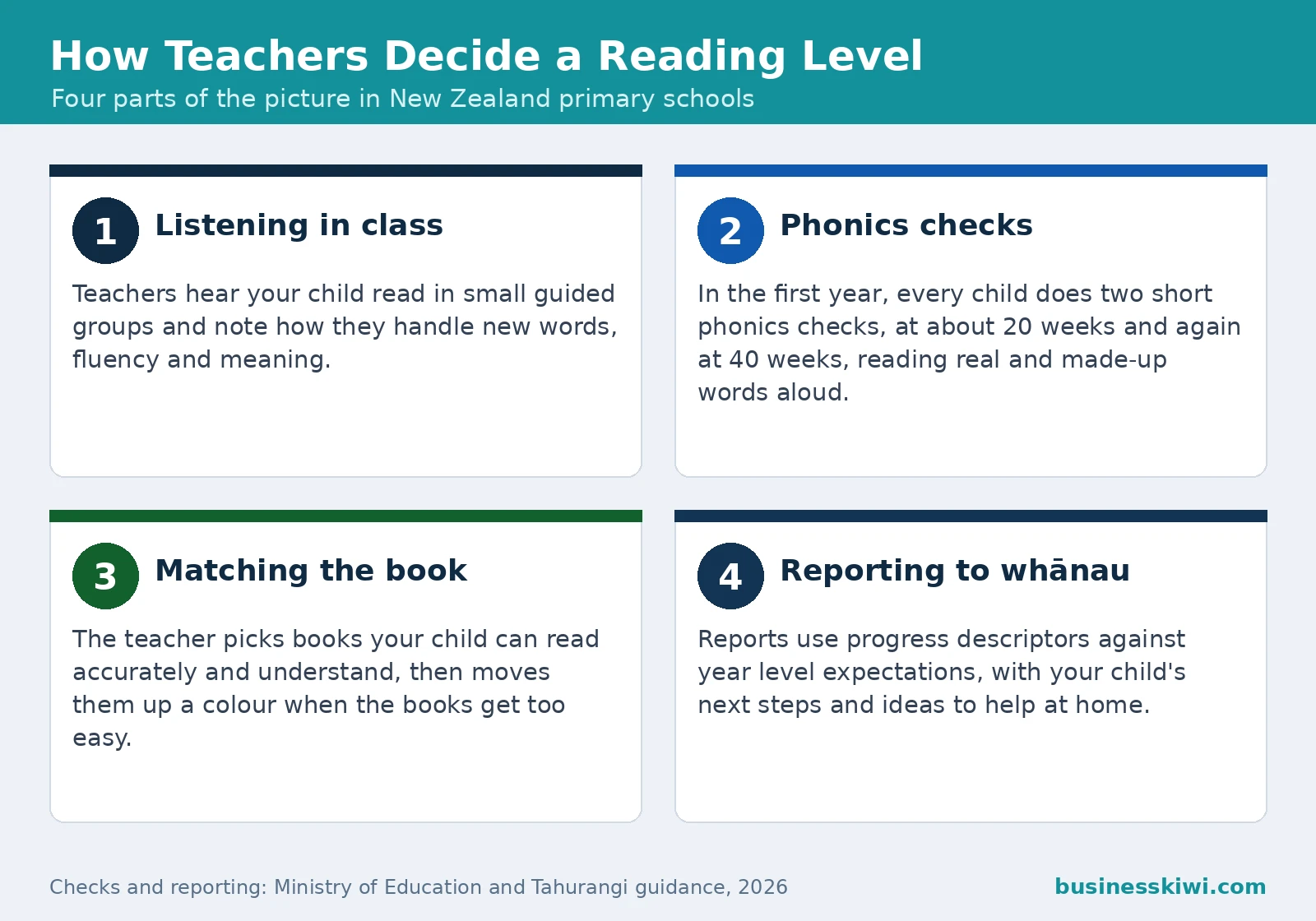
No single test sets a reading level. Teachers build the picture from several sources.
Listening in class. Teachers hear children read in small guided reading groups. They watch how a child tackles an unknown word, whether the reading sounds smooth, and whether the child understands what they have read. This ongoing observation is the main way teachers choose the next book.
Phonics checks. From 2026, all schools carry out the Ministry’s phonics checks with children in their first year of school. The first check happens at about 20 weeks, roughly two terms in. The second happens at 40 weeks, about one full year. Your child reads words aloud one at a time. Some words are real and some are made up. The made-up words matter because a child cannot memorise them. They show whether the child can truly use letter and sound knowledge to work a word out. If a child starts to struggle, the teacher can stop the check after five wrong answers in a row. Ask your child’s teacher how the results will be shared with you. Children learning through te reo Māori do a companion set of checks called Hihira Weteoro.
Matching the book. A level is only useful if the book fits. Teachers pick texts a child can read accurately and understand, with enough challenge to learn from. When the current colour gets too easy, the child moves up.
Reporting to parents and whānau. Schools now report against the refreshed English curriculum. Progress Markers describe the learning expected by the end of each year level, and teachers use Progress Descriptors to report where your child sits against those expectations. A good report also gives your child’s next learning steps and how you can help at home. If a report mentions colours, ask the teacher what the next colour involves. Most teachers are happy to walk you through the wheel.
What you can do at home, stage by stage
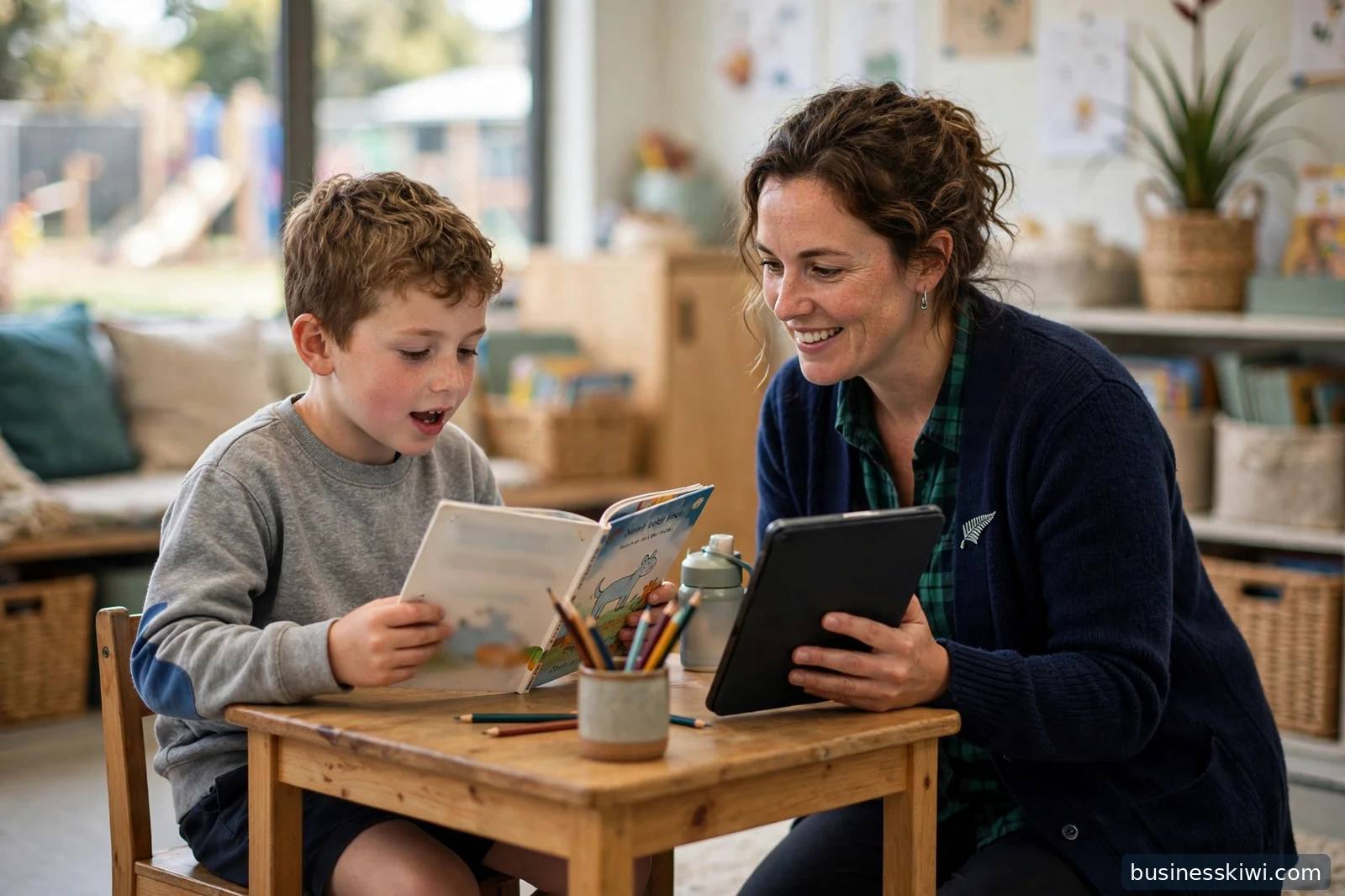
The Ministry’s advice for parents is practical and low pressure. Short, regular reading beats long, reluctant sessions. Ten relaxed minutes most days will do more than a forced half hour on Sunday.
At Magenta and Red
• Read the school book together, then let your child reread it. Familiar books build confidence fast.
• Talk about the pictures. Ask what might happen next.
• Play with sounds. The Ministry suggests asking what sound ingredients start with while you cook, sorting objects by their beginning sounds, and building simple words with magnetic letters.
• Keep it fun. If a session turns into a battle, stop and try again tomorrow.
At Yellow, Blue and Green
• Let your child read to you, and resist jumping in at the first pause. Give them a few seconds to work the word out.
• When they get stuck, prompt with the sounds: "What does it start with? Can you blend it?"
• Ask about the story afterwards. Who was in it? What happened at the end?
• Mix school books with library books on topics your child loves. Dinosaurs, trucks and jokes all count.
• Hands-on play still matters too. Building and making games grow vocabulary, and hands-on learning toys make it easy.
At Orange, Turquoise, Purple and Gold
• Your child can now read silently and for longer. Protect some quiet reading time, and keep reading aloud together too. Most children enjoy being read to well beyond the age they can read alone.
• Talk about harder books. Ask what a new word might mean, or why a character did something.
• Non-fiction is gold at this stage. Diagrams, captions and glossaries are part of the learning, so point them out.
If your child seems behind, or well ahead
One colour either way is normal variation, especially in the first two years. Children develop in bursts, and a child who started school at five years and ten months has had a very different run-up from one who started at five exactly.
Talk to the teacher if you are worried. Good questions include: What colour is my child reading at, and what comes next? What did the phonics check show? What is the one thing we should practise at home? Schools can add extra support, such as small group teaching targeted at the exact skill your child needs.
If your child is flying through levels, ask how the school stretches strong readers, and feed the habit at home with longer books and new topics.
Frequently asked questions
What reading level should a 6 year old be at in NZ?
Most children who started school at five reach Green level, which is levels 12–14 on the colour wheel, after one year at school. That lands at about age six. It is a benchmark, not a cutoff. Children progress at different rates, and teachers judge progress against time at school rather than birthdays.
What are the Ready to Read colours in order?
The wheel runs Magenta, Red, Yellow, Blue, Green, Orange, Turquoise, Purple, Gold and Silver. Magenta sits at the top and the colours move clockwise. Magenta to Green are the emergent and early stages. Orange onwards are the fluency stages.
What is the difference between Phonics Plus and Colour Wheel books?
Phonics Plus books are decodable. Children can sound out nearly every word using patterns they have already been taught. Colour Wheel books are levelled readers for guided reading. They use a wider range of words and build comprehension. Schools use Phonics Plus first, then add Colour Wheel books, usually from Blue, once decoding is secure.
What happens in the phonics check?
Your child reads a short list of words aloud to the teacher, one at a time. Some words are real and some are made up, so the teacher can see if your child can apply letter and sound knowledge to words they have never seen. Checks happen at about 20 weeks and 40 weeks of the first year at school. They are quick, low key activities, and the teacher can stop early if a child is struggling.
My child has been on the same colour for months. Should I worry?
Not necessarily. Each colour has sub-levels, so your child may be moving within the colour even if the colour name has not changed. Progress also comes in bursts. Ask the teacher what your child is working on and what the next step looks like.
Does reading level matter more than enjoying books?
Enjoyment drives everything. A child who loves stories will read more, and reading more is what builds skill. Keep home reading relaxed and positive, and let your child choose some books purely for fun, even if they look too easy or too hard. The level is a teaching tool for matching instruction, not a limit on what your child can enjoy.
What comes after the colour wheel?
After Gold and Silver, children move to Junior Journals, then CHAPTERS and School Journals, the Ministry’s instructional series for the middle and senior primary years. From there, reading becomes part of every subject, and children read to learn across the curriculum.
The bottom line
The colour wheel is simpler than it first looks. Magenta to Green covers the early stages of learning to read. The Ministry’s benchmarks put most children at Green after one year at school, Turquoise after two and Gold after three. Teachers set levels using classroom observation, the phonics checks and their knowledge of your child, not one test score. Your job is the enjoyable part: read together often, talk about books, and keep it positive.
For more guides on schooling, year levels and learning in New Zealand, browse our education guides.
Sources: Ministry of Education, The Reading and Writing Standards for Years 1–8; Tāhūrangi, Using structured literacy approaches with the Ready to Read Colour Wheel series and Ready to Read Phonics Plus phase pages; Ministry of Education, Phonics checks (parents and caregivers); Tāhūrangi, Reporting to parents and whānau.