Pennylane Early Childhood Centre: Hours, Ages and What Parents Need to Know
Pennylane Early Childhood Centre is a privately owned education and care centre at 79 Hoon Hay Road in Hoon Hay, Christchurch. It takes children from birth to school age across a nursery and a preschool, runs four named rooms, cooks all its food on site, and is owned and operated by a local couple, Luke and Sarah Dixon. Its most recent Education Review Office (ERO) report, a full quality evaluation published in April 2022, rated its leadership and professional learning at the highest level ERO gives.
This profile is drawn from the official record: the centre’s Ministry of Education directory profile, its ERO reports, the centre’s own website, its parent handbook and its enrolment form. Where those sources disagree, both versions are given rather than one being quietly chosen. The Ministry’s current record licenses the centre for more children than ERO recorded at its last two reviews, and the centre’s handbook and enrolment form describe the age range for 20 Hours ECE funding in two different ways. Each case is flagged where it arises.
Pennylane Early Childhood Centre at a glance
One naming point before anything else, because this centre is searched for under several names. The Ministry of Education and ERO both record the service as Pennylane Early Childhood Centre, with Pennylane as one word, and that is the name used in this profile. The centre itself usually shortens that to Pennylane, and its enrolment form’s service declaration uses yet another form, Pennylane Early Learning Centre. Names with a space in them, such as Penny Lane Preschool, appear on third-party listings but in none of the official sources. All of them point to the same service, at the same address, with the same service number.
The centre and how it is run
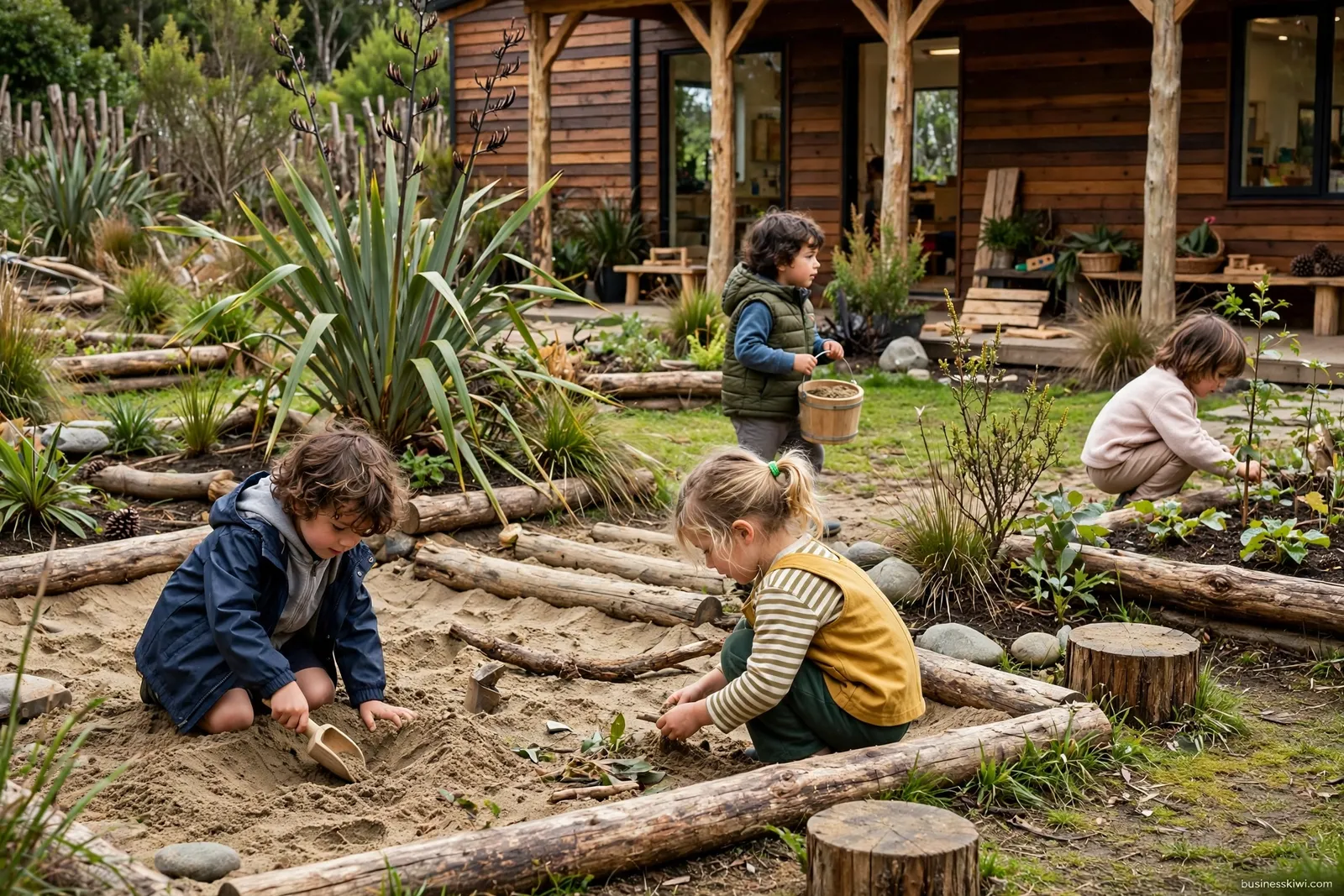
Pennylane is a purpose-built centre. ERO’s 2022 report describes it as a purpose-built and intentionally designed centre, and its 2018 report described a modern, purpose-built building with considerable development of the outside environments by the owners in the years between reviews. The centre’s own website makes the same point in plainer language: its indoor learning spaces and outdoor environments are larger than national requirements, because children need space to play.
Ownership sits close to the floor. The parent handbook states that the centre is proudly locally owned and operated by Luke and Sarah Dixon, and ERO records that the owners provide ongoing governance and management support. ERO also records that Pennylane is one of two services the owners run privately. Day-to-day operation sits with the centre manager and two team leaders, in ERO’s 2022 account. In 2018 ERO described a manager and two teacher mentors who led the nursery and the preschool, overseeing the curriculum and supporting teaching and learning. The leadership shape is consistent across the two reports; only the job titles have changed.
Inside, the centre works through four rooms. Its website lists teaching teams for the Kohara Room, the Pakiki Room, the Kahurangi Room and the Kohanga Room, alongside a support team. ERO’s 2018 report describes the same footprint from the other direction: a nursery and a preschool, each of two classrooms with an adjoining outdoor area. No permitted source maps each room name to an age group, so this profile does not guess at which room takes which ages; parents visiting will be shown which rooms their child would move through.
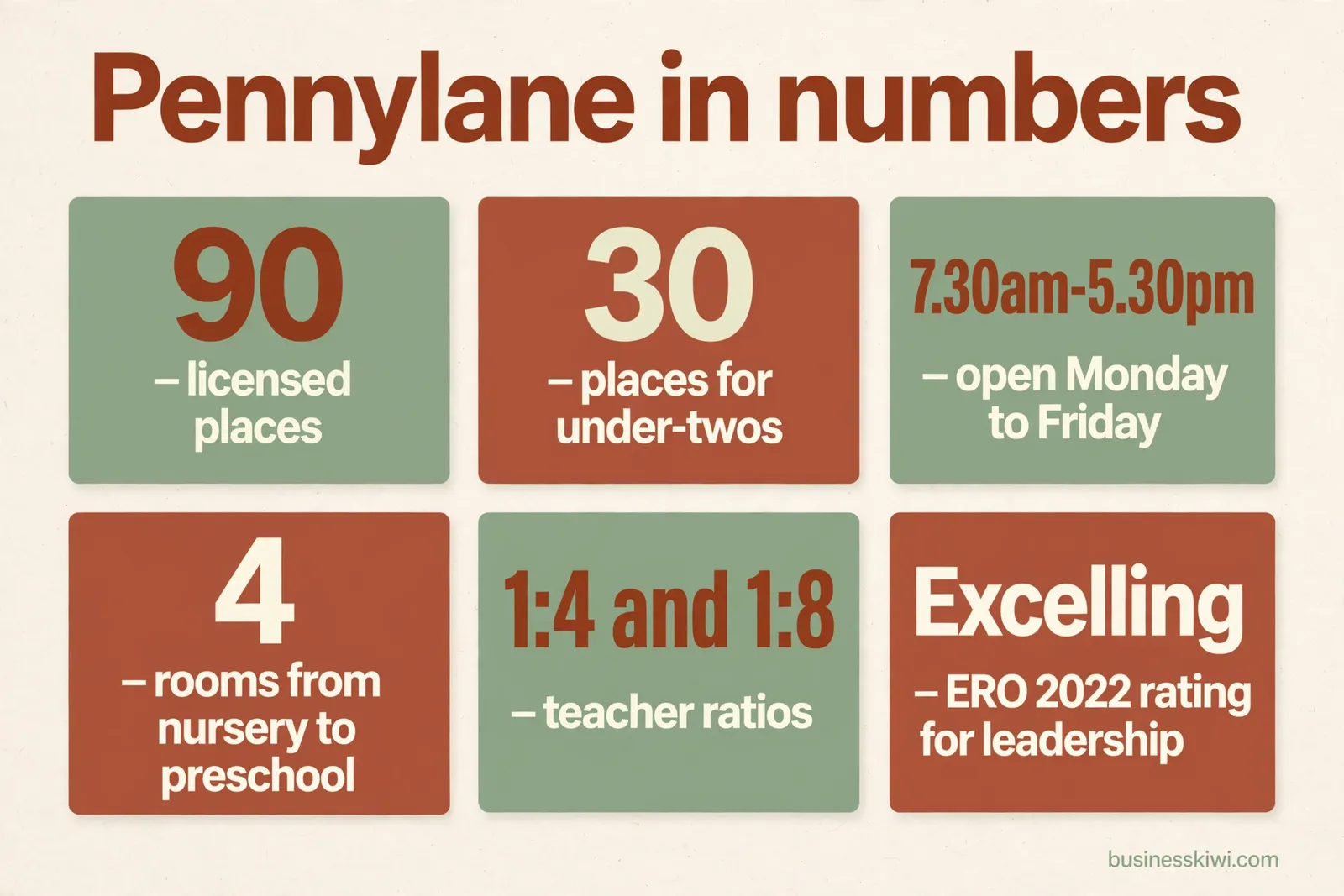
The licence position needs care, because the official sources give two different ceilings. Education Counts currently records the centre as licensed for a maximum of 90 children, including up to 30 under two. ERO’s reports, in both 2018 and 2022, record the centre as licensed for 85 children, including up to 30 aged under two. The under-two maximum agrees everywhere; the total does not. The most likely reading is that the licence has been extended since ERO last reviewed the centre in late 2021, but no permitted source says that in so many words, so this profile reports both figures with their dates and sources. Parents comparing centres should work from the current Education Counts figure of 90, and can ask the centre to confirm it.
Roll numbers count something different from the licence: the number of children enrolled across the week, not the number present at one time, which is why a roll can sit above a daily licence figure where many children attend part weeks. ERO’s current listing shows a roll of 110; its 2022 report recorded 133, and its 2018 report 119. None of the sources explains the movement, and this profile does not speculate about it.
Philosophy: love, laughter and learning
The centre sums itself up in three words: love, laughter and learning. Love is “we are whānau”, modelling love, kindness and respect. Laughter is days filled with adventure, challenge and play. Learning is “together we grow”, in spaces the centre describes as peaceful and inspiring. Underneath all three sits the sentence the owners repeat on the website and in the handbook: family is everything, and the centre aims to be an extension of your home.
The parent handbook sets out four learning priorities that guide teaching: relationships, children making connections between people, places and things (Te waihanga hononga); children leading their own learning (Te rangatiratanga); resiliency and a strong sense of identity (Te whakahua whakaaro); and collaboration, working in close partnership with parents, whānau and the community.
Formally, the programme is built on Te Whāriki, the national early childhood curriculum. ERO’s 2022 evaluation found a rich curriculum underpinned by Te Whāriki and the service philosophy, with kaiako committed to enacting Te Tiriti o Waitangi principles in everyday practice, and named the te ao Māori values woven through the daily curriculum: manaakitanga (care), ako (collaborative learning), kaitiakitanga (environmental guardianship) and whanaungatanga (relationships). The same report set the centre one clear direction for growth, covered in the ERO section below: integrating the local cultural narrative into all aspects of the curriculum, rather than most of it.
The programme: four rooms, primary caregiving and a chef
The centre’s stated starting point is play. Its programme page calls play a child’s unique way of learning about the world, and provides for both spontaneous play and more structured activities for children who enjoy the challenge. Learning environments are described as calm and unhurried, with time for rich conversations, and children free to explore and make their own discoveries. Teachers work with each child and family to recognise individual learning goals and aspirations, then plan experiences against them.
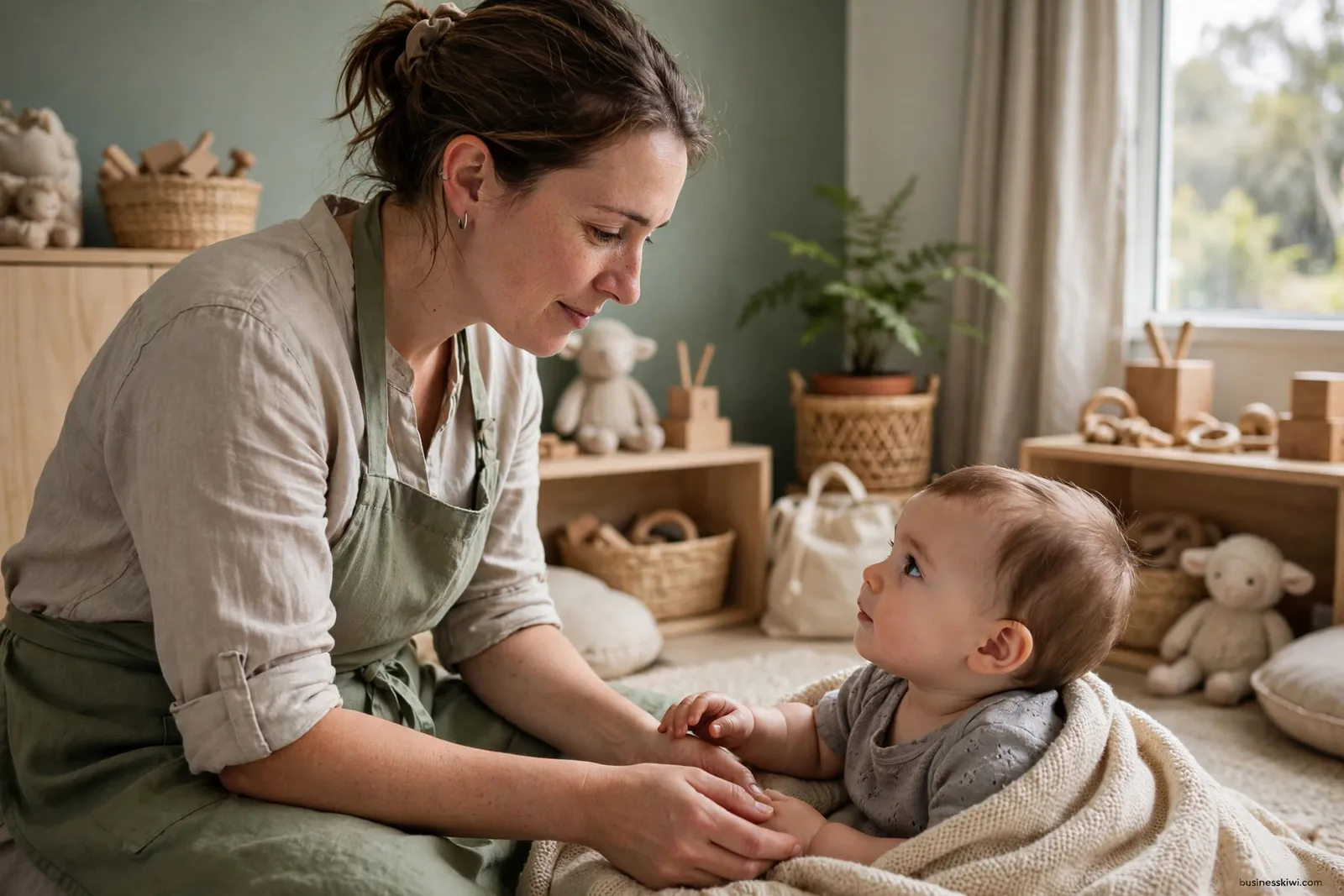
For the youngest children, the organising idea is primary caregiving. A child joining the nursery is given a key caregiver, one special person responsible for that child’s care moments: feeding, dressing, changing nappies and sleeping. The centre explains the reasoning directly. Consistency and stability make the transition into care easier, care moments are the special one-on-one times of the day, and those times should be respectful, enjoyable and unhurried, because that is when the relationship is built. ERO’s reviewers noticed the effect: the 2022 evaluation recorded that infants and toddlers experience an unhurried curriculum with a strong focus on sensory and social competence learning, and the 2018 review recorded deliberate planning for smooth transitions and thoughtful consideration of which teacher takes major responsibility for each child.
At the other end of the centre, the programme turns towards school. From the age of four, children gather for group experiences designed to build the knowledge and skills they will need at school, and the centre says it works closely with local schools so the transition is enjoyable for children and parents alike. ERO’s 2018 review also described older children supporting and learning alongside younger ones in tuakana-teina relationships.
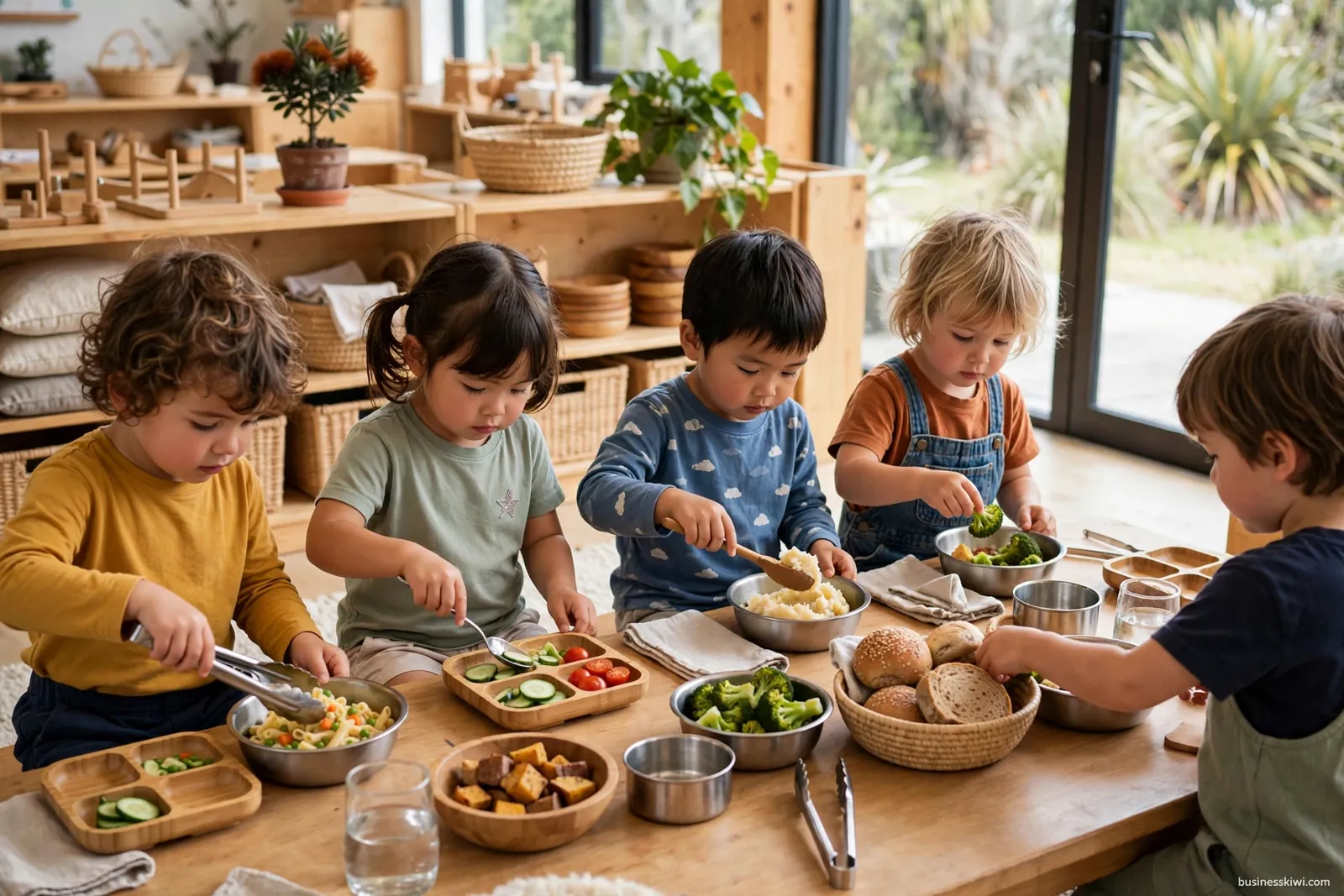
Food is provided in full, and it is part of the fee rather than an extra. The centre’s Our Place page says all of a child’s food is provided, that the menu was developed with a dietician to be high in nutrients and low in sugar, and that it is cooked on site by the centre’s qualified chef; the handbook confirms meals are included in the weekly fees. Mealtimes are treated as family meals, with children encouraged to serve themselves, clear their own plates and show appreciation for their food. The centre says it caters for a wide range of allergies, intolerances and cultural preferences, and shares recipes with families. Its staff page names the cook: Jess, listed as Centre Cook.
Parents follow the day through Storypark, the online platform the centre uses for learning stories and photos, and each child also has their own book documenting learning goals, achievements and artwork, which becomes a keepsake. The centre holds whānau evenings, education evenings and celebrations through the year, and its handbook covers excursions out of the centre from time to time, alongside the ordinary apparatus of an early childhood service: sleep and rest times, toileting support, behaviour guidance and illness and medication policies.
Hours, sessions and the shape of the year
Pennylane is a full-day, all-year centre rather than a term-time-only kindergarten. The parent handbook states the hours plainly: open Monday to Friday from 7.30am to 5.30pm, closed on public holidays. The enrolment agreement is expressly inclusive of school term breaks, so the centre stays open through the school holidays, the arrangement many Hoon Hay families with mixed-age children are looking for. The centre’s documents also refer to a Christmas closure period: the enrolment form says no fees will be charged while the centre is closed over Christmas, and the holiday holding fee does not apply then. Neither document states the length of that closure, so its dates are a question for the centre each year rather than a figure this profile can give.
Attendance runs on booked session times within those hours. Parents sign their child in and out every day at the front door, which the handbook notes is a legal requirement tied to the centre’s funding returns, as well as a safety measure for emergency evacuation. Children must be collected by the time on their enrolment form; the handbook asks parents to phone ahead in an emergency and warns that a late fee may apply.
The centre operates an open door policy within its hours: parents and family are welcome at any time, and the handbook frames that participation as a positive message to children that their family supports their learning. What to bring is the ordinary list for a full-day centre: old or play clothes and a spare change packed every day, rain attire and gumboots in winter, and a sunhat in summer, with sunblock applied before arrival and reapplied by the centre during the day.
Fees and 20 Hours ECE: what is published, and what is not
The centre does not publish its fees. No fee schedule, hourly rate or session charge appears on its website, in its parent handbook or on its Education Counts profile. The handbook says instead: “Please refer to the Fees Schedule that is available from Reception.” Families receive that schedule as part of the enrolment paperwork, alongside the enrolment form and the handbook itself. So no dollar figure for attending Pennylane appears in this profile, and any fee figure attached to this centre’s name on a third-party listing site should be treated with caution, because the centre itself has not published one.
Fees: what is published, and what is not
What the centre’s own documents do explain is the structure around the fees, in more detail than most. Invoices are issued weekly, and the handbook says fees must be kept at least one week in advance; overdue fees will be sent to a debt collection agency, with parents responsible for the agency’s charges. Fees are charged on statutory holidays even though the centre is closed, charged when a child is absent, and charged for unavoidable closures of two days or less, such as an earthquake or snow. Against that, no fees are charged during the Christmas closure, and a family holiday outside that period attracts a holding fee of 50 percent of the normal weekly fee, provided at least one week’s notice is given, for up to four weeks per year. Meals are included, as covered above, and a late collection fee may also apply.
The funding side is clearer. Education Counts records the centre as offering 20 Hours ECE, and the centre’s material confirms it participates, under the scheme’s older local name of the Free 20 hours subsidy. Here the centre’s two documents word the eligible ages differently. The handbook says the subsidy is provided by the Ministry of Education to all 3 to 6 year old children, with eligibility confirmed by an attestation form. The enrolment form’s attestation describes 20 Hours ECE as applying to 3 to 5 year olds only, at up to six hours per day and 20 hours per week, with no compulsory fees for the hours attested. The Ministry’s own description covers children aged three and over who have not yet started school. The difference between the centre’s two wordings is worth one question at enrolment if your child is five, because the documents do not resolve it between themselves.
One other form of help is covered in both documents: Work and Income operates a Childcare Subsidy for parents whose children attend the centre, subject to an income qualification, and the two forms of support may be received together. Neither document gives rates or thresholds, and this profile does not either. Children under three sit outside 20 Hours ECE entirely, so for babies and toddlers the unpublished fee schedule is the whole of the cost picture.
What ERO found
The centre’s most recent ERO report is an Akarangi Quality Evaluation dated 8 April 2022, with the review team on site in November 2021. An Akarangi evaluation is ERO’s full quality evaluation for early childhood services. It judges the conditions a service has in place to support equitable and excellent outcomes for all learners, rather than only checking regulatory compliance, so its judgements are the more informative kind for parents comparing centres.
ERO’s judgements were strong, with two domains at the top of its scale. Outcomes for learners were judged Whakawhanake, Sustaining, as were the learner and their learning, evaluation for improvement, and stewardship through effective governance and management. The remaining two domains were judged Kia rangatira ai te tipu, Excelling: collaborative professional learning, and leadership.
The findings behind those judgements describe a settled, deliberate centre. Reviewers found that kaiako know tamariki well and use assessment information to design a responsive curriculum; that parents and whānau are valued and given real opportunities to contribute to learning and centre priorities; that leaders provide highly effective mentoring, coaching and professional learning, with a strong focus on kaiako wellbeing; and that internal evaluation is effectively integrated into everyday processes. The actions ERO set were two: strengthen the bicultural curriculum by integrating the local cultural narrative into all aspects of the daily curriculum, and take a deeper focus on children’s increasing capabilities against the learning outcomes, using that information to evidence equitable and excellent outcomes. The 2022 report recorded a roll of 133 and qualified teachers at 80 to 99 percent.
The earlier report, an Education Review dated 30 April 2018 with the team on site that February, tells a consistent story at an earlier stage. Reviewers found leaders with a shared commitment to ongoing improvement, a well-formed vision and philosophy evident in practice, a curriculum that encourages children to lead their own learning, teachers who skilfully integrate Māori language and culture into daily learning, and well-documented assessment informed by parent input. Its key next steps were about internal evaluation: monitoring strategic priorities, aligning appraisal goals with those priorities, and evaluating the impact of the then-new mentor role. ERO said the next review would be in four years, the longest interval in its framework, and the full Akarangi evaluation duly followed in 2022. The 2018 report recorded a roll of 119 and reported ratios of 1:4 for under twos and 1:8 for over twos, both noted as better than minimum requirements. ERO’s institution page also lists an Education Review from January 2014 among the centre’s earlier reports; its full text is not published on the page this profile is drawn from, so it is noted here rather than summarised. No newer ERO report than the April 2022 evaluation appears on the institution page, and the sources read do not state when the next review is due, so parents should read the 2022 findings as a picture of the centre in late 2021 rather than today.
The teaching team
The centre’s website publishes its leadership and support staff by first name and role. Helen is the Centre Manager, and the handbook directs parents with concerns to phone the centre and speak to Helen. Sarah and Lucy are listed as administrators, and Jess is the Centre Cook. Teaching staff sit in the four room teams, Kohara, Pakiki, Kahurangi and Kohanga, plus a support team; the website presents those teams by room rather than publishing a full named roster in its text, and this profile follows that practice.
On qualifications, the handbook says the team combines fully qualified teachers, experienced unqualified teachers and teachers in training, all in ongoing professional development, supported by the owners and the management and administration team. Relief staff and volunteers are police vetted and never left in charge of a group, and teacher training students are supervised on placement. The most recent qualification figure from any permitted source is ERO’s April 2022 band of 80 to 99 percent qualified teachers; the centre does not publish a current percentage, so parents should ask how many of the team in their child’s room are qualified and registered.
Two things the centre publishes about working at Pennylane are worth a parent’s attention, because they bear on team stability. Its recruitment page advertises full Pay Parity pay rates, a mentoring programme for beginning teachers, individual professional development budgets, and paid registration and first aid certification. Those are the centre’s own statements rather than independently verified facts, but they are specific, checkable claims, and ERO’s 2022 findings on mentoring, coaching and kaiako wellbeing point the same way.
On ratios, the centre is unusually explicit, and its numbers agree across sources. The handbook explains that the Ministry of Education requires 1:5 for under twos and 1:10 for over twos, and that Pennylane aims to provide lower ratios by operating for the majority of the day at 1:4 for under twos and 1:8 for over twos. Those are the same ratios ERO reported in 2018, described there as better than minimum requirements. Ratios at the very start and end of the day, when numbers taper, are not addressed in the sources, and are a fair question on a visit.
Enrolling: what to do next
Enrolment runs through the centre’s enrolment form, available from its website and reception. On enrolment, parents receive the enrolment form, the fees schedule and the parent handbook, and an identification document for the child, such as a birth certificate or passport, is sighted and recorded. Signing the form means agreeing to the centre’s policies and to the conditions in the separate fees schedule, so that schedule is the document to read closely before signing: it carries the actual prices the centre does not publish anywhere else.
Settling in is treated as a process rather than a first day. The handbook acknowledges it can be exciting but sometimes daunting for parents and children, and works in partnership with families: visits before starting are straightforward under the open door policy, and nursery children are matched with their primary caregiver so one familiar person anchors the early weeks.
Questions worth asking, given what the official record does not settle: ask for the current fees schedule in writing, including what your child’s booked days cost with 20 Hours ECE applied, what is charged across the Christmas closure in practice, and how the holiday holding fee would work for your family. Ask whether the centre works from the licensed maximum of 90 that Education Counts currently records or the 85 ERO recorded in 2022. Ask which room your child would start in, who their key caregiver or room leader would be, and what the ratios are in that room at the start and end of the day. Ask how the 20 Hours wording applies if your child is five, since the handbook and the enrolment form describe the eligible ages differently. And ask when the next ERO review is expected, since the last full evaluation was published in April 2022.
The centre can be contacted on 03 338 6825 or at manager@pennylanechildcare.co.nz, and enquiries can also be made through its website. It is at 79 Hoon Hay Road, Hoon Hay, Christchurch.
Frequently asked questions
Where is Pennylane Early Childhood Centre?
It is at 79 Hoon Hay Road in Hoon Hay, Christchurch. The Ministry of Education service number is 45635, the phone number is 03 338 6825 and the email is manager@pennylanechildcare.co.nz.
What ages does Pennylane take?
Education Counts records the service as providing for all ages, and ERO describes it as providing full-day education and care from birth to school age. Its nursery works on a primary caregiving model for babies and toddlers, and children join transition to school group experiences from the age of four.
How many children can attend?
Education Counts currently records a licensed maximum of 90 children, including up to 30 under two. ERO recorded the licence as 85 children in both its 2018 and 2022 reports, so the licence appears to have been extended since ERO last reviewed the centre. ERO’s current listing shows a roll of 110. Confirm the current licence and availability with the centre.
What are the opening hours?
Monday to Friday, 7.30am to 5.30pm, per the centre’s parent handbook, closed on public holidays. The centre is open through the school term breaks, and its documents refer to a Christmas closure period during which no fees are charged, without stating its length.
How much does Pennylane cost?
The centre does not publish its fees. Its parent handbook says a fees schedule is available from reception, and families receive it with the enrolment paperwork. Invoices are weekly, fees are kept at least one week in advance, meals are included, and fees are charged on statutory holidays and for absences, with a 50 percent holding fee for family holidays of up to four weeks a year. Ask for the current schedule in writing before you enrol. Fee figures on third-party listing sites are not the centre’s published prices.
Does it offer 20 Hours ECE?
Yes. Education Counts records the centre as offering 20 Hours ECE, and the centre’s own material confirms participation under the name Free 20 hours subsidy. The centre’s handbook describes it for 3 to 6 year olds, while its enrolment form describes it for 3 to 5 year olds at up to six hours per day, so check how it applies to your child, particularly at age five.
What are the teacher-to-child ratios?
The centre’s handbook says it operates for the majority of the day at 1:4 for under twos and 1:8 for over twos, against Ministry minimum requirements of 1:5 and 1:10. ERO reported the same ratios in 2018 and described them as better than minimum requirements.
What did ERO say about Pennylane?
ERO’s most recent report, an Akarangi Quality Evaluation dated 8 April 2022, judged the centre Sustaining for outcomes for learners and Excelling in two practice domains, collaborative professional learning and leadership. It found a rich curriculum underpinned by Te Whāriki, teachers who know children well, and highly effective mentoring and internal evaluation. Its two improvement actions were to integrate the local cultural narrative into all aspects of the curriculum, and to deepen the focus on children’s progress against learning outcomes. An earlier Education Review in April 2018 was also positive and set the next review four years out.
How do I enrol my child?
Complete the centre’s enrolment form, available through its website and reception. You will receive the fees schedule and parent handbook, and the centre will sight an identification document such as your child’s birth certificate or passport. Visits are welcomed under the centre’s open door policy, and nursery children are settled with a named primary caregiver. Contact the centre on 03 338 6825 or manager@pennylanechildcare.co.nz.
Sources
- Ministry of Education, Education Counts, Pennylane Early Childhood Centre: Profile and Contact Details: https://www.educationcounts.govt.nz/find-an-els/els/profile-and-contact-details?ece=45635
- Education Review Office, Pennylane Early Childhood Centre institution page, including the Akarangi Quality Evaluation dated 8 April 2022 and the Education Review dated 30 April 2018: https://ero.govt.nz/institution/45635/pennylane-early-childhood-centre
- Pennylane Early Childhood Centre, the centre’s own website (home, our people, our programme, our place and contact pages): https://www.pennylanechildcare.co.nz/
- Pennylane Early Childhood Centre, Parent’s Handbook (PDF): https://www.pennylanechildcare.co.nz/images/parentshandbook.pdf
- Pennylane Early Childhood Centre, Enrolment Form (PDF): https://www.pennylanechildcare.co.nz/images/enrolmentform.pdf
This article is general information about Pennylane Early Childhood Centre, drawn from the official sources listed above at the time of writing. Fees, hours, licence details, staffing and ERO findings change over time, and some of the centre’s own published details currently disagree with each other, as noted in the article. Confirm the details that matter to your family directly with the centre before making enrolment decisions.