Montessori Toys in NZ: What to Buy by Age, and What Actually Follows the Method
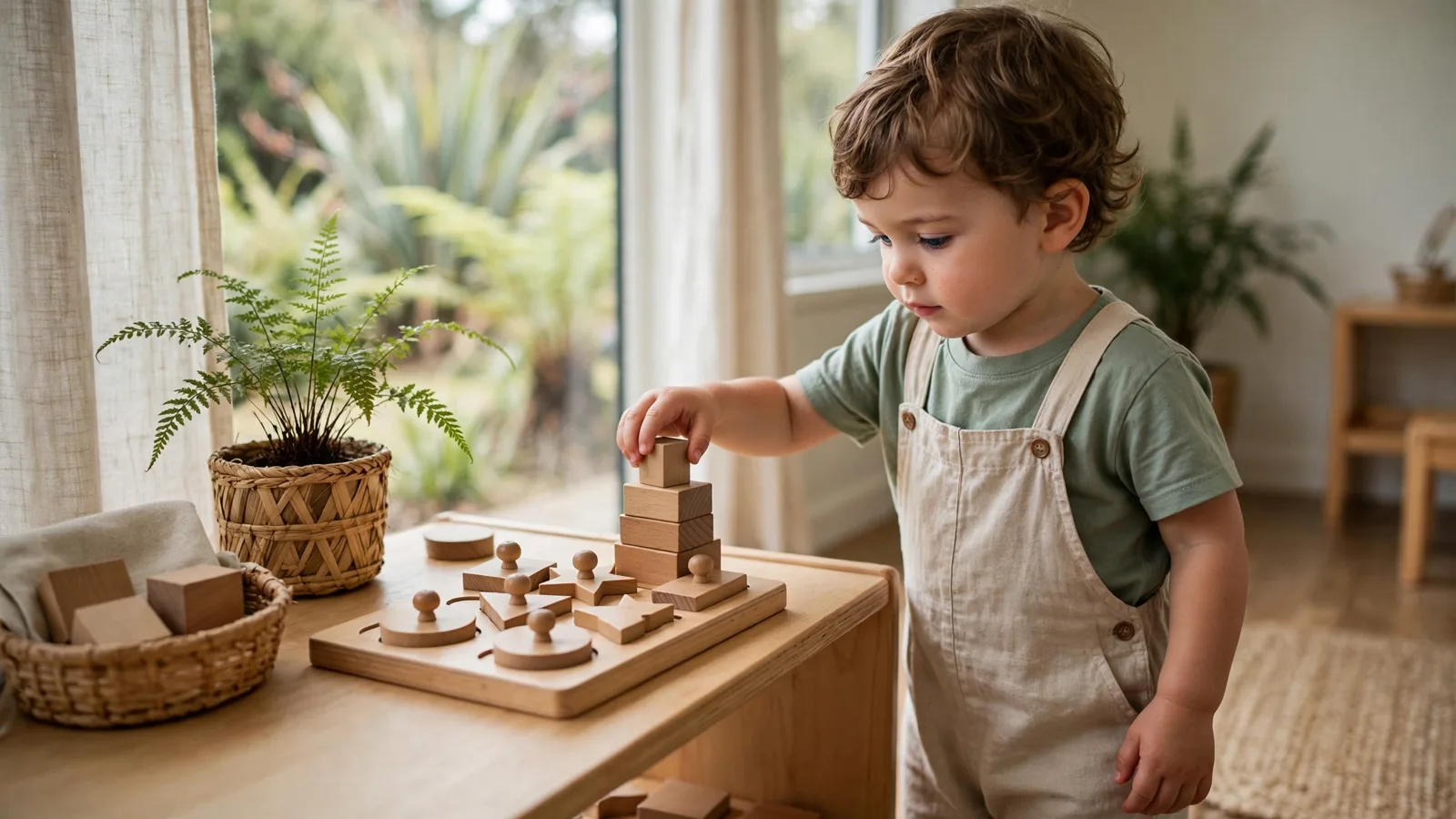
Type “Montessori toys” into any shopping site and you will be offered rainbow stackers, busy boards, plastic shape sorters with flashing lights, and wooden puzzles shaped like cartoon animals, all wearing the same label. Some genuinely reflect how Maria Montessori designed materials for young children. A great many do not. The word itself offers no guarantee, because nobody owns it and nobody polices how it is used in a product listing.
This guide sorts the real thing from the marketing. It explains what makes a material Montessori in the first place, walks through what suits each age band from birth to six, and finishes with the safety rules that apply to every toy sold in New Zealand, Montessori or not.
Quick answer
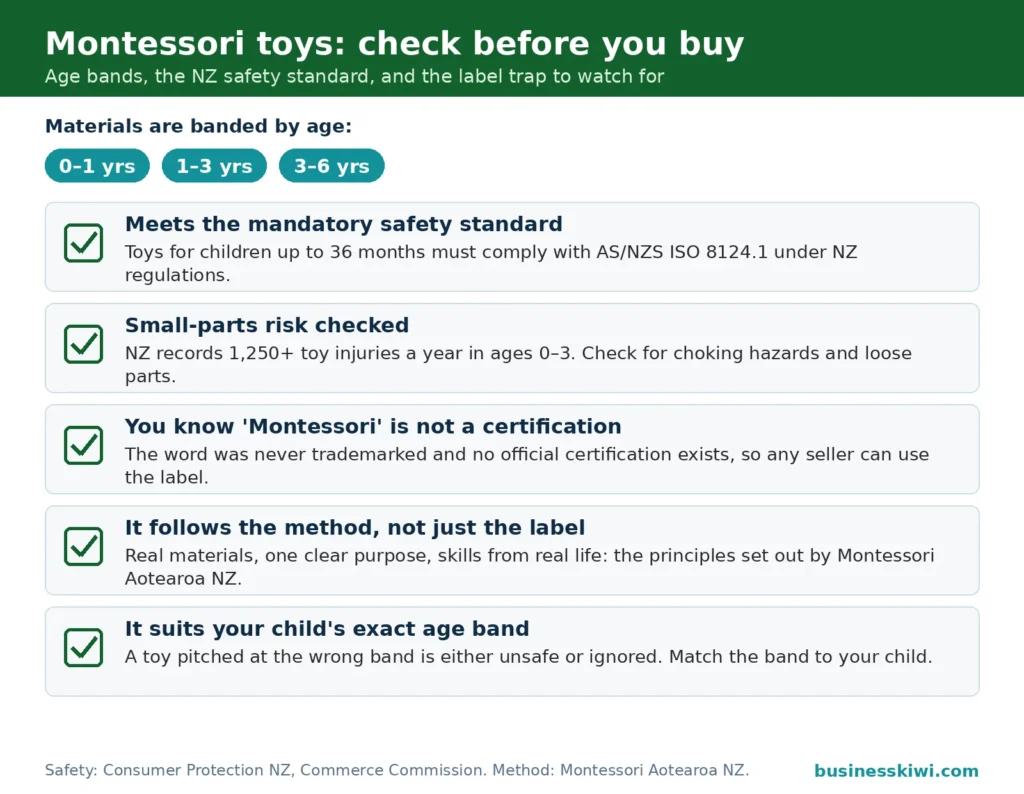
- A toy follows the Montessori method when it does one job at a time, is made to be handled and explored through the senses, lets the child spot and fix their own mistakes, and is sized for small hands to use without adult help.
- Under one: high-contrast mobiles, simple rattles and grasping toys, then an object permanence box once your baby can sit.
- Ages one to three: posting and threading activities, first knobbed puzzles, stacking and nesting, and real child-sized tools for pouring, scooping, sweeping and helping in the kitchen.
- Ages three to six: the classic sensorial sets (the pink tower, knobbed cylinders, colour tablets), dressing frames, sandpaper letters and practical life work with real purpose.
- “Montessori” is not a trademark and there is no certification for toys, so judge each product against the principles, not the packaging.
- In New Zealand, toys made or marketed for children up to and including 36 months must legally meet a mandatory safety standard based on AS/NZS ISO 8124.1, covering hazards such as small parts and accessible battery compartments.
What Montessori actually means for toys
Maria Montessori was an Italian doctor and educator who, more than a century ago, began watching how young children in a poor district of Rome chose to spend their time. Montessori Aotearoa New Zealand (MANZ) recounts a detail that still surprises people: given a room containing both toys and her specially designed materials, the children repeatedly chose the materials. They would settle with them for long stretches, concentrating in a way their teachers had not seen with conventional playthings.
That observation shapes everything. In Montessori language, the carefully designed objects are usually called materials rather than toys, and they were built to teach through the child’s own activity. MANZ describes them as auto-didactic, meaning self-teaching, and notes that Montessori kept only the designs children genuinely engaged with. From that history, you can pull out the tests that still separate a Montessori material from a toy with a trendy label.
One skill at a time. Each material isolates a single idea. A set of cylinders that vary only in height teaches height. If the same set also changed colour, width and sound, the child would have no clean way to work out what they were comparing. When you are shopping, ask what one thing the product teaches. If the honest answer is “everything”, it is probably teaching nothing in particular.
The child can see their own errors. Montessori called this the control of error. A knobbed cylinder only fits its matching hole, so a child who picks the wrong one finds out from the material itself, not from an adult saying “try again”. Self-correction matters because it protects concentration and confidence. The child repeats the work, checks the result, and fixes it independently.
Real materials, honestly made. Wood, metal, glass and fabric behave predictably and reward careful handling. Weight is real weight. A small glass jug pours like a jug because it is one. MANZ’s guide for parents of under-threes describes toddlers using genuine implements for genuine tasks, including china and glass at the table, because children rise to being trusted with real things.
Sized for the child, not the shelf. Furniture, tools and activities in a Montessori environment are scaled so a small person can reach, carry, open and complete things alone. The MANZ 0–3 guide stresses that everything, from furniture to crockery, should be size-appropriate.
No batteries doing the learning. Materials respond only to what the child does. There are no soundtracks, flashing rewards or voices telling your toddler they are clever. Cause and effect stays honest: the tower falls because it was unbalanced, and stands because it was not.
Beauty and order. This one sounds soft but is practical. Calm colours, uncluttered shelves and materials that look cared for invite careful use. MANZ describes the prepared environment for infants and toddlers as orderly, beautiful and calm, with materials easy to reach and freedom to move and choose.
What to buy by age
Children develop at their own pace, so treat these bands as a guide to the type of challenge, not a timetable your child must meet.
Birth to one year
Babies learn by watching, listening, mouthing and grasping, so the earliest materials are sensory and simple. MANZ describes the Nido, its environment for infants, as serving babies from roughly two to fourteen months, with a focus on movement and language.
- Mobiles for looking. A series of mobiles hung above a floor mat gives a young baby something ordered to track with their eyes, starting with strong black and white contrast and moving to gentle colour and movement.
- Grasping toys and rattles. Once hands start reaching, offer things that reward a grip: a small wooden rattle, a bell that rolls slowly, interlocking discs that pass from hand to hand, a soft ball with segments small fingers can hold. Natural materials give varied texture, weight and sound.
- An object permanence box. Later in the first year, once your baby sits steadily, this simple box earns its fame. The baby drops a ball through a hole, it vanishes, then rolls back into view. The idea being practised, that things still exist when unseen, is foundational.
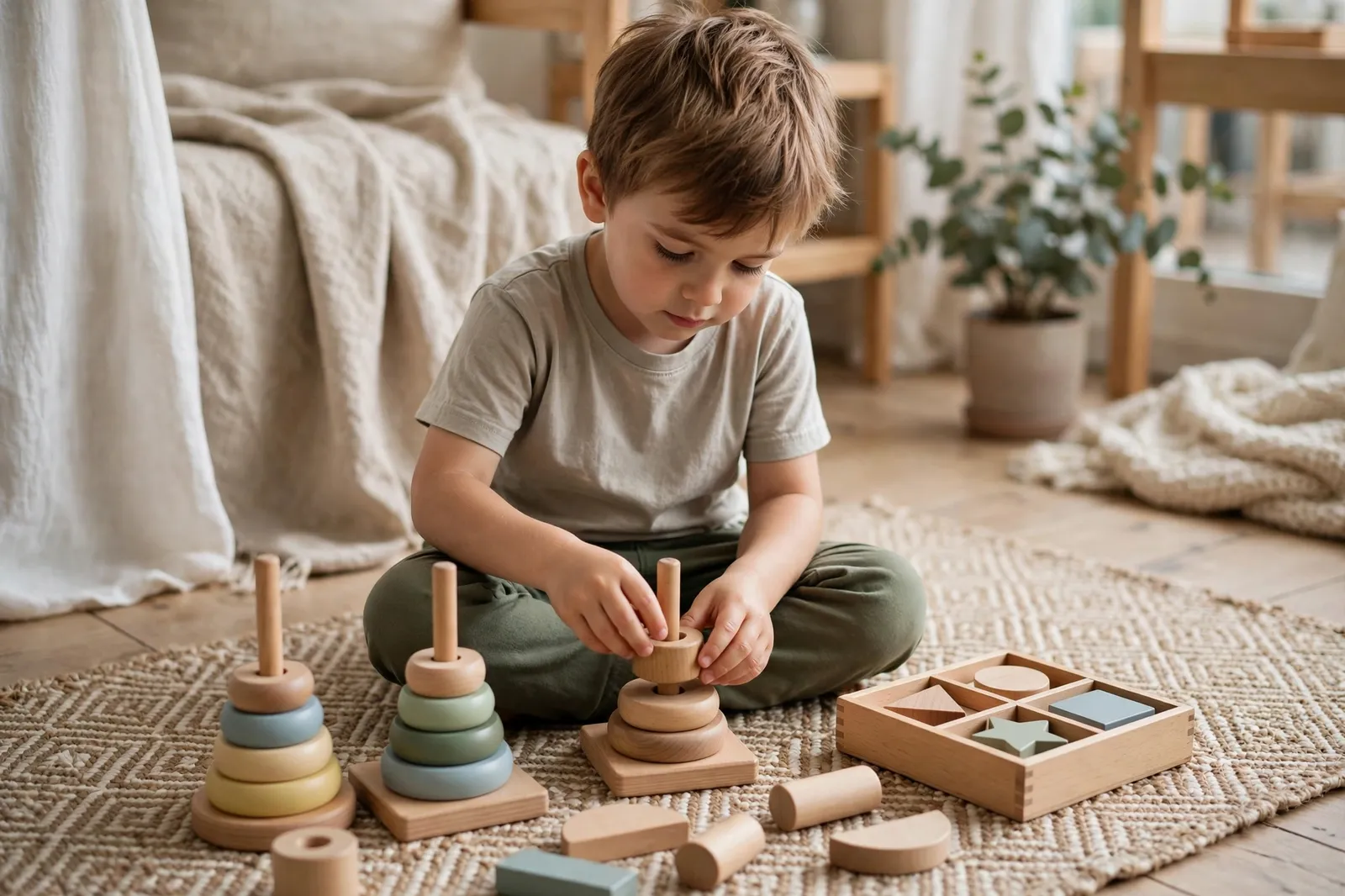
One to three years
MANZ places its toddler communities from about fourteen months to three years, concentrating on movement, language and independence. This is the age of carrying, posting, pouring and doing it myself.
- Posting and dropping activities. Coin boxes, ball drops and shape posting boxes refine hand control and give that satisfying repeat loop. One shape, one hole, one result.
- Threading and lacing. Large wooden beads on a stiff cord, or simple lacing shapes, build the hand strength and coordination that later shows up in dressing and writing.
- First puzzles with knobs. Single-shape or few-piece puzzles with a knob on each piece suit the whole-hand grasp of a young toddler and lead naturally into the pincer grip.
- Stacking and nesting. Cups, rings and boxes that grade by size introduce order. The child can see when the sequence is wrong, which is the control of error doing its quiet job.
- Real practical life tools. A small jug and cup for pouring water, a scoop for transferring beans or rice, a child-sized broom, a spray bottle and cloth for wiping the table, a low step and a little apron for helping with food preparation. This is core Montessori, not an add-on: toddlers are wired to imitate the real work of the household.
Three to six years
The 3–6 environment is the heart of the method, and MANZ notes it is the largest Montessori programme in New Zealand. Its curriculum covers practical life, sensorial work, language, mathematics and more, all through hands-on materials the child chooses.
- The pink tower. Ten wooden cubes graded from large to small, all one colour so size is the only variable. Stacking them builds visual discrimination of dimension and quietly prepares the ground for later maths.
- Knobbed cylinders. Four blocks, each holding ten cylinders that vary in height, width or both. Every cylinder has exactly one home, so the material grades the child’s eye and hand together.
- The brown stair and red rods. Companion pieces to the tower, grading thickness and length respectively. Simple, heavy, satisfying.
- Colour tablets. Sets of coloured tablets for matching and grading shades, refining colour perception in a deliberate sequence.
- Dressing frames. Frames holding real buckles, zips, buttons, bows and laces, so children can practise the fastenings on their own clothes slowly, at a table, without the morning rush.
- Sandpaper letters and numbers. Letters cut from sandpaper on boards, traced with the fingers so the shape is learned through touch and movement alongside sight and sound.
- Sound and touch materials. Paired cylinders that sound alike when shaken, fabric samples to match by feel, and boards grading rough to smooth all train single senses in turn.
Practical life and sensorial materials, explained
Two terms do most of the work in Montessori catalogues, and they are worth understanding before you buy anything.
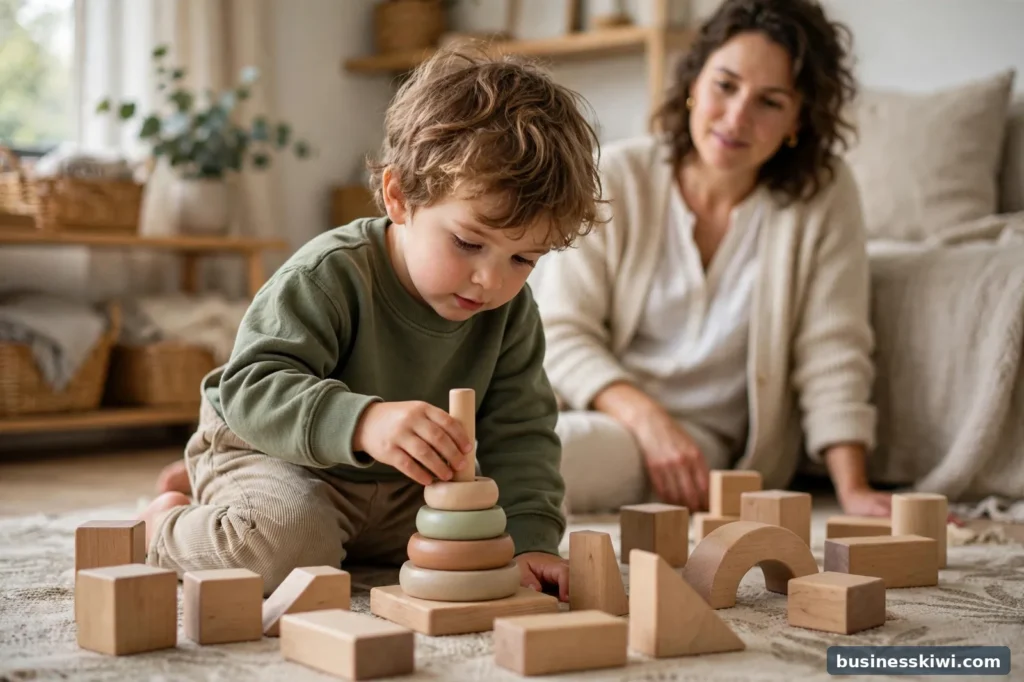
Practical life is exactly what it sounds like: the ordinary business of living, broken down into activities a child can complete. Pouring, spooning, buttoning, sweeping, washing hands, preparing a snack, caring for a plant. MANZ points out that young children love these activities and repeat them happily, and that the repetition builds concentration and coordination. The materials are mostly real household objects at child scale, which is good news for your wallet: a small jug from the kitchenware aisle does more Montessori work than many purpose-built “educational” products.
Sensorial materials are the designed sets: the towers, cylinders, tablets and rods. Their job is to refine the senses by isolating one quality at a time. A child grading rough and smooth boards is learning to notice texture precisely; a child ordering the pink tower is organising dimension. MANZ, drawing on Montessori’s own writing, describes the sensorial materials as offering the child a key to exploring the world through taste, touch, sight, smell and sound. These are the expensive, precise items, and they are where buying quality actually matters, because a badly made set with sloppy gradations teaches the wrong lesson.
The marketing problem with the word Montessori
Here is the uncomfortable part. Montessori never trademarked her name, and it has long been free for anyone to use. There is no official body certifying toys, no label a product must earn, and no legal standard a “Montessori toy” must meet in New Zealand or anywhere else. MANZ exists to support quality Montessori education and teacher training, not to approve shopping carts.
So the word on a listing tells you about the seller’s marketing, not the product’s pedigree. The modern version of the problem is the mass-produced “Montessori busy board” or “Montessori toy set” shipped from overseas marketplaces: dozens of unrelated activities crammed onto one board, lights and sounds added, fastenings that are fake versions of real ones, and nothing that isolates a single skill or corrects its own errors. Some individual items inside these sets are perfectly pleasant toys. They are just not Montessori materials, and the premium charged for the word is money spent on a label.
Apply the principles instead. Does it do one thing? Can the child tell, without you, whether they got it right? Is it real material, honestly weighted, sized for their hands? Does it need batteries to be interesting? Would a Montessori teacher recognise the design? Those five questions will filter a shopping page faster than any badge.
A related caution: genuine classroom materials from established Montessori manufacturers are precision-made and priced accordingly, and a full pink tower or cylinder set is a serious purchase for a family. Smaller home versions exist and are fine for home use, but check the gradations are consistent and the pieces are solid wood rather than hollow and feather-light, because the weight is part of the lesson.
Buying in New Zealand
You have a few realistic routes. Specialist Montessori and educational suppliers sell the classic sensorial sets and cater mainly to centres. General toy retailers stock plenty of items that fit the principles without using the word at all: wooden stacking and sorting toys, knobbed puzzles, threading sets, child-sized kitchen tools. Op shops and toy libraries are genuinely useful for practical life gear, since jugs, trays, baskets and utensils rotate through constantly, and borrowing suits baby stages that may last only a few months.
Whatever the source, run these checks before money changes hands:
- Safety standard. New Zealand law requires toys manufactured, designed, labelled or marketed for children up to and including 36 months to comply with a mandatory product safety standard under the Product Safety Standards (Children’s Toys) Regulations 2005, which adopts parts of AS/NZS ISO 8124.1, the joint Australian and New Zealand toy safety standard. The Commerce Commission enforces it, and its warning letters to suppliers show the usual failures: parts small enough to be a choking hazard, pieces that break off under foreseeable rough handling, and battery compartments a child can open without a tool. For older children the rest of the standard is not mandatory in New Zealand, which makes your own checking more important, not less.
- Small parts and mouthing. Consumer Protection NZ advises avoiding toys small enough to fit in mouths, ears or noses, and watching for pieces that could come loose. Under-threes do not yet have a reliable coughing reflex, so anything that fits through a small-parts cylinder does not belong in their hands.
- Batteries. If a toy takes button batteries, the compartment should need a screwdriver or two simultaneous actions to open. This is both a Montessori red flag and a legal requirement for the under-36-months standard.
- Finish and construction. Look for smooth surfaces, no sharp edges or cracks, and paint that will survive mouthing and washing. Consumer Protection’s Toy Safety Week guidance adds checks for long cords and strings (a strangulation risk), noise levels near little ears, and regular sweeps of the toy box to remove anything broken.
- Age grading. Treat the age on the box as safety information first and a developmental suggestion second. A toy graded 3+ may be down there because of small parts, not because a two-year-old would find it too hard.
Consumer Protection NZ and its Toy Safety Week partners, including Safekids Aotearoa, Plunket, Health New Zealand and the Commerce Commission, report more than 1,250 toy-related injuries a year among New Zealand children aged 0 to 3. Most are preventable with exactly these checks.
Toy rotation and care
Montessori shelves hold few items at a time, each complete and in its place. At home, rotation is the practical version of that idea: put out a small selection, store the rest, and swap pieces when interest fades or a skill is mastered. Rotation keeps the control of error intact too, because a puzzle with a missing piece or a cylinder set short one piece cannot teach anything except frustration. Check sets when they come back out, retire damaged items, and keep all the parts of a set together in a basket or tray.
Wooden materials are easy to live with. Wipe them with a damp cloth, dry them properly, and keep painted pieces out of prolonged soaking. Inspect knobs, cords and glued joints for looseness, particularly on anything a baby will mouth.
For ECE teachers
If you teach in a New Zealand early learning service, Montessori materials sit alongside Te Whāriki, the Ministry of Education’s play-based early childhood curriculum, rather than replacing it. Many services borrow the practical life and sensorial approach for their shelves while weaving their local curriculum around it, and Montessori centres proper combine the method with Te Whāriki expectations and MANZ’s quality framework.
A few buying notes from the classroom side. Budget honestly: centre finances are tight everywhere, and the same funding settings that sit behind ECE pay parity shape what a service can spend on resources, so durable materials that survive years of daily use usually beat cheap sets replaced every term. Prioritise completeness and gradation accuracy in sensorial sets, and plan storage before purchases, because materials stored in a jumble lose their teaching value. When a set is on the shelf, present it properly and then step back: the self-correcting design only works if adults resist the urge to correct first.
FAQs
Is there such a thing as an officially certified Montessori toy?
No. The name was never trademarked and no organisation certifies toys against the method. Organisations such as Montessori Aotearoa New Zealand support schools and teacher training, but a product calling itself Montessori has been approved by nobody. Judge the design against the principles instead.
Are Montessori toys only made of wood?
No. Wood is common because it is durable, weighted and pleasant to handle, but real Montessori environments also use metal, glass, ceramic and fabric, especially for practical life. A small ceramic jug is more Montessori in spirit than a wooden toy with flashing lights.
What should I buy first for a baby?
Start with something to look at and something to grasp: a simple mobile, then a rattle or grasping toy your baby can hold and mouth safely. Add an object permanence box once they sit confidently. You need very little in the first year.
Are busy boards Montessori?
Usually not in the strict sense. A board cramming twenty unrelated mechanisms together breaks the one-skill-at-a-time rule, and many use imitation fastenings. A single dressing frame, or a real zip and buckle to practise, is closer to the method. That said, a sturdy busy board is not a harmful toy; it is just mislabelled.
Can I set up Montessori play without buying the expensive sets?
Yes, and practical life is where to start. Child-sized versions of real tasks, pouring, sweeping, wiping, preparing food, dressing independently, cost little and carry much of the method’s value. Add one or two well-made sensorial or puzzle pieces as your budget allows, and borrow or buy second-hand where you can.
How many toys should be out at once?
Fewer than you think. A small, ordered selection that your child can choose from, use completely and put away supports concentration better than a full toy box. Rotate from storage as interests change.
Do these toys suit children with additional learning needs?
The method itself began partly in Montessori’s work with children with learning needs, drawing on earlier educators Itard and Seguin, and the self-paced, sensory design suits many different learners. For individual advice about your child, talk to their teachers or health professionals rather than relying on product claims.
For more on early learning, teaching careers and education policy in New Zealand, browse the Jobs & Education hub.
Sources
- Montessori Aotearoa New Zealand, “Montessori 3–6 years”, montessori.org.nz: the 3–6 programme, the prepared environment, and the practical life and sensorial curriculum areas.
- Montessori Aotearoa New Zealand, “Children learn through their senses”, montessori.org.nz: how Montessori developed her self-teaching materials and how children responded to them.
- Montessori Aotearoa New Zealand, Montessori Parent Guide 0–3 Years (2025), montessori.org.nz: Nido and toddler community age ranges, child-sized environments, real implements, and essential elements of quality Montessori practice for under-threes.
- Ministry of Education, “What your child learns at early learning services”, education.govt.nz: Te Whāriki as New Zealand’s play-based early childhood curriculum.
- Consumer Protection NZ (MBIE), “Toy Safety Week 2025: Helping you keep tamariki safe during play”, consumerprotection.govt.nz: annual toy-related injury figures for ages 0–3 and the six toy safety checks.
- Consumer Protection NZ (MBIE), Keeping Kids Safe: Children’s and Nursery Products, consumerprotection.govt.nz: the mandatory AS/NZS ISO 8124.1 standard for toys and general product safety guidance.
- Commerce Commission, Fair Trading Act warning letters on children’s toys (2021–2026), comcom.govt.nz: the Product Safety Standards (Children’s Toys) Regulations 2005, the standard’s application to toys for children up to and including 36 months, and common compliance failures.
- Ministry of Business, Innovation and Employment, “Ensuring Trans-Tasman Alignment of Toy Safety Regulations” (2026), mbie.govt.nz: the scope of the 2005 Regulations and which parts of the standard are mandatory in New Zealand.
Disclaimer
This article is general information for parents, caregivers and teachers, based on the sources listed at the time of writing. It is not medical, developmental or purchasing advice for an individual child. Toy safety standards and product ranges change, so check current requirements with Consumer Protection NZ and follow the age grading and warnings on any product you buy. If you have concerns about your child’s development, speak with their early learning service, Plunket nurse or GP.