Paralegal Jobs in NZ: What They Do, Qualifications, Pay and How to Get In

Quick answer
A paralegal in New Zealand is a legal support professional who does substantive legal work inside a law firm, an in-house legal team or a government agency, working under the direction of a lawyer. The title itself carries no protected status here. Unlike overseas, where paralegal is often a defined occupation with its own credential, New Zealand firms use the word loosely, and the same job is just as often advertised as legal executive or legal assistant. The role with a recognised qualification behind it is the legal executive. The pathway qualification is the New Zealand Diploma in Legal Executive Studies (Level 6), and graduates who register with Legal Executives New Zealand (LENZ) can call themselves registered legal executives. According to Tahatū, the government’s career information service, legal executives most commonly earn between $64,000 and $93,000 a year. If you want legal work without a law degree, this is the main professional route in.
What a paralegal actually does all day
Strip away the job title and the work looks much the same from firm to firm. The New Zealand Law Society describes a legal executive as a trained assistant to a lawyer, and the daily mix it lists will be familiar to anyone working as a paralegal: searching public registers, preparing and filing documents, preparing estates, working on the sale and purchase of real estate or a business, and debt recovery. A legal executive may interview clients on behalf of a lawyer, the Law Society notes, but does not appear in court.
In practice, a paralegal’s week usually involves some blend of the following:
- File work on property matters. Conveyancing is the backbone of legal support work in New Zealand. That means ordering and reading title records and council LIM reports, preparing sale and purchase documentation, tracking conditions and settlement dates, and helping get files ready for settlement day.
- Estates, wills and trusts. Preparing estate administration files, drafting wills and enduring powers of attorney for a lawyer to review, and keeping trust records in order.
- Document drafting and preparation. Contracts, leases, court forms and correspondence, usually from precedents, checked and signed off by the supervising lawyer.
- Legal research. Finding legislation, cases and commentary that a lawyer needs for advice or a dispute, and summarising what turns up. Tahatū puts research at the centre of the legal executive role, describing the job as researching and preparing cases for lawyers, filing legal documents and, within limits, providing legal advice.
- Client contact. Taking instructions, updating clients on where their matter sits, gathering documents and ID, and answering the everyday questions that do not need a lawyer’s input.
- File and deadline management. Diarising court and settlement dates, keeping files complete, and making sure nothing with a deadline attached slips.
The balance shifts with the practice area. A paralegal in a litigation team spends more time on court documents, discovery and hearing preparation. One in a suburban property practice might run conveyancing files almost end to end. In-house paralegals, employed by a company rather than a firm, tend to do more contract administration, company secretarial support and compliance work.
Paralegal, legal executive, legal secretary or lawyer?
These four titles describe genuinely different positions in the New Zealand system, even though job ads sometimes blur them.
Paralegal
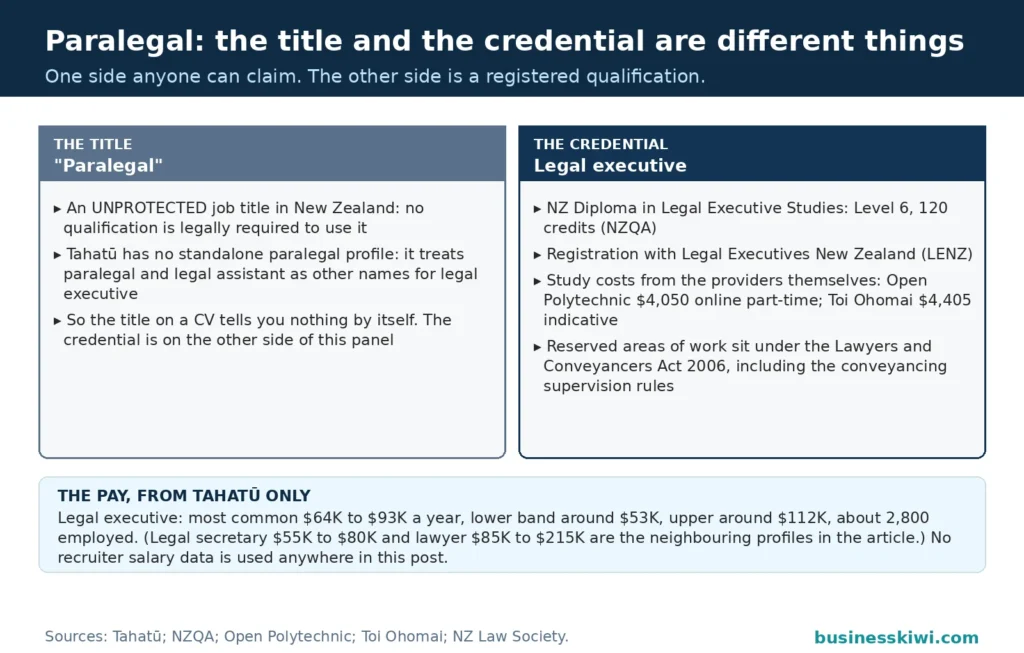
Paralegal is a job title, not a protected credential. No statute defines it, no register exists for it, and two firms can use it for quite different levels of responsibility. Tahatū does not maintain a separate paralegal occupation profile at all. Its legal executive profile lists paralegal and legal assistant as other names for the same occupation, which tells you how the local market actually treats the word. Some employers use paralegal for diploma-qualified staff doing legal executive work. Others use it for law graduates or senior support staff who have not gone through the legal executive qualification. When you are job hunting, read the duties and the qualification requirements in the ad rather than relying on the title.
Legal executive
A legal executive is the qualified version of the role. The recognised qualification is the New Zealand Diploma in Legal Executive Studies (Level 6), and legal executives who also register with LENZ, the professional association, are registered legal executives. Registration comes in grades that reflect experience: Affiliate for registered legal executives in the early years of their career, Associate for experienced registered legal executives, and Fellow for senior registered legal executives. LENZ also has a Support category for students, unqualified legal executives and people in related roles. Registered legal executives are entitled to associate membership of the New Zealand Law Society through their LENZ membership, and LENZ maintains a public register the public can search.
Legal secretary
A legal secretary is primarily an administrative role: preparing and filing legal documents and correspondence, managing diaries and billing, and keeping the office side of a practice running. Tahatū lists legal secretaries as earning most commonly between $55,000 and $80,000, with training of up to two years, and notes they may assist with legal research. The distinction that matters is responsibility for the legal content of a file. A legal executive or paralegal is expected to progress the legal work itself under supervision. A secretary supports the people doing that work. The roles overlap in small firms, and secretary jobs are a common first step into the sector, but they are not the same job.
Lawyer
A lawyer is in a different legal category altogether. To practise as a lawyer in New Zealand you need a law degree, completion of a professional legal studies course, admission to the High Court as a barrister and solicitor, and a current practising certificate issued by the Law Society. Only someone holding that certificate may describe themselves as a lawyer. Tahatū puts lawyers’ most common pay at $85,000 to $215,000 a year, reflecting the longer training and the personal professional responsibility that comes with the certificate.
The line none of them can cross: reserved work
The Lawyers and Conveyancers Act 2006 reserves certain work to lawyers, and this boundary shapes every paralegal and legal executive job. As the Law Society explains it, the reserved areas of work defined in the Act cover advising on the direction or management of proceedings before a court or tribunal, appearing as an advocate, representing another person in proceedings, and anything another statute says only a lawyer may do, such as certifying a relationship property agreement under the Property (Relationships) Act 1976. The Law Society’s guidance also treats drafting court documents and filing applications on behalf of another person as falling within the reserved area, which is why court-facing documents prepared by support staff are filed under a lawyer’s responsibility rather than in the paralegal’s own right.
Conveyancing has its own restriction: only a lawyer or a licensed conveyancer may provide conveyancing services, or someone working under the direct supervision of one. That supervision point is what makes legal executive conveyancing work lawful. The file sits within a practice where a lawyer or licensed conveyancer carries the responsibility.
Outside the reserved areas, there is a wide field of legal work that non-lawyers can legitimately do, including general contract and commercial work, research, document preparation and advice on matters that are not about proceedings. Paralegal and legal executive roles live in that space, normally inside an organisation where a lawyer supervises the work and takes responsibility for the reserved parts of any matter.

Qualifications: the diploma and registered status
The New Zealand Diploma in Legal Executive Studies (Level 6)
This is the qualification the whole occupation is built around. It sits on the New Zealand Qualifications Framework at Level 6, carries 120 credits, and is recorded by NZQA under the code NZ3508. The Law Society ran its own legal executive diploma until 2017. That qualification was discontinued and replaced by this diploma, which is now delivered by a small number of tertiary providers.
Open Polytechnic is the best known provider. Its diploma is delivered fully online by distance learning, is studied part-time, and is made up of six courses:
- Introduction to the Legal System
- Law Office Practice
- Wills, Trusts and Estates Law and Practice
- Litigation Law and Practice
- Business Law and Practice
- Property Law and Practice
Open Polytechnic lists its fees at $4,050 for domestic students, notes that courses start at multiple points through the year, and says the diploma prepares graduates to work as legal executives under the supervision of a practising lawyer, in law offices as well as banking, property, insurance, finance and government work. Achieving the qualification is also one of the eligibility criteria for becoming a registered legal executive through LENZ.
Toi Ohomai Institute of Technology offers the same diploma fully online, over one year full-time or part-time, with indicative domestic fees of $4,405 and StudyLink assistance available. Its outline of the programme focuses on assisting with the transfer of land ownership, administering deceased estates and preparing and filing court documents. Some papers can be cross-credited towards its Diploma in Conveyancing, and Toi Ohomai positions the diploma as a foundation for anyone who later decides to attempt a law degree.
Fees change, and providers set their own, so treat the figures above as the providers’ published starting points and check the current fee before you enrol.
Becoming a registered legal executive
The diploma alone makes you qualified. Registration is the professional layer on top. LENZ registers legal executives, publishes the public register, runs professional development and mentoring, and carries out a biennial survey of members’ salaries and working conditions. Its JobLink board advertises legal executive vacancies, which gives a fair sense of where demand sits. Registration matters to employers because it signals that a practitioner has met the professional body’s requirements and is accountable to it, and it is the version of the role that comes with statutory recognition, as LENZ puts it.
Other study routes
Not everyone arrives via the diploma. Common variations include:
- A law degree, completed or partly completed. Law graduates who are not admitted, and students working their way through a degree, are often hired into paralegal-titled roles. The degree does not make them lawyers, and the reserved work rules apply to them exactly as they do to anyone without a practising certificate.
- Conveyancing study. The separate Diploma in Conveyancing leads towards becoming a licensed conveyancer, a distinct regulated occupation. Tahatū lists conveyancers as earning most commonly $68,000 to $86,000.
- Shorter legal administration study. Certificates in legal administration or office administration can help you land a legal secretary or administrator job, which is where many legal executives start.
- Experience alone. Plenty of working paralegals have no formal legal qualification. They picked up the work inside a firm and were trained on the job. The trade-off is portability: the diploma and registration travel with you between employers, while firm-specific experience is harder to evidence.
Where paralegals work
Private law firms remain the biggest employers, from large national firms with dedicated legal executive teams through to two-person suburban practices where one legal executive handles most of the property work. The public register maintained by LENZ lists registered legal executives in firms in centres all over the country, not just the main cities.
Beyond firms, the same skills are used in:
- In-house legal teams at banks, insurers, property companies and large businesses, where paralegals manage contracts, leases and compliance files.
- Government departments and Crown entities, which employ legal support staff in Wellington and regional offices. Toi Ohomai names government departments, local authorities, insurance, property and share broking among the destinations its legal studies graduates are equipped for.
- Courts and justice sector agencies, in registry and case support roles.
- Conveyancing practices, including firms run by licensed conveyancers, where legal executives support high volumes of property settlements.

Pay and job prospects
All of the pay figures in this section come from Tahatū, the career information service provided by the Ministry of Education, because it is the official source that profiles these occupations. Tahatū does not publish a standalone paralegal pay band. It treats paralegal as another name for a legal executive, so the legal executive figures are the ones that apply:
- Legal executive (including paralegal roles): most commonly $64,000 to $93,000 a year before tax, with a lower point of around $53,000 and an upper point of around $112,000 for the most experienced.
- Legal secretary: most commonly $55,000 to $80,000 a year.
- Lawyer: most commonly $85,000 to $215,000 a year.
Tahatū counts roughly 2,800 people employed as legal executives in New Zealand and describes employment in the occupation as steady. Training time is listed at about two years, which matches the part-time reality of the diploma for most people studying alongside work.
Where you sit in the band depends on the usual things: years of file-running experience, whether you hold the diploma and registration, the practice area (busy conveyancing and commercial teams pay for proven settlement experience), and location. Recruitment agency salary guides exist, but they are marketing documents rather than official statistics, so we have not used them here. LENZ’s biennial survey of its own members is the other credible source on what registered legal executives actually earn, and its results are published for members.
Skills that get you hired
Employers advertising paralegal and legal executive roles are generally looking for the same cluster of abilities:
- Accuracy under volume. Legal documents have consequences when a name, date or title reference is wrong. Careful proofreading and document checking are the core craft skills.
- File discipline. Keeping matters moving, diarising deadlines, and knowing the state of every file you touch.
- Plain, precise writing. Most of the job is drafting: letters, emails, documents and file notes that a client or another firm can act on without a follow-up phone call.
- Research competence. Finding the right legislation, register information or precedent quickly, and summarising it accurately.
- Client manner. Much of the client contact in a property or estates practice runs through the legal executive. Calm, clear communication matters, especially around settlements, where clients are stressed.
- Systems skills. Practice management software, electronic conveyancing through Land Information New Zealand’s systems, and the Microsoft Office suite are the daily tools.
- Judgement about the boundary. Knowing which questions you can answer and which ones must go to the supervising lawyer is a professional skill in itself, and it is exactly what the reserved work rules require of you.
How to get in
There is no single door, but the routes that work are well worn.
Start in a support role. Legal secretary, legal administrator and receptionist jobs in law firms are the classic entry point. You learn the file systems, the software and the rhythm of practice, and firms frequently support good administrators into diploma study. Both diploma providers are set up for people who are already working: Open Polytechnic’s programme is part-time and online, and Toi Ohomai promotes part-time study while you work.
Study the diploma. If you are not yet in the sector, the Level 6 diploma is the credential that gets your application taken seriously for legal executive and paralegal roles. Some students complete it before applying for jobs, others enrol once they are in a firm. Either order works.
Apply like someone who already does the work. Firms read applications for evidence of accuracy and file discipline, so a CV with any administration, banking, insurance, real estate or customer service history is worth presenting carefully. Your application letter matters more than most candidates realise: it is the first writing sample the firm sees. Our cover letter guide walks through how to structure one that reads as precise and professional rather than generic. Keep it error-free. A typo in an application for a detail-focused job is the fastest way to be screened out.
Consider registering once you qualify. Registration with LENZ, starting at Affiliate level, puts you on the public register that employers and clients can check, and connects you to the profession’s mentoring and development network.
Think about where the work is. Property-heavy practices hire the most legal support staff, so conveyancing confidence is the most marketable specialisation. If you are in a smaller centre, general practice firms are your main market. If you are in Wellington, government legal teams are a realistic alternative to private practice.
Frequently asked questions
Is a paralegal the same as a legal executive in New Zealand?
Often, yes, in terms of the work done day to day. Tahatū treats paralegal and legal assistant as alternative names for the legal executive occupation. The difference is credential rather than tasks. A legal executive who holds the New Zealand Diploma in Legal Executive Studies (Level 6) and registers with Legal Executives New Zealand has a recognised qualification and professional status behind the title. Paralegal on its own guarantees neither.
Do I need a qualification to work as a paralegal?
Not legally, because the title is not regulated. Plenty of paralegals learned on the job. In practice, though, the Level 6 diploma is the qualification employers ask for when they advertise legal executive roles, and it is a requirement for registration with LENZ. If you want the work to become a career rather than a stopgap, the diploma is the investment that makes your experience portable between firms.
How much do paralegals earn in NZ?
Tahatū, the official careers service, puts legal executives, including paralegal roles, at most commonly $64,000 to $93,000 a year before tax, with entry-level pay around $53,000 and experienced practitioners reaching about $112,000. Legal secretaries most commonly earn $55,000 to $80,000. Pay varies with experience, registration, practice area and region.
Can a paralegal give legal advice or appear in court?
A paralegal cannot appear in court as an advocate or represent clients in proceedings, and advising on the direction or management of court or tribunal proceedings is reserved to lawyers under the Lawyers and Conveyancers Act 2006. The Law Society is clear that a legal executive does not appear in court. Within a firm, under a lawyer’s supervision, paralegals and legal executives can do a wide range of other legal work, including preparing documents, researching, interviewing clients and advising on matters that fall outside the reserved areas.
Can a paralegal become a lawyer later?
Only by completing the full lawyer pathway: a law degree, the professional legal studies course, admission to the High Court and a practising certificate. There is no shortcut from legal executive registration to a practising certificate, although the experience helps. Toi Ohomai describes its diploma as a useful foundation for someone considering a law degree further down the track, and some diploma papers may cross-credit towards related study such as conveyancing.
Sources
New Zealand Law Society, Legal Executive Diploma, lawsociety.org.nz
New Zealand Law Society, Regulated services: what they are and why they matter, lawsociety.org.nz
New Zealand Law Society, Overseas lawyers working in New Zealand, lawsociety.org.nz
Legal Executives New Zealand, Membership levels and applying to join, legalexecutives.org.nz
Legal Executives New Zealand, Find a Registered Legal Executive, legalexecutives.org.nz
Tahatū Career Navigator, Legal executive occupation profile, tahatu.govt.nz
Tahatū Career Navigator, Law career area (legal secretary, lawyer, conveyancer profiles), tahatu.govt.nz
NZQA, New Zealand Diploma in Legal Executive Studies (Level 6) NZ3508, nzqa.govt.nz
Open Polytechnic, New Zealand Diploma in Legal Executive Studies (Level 6), openpolytechnic.ac.nz
Toi Ohomai Institute of Technology, New Zealand Diploma in Legal Executive Studies (Level 6), toiohomai.ac.nz
Disclaimer
This article is general careers information only, based on official sources available at the time of writing. Job titles, pay bands and course fees change, so check current details with employers, providers and Tahatū before making decisions. The boundaries on what non-lawyers may do are set by the Lawyers and Conveyancers Act 2006. Nothing here is legal advice about those boundaries, and anyone unsure whether particular work is reserved to lawyers should check the New Zealand Law Society’s current guidance.
More careers and study guides are in our Jobs and Education section.