Finance Jobs in NZ: Roles, Qualifications, Pay and How to Get In

Quick answer
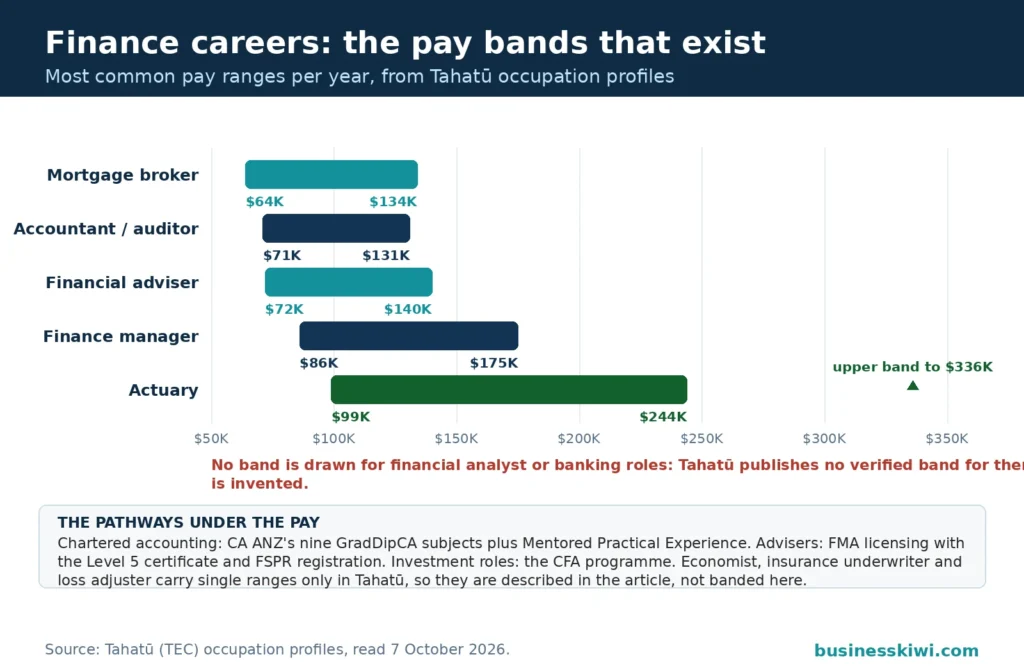
Finance work in New Zealand spreads across seven broad families: banking, accounting, financial advice, insurance, funds and investment, risk and compliance, and public sector finance. Most professional roles expect a degree in accounting, finance, commerce or economics, and some carry formal registration on top. Chartered accountants complete the CA ANZ programme while working, and anyone who gives regulated financial advice to retail clients must work under a Financial Advice Provider licence issued by the Financial Markets Authority (FMA) and meet competence standards set at the level of the New Zealand Certificate in Financial Services (Level 5). Entry usually comes through graduate programmes, trainee and support roles, or accounts work that builds toward a designation. Pay varies widely by family: Tahatū, the government careers site, puts the most common pay band for accountants and auditors at $71,000 to $131,000, and for financial advisers at $72,000 to $140,000.
The main finance job families
Finance is not one job market but several, and they recruit differently. A bank, an accounting firm, an insurer and a government ministry may all advertise a “finance analyst” on the same day while meaning quite different work. The families below are the ones that matter in New Zealand, with the roles each one actually contains.
Banking
Banks employ people at every level of the finance ladder. At the customer end sit branch and contact centre teams, personal bankers and lending staff who assess home loans and business credit. Behind them are the roles customers never see: credit analysts, treasury teams managing the bank’s own funding, product and pricing specialists, and large operations areas that process payments and keep accounts accurate.
Plenty of bankers start in customer service roles and move sideways into lending or business banking once they know the products. Rural banking is its own branch of the profession in New Zealand, built around farm finance and seasonal lending. ASB, on its own careers site, runs its graduate programme out of Auckland but places rural banking graduates in regional offices around the country, which reflects how much of banking still happens face to face outside the main centres.
Accounting
Accounting is the largest single pool of finance work. Tahatū counts about 29,000 accountants and auditors in New Zealand, with employment holding steady. Public practice firms, from sole practitioners to the big international networks, employ graduates in audit, tax and business advisory work for clients. In-house teams inside companies, councils and charities do the other half of the profession: financial accounting and reporting, management accounting, budgeting and finance business partnering with operational managers.
The work splits by temperament as much as by skill. Audit and tax reward precision and an appetite for rules. Management accounting and business partnering reward people who can explain what the numbers mean to managers who do not live in spreadsheets. Our accountant salary guide breaks down pay across those roles in more detail. Beneath the degree-level profession sits a layer of accounts officers, payroll staff and accounting technicians who keep ledgers, pay runs and reconciliations moving; that layer is a genuine entry point, covered further below.
Financial advice
Financial advisers help people make decisions about money: KiwiSaver and investments, mortgages, insurance, retirement planning. Tahatū counts about 5,600 financial advisers and records employment in the occupation as increasing. Mortgage brokers, who advise on home lending and help clients apply for loans, number about 800 on the same measure.
Advice is the most tightly regulated family in this guide. Since March 2021, regulated financial advice to retail clients can only be given by or on behalf of a licensed Financial Advice Provider, and advisers have to meet the competence, ethics and disclosure standards described in the qualifications section below. Many advisers are self-employed or work in small firms under a provider’s licence; others sit inside banks and insurers as nominated representatives with tighter limits on what they can recommend. For a closer look at the planning side of this career, including how advisers build a client base, see our guide to becoming a financial planner.
Insurance
Insurers need finance skills in places most people never think of. Underwriters assess the risk in insuring people and property and set the terms on which cover is offered. Loss adjusters and investigators assess, review and calculate claims after something has gone wrong. Claims teams, pricing analysts and actuaries round out the technical side, and brokers sit between insurers and clients, arranging cover for businesses and households.
Entry is less degree-bound than in accounting. Tahatū puts training for underwriters and loss adjusters at up to two years, and people often arrive from claims or administration roles and pick up qualifications on the job. Giving insurance advice to retail clients is regulated financial advice, though, so broker and adviser roles in insurance run into the same licensing and competence rules as every other adviser.
Funds and investment
This is the smallest and most concentrated family. It covers fund managers and KiwiSaver providers, wealth management firms, sharebroking and research teams, and the corporate finance advisers who work on business sales, valuations and capital raising. Investment banking exists in New Zealand but on a modest scale, mostly in Auckland, and it recruits from the same analyst pool as the fund managers.
Day to day, the work is analysis: building financial models, valuing companies, monitoring portfolios and writing research that portfolio managers act on. Our financial analyst salary guide covers pay for the analyst roles in this family. The CFA designation, run by CFA Institute, is the credential employers in this corner of finance most often name; it is voluntary, but it signals serious intent.
Risk and compliance
Every financial institution now carries a risk and compliance function, and many large companies have copied the pattern. Credit risk teams watch lending quality. Operational risk and compliance staff track whether the business is meeting its obligations under anti-money laundering law, conduct rules and prudential requirements. Internal auditors test controls from inside the organisation, and fraud investigators pick over transactions that do not add up.
These teams hire from accounting, banking operations and law as much as from dedicated risk degrees. The regulator is also an employer in this space: the FMA employs supervision, monitoring and enforcement staff to oversee the firms everyone else works for.
Public sector finance
Central and local government run on finance teams. Ministries, departments, councils and health agencies employ management accountants, finance analysts, business partners and chief financial officers to manage public money, prepare budgets and report against them. The Ministry of Business, Innovation and Employment’s own position descriptions for senior finance roles ask for forecasting, budgeting and financial analysis experience, and list a CA ANZ qualification as expected or desirable, which tells you the professional standard public sector finance works to.
Public sector roles appeal to people who want the work to connect to public outcomes, and they offer a route into finance leadership without the partnership track of a firm. Vacancies across government are advertised through the government jobs site and each agency’s own careers pages.
Qualifications and registration
Degrees and starting points
A bachelor’s degree in accounting, finance, commerce or economics is the standard entry ticket for professional roles, and maths or statistics degrees feed the actuarial and quantitative corners. Employers recruiting graduates generally care more about the degree and your marks than about which university issued it. Not every finance job needs a degree, though. Accounts, claims and bank customer roles hire on experience and aptitude, and the designations below can be earned while you work.
The chartered accountant pathway
For accounting roles, the designation that counts is Chartered Accountant, through Chartered Accountants Australia and New Zealand (CA ANZ). The route runs like this. You first become a provisional member, which normally requires a CA ANZ-accredited degree; if your degree is in another field or is not accredited, the CA Foundations programme fills the gaps. You then complete the CA Program while employed: a Graduate Diploma of Chartered Accounting made up of nine subjects, seven core and two electives, studied part time alongside work. Alongside the study you complete three years of Mentored Practical Experience, at least 500 days in a relevant accounting role with an approved training employer, supervised by a mentor. Finish both parts and you can apply for full membership and use the CA designation.
Two related points matter for job hunters. Accountants who want to offer accounting services to the public need to be CA members holding a Certificate of Public Practice. And if the full CA is more than you need, CA ANZ also runs an Accounting Technician designation, built around its AT Program course and supervised practical experience, aimed at the accounts officer layer described earlier.
Advisers: licensing and the Level 5 certificate
Financial advice has a legal structure you have to work inside. The licence itself is held by the Financial Advice Provider, the business. The FMA describes three licence classes: Class 1, built for sole advisers; Class 2, for businesses that engage more than one adviser; and Class 3, for large organisations that engage nominated representatives. If you run your own advice business you need your own licence. If you are employed as a financial adviser or nominated representative, you give advice under your provider’s licence instead, and individual financial advisers are registered on the Financial Service Providers Register.
Competence is set by the Code of Professional Conduct for Financial Advice Services. The FMA states that the Code’s competence standards require capabilities equivalent to the qualification outcomes of the New Zealand Certificate in Financial Services (Level 5), version 2. Most new advisers simply complete the certificate: two core courses covering the financial services industry and the regulatory framework, plus a specialist strand in the type of advice they will give, such as investments or general insurance. Providers such as Open Polytechnic deliver it by distance, and its stated career outcomes include investment adviser, paraplanner and adviser support roles, which is exactly how many advisers start, supporting a senior adviser while they study. The Code also requires continuing professional development every year, and advisers carry legal duties to put the client’s interests first where there is a conflict, to exercise care, diligence and skill, and to make the required disclosures to clients.
Other designations worth knowing
The CFA charter is the investment industry’s heavyweight credential. CFA Institute requires candidates to pass three exam levels, complete practical skills modules and accumulate 4,000 hours of qualifying work experience before they can use the designation. It is studied while working in the industry, not instead of a job. Actuaries sit at the other extreme of study length: Tahatū gives training for actuaries at six to eight years, combining a degree strong in mathematics and statistics with professional examinations taken over years in employment.

Pay and prospects
The figures below come from Tahatū occupation profiles, read in October 2026. Tahatū presents pay before tax in three bands: a lower figure, the most common range, and an upper figure reached by experienced or senior people. Treat the most common band as the realistic middle of each occupation.
Finance manager is Tahatū’s umbrella for senior finance leadership: its profile lists chief financial officer and financial controller among the job titles it covers, which is why the top of its range runs so high. Our CFO salary guide looks at that executive end on its own. Actuaries sit in a small profile of their own: a most common band of $99,000 to $244,000, with the upper figure reaching $336,000. For three more specialist occupations Tahatū publishes a single yearly range rather than the three-band split: economists at $81,000 to $170,000, insurance underwriters at $81,000 to $159,000, and insurance loss adjusters and investigators at $78,000 to $126,000.
Prospects follow the same pattern as the headcounts. Accounting and finance management are large, stable occupations with constant turnover rather than rapid growth. Adviser numbers are growing from a smaller base, which matches the licensing regime bedding in and an ageing adviser workforce. None of these figures capture bonuses or commission, which matter a great deal in advice, broking and investment roles; base salary is only part of what those jobs pay.

Entry routes: how people actually get in
Graduate programmes. The big employers run structured intakes. ASB’s graduate programme, described on its own careers site, rotates graduates through different parts of the bank over 18 months, with a move to a new team every six months and a sponsor to mentor them. Eligibility is aimed at final-year students and people who finished a degree within the past 24 months. Accounting firms run the same pattern with a professional twist: you are hired as a provisional CA member and your employer supports the CA Program study and practical experience described above.
Trainee and support roles. Advice firms hire paraplanners and adviser support staff, roles Open Polytechnic names as outcomes of the Level 5 certificate, and banks and insurers hire into claims, operations and customer teams from which people move into underwriting, lending and analysis. These roles rarely make headlines, but they are how a large share of the industry actually started.
Accounts work without a degree. Accounts payable and receivable, payroll and assistant accountant jobs are advertised constantly, and the Accounting Technician designation gives that experience a professional frame. Plenty of finance managers started in a ledger.
Public sector entry. Ministries and agencies hire graduates and analysts directly, and their finance teams recruit experienced accountants from practice mid-career. If you want public sector work, the government jobs site and agency careers pages are the places to watch.
Whichever route you take, applications for graduate intakes open early and close months before the start date, so final-year students need to be looking at employer careers pages from the start of their last year, not the end of it.
Where the jobs are
Finance jobs follow employers, and employers cluster. The head offices of the big banks and insurers sit in Auckland and Wellington, and with them the treasury, product, risk and investment teams. ASB bases its graduate programme in Auckland for that reason, while noting that rural banking graduates can be placed in regional offices. Wellington carries the public sector: the ministries and agencies whose finance teams were described above, plus the regulators.
Outside those two cities, the work is real but thinner and more generalist. Every centre has accounting firms, bank branches, insurance offices and council finance teams, and regional employers often want one person who can cover accounting, analysis and reporting together rather than a narrow specialist. If you are flexible about location, small markets can fast-track responsibility; if you want depth in investment or treasury, expect Auckland.
Skills employers ask for
Read across employer job descriptions and the same list keeps surfacing. The Ministry of Business, Innovation and Employment’s senior finance position descriptions ask for experience in forecasting, budgeting and financial analysis, confidence with financial modelling, and the ability to convey complex financial information simply and concisely to people outside finance. Stakeholder management appears in almost every senior description: finance roles are expected to partner with the business, not just report on it.
Employers at entry level say it more plainly. ASB describes the graduates it wants as curious, motivated and excited to learn. Add strong spreadsheet skills, accuracy under deadline pressure, and the communication range to talk to a client, a manager or an auditor, and you have the bundle every finance family in this guide is hiring for. In advice roles, the Code adds a legal layer to the same idea: ethical behaviour, client care and keeping your competence current are conditions of the job, not soft extras.
Frequently asked questions
Do you need a degree to work in finance in New Zealand?
Not for every job. Accounts, claims, bank customer service and adviser support roles hire on experience and aptitude, and the Accounting Technician designation and the Level 5 financial services certificate are both designed to be completed while working. But the chartered accountant pathway starts from a degree (or the CA Foundations bridge), and analyst, actuarial and most graduate programme roles expect one.
How long does it take to become a chartered accountant?
Typically a three-year degree, then the CA Program studied while you work: nine subjects in the Graduate Diploma of Chartered Accounting plus three years of Mentored Practical Experience, at least 500 days of it in a relevant role. Most people take around three years after graduating to reach full CA membership.
Do financial advisers need their own licence?
Usually not. The FMA licence is held by the Financial Advice Provider, the business. An adviser employed by a provider gives advice under that licence and is registered on the Financial Service Providers Register. You need your own licence if you provide advice on your own account, for example running your own advice business. Either way, advisers must meet the Code of Professional Conduct’s competence standards, set at the level of the New Zealand Certificate in Financial Services (Level 5), and keep up continuing professional development.
Which finance jobs pay the most?
On Tahatū’s figures, the highest ceilings sit with actuaries, whose published range runs to $336,000 at the upper end, followed by senior finance managers and chief financial officers at up to $244,000, and experienced financial advisers at up to $224,000. Those top figures belong to senior, often executive roles; the most common bands in the pay table above are a better guide to mid-career earnings.
Can I move into finance from another industry?
Yes, and it happens often. The CA Foundations pathway exists for graduates whose degrees are not in accounting, the Level 5 certificate takes entrants with NCEA Level 2 English or equivalent experience and is built for career changers entering advice, and banks and insurers regularly hire operations and customer staff from retail, hospitality and administration backgrounds into roles that lead toward lending, underwriting and analysis.
Sources
Tahatū Career Navigator, Accountant and auditor, tahatu.govt.nz
Tahatū Career Navigator, Finance manager, tahatu.govt.nz
Tahatū Career Navigator, Financial adviser, tahatu.govt.nz
Tahatū Career Navigator, Mortgage broker, tahatu.govt.nz
Tahatū Career Navigator, Actuary, tahatu.govt.nz
Tahatū Career Navigator, Economist, tahatu.govt.nz
Tahatū Career Navigator, Insurance underwriter, tahatu.govt.nz
Tahatū Career Navigator, Insurance loss adjuster and investigator, tahatu.govt.nz
Financial Markets Authority, Financial Adviser, fma.govt.nz
Financial Markets Authority, Financial Advice Provider licensing, fma.govt.nz
Chartered Accountants Australia and New Zealand, CA Program and pathways to membership, charteredaccountantsanz.com
Chartered Accountants Australia and New Zealand, Accounting Technician programme, charteredaccountantsanz.com
Open Polytechnic, New Zealand Certificate in Financial Services (Level 5), openpolytechnic.ac.nz
ASB Bank, Early Careers and Graduate Programme, careers.asbgroup.co.nz
Ministry of Business, Innovation and Employment, Finance position descriptions, mbie.govt.nz
CFA Institute, CFA Program, cfainstitute.org
Disclaimer
This article is general careers information only. Pay figures are indicative ranges published by Tahatū and change over time, and qualification and licensing requirements are set by the bodies named in the article. Check current requirements with the FMA, CA ANZ, CFA Institute or the relevant qualification provider before making study or career decisions, and treat employer programme details as current only at the employer’s own careers site.
More guides to careers, study and working life in New Zealand are in our Jobs and Education section.