CFO Salary NZ: What Chief Financial Officers Earn

Ask a search engine what a chief financial officer earns in New Zealand and you will get a confident number within seconds. Ask where that number came from and things get murkier. Most of the figures circulating online trace back to recruitment agency guides and self-reported salary websites, which are marketing products rather than official statistics. New Zealand has no official CFO salary series. Stats NZ does not publish one, and no government agency surveys the pay of chief financial officers as a standalone occupation.
That does not mean the question is unanswerable. It means the honest answer has to be built from the official evidence that does exist: the government careers service data that groups CFOs with other finance leaders, the professional body’s remuneration research covering the accountants who fill these roles, and the public sector’s published pay disclosure system. Put together, those sources give a realistic picture of what CFO work pays in New Zealand, and just as importantly, they show why the range is so wide.
The short answer
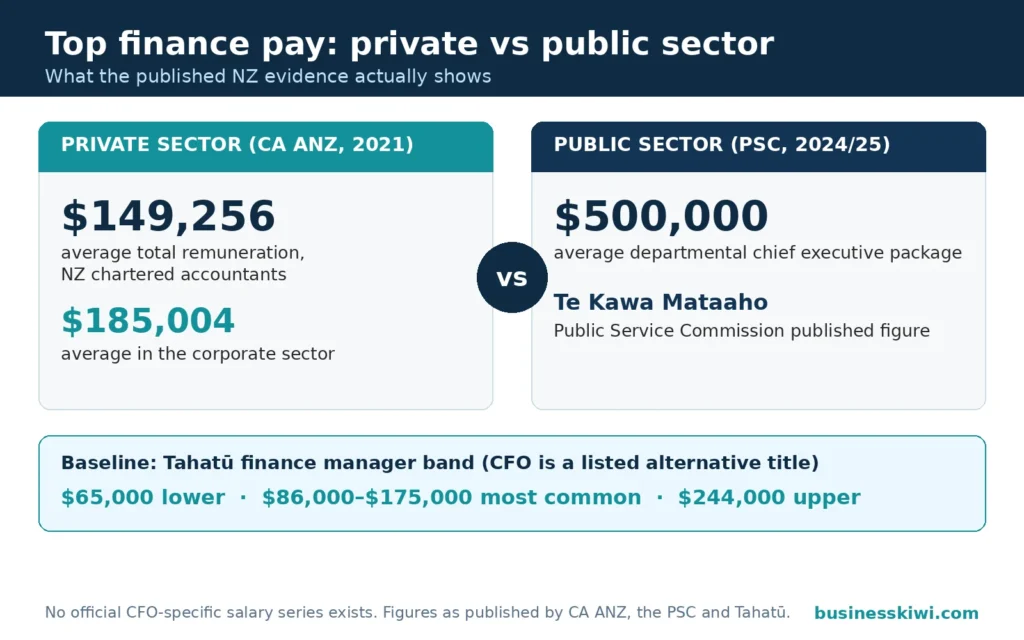
Tahatū, the government careers service run by the Tertiary Education Commission, covers the chief financial officer role inside its finance manager occupation. Chief financial officer and financial controller are both listed as alternative titles for that occupation, alongside titles such as finance and administration manager and investments manager. For the occupation as a whole, Tahatū puts pay at a lower end of $65,000 a year, a most common range of $86,000 to $175,000 a year, and an upper end of $244,000 a year. Around 20,000 people work in the occupation, and Tahatū describes employment change in it as steady.
CFOs sit at the top of that occupation rather than spread evenly through it. A working CFO in a mid-sized company is generally operating in the upper part of the most common range and beyond it, while the lower figures in the band belong to finance managers in smaller organisations whose jobs carry the same family of titles but a fraction of the scope. The sections below explain how to read the official figures, what sits on top of base salary, and why two people with CFO on their business cards can earn very different amounts.
What a CFO actually does
A chief financial officer is the most senior finance role in an organisation, accountable for the whole financial position rather than for one part of it. The brief usually covers financial reporting and compliance, funding and banking relationships, treasury and cash flow, financial planning, risk management, and advice to the chief executive and board on decisions with financial consequences. Tahatū summarises the finance manager occupation as overseeing an organisation’s strategic accounting, investments, risk management and other financial activities, and at CFO level the emphasis falls heavily on the strategic end of that list.
The distinction between the senior finance titles matters when comparing pay:
- Finance manager is the broadest label. It can describe someone running a small finance team in a regional business, or a senior leader in a large one. This breadth is exactly why the Tahatū band is so wide.
- Financial controller is usually the senior accountant responsible for the integrity of the numbers: reporting, controls, audit, tax compliance and the finance team’s day-to-day output. Controllers often report to the CFO and are the most common internal candidates for the role.
- Head of finance and finance director are commonly used as near-equivalents to CFO, particularly in organisations that reserve the CFO title for listed companies or for a group role sitting above several businesses.
- Chief financial officer carries the full accountability, including presenting to the board, fronting investors, lenders and auditors, and sharing responsibility for strategy with the chief executive.
Reporting lines follow from that. A CFO normally reports to the chief executive and has a direct relationship with the board or its audit and risk committee. In a small business, the most senior finance person may report to the owner and handle everything from payroll queries to bank negotiations, with a title that ranges from office manager to CFO depending on the employer’s habits. In a listed company, the CFO leads a department of specialists and spends much of the year on disclosure, investor relations and capital decisions. The title is the same. The jobs are not, and pay follows the job, not the title.
Organisation size is the single biggest driver. Revenue, headcount, debt, regulatory obligations and the number of entities being consolidated all scale the role. A CFO of a $15 million turnover business and a CFO of a $1.5 billion listed group are both chief financial officers, but nobody setting pay would treat the roles as interchangeable.

The official pay evidence
Because there is no CFO-specific series, the sensible approach is to work with the official bands that CFOs sit inside, labelled exactly as their sources label them.
Tahatū’s finance manager figures are the closest official anchor: lower end $65,000, most common $86,000 to $175,000, upper end $244,000 a year. These are occupation-wide figures drawn from official labour market data, and they describe everyone in the occupation from junior finance managers up. A CFO reading them should focus on the top of the most common range and the upper figure, keeping in mind that the very largest CFO packages, particularly in listed companies where equity forms part of pay, can run past what an occupation band captures.
The professional body data adds a second reference point. Chartered Accountants Australia and New Zealand (CA ANZ) surveys its members’ remuneration, and most CFOs in New Zealand are chartered accountants by background. In CA ANZ’s 2021 member remuneration survey, which drew responses from 1,895 New Zealand members, the average total remuneration for New Zealand chartered accountants was $149,256 a year. Members working in the corporate sector recorded the highest sector average, at $185,004 a year. Those are averages across the whole profession, from early-career accountants to partners and executives, so a CFO should sit well above the overall average and somewhere around or beyond the corporate figure, depending on the employer.
CA ANZ’s more recent survey releases show the direction of travel rather than CFO-specific numbers. Its survey released in February 2025, with more than 8,300 respondents across Australia and New Zealand, found that New Zealand members with six to ten years of experience reported total median remuneration of $118,300, and that this experience group earned 53 percent more than members with zero to five years of experience. The 2025/26 survey, covering more than 4,100 members, recorded the corporate sector as New Zealand’s largest increase in median remuneration, up 6 percent, and reported that 76 percent of respondents received a pay rise. The detailed salary tables from these surveys are available to CA ANZ members only, so the role-by-role breakdowns, including anything close to a CFO line, are not public. Anyone quoting a precise CFO figure from the CA ANZ survey is working from material the public cannot check.
How a CFO package is put together
Base salary is only part of what a CFO receives, and at this level the rest of the package can be substantial. The typical structure looks like this:
- Base salary. The fixed component, and the figure the Tahatū bands broadly describe.
- Short-term incentive. An annual bonus tied to company and personal performance measures. How common bonuses are across the profession shows up in CA ANZ’s 2021 survey: the average New Zealand member package of $149,256 was made up of an average base salary of $129,001, an average bonus of $10,602 and other components of $9,652. Executive bonuses are typically a much larger share of the package than that profession-wide average, but no official source publishes a CFO-specific percentage, so treat any exact figure quoted elsewhere with suspicion.
- Long-term incentive. In listed and some large private companies, part of pay is delivered in shares or share rights that vest over several years. This component can rival or exceed the annual bonus in a good year and be worth little in a bad one, which is one reason headline CFO pay at listed companies jumps around between years.
- KiwiSaver and superannuation. Inland Revenue requires employers to contribute a minimum of 3.5 percent of an employee’s gross salary to KiwiSaver, generally on top of pay, and some executive packages contribute more or use a complying superannuation fund instead. At CFO salaries, that percentage is real money.
- Other benefits. Health insurance, a vehicle or vehicle allowance, professional memberships and, occasionally, additional leave all appear in senior packages.
The public sector uses a similar definition when it reports executive pay. Te Kawa Mataaho, the Public Service Commission, defines the total remuneration it discloses for chief executives as base salary plus the employer’s superannuation contribution plus the value of any benefits, such as a week of leave above the statutory 20 days. Its disclosure notes add that packages can include performance-related payments, the employer’s cost of insurance and the value of the use of a vehicle. That is a useful reminder whenever you compare packages: compare totals, not base salaries.
The public sector angle
Government departments and Crown entities employ plenty of senior finance leaders, usually titled chief financial officer, deputy secretary of finance, or group manager of finance, and usually sitting one tier below the chief executive. Their pay is not published individually. What the Public Service Commission publishes, twice a year and at Cabinet’s request since 2010, is the remuneration of chief executives themselves: the people public sector CFOs report to.
That disclosure gives a ceiling and a sense of scale. The Commission reports that the average total remuneration package for secretaries of departments and chief executives of departmental agencies was $500,000 in 2024/25, up 0.8 percent on the year before, with a net increase of 3.7 percent across the five years from the $482,000 average recorded for 2019/20. Departmental CFOs earn less than the chief executives they support, and their remuneration is set within agency pay frameworks rather than disclosed person by person. In Crown entities, boards set executive pay and must follow the Commission’s guidance environment for chief executives, including obtaining the Commissioner’s consent to chief executive terms under section 117 of the Crown Entities Act 2004. Below chief executive level, senior staff pay surfaces in annual reports in aggregate and banded form rather than as named figures.
The Commission’s workforce data gives one more marker for the tier CFOs occupy in departments. As at 30 June 2021, the average base salary of tier 2 managers in the Public Service, the tier that includes deputy secretaries and departmental CFOs, was 3.6 times that of non-management staff, compared with 5.4 times for chief executives and 2.5 times for tier 3 managers. It is a ratio rather than a salary, but it confirms the pecking order the pay follows.

The path to a CFO seat
Almost every CFO in New Zealand arrives through accounting. The standard route runs through a commerce or accounting degree, qualification as a chartered accountant, and a climb through roles of increasing scope: financial accountant, senior accountant, finance manager, financial controller or head of finance, then CFO. Pay at the earlier rungs of that ladder is covered in our accountant salary guide, and the analyst rung that many finance careers pass through is covered in our financial analyst salary guide.
The CA ANZ pathway to the Chartered Accountant designation has two parts. The first is academic: an accredited degree, followed by the CA Program’s Graduate Diploma of Chartered Accounting, made up of nine subjects, seven core and two electives. The second is Mentored Practical Experience, three years of structured, supervised work in an approved role, amounting to at least 500 days of practical experience, with progress reviewed with a mentor every six months. Both parts must be completed within a maximum provisional membership period of eight years.
Qualification alone does not make a CFO. The appointments that lead to the role usually add some combination of commercial or operational finance experience, time in a controller seat owning the audit and reporting cycle, exposure to boards, and experience of transactions, funding rounds or restructures. Public practice experience, particularly audit, remains a common early-career foundation, and many CFOs also spend time in corporate finance or strategy roles. The CA ANZ survey pattern is consistent with that long build: pay rises steeply with experience, with the six to ten year group earning well over half as much again as the newest members in New Zealand, and the senior corporate cohort sitting at the top of the profession’s earnings.
First CFO appointments often come through one of three doors: promotion from financial controller when the incumbent leaves, a move from a larger company where the candidate was number two in finance to a smaller company where they become number one, or appointment into a growth business backed by private equity or new investors. Each route resets the pay conversation, because the benchmark is the scope of the new job rather than the salary of the old one.
Outlook for finance leadership roles
Tahatū counts around 20,000 people in the finance manager occupation and rates employment change as steady, which points to ongoing replacement demand as senior finance people retire or move, rather than rapid expansion. CA ANZ’s survey results support a picture of a mature, well-paid profession: most members received pay rises in the latest survey, the corporate sector led New Zealand’s growth, and flexibility ranked as the most valued non-pay benefit. For experienced finance leaders, the practical constraint is the number of CFO seats. There is only one per organisation, so progression depends on vacancies and on being visibly ready when one opens.
FAQs
Is there an official average CFO salary for New Zealand?
No. No official NZ series tracks CFO pay on its own. The nearest official figures are Tahatū’s finance manager occupation bands, which include chief financial officer as one of the occupation’s titles: a most common range of $86,000 to $175,000 a year and an upper end of $244,000. CFOs sit towards the top of that occupation rather than in the middle of it.
Why do advertised CFO salaries vary so much?
Because the title covers very different jobs. A CFO in a small company may be its only senior finance person, while a listed company CFO leads a large department and carries disclosure and investor obligations. Organisation size, sector, and whether equity or bonuses form part of the package explain most of the variation.
Do CFOs receive bonuses on top of salary?
Usually, yes, in the private sector. Annual short-term incentives tied to performance are standard at this level, and listed company CFOs often have long-term incentives paid in shares. CA ANZ’s 2021 survey found bonuses formed part of the average chartered accountant package across the profession ($10,602 on an average total of $149,256), and the bonus share is generally larger at executive level, though no official source publishes a CFO-specific percentage.
What qualifications do most CFOs hold?
Most are chartered accountants. The CA ANZ pathway combines an accredited degree, the Graduate Diploma of Chartered Accounting through the CA Program (nine subjects), and three years of Mentored Practical Experience. Experience in controller, head of finance or finance director roles usually follows before a first CFO appointment.
How much does a public sector CFO earn?
Individual public sector CFO pay is not published. The Public Service Commission publishes chief executive remuneration twice a year: the average package for departmental chief executives was $500,000 in 2024/25. Departmental CFOs sit one tier below that level, at the tier 2 management level, and their pay is set inside agency frameworks rather than disclosed individually.
Sources
- Tahatū Career Navigator, Finance manager occupation profile (pay bands, alternative titles including chief financial officer, people employed, employment change): https://tahatu.govt.nz/work/explore-career-ideas/occupation/T00015-finance-manager
- Chartered Accountants Australia and New Zealand, 2021 Member Remuneration Survey results (NZ average total remuneration, package composition, sector averages): https://www.charteredaccountantsanz.com/news-and-analysis/news/latest-ca-remuneration-survey-uncovers-work-landscape-and-vast-gender-pay-gap
- Chartered Accountants Australia and New Zealand, Remuneration Survey media release, 4 February 2025 (experience-group medians, pay rise shares): https://www.charteredaccountantsanz.com/news-and-analysis/media-centre/press-releases/pay-rises-flexible-working-and-gender-pay-gap-new-survey-for-cas
- Chartered Accountants Australia and New Zealand, Remuneration Survey 2025/26 (sector movements, member-only salary tables): https://www.charteredaccountantsanz.com/news-and-analysis/news/remuneration-survey-2025-26
- Chartered Accountants Australia and New Zealand, CA Program entry requirements and Mentored Practical Experience: https://www.charteredaccountantsanz.com/become-a-member/entry-requirements/chartered-accountant and https://www.charteredaccountantsanz.com/become-a-member/course-descriptions/ca-program/mentored-practical-experience-mpe
- Te Kawa Mataaho Public Service Commission, Chief executive remuneration (average packages and definition of total remuneration): https://www.publicservice.govt.nz/system/leaders/appointing-leaders/leader-pay/chief-executive-remuneration
- Te Kawa Mataaho Public Service Commission, Public Service leaders’ pay and chief executive remuneration disclosure notes: https://www.publicservice.govt.nz/system/leaders/appointing-leaders/leader-pay and https://www.publicservice.govt.nz/system/leaders/appointing-leaders/leader-pay/chief-executive-remuneration-detailed-disclosure-notes
- Te Kawa Mataaho Public Service Commission, Workforce Data 2021, Senior leader remuneration/pay (management tier salary ratios): https://www.publicservice.govt.nz/research-and-data/public-service-workforce-data-2021/workforce-data-senior-leadership-2021/workforce-data-senior-leader-remunerationpay-2021
- Inland Revenue, Employer contributions to KiwiSaver accounts (minimum compulsory employer contribution): https://www.ird.govt.nz/kiwisaver/kiwisaver-individuals/growing-my-kiwisaver-account/employer-contributions-to-kiwisaver
Disclaimer
This article is general information about CFO and finance leadership pay in New Zealand, based on official and professional body sources available at the time of writing. It is not career advice, financial advice or a salary negotiation service. Pay for any individual role depends on the organisation, the scope of the job and the full package, so check current official sources and your employment agreement when making decisions.
More salary and career guides are collected in the Jobs & Education hub.