$40 an Hour Is How Much a Year in NZ? Salary, Tax and Take-Home Pay

A job advertised at $40 an hour sounds straightforward, yet almost nobody budgets by the hour. We budget by the week, the fortnight and the year. This guide converts $40 an hour into those bigger numbers, then works through the income tax, ACC levy and KiwiSaver deductions that sit between the headline rate and the money that actually reaches your bank account. The tax figures use Inland Revenue rates, and every take-home number below is an estimate for one job, on the main tax code, with no student loan.
The quick answer
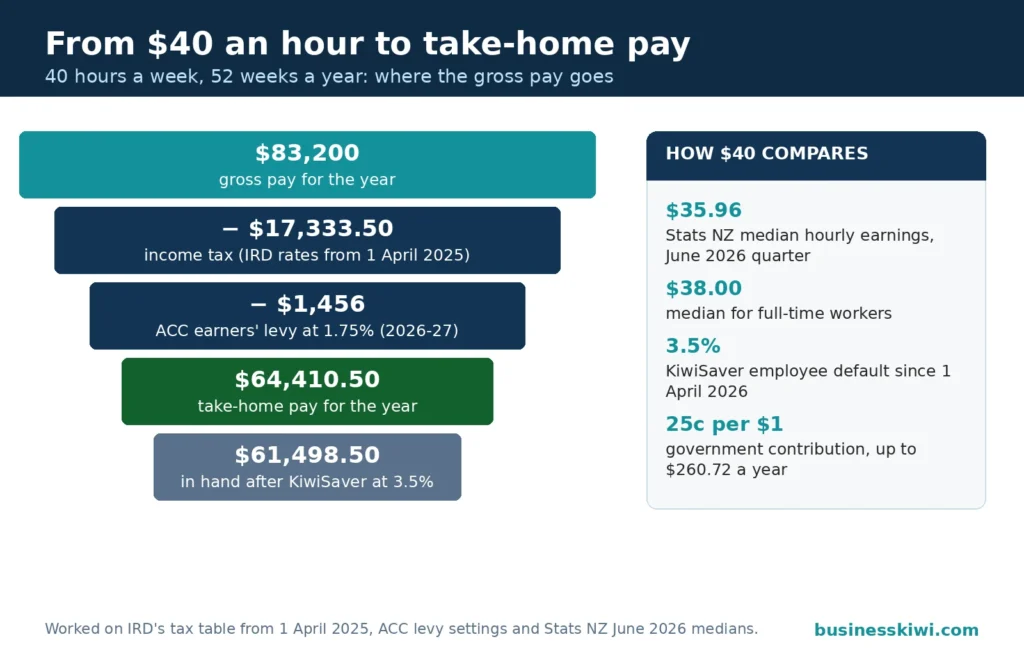
At $40 an hour, working 40 hours a week for 52 weeks, gross pay comes to $83,200 a year. That is $1,600 a week, or $3,200 a fortnight, before tax.
On that income, estimated income tax is $17,333.50 and the ACC earners’ levy is $1,456 for the year. That leaves estimated take-home pay of $64,410.50 a year before KiwiSaver, roughly $1,238.66 a week or $2,477.33 a fortnight.
Most employees are in KiwiSaver, and the current default employee rate is 3.5%. At that rate a further $2,912 comes out over the year, leaving estimated take-home pay of $61,498.50, roughly $1,182.66 a week.
Hours matter more than anything else in this calculation. Work a 37.5 hour week instead of 40 hours and the same $40 an hour produces $78,000 a year. The sections below show the workings for several patterns of hours.
What $40 an hour pays at different hours
There is no single legal definition of full-time work in New Zealand. Employment NZ says full-time generally means 30 hours or more a week, with part-time being anything under that, but workplaces set their own standard weeks and 37.5 or 40 hours are both common. That is why one hourly rate can stand for several different salaries.
The monthly column is the annual figure divided by 12. Few people are paid monthly, but the monthly equivalent is handy when you set an hourly rate against monthly costs like rent or a mortgage payment.
Every figure in that table assumes you are paid for all 52 weeks of the year. For a permanent employee that is a reasonable assumption. Pay continues through annual holidays and public holidays, and Employment NZ confirms that employees become entitled to at least 4 weeks of paid annual holidays after 12 months of continuous employment. The position is different for casual work, where weeks may have no work in them at all. That is covered further down.
It also assumes no unpaid leave. Take two weeks off without pay during the year and a 40 hour week at $40 an hour pays $80,000 instead of $83,200, because only 50 weeks are paid.

The tax on $83,200, worked through properly
Most wage earners never see the tax system up close because the tax is collected before they are paid. That system is PAYE, short for pay as you earn. Your employer calculates the tax on each pay, sends it to Inland Revenue, and pays you the rest.
New Zealand taxes income in slices. Each slice of income has its own rate, and a higher rate applies only to the slice that falls inside its band, never to everything you earn. Our tax rates guide walks through the full table. The rates in force since 1 April 2025, as published by Inland Revenue, are:
Here is the tax on $83,200, band by band:
Only $5,100 of the income reaches the 33% band. That 33% is the marginal rate, the rate paid on the next dollar you earn. The effective rate is different: $17,333.50 spread across the whole $83,200 comes to about 20.8% of gross pay. People sometimes worry that a pay rise could leave them worse off by dragging all their income into a higher band. That cannot happen under a sliced system, because the higher rate never reaches back over the lower slices.
The ACC earners’ levy
PAYE carries a second deduction that often gets mistaken for tax. The ACC earners’ levy helps fund cover for injuries that happen away from work, a rolled ankle at Saturday football or a ladder fall at home, and your employer collects it through your pay. For the 2026-27 year, Inland Revenue sets the levy at $1.75 per $100 of liable earnings, which is 1.75%, on earnings up to a maximum of $156,641.
On $83,200 the levy is $1,456 for the year. The cap does not bite here, because $83,200 sits well below the $156,641 maximum.
Your estimated take-home pay
Putting the two deductions together gives the following picture at 40 hours a week:
Weekly and fortnightly amounts are the annual figures divided by 52 and by 26, rounded to the nearest cent. Real payslips will not match to the cent. Employers work out PAYE one pay period at a time, so each pay varies slightly around these annualised estimates, and Inland Revenue squares up any difference after the tax year ends.
A single fortnight, with KiwiSaver at the default rate, looks like this: $3,200 gross, less $666.67 tax, less $56.00 for the ACC levy, less $112.00 for KiwiSaver, leaving $2,365.33 in hand.

KiwiSaver at $40 an hour
KiwiSaver deductions come out of your pay after tax has been calculated. They shrink your take-home pay but not your tax bill, and the money is still yours. It simply sits in your KiwiSaver account rather than your everyday account.
The default employee contribution rate rose to 3.5% on 1 April 2026. Employees can choose to contribute 3.5%, 4%, 6%, 8% or 10% of their gross pay. Some payslips still show 3%, because Inland Revenue allows a temporary rate reduction that takes an employee back to 3% for a period. Nothing stops you choosing a higher rate, and extra voluntary payments can be made straight to your provider.
At $83,200 a year, each rate looks like this:
Your employer has to contribute as well. Inland Revenue requires a compulsory employer contribution of at least 3.5% of your gross pay, which is $2,912 a year at this income, and in most arrangements it is paid on top of your wages rather than carved out of them. One qualification: employer contributions are taxed through employer superannuation contribution tax before they reach your account, so the amount credited lands slightly under the full 3.5%.
The government adds a contribution of its own. Eligible members receive 25 cents for every dollar they contribute, up to a maximum of $260.72 a year. Getting the full amount takes contributions of at least $1,042.86 between 1 July and 30 June. On $40 an hour full-time, even the default 3.5% rate contributes $2,912, comfortably past that threshold, and taxable income of $83,200 is under the $180,000 eligibility limit Inland Revenue sets. None of this money is take-home pay. It goes into your KiwiSaver account, which is why it does not appear in the tables above.
If you have a student loan
The estimates in this article leave student loan repayments out, and they are large enough to change the picture. If you have a student loan and use a tax code with SL, Inland Revenue deducts 12% of every dollar you earn over the repayment threshold. For the 2026 tax year that threshold is $24,128 a year, applied pay period by pay period at $464 a week.
On a steady $1,600 a week, the repayment is 12% of the $1,136 earned above the weekly threshold, which is $136.32 a week. Across a full year that is roughly $7,088.64. With a student loan, estimated take-home pay before KiwiSaver drops to about $1,102.34 a week instead of $1,238.66.
What $40 an hour means in context
Against the median
Stats NZ puts median hourly earnings from wages and salaries at $35.96 for the June 2026 quarter, and the median for full-time workers at $38.00 an hour. Measured against the whole workforce, $40 an hour is $4.04 an hour above the median. That is a useful reality check, but medians blend every region, industry and level of experience into one number. They cannot tell you whether $40 an hour is a fair rate for your job in your town.
Casual work and the 8% question
The same rate buys different things depending on the type of employment behind it. A permanent employee on $40 an hour is paid for annual holidays and public holidays on top of the hours worked, and has sick leave entitlements building up as well.
Casual employees have no guaranteed hours and no ongoing expectation of work. Some casuals, and some people on fixed-term agreements of less than 12 months, are paid holiday pay as they go: an extra 8% of gross earnings in each pay, instead of paid annual holidays later. Employment NZ is strict about this. Pay as you go is only allowed where the agreement runs under 12 months, or where the work is so irregular that providing 4 weeks of annual holidays in the usual way is impracticable. It is not an option employers can choose for everyone.
If your $40 an hour already has the 8% rolled into it, the underlying rate is lower than the headline. Dividing $40 by 1.08 gives a base rate of $37.04 an hour, with the remaining $2.96 being the holiday component. Compare a casual rate with a permanent rate on that basis, not headline against headline.
Salaried versus waged work
An hourly paid worker who works more hours earns more money. A salaried worker is paid the same annual amount whether a given week runs short or long. The two only line up while the hours match. An $83,200 salary matches $40 an hour at exactly 40 hours a week. If the role regularly takes 45 hours, the effective rate falls to about $35.56 an hour, and at 50 hours a week it is $32.00 an hour. When you weigh a salary offer against hourly paid work, divide the salary by the hours you will genuinely work, not the hours printed in the advertisement.
Overtime is not a given
A healthy base rate does not carry a built-in premium for extra hours. There is no general legal requirement in New Zealand for hours beyond 40 to be paid at time and a half. Whether extra hours are paid at a higher rate, at your usual rate, or absorbed into a salary depends on your employment agreement. Read that clause before you count on overtime money.
Why a $40 contract rate is not the same thing
Contract rates look generous next to wages, and the comparison misleads. Employment NZ draws the line clearly: for an employee, the employer handles PAYE tax and ACC, while a contractor usually pays their own tax and ACC, receives no paid annual holidays, and gets no compulsory employer KiwiSaver contribution. A contractor charging $40 an hour also has to absorb gaps between jobs, unpaid admin time, equipment costs and their own KiwiSaver contributions out of that rate. Fewer of their hours are billable, too. A contract rate is a business price, not a wage, and it should not be set directly against the $83,200 employee figure.
Going the other way: salary to hourly
Comparing a salary offer with hourly work means running the maths in reverse. A 40 hour week across 52 weeks contains 2,080 paid hours, so divide the salary by 2,080.
Seen from this direction, $40 an hour sits between an $80,000 and a $90,000 salary at standard full-time hours, which lines up with the $83,200 gross figure. Shorter standard weeks change the answer: at 37.5 hours a week there are 1,950 paid hours in a year, so an $83,200 salary works out at $42.67 an hour instead.
FAQs
Is $40 an hour a good wage in New Zealand?
It sits above the middle of the market. Stats NZ measured median hourly earnings at $35.96 in the June 2026 quarter, and $38.00 an hour for full-time workers, so $40 an hour clears both marks. Whether it is good pay for you still depends on your occupation, region and experience, and on what the role demands beyond the contracted hours.
How much tax do I pay if I earn $40 an hour full-time?
On gross pay of $83,200, estimated income tax is $17,333.50 for the year, plus the ACC earners’ levy of $1,456. That is an effective income tax rate of about 20.8%, even though the top marginal rate that touches the income is 33%.
What is $40 an hour after tax per week?
Estimated take-home pay is about $1,238.66 a week before KiwiSaver, based on 40 hours a week for 52 weeks. With KiwiSaver deducted at the 3.5% default rate, it is about $1,182.66 a week. Student loan repayments, where they apply, come off on top of those figures.
Does the $83,200 figure include holiday pay?
For a permanent employee, paid annual holidays sit inside the $83,200 rather than on top of it. You keep being paid while you take your 4 weeks of annual holidays, so the annual total already reflects a full paid year. For a casual employee on pay as you go terms, an 8% holiday component may already be inside the $40 hourly rate itself, which makes the underlying base rate about $37.04 an hour.
What if I work part-time at $40 an hour?
The hourly rate stays the same and the totals scale with hours. At 30 hours a week, gross pay is $62,400 a year, and at 20 hours a week it is $41,600. Tax takes a smaller share at those levels, because a lower annual income reaches less of the higher tax bands.
Sources
The figures in this article come from the following official sources, checked in October 2026:
- Inland Revenue, Tax rates for individuals, ird.govt.nz
- Inland Revenue, ACC earners’ levy rates, ird.govt.nz
- Inland Revenue, Employee contributions, ird.govt.nz
- Inland Revenue, Employer contributions to KiwiSaver accounts, ird.govt.nz
- Inland Revenue, KiwiSaver benefits, ird.govt.nz
- Inland Revenue, Repaying my student loan when I earn salary or wages, ird.govt.nz
- Employment New Zealand, Understanding types of workers, employment.govt.nz
- Employment New Zealand, Managing annual holidays, employment.govt.nz
- Stats NZ, Labour market statistics (income), June 2026 quarter, stats.govt.nz
Disclaimer
This article is general information only. It is not tax, legal or financial advice. The take-home figures are estimates based on the settings described above, and your actual pay will depend on your tax code, hours, KiwiSaver choices and personal circumstances. For advice on your own situation, contact Inland Revenue or talk to a qualified tax professional.
For more guides on pay, tax and working life in New Zealand, browse the Jobs & Education hub.