Aircraft Engineer Salary NZ: Licensed and Unlicensed Pay Explained

Aircraft engineers sit in an odd corner of the New Zealand labour market. The work is engineering, but the pay ladder is not really set by engineering degrees or years of service alone. It is set by a licence. Whether you can legally certify an aircraft as safe to fly, and sign it back into service, matters more to your income than almost anything else in this trade.
This guide covers aircraft maintenance engineers only: the people who inspect, service and repair aeroplanes and helicopters, and the licensed aircraft maintenance engineers (LAMEs) who certify that work. It does not cover aeronautical design engineers or engineering technicians in other industries. If you want the wider picture across civil, mechanical, electrical and other roles, our general engineer salary guide covers those occupations separately.
The short answer
New Zealand has no single official salary series for aircraft engineers, so be wary of any website that quotes one precise average. What the official careers services publish is this:
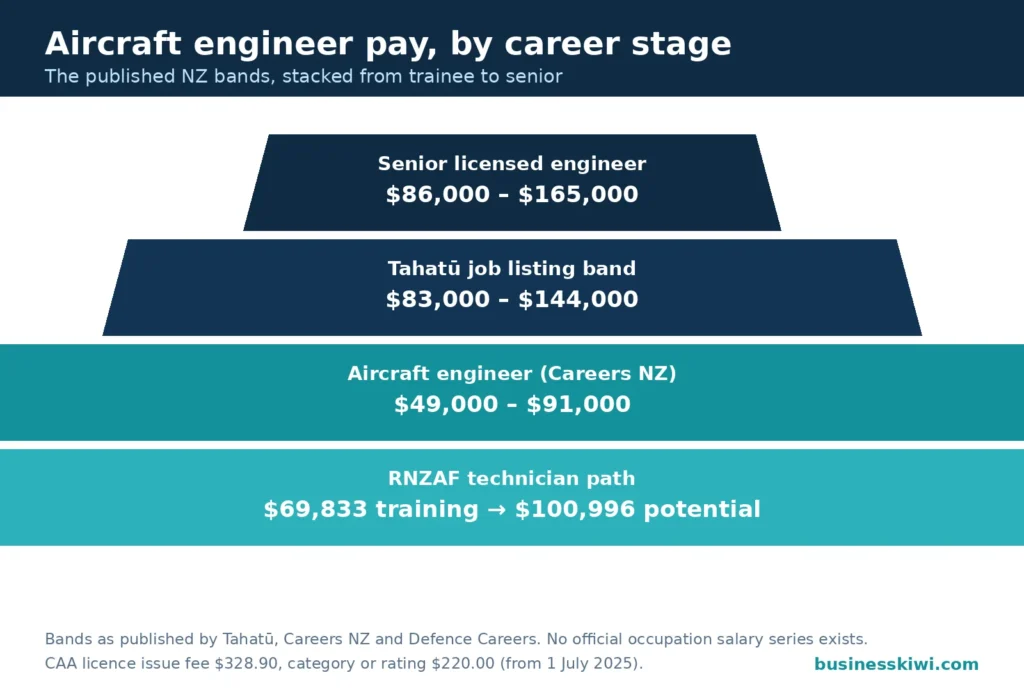
- Tahatū Career Navigator, the government’s careers service, lists pay for aircraft maintenance engineers at $83,000 to $144,000 a year, before tax.
- Careers NZ’s occupation profile splits the occupation by seniority. It says aircraft maintenance engineers usually earn $49,000 to $91,000 a year, while senior aircraft maintenance engineers and supervisors usually earn $86,000 to $165,000 a year.
- In the Royal New Zealand Air Force, Defence Careers publishes $69,833 while under training for its aeronautical trades, with future potential earnings of $100,996.
Read together, those three sources tell a consistent story. Pay starts modestly during training, settles into a solid trades income once you are qualified, and climbs steeply once you hold a licence, type ratings and supervisory responsibility. The sections below explain why the ranges are wide, and what moves a person from the bottom of them to the top.
What an aircraft maintenance engineer actually does
Aircraft maintenance engineers keep aircraft airworthy. The day-to-day work covers inspecting and servicing engines, propellers and airframes, working through scheduled checks, diagnosing faults, and repairing or replacing parts and systems that are faulty or have reached the end of their safe life. The systems involved go well beyond the engine: hydraulics, pressurisation and ventilation, fuel, landing gear, flight controls, and the electrical, instrument, radio and navigation equipment grouped under the label avionics.
Two features of the job shape everything else, including pay. The first is legal accountability. Maintenance is carried out under Civil Aviation Authority rules, against the manufacturer’s instructions for continued airworthiness, and every task has to be recorded. The second is specialisation. As the CAA’s own guide to the occupation puts it, powerplant specialists work on engines and propellers, airframe specialists work on the body of the aircraft and its systems other than instruments, powerplants and propellers, and mechanical specialists range across the whole aircraft other than instruments and radio systems. Some engineers work mainly on aeroplanes, others on helicopters, and some on both.
The work happens in hangars and workshops, out on airfields, and sometimes in the field, wherever an aircraft has gone unserviceable. A check that the law requires every 100 hours of flying is routine work in this trade. So is a major rebuild that keeps an aircraft on the ground for weeks.

Licensed and unlicensed: the divide that drives pay
Anyone can turn a spanner on an aircraft under supervision. Only a licensed engineer can certify the work and release the aircraft to service. That distinction is the single biggest pay lever in the occupation.
An unlicensed aircraft maintenance engineer does the hands-on maintenance: inspections, servicing, repairs, component changes and testing. Their work is checked and certified by someone else. A licensed aircraft maintenance engineer, a LAME, holds an aircraft maintenance engineer licence issued by the Civil Aviation Authority under Civil Aviation Rule Part 66. The licence is what allows its holder to certify maintenance and sign an aircraft back into service within the categories and ratings on that licence. Licensed engineers also inspect, supervise and approve the work of unlicensed engineers, which is why the Careers NZ profile describes progression into licensed roles as the step into supervision.
There is a middle step worth knowing about. Part 66 also provides for a certificate of maintenance approval, which lets an experienced engineer certify specified work under an approved organisation’s system without holding the full licence. Further up the ladder sits the certificate of inspection authorisation. To be eligible, an engineer must hold a group or type rating on a current licence, have held the licence for at least five years, have recent and current experience, and complete an inspection authorisation course. Holders can certify reviews of airworthiness and the conformity of major repairs and modifications, with mechanical and avionic variants of the authorisation.
Employers pay for certification rights because aircraft earn nothing while they sit on the ground. A LAME who can release an aircraft to service keeps a fleet moving, so licensed engineers are scarcer, harder to replace, and paid accordingly. No official source puts a dollar figure on the licence premium itself, and this guide will not invent one. What the published bands show is the shape of it: the senior band in the Careers NZ profile, which captures licensed and supervisory engineers, starts roughly where the general band ends.
The licence: categories, group ratings and type ratings
A Part 66 licence is not one blanket permission. It is built up in layers, and each layer tends to support pay.
The licence itself is issued in one or more of seven categories set out in rule 66.5: aeroplane, rotorcraft, powerplant, electrical, instrument, radio, and lighter-than-air aircraft. On top of categories sit group ratings, which cover families of aircraft listed in an appendix to Part 66, and aircraft and component ratings, which cover specific types. A type rating is what ties a licensed engineer to a particular aircraft type, such as a specific airliner or helicopter model, and employers generally need engineers rated on the types they actually operate.
This layering explains a lot of the spread in the salary bands. A licensed engineer rated on one small aircraft type has narrower value to an employer than a licensed engineer holding several categories and type ratings across a fleet. It also explains why pay negotiations in this trade so often revolve around which ratings an employer will fund, and which an engineer brings with them.
Pay in detail, by career stage
Because the official sources publish bands rather than a stage-by-stage scale, the honest way to present pay is stage by stage, using only the figures those sources support.
Trainees and apprentices. No official source publishes a standard civilian apprentice or trainee wage for this occupation, so there is no verified figure to quote. Training takes three to five years all up, according to Careers NZ, and the early part of it is usually a pre-employment qualification followed by an apprenticeship. The one published trainee figure comes from the Defence Force: RNZAF aeronautical trades are paid $69,833 while under training, and that salary is paid while the recruit completes courses the civilian trainee often pays to attend. Treat the military figure as a benchmark for the training years, not as the civilian rate.
Qualified but unlicensed engineers. Once the apprenticeship is complete, an engineer works as a qualified tradesperson whose work is certified by others. This is the heartland of the Careers NZ band of $49,000 to $91,000 a year. Where a person lands in that band depends on experience, specialisation and the size of the operation. Avionics skills, non-destructive testing and structural repair work are all specialisations the profile identifies, and each broadens the work an engineer can be given.
Licensed engineers. The licence requires at least five years of practical aviation engineering experience and passes in 10 theory examinations (more on both below), so licensing is a mid-career milestone rather than an entry step. Licensed engineers take on certification duties and supervise others, and their pay is best read against the upper part of the published bands: Tahatū’s $83,000 to $144,000 range for the occupation, and the senior Careers NZ band. Type ratings on an employer’s fleet are usually what separate a newly licensed engineer from a well-paid one.
Senior engineers and supervisors. Careers NZ puts senior aircraft maintenance engineers and supervisors at $86,000 to $165,000 a year. This group includes engineers running shifts and hangars, holders of inspection authorisations, and specialists whose ratings cover high-value work. Some experienced engineers are also self-employed, contracting their certification skills to smaller operators, although no official source publishes contractor rates.
One more caution about the two careers-service bands. Tahatū’s $83,000 to $144,000 and Careers NZ’s split bands come from different data and different vintages, which is why they do not line up neatly. Both are published by official NZ careers services, and both are before tax. Neither is a promise of what any individual employer will pay.
The Defence Force route and its published pay
The Royal New Zealand Air Force is one of the largest trainers in this trade, and it is the only employer in the sector that publishes simple pay figures on its own careers pages.
Defence Careers lists $69,833 a year while under training for Air Force aeronautical trades, rising to future potential earnings of $100,996 as experience, qualifications and rank accumulate. Training starts with a 12-week recruit course at RNZAF Base Woodbourne, followed by a 17-week Aeronautical Engineering Fundamentals Course that Defence Careers describes as a requirement for all technical trades in the RNZAF, then trade-specific training and around 18 months of on-the-job consolidation on a base. The package around the salary matters too: Defence Careers lists allowances for field, sea, overseas and operational service, subsidised food and accommodation on base, and free medical and dental care.
Military pay is not directly comparable with civilian pay. Rank progression, postings and allowances drive it, and there is no CAA licence at the end of the military pathway in the way there is in civil aviation, although the skills transfer and many engineers move into civilian licensed roles after service. The Royal NZ Navy also employs aircraft maintenance engineers to work on its helicopters, according to the Careers NZ profile.
What moves pay up or down
Beyond the licence itself, the published sources point to a consistent set of influences:
- Type ratings and categories. Each additional rating widens the fleet an engineer can certify, and scarce ratings command more.
- Employer and fleet. Air New Zealand is the country’s largest employer of aircraft maintenance engineers. Its engineering and maintenance operation works from three bases: Auckland for wide-body aircraft, Christchurch for narrow-body aircraft and Nelson for turboprop aircraft. Large airline operations, maintenance and overhaul firms, helicopter companies and general aviation workshops all sit in the same labour market but pay at different points in the bands.
- Shift patterns. Aircraft are maintained around the clock, and engineers usually work shifts. How any individual employer pays for nights, weekends and call-outs is set by that employer’s own agreements, which are not published in full, so this guide quotes no penalty rates.
- Location and mobility. Work concentrates around the main bases and airports, and engineers who travel for field work or overseas contracts sit outside the domestic bands altogether.
- Shortage. This occupation was added to Immigration New Zealand’s Green List in March 2024, which signals officially recognised demand, and Careers NZ rates the chances of getting a job as good. Shortages do not set anyone’s individual salary, but they strengthen an experienced licensed engineer’s hand at negotiation time.
Training pathway: how people get into the trade
There is no single compulsory entry qualification, but the established pathway has a clear shape, and it takes three to five years end to end.
At school, NCEA Level 2 in English, maths and science is usually needed to enter tertiary training, and technology subjects help. The first formal step is an initial qualification such as the New Zealand Certificate in Aeronautical Engineering (Pre-Employment Skills) (Level 3), a 130-credit qualification offered by Air New Zealand’s Aviation Institute among others, or a Certificate in Aeronautical Engineering Fundamentals (Level 3) through Nelson Marlborough Institute of Technology or the Royal NZ Air Force. Air New Zealand’s Academy of Learning delivers the Level 3 certificate over 36 weeks in Auckland and Christchurch, with indicative fees of $12,637 plus about $500 of course-related costs for its 2027 intakes, and its Aviation Institute accepts between 30 and 50 people a year into engineering training, with Air New Zealand taking up to 20 trainees a year.
From there, trainees complete an apprenticeship, overseen in the civilian sector by ServiceIQ, and gain a New Zealand Certificate in Aeronautical Engineering (Level 4) or a Diploma in Aeronautical Engineering (Level 5). NZQA’s register lists the Level 4 Applied Skills certificate at 210 credits, with strands that mirror the trade’s specialisations: Aircraft Mechanical, Aircraft Powerplant, Aircraft Structures, Avionic Maintenance and Rotorcraft among them. A Level 4 Specialist Support certificate (120 credits) covers narrower support roles, and the pathway continues to the New Zealand Diploma in Aeronautical Maintenance Certification (Level 6), which aligns study with the licensing examinations.
The licence itself sits on top of the qualifications. The CAA states that to obtain an aircraft maintenance engineer licence in New Zealand you must pass 10 theory exams and have at least five years of practical aviation engineering experience, recorded as you go. In practice, engineers build that experience through their apprenticeship and early qualified years, sit the exams subject by subject, and apply for the licence and its first category once both parts are complete. Group and type ratings, and later the inspection authorisation, are added over the following years.
What the licence costs
The CAA’s own application fees are the smallest cost in the whole pathway, but they are worth knowing. Under the CAA fees schedule in force from 1 July 2025, including GST:
Examination fees are charged separately by the examination provider, and the CAA does not publish those on its fees page, so they are not quoted here. The real costs of licensing are the years of experience required and the study time, not the application charges.
Hours, shifts and working conditions
Passengers fly at all hours, so maintenance happens at all hours. Careers NZ describes aircraft maintenance engineers as usually working shifts, with some required to be on call during evenings and weekends. Heavy maintenance runs in hangars on planned schedules, while line maintenance turns aircraft around between flights, often at night so the fleet is ready for the morning. Work can involve travel around New Zealand or overseas, and field recovery work away from base.
The physical side is real. Engineers spend long periods on their feet, work in and around aircraft including confined spaces such as cockpits and wheel bays, do some heavy lifting, and work around fuel, oil and hydraulic fluids in noisy environments. Normal colour vision is required, because some aircraft components are colour-coded. None of that is unusual for a skilled trade, but it is worth weighing alongside the salary figures.
Job outlook
The official outlook is positive. Careers NZ rates the chances of getting a job as an aircraft maintenance engineer as good, due to increasing demand for their services, and notes that vacancies typically arise when qualified people retire or move overseas. The Census counted 3,192 aircraft maintenance engineers working in New Zealand in 2018, so this is a small, specialised workforce in which experienced licensed engineers are genuinely scarce. The occupation’s place on the Immigration New Zealand Green List since March 2024 underlines the same point: the government is actively encouraging skilled aircraft maintenance engineers from overseas to work here because local supply is not meeting demand.
The Careers NZ profile also points to the global picture, citing Boeing’s Pilot and Technician Outlook 2022-41, which projected demand for 610,000 civil aviation maintenance technicians worldwide over 20 years. For a New Zealand engineer, that global demand cuts both ways: it creates overseas options, and it means local employers compete for licensed staff who could leave.
FAQs
How much does an aircraft engineer earn in NZ?
Official NZ careers services publish bands rather than one average. Tahatū lists $83,000 to $144,000 a year for aircraft maintenance engineers. Careers NZ says engineers usually earn $49,000 to $91,000, and senior engineers and supervisors usually earn $86,000 to $165,000. All figures are before tax, and where you sit depends mainly on whether you hold a licence and which type ratings you carry.
Do licensed aircraft engineers earn more than unlicensed engineers?
Yes, in structure if not by a published dollar amount. Only licensed engineers can certify maintenance and release aircraft to service, and they supervise and approve the work of unlicensed engineers. That legal responsibility is why the senior band published by Careers NZ sits well above the general band. No official source quantifies the premium as a single figure.
How long does it take to become a licensed aircraft maintenance engineer in NZ?
Training takes three to five years in total. The CAA requires at least five years of practical aviation engineering experience and passes in 10 theory exams before it will issue a licence, so licensing usually comes after an apprenticeship and the first qualified years, not straight out of training.
What qualifications do I need to start training?
There is no compulsory entry qualification, but NCEA Level 2 in English, maths and science is usually needed for tertiary training. The usual first step is the New Zealand Certificate in Aeronautical Engineering (Pre-Employment Skills) (Level 3), followed by an apprenticeship leading to a Level 4 certificate or Level 5 diploma.
Is there a shortage of aircraft engineers in New Zealand?
The official signals say yes. Careers NZ rates job chances as good because of increasing demand, and the occupation was added to Immigration New Zealand’s Green List in March 2024, which is the government’s mechanism for actively encouraging skilled workers from overseas into roles employers cannot fill locally.
Sources
- Tahatū Career Navigator (Tertiary Education Commission), aircraft maintenance engineer career listing, pay band: https://tahatu.govt.nz/work/explore-career-ideas/120-air-and-sea-transport
- Careers NZ, aircraft maintenance engineer occupation profile (pay by seniority, job chances, training, employers, working conditions), read via Wintec, Te Pūkenga: https://www.wintec.ac.nz/future-you/explore/jobs/maintenance-and-repair/aircraft-maintenance-engineer
- Civil Aviation Authority, Civil Aviation Rule Part 66, Aircraft Maintenance Personnel Licensing: https://www.aviation.govt.nz/assets/rules/initial-issue/Rule-Part-066-Aircraft-Maintenance-Personnel-Licensing-signed-goat-skin.pdf
- Civil Aviation Authority, Part 66 AME licence syllabuses (examination and experience requirements): https://www.aviation.govt.nz/licensing-and-certification/engineering/maintenance-engineer-licensing/part-66-ame-licence-syllabuses/
- Civil Aviation Authority, fees, levies and charges schedule: https://www.aviation.govt.nz/about-us/what-we-do/how-we-are-funded/fees-levies-and-charges/
- Civil Aviation Authority, Being a licensed aircraft maintenance engineer (Good Aviation Practice booklet): https://aviation.govt.nz/assets/publications/gaps/being-a-lame-junior.pdf
- Defence Careers, Air Force aeronautical trades (training salary, future potential earnings, training structure): https://www.defencecareers.mil.nz/air-force/careers/browse-roles/aeronautical-metal-worker
- NZQA qualification register, New Zealand Certificate in Aeronautical Engineering (Pre-Employment Skills) (Level 3) and (Applied Skills) (Level 4): https://www.nzqa.govt.nz/nzqf/search/addToShortList.do?selectedItemKey=2898 and https://www.nzqa.govt.nz/nzqf/search/addToShortList.do?selectedItemKey=2909
- Air New Zealand Academy of Learning (programme length, locations, indicative fees): https://careers.airnewzealand.co.nz/academy-of-learning
- Air New Zealand Careers, Engineering and Maintenance (bases and specialisations): https://careers.airnewzealand.co.nz/engineering
Disclaimer
This article is general information about pay, licensing and training for aircraft maintenance engineers in New Zealand, drawn from the official sources listed above. Pay bands are published ranges, not guarantees, and individual salaries depend on the employer, the licence categories and ratings held, and the agreement you sign. It is not career advice or financial advice. If you are weighing up training or a job change, check the current figures on Tahatū and the CAA website, and talk to the training providers and employers involved.
For more career and salary guides, see the Jobs & Education hub.