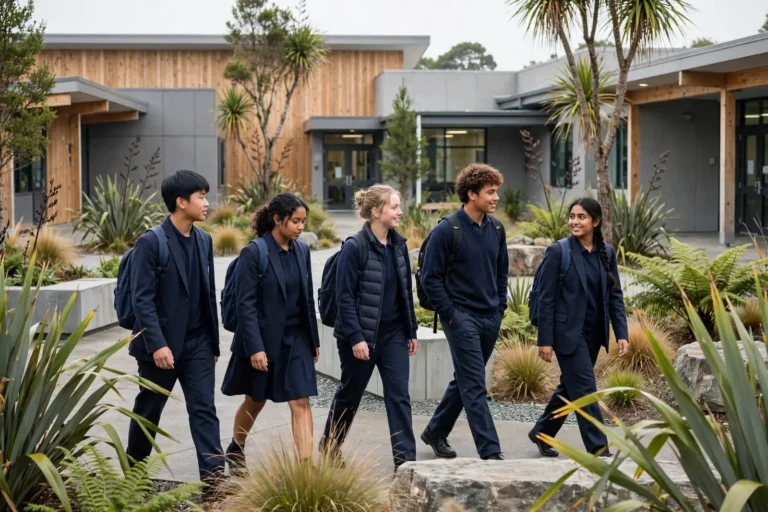
Maeroa Intermediate School: Enrolment, Zone and What Parents Need to Know
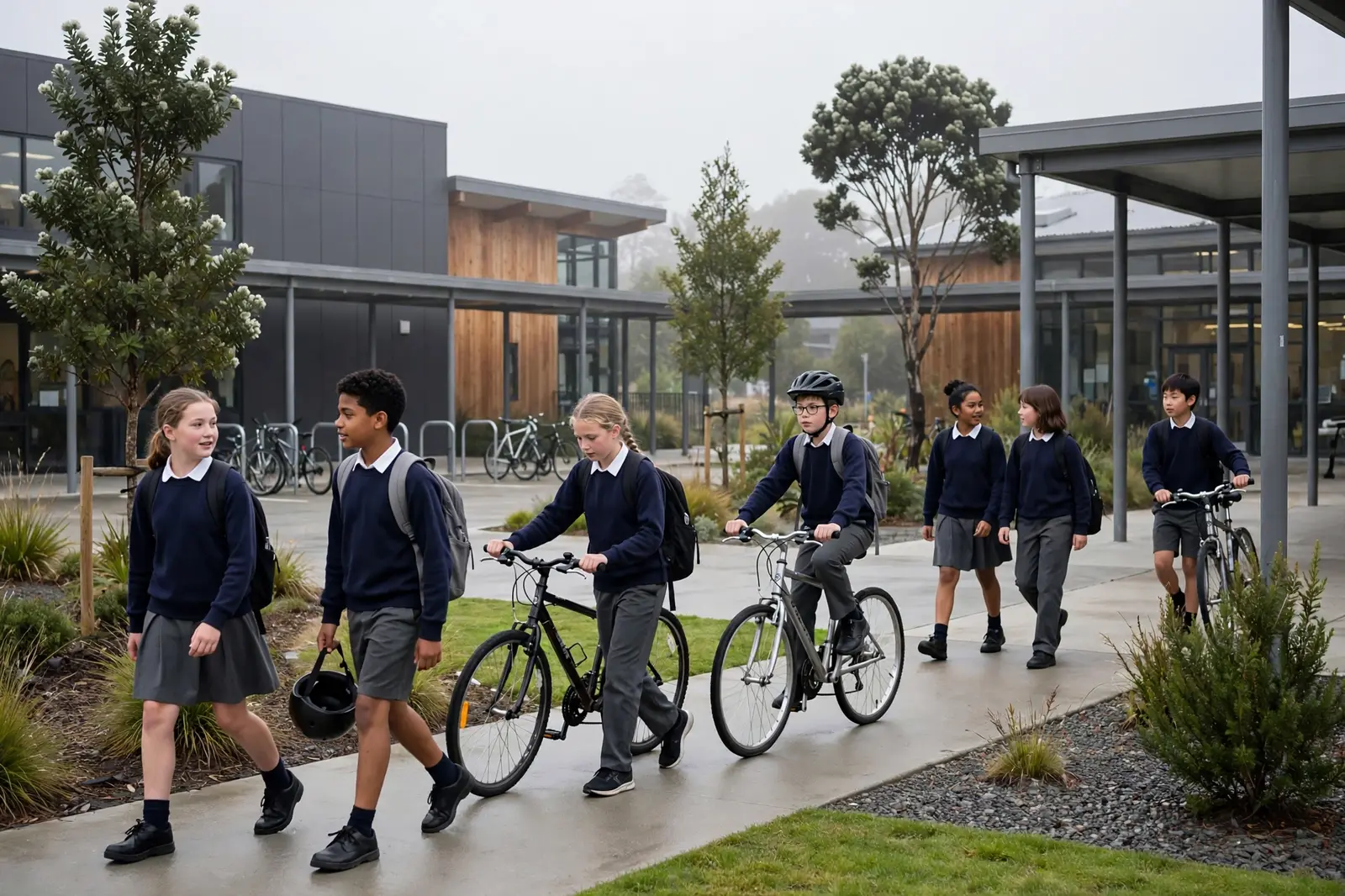
Two years is a short time at a school, but for children aged about 11 to 13 they are formative ones. Maeroa Intermediate School in Hamilton exists for exactly that stage: a state intermediate for Year 7 and Year 8 students, on Churchill Avenue in the west of the city, and part of its community since 1954. If your child is finishing primary school in Hamilton and Maeroa is on your list, or inside your zone, this guide brings together what the Ministry of Education records about the school and what the school itself publishes about enrolment, costs, uniform and daily life.
Everything below comes from official sources: the school’s Education Counts profile and roll data published by the Ministry of Education, plus the school’s own website and its Information Book for 2026. Enrolment details and term dates change, so confirm the current position with the school office before you act on it.
Maeroa Intermediate at a glance
- Official listing name: Maeroa Intermediate (the school styles itself Maeroa Intermediate School)
- Ministry of Education institution number: 1792
- School type: State intermediate school, Years 7 and 8
- Gender: Co-educational
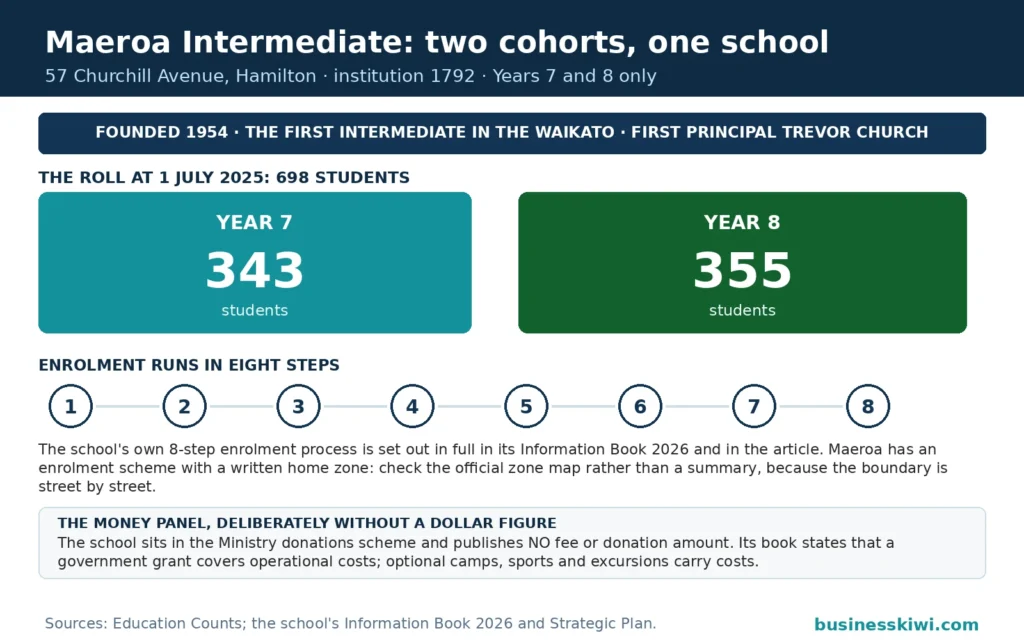
- Roll: 698 students at 1 July 2025 (343 in Year 7, 355 in Year 8)
- Principal: Susan Wood
- Address: 57 Churchill Avenue, Hamilton 3200
- Phone: 07 847 5014
- Email: office@maeroa.school.nz
- Boarding: No
- Enrolment scheme: Yes, the school operates an enrolment scheme with a home zone
- Māori medium: Some students learn in Māori medium, through the school’s Te Puaawaitanga unit
Education Counts does not display an Equity Index figure for the school on the profile page used for this guide, so none is quoted here. The Equity Index replaced deciles as the Ministry’s measure of the socio-economic barriers a school’s students face; the school’s current figure is best checked on its Education Counts profile.
About the school
Maeroa Intermediate School was founded in 1954 and, as the school records in its strategic plan, it was the first intermediate school in the Waikato region. Its first principal was Mr Trevor Church. The school describes itself as a large inner-city school in West Hamilton drawing on a diverse community, and the roll data backs that up. Of the 698 students recorded at 1 July 2025, the largest groups were European/Pākehā (358 students) and Māori (357), with Pacific students (89) and Asian students (89) also making up a significant share. Ethnicity in Ministry roll data is multiple response, so students who identify with more than one group are counted in each.
The school’s motto is “I will not cease from mental fight”, a line it links to developing lifelong learners with resilience, responsibility and respect. Its vision, published in its strategic plan, is to develop confident and competent learners who can find their place within communities. The campus includes large turfed areas, a gymnasium, an auditorium and a swimming pool, and its enviro group is restoring the school gully, with community working bees held regularly.
Intermediate schooling is a distinct New Zealand stage: two years of specialist teaching between primary and secondary school. Maeroa’s own material leans into that purpose, opening with the point that the early adolescent years are a critical time, physically and emotionally, and that the middle years need their own teaching approach.
Year levels and the learning programme
Maeroa teaches Years 7 and 8 only. Students are placed in composite Year 7/8 classes, so each homeroom mixes first-year and second-year students; the school’s strategic plan puts the number of classrooms at twenty-four. Within those classes, the core learning focus is English, mathematics, science and social inquiry, taught by the homeroom teacher. Teachers track individual progress, plan for individualised learning, and can recommend additional support or extension.
Two features set intermediate apart from primary school, and both feature at Maeroa. The first is specialist teaching. Students rotate through a technology and arts programme, and the school’s published specialist subjects include hard materials (which it calls Explorations), food technology, music, media art, visual art and digital technology. The school also employs a part-time dance and drama teacher. The second is language learning: international languages and te reo Māori are compulsory for all students, according to the school’s Information Book.
Digital learning is integrated across the programme, with devices available in all learning spaces. The school is a Google Apps for Education school, so each student has a school email address and Google Drive access for schoolwork, covered by a cybersafety agreement families sign at enrolment. Physical education and health are scheduled weekly, addressing the physical and emotional needs of emerging adolescents.
The school frames its learner profile around three words: learners, communicators and citizens. Students are expected to be literate, numerate and digitally capable, to set goals based on feedback, to listen to other perspectives, and to take part in the life of the school and community.
Specialist classes, extension and support
Alongside the composite homeroom classes, the school runs three specialised class options, described in its Information Book:
- Te Puaawaitanga, the school’s Māori language unit, gives students the opportunity to learn te reo Māori and deepen their knowledge of tikanga. Education Counts records that some Maeroa students are taught in Māori medium.
- Te Ara Poutama is the school’s class for gifted and talented education (GaTE), for more academically minded students who can work with greater independence.
- The Sports Unit focuses on academic success through sporting models, balancing classroom learning with the sporting arena.
For students who need more help, the school supports learners who require additional academic, social or behavioural support, and asks families to share all relevant background information at enrolment so support can be arranged. Where the school cannot provide what a student needs, it may ask a family’s permission to involve outside agencies. The strategic plan records ten learning assistants on staff, along with a counsellor funded by the Ministry of Education.
Sport, culture and the Koru system
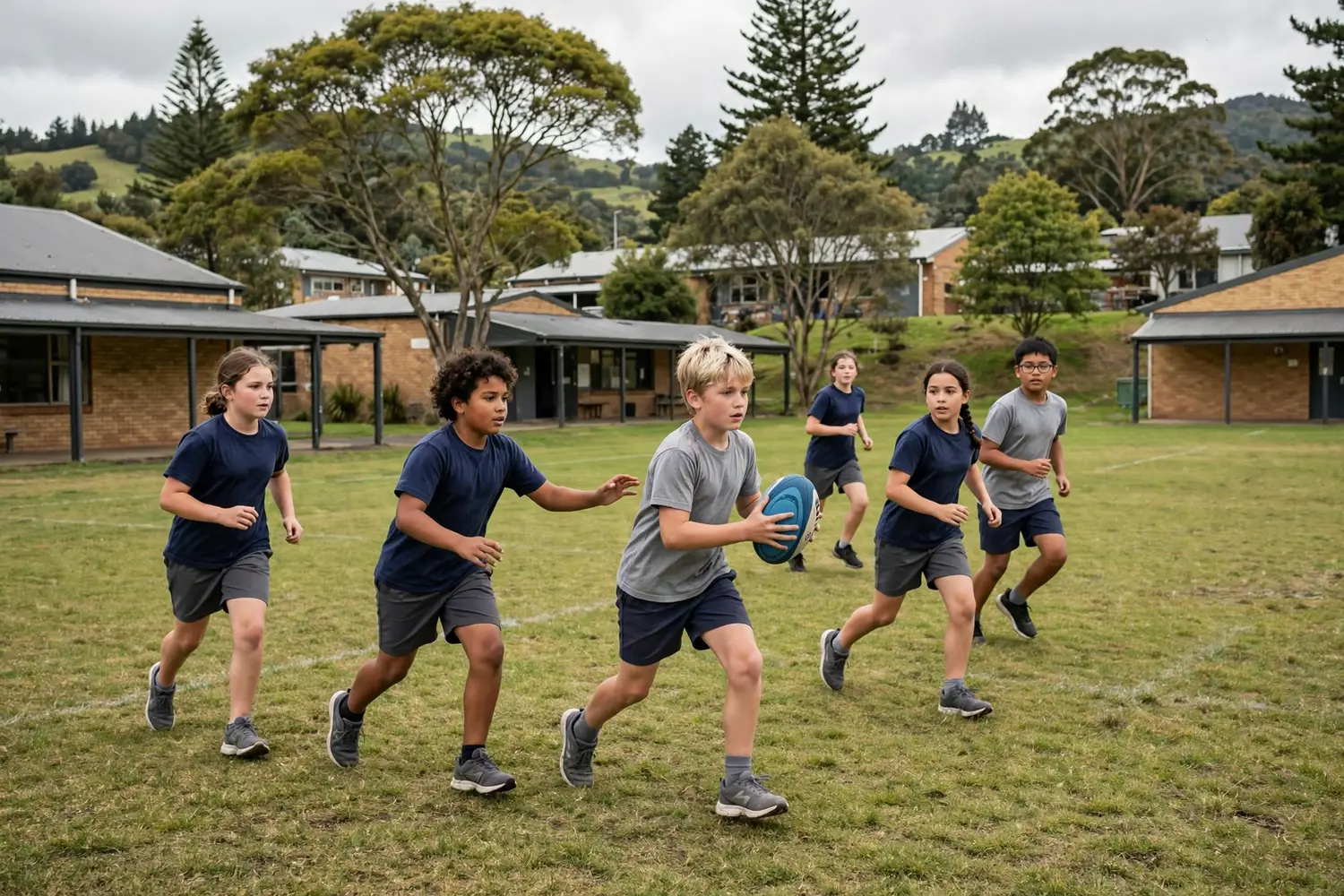
A large part of intermediate life happens outside the homeroom, and Maeroa publishes a long list of opportunities. In sport, the school fields teams across codes including athletics, basketball, cricket, cross country, futsal, hockey, netball, rugby, soccer, softball, swimming, touch and volleyball. Its most competitive teams compete at the AIMS Games and in WIMS, the Waikato Intermediate and Middle Schools competition. Cultural and performing arts options include competitive and mainstream kapa haka, a Pasifika group, dance, drama workshops, a school production, Show Quest, choir, and instrument lessons in guitar, drums and violin, plus rock band.
Academic extension beyond the classroom includes Waimaths, the EPro8 Challenge, chess, Lit Quiz, Otago Maths competitions and a science fair. Education outside the classroom runs on a two-year cycle: overnight tenting camps in alternate odd years, and an onsite teambuilding challenge with a visit to a local place of historical importance in even years. There are also leadership camps, including three nights at Blue Mountain Adventure Centre and five nights through Hillary Outdoors, and a Japanese cultural exchange.
Recognition runs through the school’s Koru system. Students earn koru flashes for things as simple as representing their class in a lunchtime sport, showing effort and progress in learning, helping someone out, or demonstrating respect. Each colour stands for an area: red for academic, black for community, service and special awards, blue for sports, pale blue for virtues, yellow for cultural, green for enviro, and white for excellence. Collecting flashes leads on to badges. Opportunities are published in the daily notices, read each morning and posted on the school website.
Enrolment and the home zone
Maeroa operates an enrolment scheme, put in place to prevent overcrowding or the likelihood of overcrowding. Education Counts records the school’s zoning as a written description of an enrolment zone, and the full home zone description and map are published by both Education Counts and the school. All students who live within the home zone are entitled to enrol. In general terms, the zone covers a band of western and central Hamilton. It begins around Te Rapa Road and Vardon Road in the north, follows the Waikato River and the edge of the central city, takes in streets around Frankton, and runs south and west through the Dinsdale area toward Whatawhata Road and Grandview Road. The home zone includes both sides of all roads and streets unless the written description states otherwise, and some boundary streets are included only in part or on one side. Because the edges are drawn street by street, the only safe way to check a specific address is to read the official zone description and map, or to ask the school office. Never rely on a real estate listing’s claim about zoning.
Proof of residence within the home zone is required. Each year, the school seeks applications from in-zone students for the following year by a date it publishes on its website. That process lets the board assess how many places, if any, can be made available to students who live outside the home zone. Out-of-zone applications, where places exist, are considered under the priority order set out in the enrolment scheme published on Education Counts, with a ballot where a priority group is oversubscribed.
The enrolment process, step by step
The process the school publishes is written for in-zone families:
- Check that your address is inside the zone, using the zone information on the school’s website.
- Gather two pieces of proof of address: a current utility bill and one other document.
- Call the office on 07 847 5014 to make an enrolment appointment.
- Attend the appointment with your child and meet a staff member.
- Bring a copy of your child’s last school report and their immunisation record (the school notes this does not include COVID-19 immunisation details).
- The school contacts your child’s previous school for relevant learning information.
- Once enrolment is confirmed, purchase the school uniform from NZ Uniforms.
- New enrolments usually start, by mutual agreement, on the following Monday.
If your child is currently in Year 6, the school asks you to contact the office for details of how to enrol for the following year. The school also holds an open information night for prospective families each year; the date is published on its enrolment pages. As part of the transition programme, which the school calls Manawanui, families of new students are met individually, and children have the opportunity to meet their teacher before the school year starts.
Fees, donations and other costs
Families often want a single figure for what a state school costs. At Maeroa there is no published school fee or donation amount, and the official position is more reassuring than at many schools.
Education Counts records the school’s donations position as one where donations should not be requested, unless for a school camp: the marker of a school in the Ministry of Education donations scheme. The school’s Information Book puts it in plainer language: a government grant covers its operational costs, and families do not have to pay for their child’s technology or arts expenses.
What the grant does not cover, the school says, is the total cost of overnight camp experiences, extracurricular sports and excursions. Those are optional experiences that parents can choose to nominate their child for. Expect possible costs attached to camps, sports teams and trips your child opts into, rather than a compulsory charge for the core programme. Payments can be spread out: families can pay by the week, month, term or year, at the office or online, and the school encourages automatic payments set up early in the year. The one unavoidable purchase is the uniform, sold through NZ Uniforms (see below); the school does not publish uniform prices, so check the retailer’s current price list when budgeting.
Uniform
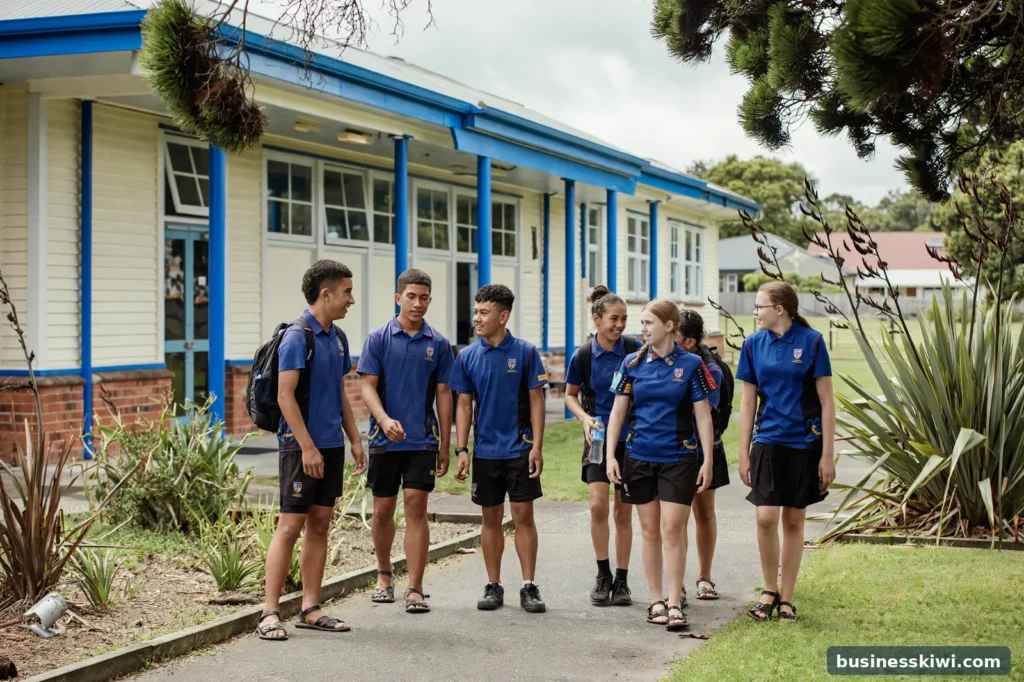
Maeroa has a regulation uniform, required under a Board of Trustees bylaw, and students are expected to wear it correctly and with pride. It can only be purchased from NZ Uniforms at 244 Tristram Street, Hamilton, according to the school’s Information Book. Every item should be clearly named so lost property can be returned.
Footwear rules are specific. Students wear either black Roman sandals or similar with a back strap (no socks with sandals, and no Crocs, scuffs or jandals), or black shoes with no other colour on the sole, tongue or laces, no heel, sitting below the ankle. Socks are black with no stripes, and stockings black with no holes.
Personal presentation rules are equally detailed. Nails must be trimmed, with no false or acrylic nails and no nail polish. Makeup and false eyelashes are not permitted. Hair that falls past the shoulders should be tied back and kept a natural colour. Jewellery is limited to a named wristwatch, plus one pair of small ear studs. Taonga of cultural significance may be worn but must sit below the level of the clothing.
The school day, term dates and getting there
The school day is built around four teaching blocks. Students may be on the grounds from 8:15am, when teachers are on duty, and classrooms open at 8:30am. Block 1 runs from 8:45am to 10:15am, followed by morning tea, and Block 2 runs from 10:35am to 12:05pm. After lunch (12:05pm to 12:30pm) and Block 3 (to 1:30pm) there is a sports break from 1:30pm to 2:00pm, before the final block ends the day at 3:00pm.
The school’s published term dates for 2026 are: Term 1, Monday 2 February to Thursday 2 April; Term 2, Monday 20 April to Friday 3 July; Term 3, Monday 20 July to Friday 25 September; and Term 4, Monday 12 October to Wednesday 16 December. Knowing the term dates early helps families plan work and care around school holidays. Stationery lists are handed out at the school’s Meet the Teacher evening and posted on the school website afterwards.
Getting to school is covered in some detail by the school, and it is worth reading before the first week. For walkers, the school advises families to walk the route together beforehand, use designated crossings including the traffic lights on Maeroa Road, and choose a route that avoids the tunnels under the roundabout if one exists. Cyclists and scooter riders get a locked storage cage, which closes at 8:45am; late arrivals lock their bike or scooter outside it. Bikes must be roadworthy, riders must follow the road code, and an approved helmet, correctly fastened, is required by law.
By car, the rules are strict. Parent cars are not allowed on the school grounds between 8:15am and 8:45am or between 2:30pm and 3:15pm, and the car park is not for dropping off or picking up students. A 30 km/h zone operates around the school from 8:10am to 8:45am and 2:55pm to 3:15pm and is patrolled. There are yellow no-stopping lines on Churchill Avenue, and the driveway must stay clear for buses carrying students who use wheelchairs. The school has no before or after school care of its own, though it says local options with a pickup service exist and it can pass on their details.
Attendance, health and daily practicalities
The school aims for 90 percent attendance, the level the Government and the Ministry of Education count as regular attendance: missing no more than about one day a fortnight. Parents or caregivers must notify the school by phone, text or email on the first day of any absence, and a medical certificate is required if a student is away for more than three days. Students arriving after the 8:45am bell sign in at the Resource Room, and parents receive a text notification. Patterns of unexplained absence may be referred to School Attendance Services in Hamilton. Homework expectations are light: practising maths facts where recall is not yet confident, plus regular reading, with an optional homework contract that can earn koru flashes for families who want more.
On health, the school has first aid trained staff but no school nurse, and it asks families to keep unwell children home, including until 24 hours after the last episode of vomiting or diarrhoea. A mobile dental clinic visits for part of the year, a public health nurse visits regularly, and the school distributes free sanitary products supplied by the Government. Medication must be handed to the office with a completed permission form and is given under adult supervision, except asthma inhalers, which students carry. A part-time counsellor is available, funded by the Board of Trustees.
Two practical points catch many families out. Maeroa takes part in the Government’s school lunch programme, which the school expected to continue through 2026; families indicate on the enrolment pack whether their child will have the school lunch or bring their own, and around 250 students chose to bring their own in 2025, mostly for taste preferences. Food is also available at morning tea in the Friendship Room, through the school’s Brunch Club, for students who missed breakfast. Mobile phones are not carried during the day: students hand them in before school and collect them at 3:00pm, and a phone found during the day is held at the office for a parent to collect.
What the Education Review Office does
The Education Review Office (ERO) is the government agency that reviews schools and publishes its findings for parents and communities. Maeroa’s Education Counts profile links directly to the school’s ERO report, and that is where parents should read the current review in full. ERO reports change as reviews are completed, so use the report as one input alongside a visit, the school’s own strategic and annual plans, and a conversation with the school about your child’s needs.
Frequently asked questions
What year levels does Maeroa Intermediate School teach?
Maeroa is an intermediate school for Years 7 and 8 only. Students usually arrive from primary school at the start of Year 7, aged about 11, and leave at the end of Year 8 for secondary school. The roll at 1 July 2025 was 698, split between 343 in Year 7 and 355 in Year 8.
Is Maeroa Intermediate zoned?
Yes. The school operates an enrolment scheme with a home zone, recorded by Education Counts as a written description of an enrolment zone. Students who live inside the zone are entitled to enrol. The zone covers parts of western and central Hamilton and its boundaries are drawn street by street, so check your exact address against the official zone description and map.
How do we enrol if we live in the zone?
Call the school office on 07 847 5014 to make an enrolment appointment. You will need two pieces of proof of address (a current utility bill and one other), your child’s last school report and their immunisation record. You and your child meet a staff member, the school contacts the previous school for learning information, and once enrolment is confirmed new students usually start by agreement on the following Monday.
Can my child enrol if we live outside the zone?
Possibly, but it depends on places. Each year the board assesses how many places can be offered to out-of-zone students after in-zone enrolments are counted. Where applications are taken, they are handled under the priority order in the enrolment scheme published on Education Counts, with a ballot if a priority group has more applicants than places. Contact the office for the current year’s position.
Does the school charge a fee or ask for a donation?
There is no published school fee or donation amount. Education Counts records that donations should not be requested at this school, except for a school camp, and the school says a government grant covers its operational costs, including the technology and arts expenses families might otherwise pay for. Parents may donate voluntarily. Optional activities the grant does not fully cover, such as overnight camps, extracurricular sports and excursions, can carry costs for the students who take part.
Where do we buy the uniform, and what footwear is allowed?
The uniform is sold only through NZ Uniforms at 244 Tristram Street, Hamilton, and the school does not publish prices. Footwear is either black Roman-style sandals with a back strap, worn without socks, or plain black shoes below the ankle with no heel and no other colour showing.
What time does the school day start and finish?
Students can arrive from 8:15am and classrooms open at 8:30am. Teaching starts at 8:45am and the day ends at 3:00pm, with morning tea, lunch and an afternoon sports break in between. Students who arrive after the 8:45am bell must sign in at the Resource Room.
Does Maeroa offer learning in te reo Māori?
Yes. Te reo Māori is compulsory for all students as part of the language programme, and the school also runs Te Puaawaitanga, a Māori language unit for students who want to learn the language in more depth and develop their understanding of tikanga. Education Counts records that some students at the school are taught in Māori medium.
This guide is general information only, based on official sources published by the Ministry of Education and by Maeroa Intermediate School. Enrolment schemes, zone boundaries, term dates and school arrangements change from year to year. Always confirm the details that matter to your family with the school office and on the school’s Education Counts profile before making decisions.
Sources
- Ministry of Education, Maeroa Intermediate: Profile and Contact Details, educationcounts.govt.nz
- Ministry of Education, Maeroa Intermediate: Student Population, Year Level, educationcounts.govt.nz
- Ministry of Education, Maeroa Intermediate: Student Population, Age, educationcounts.govt.nz
- Maeroa Intermediate School, Enrolment Zone, maeroa.school.nz
- Maeroa Intermediate School, Enrolment Process, maeroa.school.nz
- Maeroa Intermediate School, Information Book 2026, maeroa.school.nz
- Maeroa Intermediate School, 2024 Maeroa Strategic Plan, maeroa.schoolzineplus.com
- Maeroa Intermediate School, Welcome to Maeroa Intermediate, maeroa.school.nz