Property Funds in NZ: How They Work, What They Cost and How You Get Your Money Out

The short answer
A property fund pools money from many investors and uses it to buy commercial property, such as office buildings, warehouses, shops and industrial sites. You receive a share of the rent as regular distributions, and the value of your investment moves with the value of the properties. The trade-off is access. Most NZ property funds are unlisted, so there is no exchange where you can sell when you want to. Leaving depends on the fund’s own rules, and those rules can mean waiting months or years. The Financial Markets Authority (FMA) warns that returns quoted for these products are estimates, and that you may struggle to get your money out. Every fund’s fees, minimum investment and exit terms are set out in its Product Disclosure Statement (PDS), and they differ a lot from fund to fund.
What a property fund is
The FMA’s guide to managed funds describes the basic model. Your money is pooled with other investors’ money. Everyone owns a share of the whole fund rather than a slice of one building. A manager chooses and runs the investments, and each fund has a strategy that sets what it can buy, how much risk it takes and what it charges. A property fund applies that model to one asset class: real estate, usually commercial property that earns rent from business tenants.
That structure brings two features readers need to hold onto. First, the price of your investment rests on property valuations, not on a live market. Valuers assess the buildings at intervals, and the manager sets unit or share prices from those valuations. Second, the fund is a separate layer between you and the buildings. The manager handles tenants, maintenance, borrowing and sales, and charges fees for doing so. KiwiSaver funds are one form of managed fund, but a property fund is a standalone investment that sits outside KiwiSaver.
The main forms in NZ
NZ property funds come in several legal shapes, and the shape decides how protected you are and how you can leave.
Diversified unlisted funds
These funds hold a portfolio of properties across sectors and regions, so no single building carries the whole return. Pacific Property Fund Limited is a documented example. Its PDS, dated 7 July 2026, describes a company that has invested since 2014 and, after a 2026 merger and capital raise, expected to hold 29 properties valued at about $713 million, with 114 tenants, occupancy around 90 percent and a weighted average lease term of 6.2 years. It is managed under contract by PMG Property Funds Management Limited. The PDS states plainly that the company is not a managed investment scheme, so it does not need an FMA-licensed manager or a licensed independent supervisor. Investor protection instead comes from the Companies Act 1993, the company constitution and shareholder voting rights.
Single-asset schemes and property syndicates
The FMA uses the term property syndicates for offers where investors pool money to buy property together. A syndicate might be a managed investment scheme with an FMA-licensed manager and retail units, or a company selling shares, and the FMA says the structure decides which disclosure documents you get and which protections apply. Minimum investments are often high: the FMA says $50,000 is typical. Centuria NZ Meridian Property Investment shows the managed scheme form. Its PDS, dated 1 October 2026, offers units in two stapled trusts that together own one asset, Meridian Mall in Dunedin, bought for $89 million. A licensed manager runs it, a licensed supervisor oversees it, and the minimum investment is $25,000. One property means one local market and one set of tenants decide your return.
Listed property vehicles
Some NZ property owners are listed on the NZX. You buy shares or units through a broker and can usually sell on any trading day, as long as another investor wants to buy. The FMA draws the same contrast in its managed fund guide: exchange-traded products are more liquid because they can be bought and sold whenever the exchange is open, while managed funds are less liquid. The price of a listed vehicle is set by the market, though, and it can sit above or below the value of the buildings it owns. Listing solves the exit problem, but it swaps valuation-based pricing for market pricing, with daily ups and downs.
| Feature | Unlisted property fund | Listed property vehicle | Owning property directly |
|---|---|---|---|
| How you own it | Units or shares in a fund or company that owns the buildings | Shares or units traded on the NZX | Your name is on the title |
| How you get out | Only on the fund’s terms: withdrawal windows, buy-backs or a matching service, and these can be limited or unavailable | Sell on the exchange when it is open, if a buyer is there | Sell the property, which takes time and costs money |
| How the price is set | From property valuations, at intervals | By the market, every trading day | By the sale price you can achieve |
| Typical entry cost | Set by the PDS: the examples in this guide range from $1,190 to $25,000, and the FMA says $50,000 is typical for syndicates | The cost of the parcel you buy through a broker | The purchase price, usually with a mortgage, plus legal and other costs |
| Oversight | An FMA-licensed manager and supervisor for managed investment schemes; company structures rely on the Companies Act | NZX listing rules and market disclosure | You carry the legal duties yourself |

How you invest, and how you get your money out
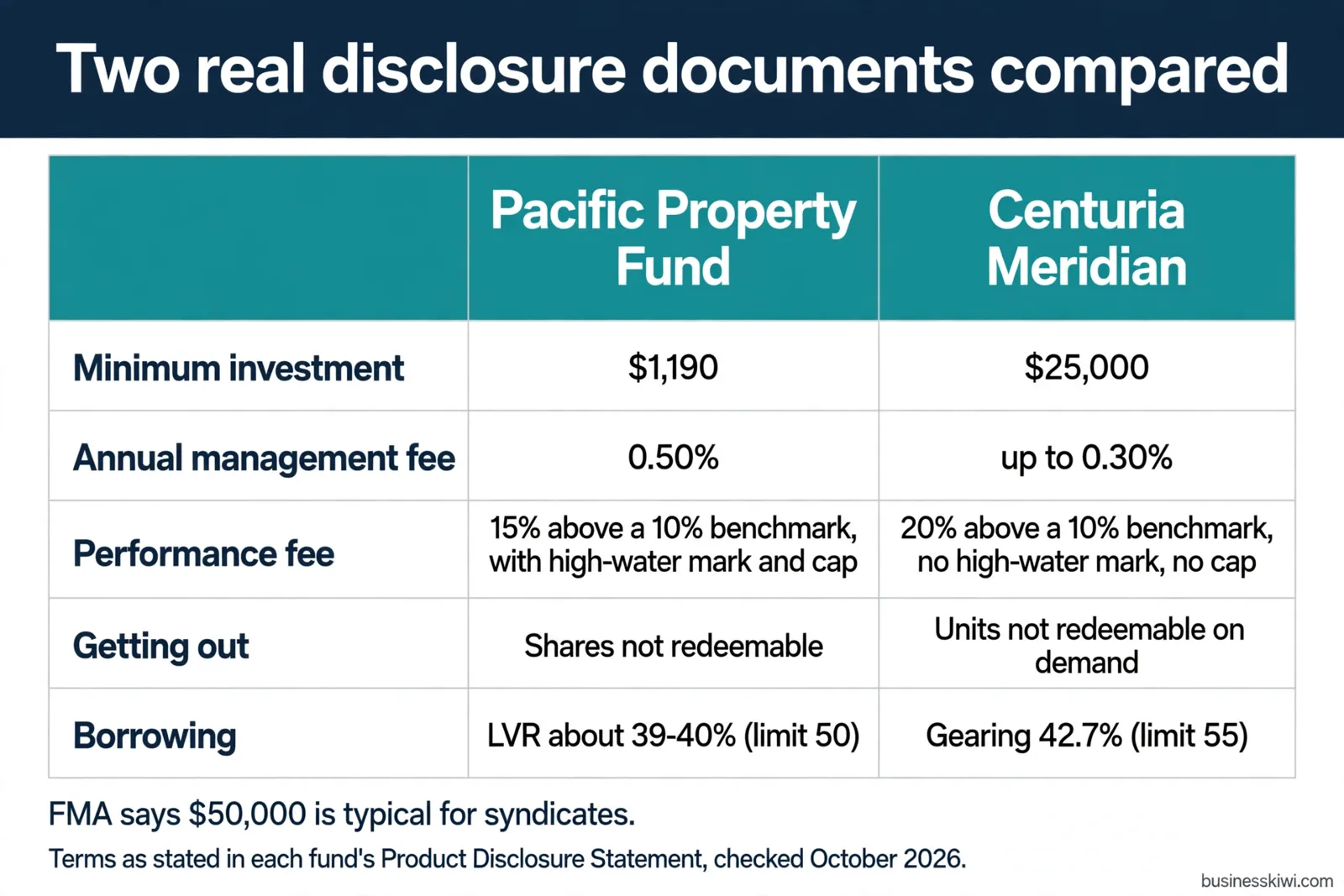
Joining starts with the PDS. The FMA advises checking that any fund is registered on the Disclose register before you invest, and the PDS is where the manager must state the minimum investment and how to apply. Pacific Property Fund’s 2026 capital raise set a minimum subscription of 1,000 shares at $1.19 each, which is $1,190, with applications made on the form that goes with the PDS. The Centuria Meridian scheme set its minimum at $25,000, and its offer ran to fixed opening and closing dates, with units allotted at settlement. There is no standard pattern, which is why the PDS matters more than any advertisement.
While you hold the investment, returns usually arrive as distributions paid from rent, after the fund’s costs and loan interest are met. Both examples in this guide pay monthly. Pacific Property Fund’s PDS says dividends have been declared monthly since September 2022 and its policy is to distribute 100 percent of adjusted funds from operations, although the board can pay less to fund building work or reduce debt, and dividends are not guaranteed. The Centuria Meridian PDS sets a policy of distributing 80 to 100 percent of funds from operations across a full year, and repeats that cash distributions are not guaranteed and may vary.
Leaving is where property funds differ most from other managed funds. The FMA notes that many managed funds offer daily redemption, although a manager may require notice or set a minimum holding period. A building cannot be sold in a day, so property funds restrict exits far more tightly. The Centuria Meridian PDS states that an investment is not redeemable on demand. The scheme has a five-year term. Before it ends, the manager must first try to raise new capital to pay out investors who choose to withdraw. If that is not in investors’ best interests, the property is sold and the scheme wound up. If withdrawal requests exceed the money available, the manager withdraws the withdrawal offer and moves to sell the property instead. Outside that process, your only route is finding a buyer yourself, directly or through the manager’s secondary market facility, and the PDS warns there is no established market and no guarantee of a buyer. Pacific Property Fund is blunter still: its shares are not redeemable, meaning you cannot require the company to buy them back. The company may repurchase shares from time to time, at the board’s discretion and possibly at a discount to asset value, or you can join the queue in the manager’s matching service, which pairs sellers with buyers in order and charges sellers 1.5 percent. The FMA’s guidance on syndicates makes the same point in plain terms: value gains are not locked in until you sell, and selling may be difficult.
What property funds charge
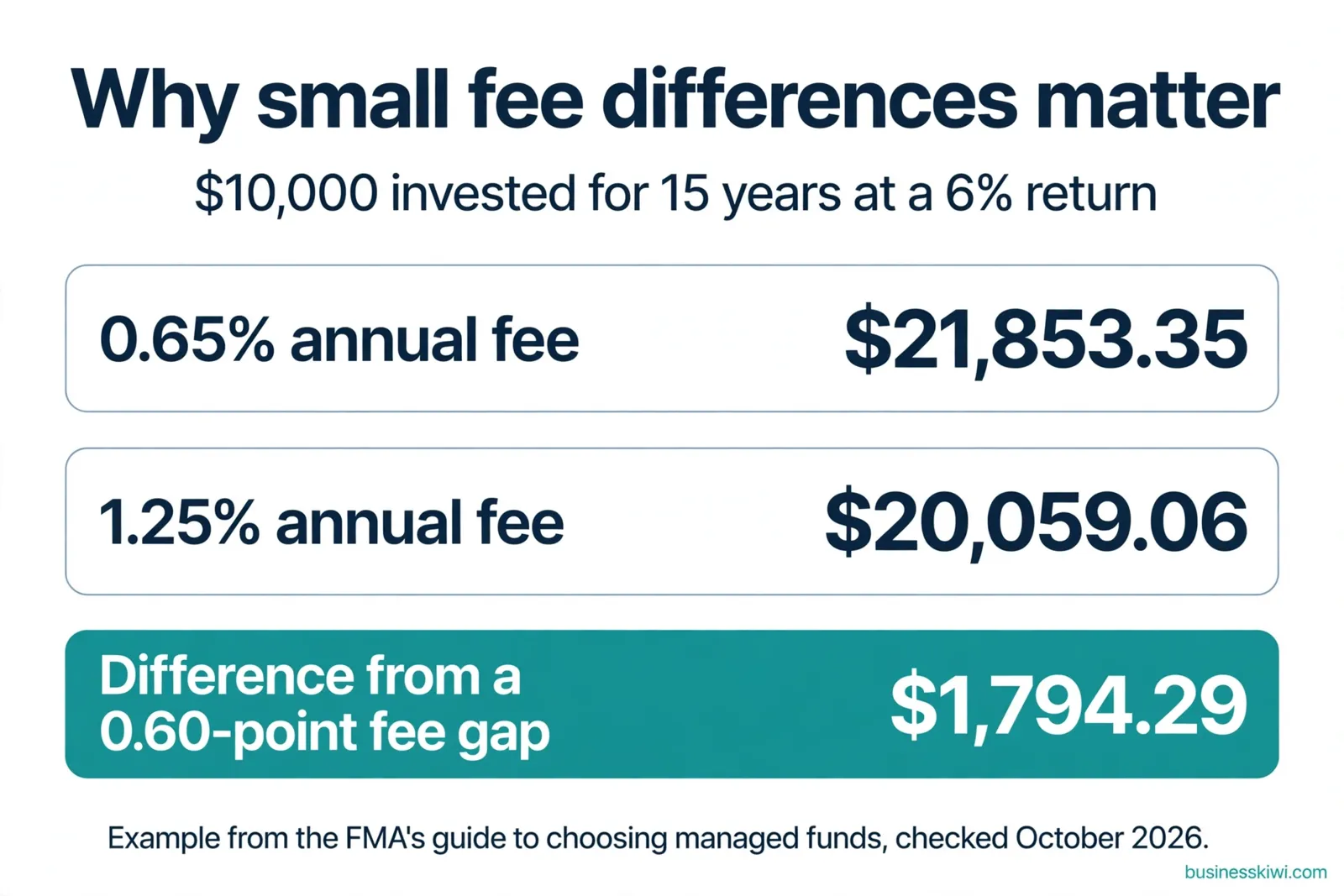
Fees look small as percentages and large as dollars over time. The FMA’s managed fund guide illustrates the effect: $10,000 invested for 15 years at a 6 percent return grows to $21,853.35 with a 0.65 percent annual fee, but only $20,059.06 with a 1.25 percent fee. The gap of about $1,794 comes from a fee difference of just over half a percent a year. Property funds also carry costs that share and bond funds do not, because buildings must be bought, leased, maintained and sold.
The Centuria Meridian PDS lists establishment costs of $6,127,000 within a total package of $95,877,000, funded by $38.3 million of bank debt and $57,577,000 from investors. The manager’s own establishment fee was $1,740,000, and brokerage of $1,007,597 was paid to the selling agent. Ongoing, the annual management fee is capped at 0.30 percent of the average month-end value of the scheme’s assets. The performance fee is 20 percent of any outperformance above a total return benchmark of 10 percent a year, with no high-water mark and no cap, which the PDS itself notes can mean paying a performance fee twice on value that was lost and then recovered. There is also a 2 percent fee if the property is sold, leasing fees of up to 15 percent of a year’s rent on new leases of five years or more, and a 2 percent administration fee on arm’s length secondary transfers. The largest ongoing cost is interest on the bank loan, which the PDS forecasts will outweigh the manager’s own fees many times over.
Pacific Property Fund’s PDS sets a different stack. Its fund management fee is 0.50 percent a year of the value of the property investments, falling to 0.45 percent on any part above $1 billion. Property management costs 2 percent of gross rental income collected. The manager charges 1 percent of the price when a property is bought or sold, 2 percent of equity it raises, and a performance fee of 15 percent of outperformance above a 10 percent annual benchmark. Unlike the Centuria scheme, that performance fee has a high-water mark and an annual cap, so the manager cannot be paid twice for the same ground. Selling through the matching service costs 1.5 percent. Neither fee stack is typical of all funds. They show why the fees section of the PDS deserves a slow read.
The risks, in the documents’ own terms
Liquidity risk runs through both PDS documents. Pacific Property Fund rates it very likely that shareholders who want to sell will face a lack of liquidity at times, and warns that a sale price may be below both the original investment and the most recent asset value. Valuation risk sits beside it. Property values rest on valuers’ judgements about rents, vacancies and market conditions, and both documents warn that a forced sale can achieve less than the valuation. Pacific Property Fund’s PDS illustrates the leverage effect: a 10 percent fall in property values would cut the value of each share by about 15.8 percent of the issue price.
Concentration risk depends on the fund’s shape. A single-asset scheme stands or falls on one property. Even a diversified fund carries tenant risk, because rent is its only real income. Pacific Property Fund’s largest property was expected to contribute 16.4 percent of annualised net rental income, and its PDS lists the ways rent can fall: leases ending without renewal, tenants defaulting, rents dropping at review, or space sitting empty. In the Centuria Meridian scheme, about 92 percent of the floor area was let, the average lease had about five years to run, and car parking provided about 16 percent of income, a stream that depends on daily demand rather than leases.
Borrowing magnifies everything. The Centuria scheme’s gearing at issue was 42.7 percent, and its bank covenants require its loan-to-value ratio to stay at or below 55 percent and interest cover at or above two times. Pacific Property Fund’s loan-to-value ratio sat around 39 to 40 percent against a covenant limit of 50 percent, and its PDS states that bank borrowings rank ahead of shareholders. If a covenant is breached, lenders can require distributions to be cut or stopped, or can force property sales. Interest rate rises flow the same way, because both funds borrow at floating rates and hedge only part of the exposure. Both documents also flag dependence on an external manager, and the FMA warns that forecast returns for syndicates rest on assumptions about vacancies, rent defaults, fee increases and interest rates, any of which can move against the forecast.
Tax in outline
Many NZ property funds are portfolio investment entities (PIEs), so tax is charged inside the fund at your prescribed investor rate (PIR), capped at 28 percent, and distributions generally need no further tax if your PIR is correct. Pacific Property Fund is a multi-rate PIE and pays its dividends after PIE tax. The Centuria Meridian structure shows a wrinkle: about 84 percent of its forecast income, everything except car parking, sits in a PIE trust taxed at each investor’s PIR, while the car parking income sits in a non-PIE trust taxed like a company at 28 percent, with its distributions treated as dividends. Pacific Property Fund’s PDS also notes that selling shares can be taxable if you hold them on revenue account. Tax settings differ by fund and by investor, so this outline is a prompt to check the PDS tax section and take advice, not an answer.
What to read before you invest
Start with the PDS, then the documents behind it. The FMA’s managed fund guide says to review the PDS for the fund’s risks, likely returns, fees, investments and manager, and to check the fund is registered on the Disclose register before investing. Fund updates each quarter and the annual report show what has actually happened since. For a syndicate, the FMA adds the governing document and the valuation report to that list, and asks what ongoing reporting the syndicate must provide. If an offer is wholesale only, it sits outside the retail disclosure and governance protections, and the FMA strongly recommends taking financial advice before going in.
For the wider picture, our investing in New Zealand guide covers the main asset classes, and our NZ investment options guide compares them side by side. Our KiwiSaver funds guide covers the retirement scheme these funds sit outside, and our property vs shares comparison weighs the two asset classes directly. More money guides are in the Finance section.
Frequently asked questions
What is a property fund?
A fund that pools investors’ money to buy property, usually commercial buildings. You own units or shares in the fund rather than the building itself. Rent, after costs and interest, is paid out as distributions, and your investment value moves with the properties’ valuations.
How do I get my money out of an unlisted property fund?
Only on the fund’s terms. Some funds offer withdrawal windows or buy-backs, others rely on a matching service that pairs you with a buyer, and some, like the Centuria Meridian scheme, run a set term with an exit process near the end. There may be no buyer and no window open when you want out.
Can a property fund refuse or delay withdrawals?
Yes, where the fund’s documents allow it, and some funds offer no withdrawal right at all. Pacific Property Fund’s shares are not redeemable, and its buy-backs happen only if the board chooses. The Centuria Meridian PDS says that if withdrawal requests exceed the money available, the withdrawal offer is withdrawn and the property is sold instead.
How do property funds pay returns?
Mostly as distributions from rent, paid monthly or at another interval the PDS states, plus any change in the value of your units or shares. Distributions are not guaranteed in either example used in this guide, and both PDS documents say the amounts can vary or be cut.
What fees do property funds charge?
Expect an annual management fee, property management and leasing fees, and transaction fees when properties are bought or sold. Some funds add performance fees and establishment costs, and the fund also pays interest on its borrowings, often its largest cost. The two PDS examples in this guide charge annual management fees of 0.50 percent and up to 0.30 percent.
How is a property fund taxed in New Zealand?
Many funds are PIEs, so tax is paid inside the fund at your prescribed investor rate, capped at 28 percent, and distributions generally need no further tax. Structures vary: one example in this guide splits its income between a PIE trust and a non-PIE trust. Check the tax section of the PDS.
What should I check before investing in a property fund?
Read the PDS in full, confirm the fund appears on the Disclose register, and focus on the exit terms, the full fee list, how much the fund borrows and how concentrated its properties are. Then read the latest fund update or annual report to see actual results against the promises.
Bottom line
A property fund can be a sensible way to own a share of commercial property without buying a building, as long as you go in with your eyes open about the exit. The rent-based income and professional management are real benefits. So are the fees, the borrowing and the possibility that your money is locked in for years. The PDS tells you all of it. Read it before the brochure.
Sources
- Financial Markets Authority, Property syndicates: https://www.fma.govt.nz/consumer/investing/types-of-investments/property-syndicates/
- Financial Markets Authority, Property investment: https://www.fma.govt.nz/consumer/investing/types-of-investments/property-investment/
- Financial Markets Authority, Types of investments: https://fma.govt.nz/investors/ways-to-invest/
- Financial Markets Authority, Funds: Your guide to choosing, buying and monitoring managed funds and exchange-traded funds: https://www.fma.govt.nz/assets/Consumer-section/Managed-Fund-Guide.pdf
- Centuria Funds Management (NZ) Limited, Product Disclosure Statement: Centuria NZ Meridian Property Investment, dated 1 October 2026: https://centuria.co.nz/wp-content/uploads/2026/10/Centuria-NZ-Meridian-Property-Investment-Product-Disclosure-Statement.pdf
- Pacific Property Fund Limited, Product Disclosure Statement, dated 7 July 2026 (Offer Register OFR15196): https://www.smartinvestor.sorted.org.nz/disclose-document/cfff658341ccaf63/Product-Disclosure-Statement.pdf
This article is general information about property funds in New Zealand. It is not financial advice and does not recommend any fund, manager or product. Property funds can fall in value, distributions are not guaranteed, and unlisted funds can be hard to exit. Read the Product Disclosure Statement for any fund you are considering, and consider advice from a licensed financial adviser before investing.