Flat Bush, Auckland: A Practical Guide to the Suburb
Flat Bush, Auckland: A Practical Guide to the Suburb
The short answer
Flat Bush is a large, planned suburb in south-east Auckland, about 25 kilometres from the city centre. It was farmland until large-scale building began in the 2000s, and it has since become one of the fastest growing parts of the city. Stats NZ puts the population of the Flat Bush area at 55,900 people at 30 June 2025, up from 45,147 at the 2023 Census and 32,244 at the 2018 Census.
The suburb is built around Ormiston Town Centre and the 94-hectare Barry Curtis Park. It has a full set of new schools, from primary through to senior college, and a private hospital on Ormiston Road. Most homes are large, modern family houses, and most residents drive to work. There is no train station in Flat Bush, so buses to Manukau and Botany do the heavy lifting for public transport.
If you are thinking of moving here, the things to check first are the school enrolment zones, the bus routes to where you work, and the size and age of the house, because Flat Bush homes tend to be bigger and newer than the Auckland average. This guide covers where the suburb is, who lives here, what housing costs, the schools, the transport, and the services, all from official sources.
Where Flat Bush is
Flat Bush sits in south-east Auckland, between Botany to the north, East Tamaki to the west, and the rural fringe toward Whitford and Brookby to the east and south. Auckland Council puts the new Ormiston town centre about 25 kilometres from the Auckland city centre.
The suburb is part of the Howick ward and the Howick Local Board area. In the 2025 local elections Flat Bush gained its own subdivision on the Howick Local Board, electing three board members, which reflects how large the area has become.
The name can confuse newcomers. Flat Bush is the suburb. Ormiston is the name of the town centre and of some of the newer neighbourhoods within the suburb. You will see both names on maps, bus stops, and shop signs, and they refer to the same part of Auckland. The main roads are Ormiston Road, Chapel Road, Flat Bush School Road, Murphys Road, and Te Irirangi Drive.
How Flat Bush grew
Flat Bush was farmland for most of its history. Planning for a new town on the land began in the 1990s, and large-scale house building followed in the 2000s. The area was planned as a complete suburb rather than a collection of subdivisions, with a town centre, a large park, and new schools built alongside the housing.
The landmarks arrived in step with the houses. The Fo Guang Shan Buddhist Temple opened in 2007. The first stage of Barry Curtis Park opened in 2009. The PAK’nSAVE supermarket at Ormiston opened in November 2015 as the first building of the town centre, and the full Ormiston Town Centre opened in March 2021. New schools opened through the same period, including Baverstock Oaks School in 2005, Ormiston Junior College and Ormiston Senior College in the 2010s, and Te Uho o te Nikau Primary School in 2019.
Growth has not stopped. The population rose from 23,217 at the 2013 Census to 45,147 at the 2023 Census, and Stats NZ estimates it reached 55,900 by June 2025. New housing, roads, and community facilities are still being added, and the council has plans for a permanent library, community centre, and pool and leisure centre in the town centre over the next nine years.
Who lives in Flat Bush
Flat Bush is one of the most ethnically diverse parts of New Zealand, and it is also one of the youngest. The median age in the Flat Bush area is 33.9 years, against 38.1 years for New Zealand as a whole. The figures below come from Stats NZ, based on the 2023 Census and the June 2025 population estimate.
| Measure | Flat Bush | New Zealand |
|---|---|---|
| Population, 30 June 2025 | 55,900 | 5,324,700 |
| Population, 2023 Census | 45,147 | Not stated here |
| Population, 2018 Census | 32,244 | Not stated here |
| Population, 2013 Census | 23,217 | Not stated here |
| Median age | 33.9 years | 38.1 years |
| Median personal income | $46,200 a year | $41,500 a year |
| Median household income, 2023 | $148,700 a year | Not stated here |
| People with a post-school qualification | 51.8% | 54.0% |
| People who speak te reo Maori | 1.1% | 4.3% |
| Businesses, February 2025 | 4,815 | Not stated here |
| Private dwellings | 12,135 | Not stated here |
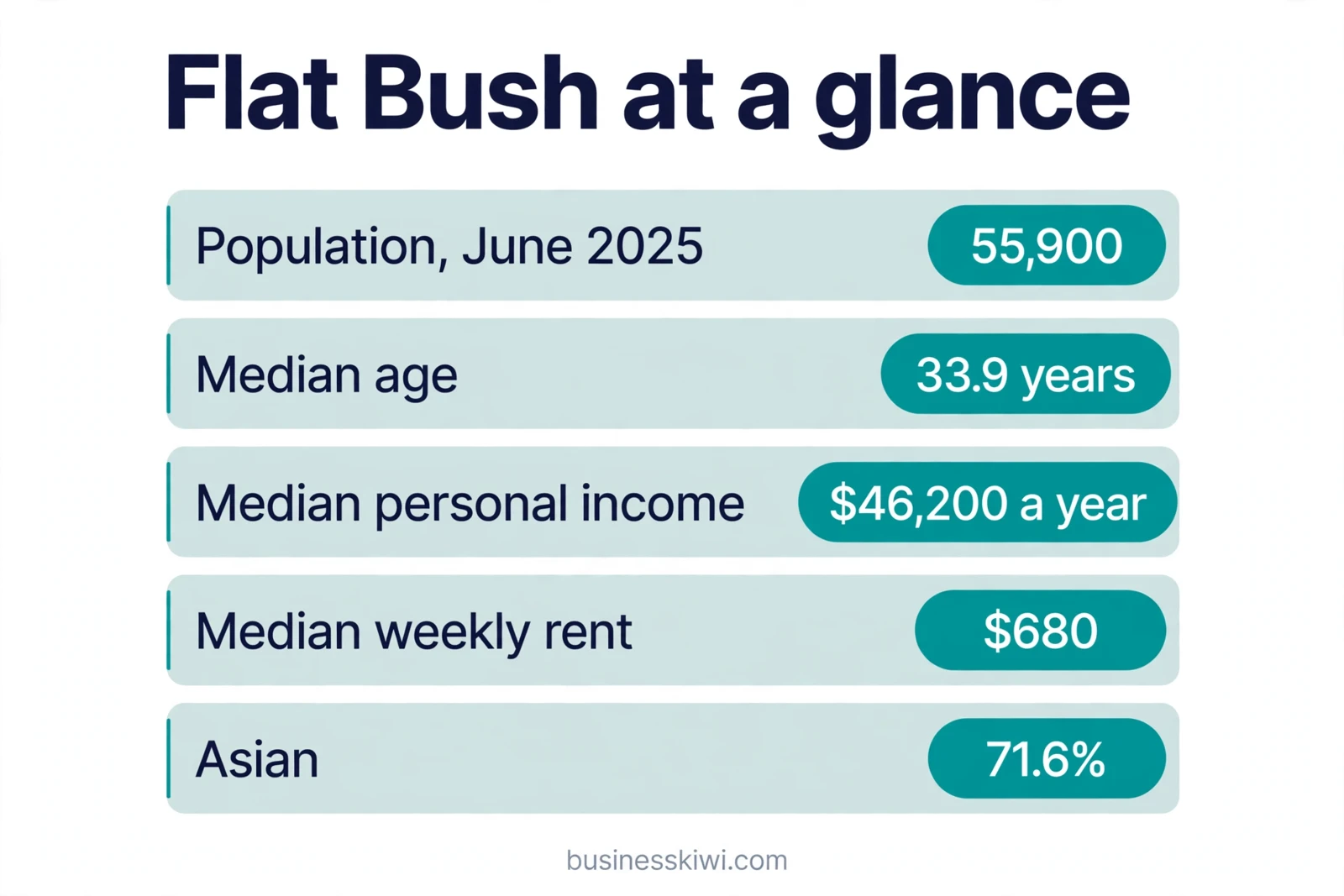
The ethnic mix is the suburb’s most distinctive feature. At the 2023 Census, 71.6% of people in the Flat Bush area identified as Asian, 14.7% as European, 12.0% as Pacific Peoples, 5.7% as Maori, and 3.0% as Middle Eastern, Latin American or African. Because people can identify with more than one ethnic group, these figures add to more than 100%.
The largest groups in detail were Indian at 29.9%, Chinese at 25.1%, New Zealand European at 12.1%, Southeast Asian at 12.0%, and Samoan at 7.0%. Nearly half the population was born overseas: 43.9% were born in Asia, 11.6% in the Pacific Islands, and 5.4% in the Middle East and Africa. The most common languages after English were Northern Chinese at 9.8%, Hindi at 7.8%, Yue at 6.5%, Samoan at 4.0%, and Tagalog at 3.3%. For religion, 29.7% said they had no religion, 29.5% were Christian, 15.2% were Hindu, 5.8% were Muslim, and 5.4% were Buddhist.
Work patterns look much like the rest of Auckland, with a tilt toward full-time work. At the 2023 Census, 56.9% of people aged 15 and over were employed full-time, 10.4% part-time, 2.9% unemployed, and 29.8% not in the labour force. Most people drive to work: 64.7% drove a private car, 10.2% drove a company car, 14.8% worked at home, 4.4% travelled as a passenger in a car, 2.5% took a public bus, 1.4% took a train, and 0.8% walked or jogged.
Housing and what it costs
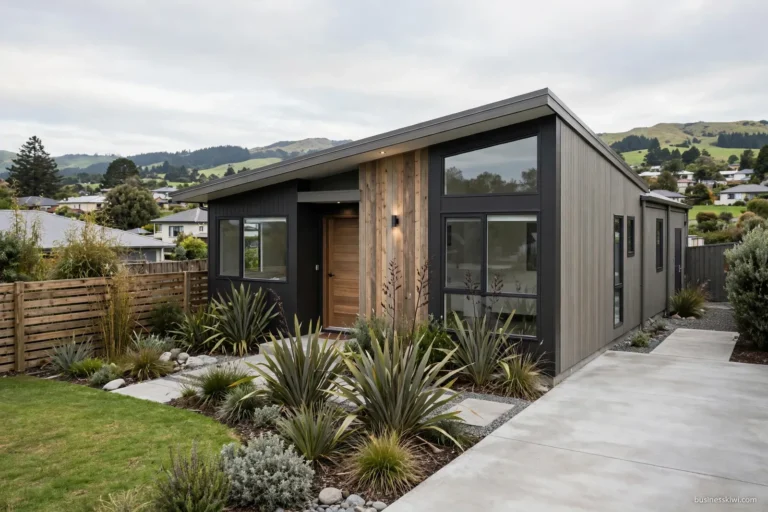
Flat Bush homes are newer and larger than the Auckland norm. At the 2023 Census, 42.6% of private dwellings in the area had five or more bedrooms, 28.0% had four bedrooms, 17.9% had three, 9.1% had two, and only 2.4% had one bedroom. That is a suburb built for families, and it shows in the school rolls as well.
Most households own their home. At the 2023 Census, 54.8% of households owned their dwelling, 10.7% held it in a family trust, and 34.4% did not own it. Stats NZ puts home ownership, including family trusts, at 65.6% for the area, close to the national figure of 66%.
On rents, Stats NZ reports a median weekly rent of $680 for the Flat Bush area, against $450 for New Zealand as a whole. That figure covers private dwellings in the area and reflects the large, modern houses that dominate the suburb. If you are renting, our guide to renting in Auckland explains how rents, tenancy rights, and finding a rental work across the city.
There is one honest gap in this section. No official free source publishes a suburb median sale price for Flat Bush, so this guide does not quote one. House prices in a new suburb vary widely by street, section size, and build quality, and any single figure would be misleading. If you are buying, get a current valuation and check recent sales for the specific street, not a suburb average. Tenants should also know that a periodic tenancy is the most common arrangement in New Zealand, and the rules for ending one are worth reading before you sign.
Ormiston Town Centre
Ormiston Town Centre is the commercial heart of Flat Bush. It sits on Ormiston Road beside Barry Curtis Park, on a 19-hectare development of Auckland Council land. The centre was built by Todd Property Group in partnership with Panuku Development Auckland, the council’s development agency.
The first stage opened in November 2015, when the PAK’nSAVE supermarket began trading. Auckland Council reported at the time that the 6,160 square metre supermarket was expected to create 130 new jobs. The main enclosed centre opened in March 2021, after construction delays linked to the COVID-19 pandemic. The centre now has about 30,000 square metres of retail space and around 100 shops and businesses, with four major tenants: The Warehouse, PAK’nSAVE, New World, and a Hoyts cinema complex. There are also cafes and restaurants, a three-level car park building, and terraced housing to the south of Ormiston Road.
The town centre is still growing. The council’s plan for the area includes a permanent library and community centre, and a pool and leisure centre, to be delivered over the next nine years, with $83 million already earmarked. In the meantime, a temporary library is opening inside Ormiston Town Centre near the food court, at 240 Ormiston Road, and is set to open early in 2026. Auckland Council has allocated $489,000 for its first six months, with ongoing annual costs expected to be $870,000. The temporary library offers full library access, including a collection of more than 3.4 million items, computers, printing, and community activities.
Barry Curtis Park and the outdoors
Barry Curtis Park is the suburb’s biggest open space and one of its best-known features. Auckland Council describes it as Auckland’s largest urban park built in 100 years, at 94 hectares. The first stage opened in 2009, on former farmland, and the park was named after Sir Barry Curtis, the long-serving former mayor of Manukau City.
The park runs through the middle of the suburb, between Chapel Road, Stancombe Road, and Ormiston Road. It has walking tracks, sports fields, playgrounds, a skate park, wetlands, ponds, and wide open grass. The distinctive cable-stayed bridge on Ormiston Road crosses the park and has become a local landmark. The park was designed around restored streams and wetlands in the Otara Creek catchment.
For a quieter walk, Murphy’s Bush is a reserve on Murphys Road, at 160 Murphys Road. It is a remnant kahikatea forest, described as the largest remaining area of mature lowland bush in Auckland, with walking tracks through tall native trees including kahikatea, rimu, puriri, and totara. The bush was in the Murphy family since 1881, and the western part of the reserve opened to the public in 1977.
Fo Guang Shan Temple, Murphy’s Bush and local landmarks
The Fo Guang Shan Buddhist Temple is the most striking building in Flat Bush. It stands at 16 Stancombe Road, beside Barry Curtis Park. The temple opened in 2007 and is the largest Buddhist temple in New Zealand. It was built in the style of the Chinese Tang dynasty, on a site of 3.6 hectares, and it includes a large Buddha statue, a two-tonne bell, an exhibition gallery, and landscaped gardens. The temple is a community centre as well as a place of worship, and it runs meditation and Dharma activities, an art gallery, and a vegetarian teahouse. It is open to visitors, with modest dress expected as in any temple.
Murphy’s Bush, covered above, is the suburb’s link to the landscape before the houses arrived. The suburb’s newer landmarks are the Ormiston Road bridge, the town centre, and the schools, which were all built as part of the same planned growth.
Schools in Flat Bush
Flat Bush has a full set of schools, and they are a major reason families move here. The table below lists the main schools in the area, with rolls at 1 July 2025 from the Ministry of Education’s Education Counts service. School rolls change every year, so treat these as a snapshot, not a permanent figure.
| School | Years | Type | Roll, 1 July 2025 |
|---|---|---|---|
| Flat Bush School | 1 to 6 | State, contributing primary | 398 |
| Baverstock Oaks School | 1 to 6 | State, contributing primary | 601 |
| Ormiston Primary School | 1 to 6 | State, contributing primary | 1,116 |
| Mission Heights Primary School | 1 to 6 | State, contributing primary | 706 |
| Te Uho o te Nikau Primary School | 1 to 6 | State, contributing primary | 597 |
| Chapel Downs School | 1 to 6 | State, contributing primary | 760 |
| Ormiston Junior College | 7 to 10 | State | 1,437 |
| Mission Heights Junior College | 7 to 10 | State | 915 |
| Ormiston Senior College | 11 to 13 | State | More than 1,400 |
| Sancta Maria College | 7 to 13 | State-integrated Catholic, co-ed | 1,074 |
| Tyndale Park Christian School | 1 to 13 | Independent Christian | Not stated here |
A few details are worth knowing. Flat Bush School is the area’s original primary school, on Flat Bush Road, led by principal Banapa Avatea. Baverstock Oaks School, on Baverstock Road, opened in 2005 and has had an enrolment scheme since 1 January 2009. Ormiston Primary School, on Ormiston Road, is the largest primary in the area, with a roll of 1,116, led by principal Heath McNeil. Mission Heights Primary School, on Jeffs Road, is led by principal Caroline Bush. Te Uho o te Nikau Primary School, on Flat Bush School Road, opened on its new site in 2019 as a public-private partnership school, and its name was gifted by Ngai Tai ki Tamaki.
Ormiston Junior College covers Years 7 to 10 and has grown fast, from a roll of 762 in 2021 to 1,437 in 2025. Ormiston Senior College, on Ormiston Road, covers Years 11 to 13, led by principal Tim Botting, and has more than 1,400 students. Its enrolment scheme has been in place since 1 March 2017. Mission Heights Junior College, on Jeffs Road, covers Years 7 to 10, led by principal Raeesa Dada, with a roll of 915. Sancta Maria College, on Te Irirangi Drive, is a state-integrated Catholic college for Years 7 to 13, led by principal Andrew Mackenzie, which opened in January 2004. Tyndale Park Christian School, on Murphys Road, is an independent Christian school for Years 1 to 13.
Enrolment schemes matter here. Several Flat Bush schools have zones, and living in the suburb does not guarantee a place at every school. Check the enrolment scheme for each school on the Education Counts website before you buy or rent, and confirm the zone boundary for the exact address.
Getting around
Flat Bush has no train station. Public transport means buses, and the buses connect the suburb to Manukau, Botany, and Middlemore. The main routes, from Auckland Transport timetables, are:
| Route | Where it runs |
|---|---|
| 35 | Manukau bus station to Botany, via Chapel Road and Ormiston |
| 355 | Manukau bus station to Botany, via Ormiston and Mission Heights |
| 314 | Middlemore station to Ormiston, via Otara and Mission Heights |
| 352 | Manukau bus station to Panmure, via Flat Bush |
| 739 | Botany to Beachlands and Maraetai, via Ormiston and Whitford |
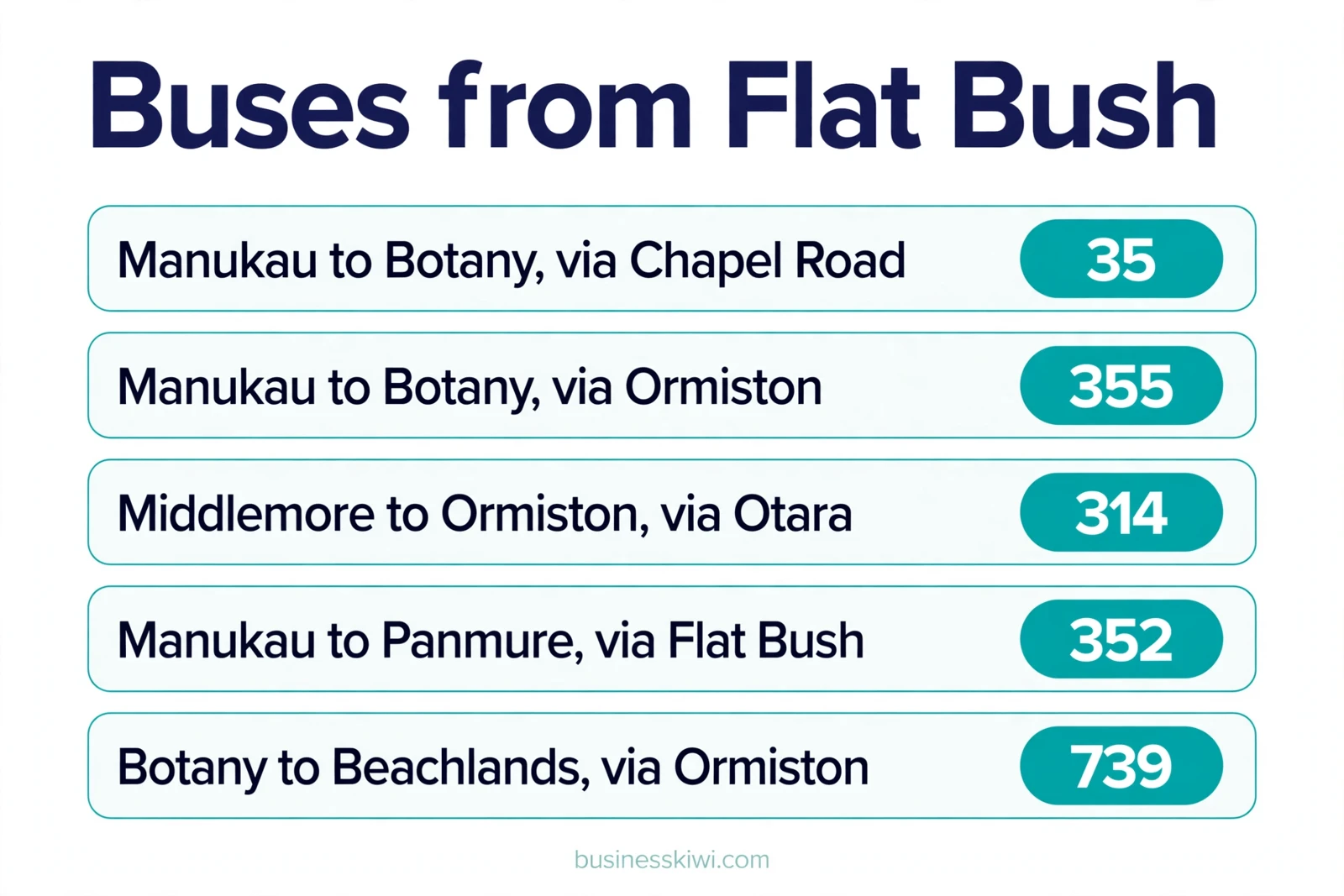
The 35 and the 355 are the workhorses, running between Manukau and Botany through the suburb. The 314 links Ormiston to Middlemore station, which is useful for the hospital and for trains. The nearest train stations are Manukau station and Middlemore station, both reached by bus. Check the Auckland Transport journey planner before you travel, because timetables and stopping patterns change.
Most residents drive. At the 2023 Census, 64.7% of people travelling to work drove a private car, and another 10.2% drove a company car. The main driving routes are Ormiston Road and Chapel Road to Botany and Manukau, Te Irirangi Drive toward East Tamaki and the motorway network, and Murphys Road toward Whitford. Traffic on Ormiston Road and Chapel Road can be slow at peak times, which is worth factoring into any move.
Everyday services
Flat Bush is well served for day-to-day needs, and most of them sit in or near the town centre. Ormiston Town Centre has two supermarkets, a cinema, shops, cafes, and restaurants. The temporary library opening in the town centre in early 2026 will fill the biggest gap in local services, and the permanent library, community centre, and pool and leisure centre are planned to follow.
For health care, Ormiston Hospital is a private surgical hospital at 125 Ormiston Road, with more than 70 specialist surgeons, offering private surgery including surgery covered by ACC and health insurance. Public hospital care is at Middlemore Hospital, reached by the 314 bus or by car. Day-to-day shopping, food, and services are concentrated in and around the town centre.
Flat Bush is part of the Howick Local Board area, and the board’s Flat Bush subdivision elects three members. The Howick Local Board looks after local parks, libraries, community facilities, and local events, so it is the first place to go for issues with a park, a playground, or a community hall.
Who Flat Bush suits
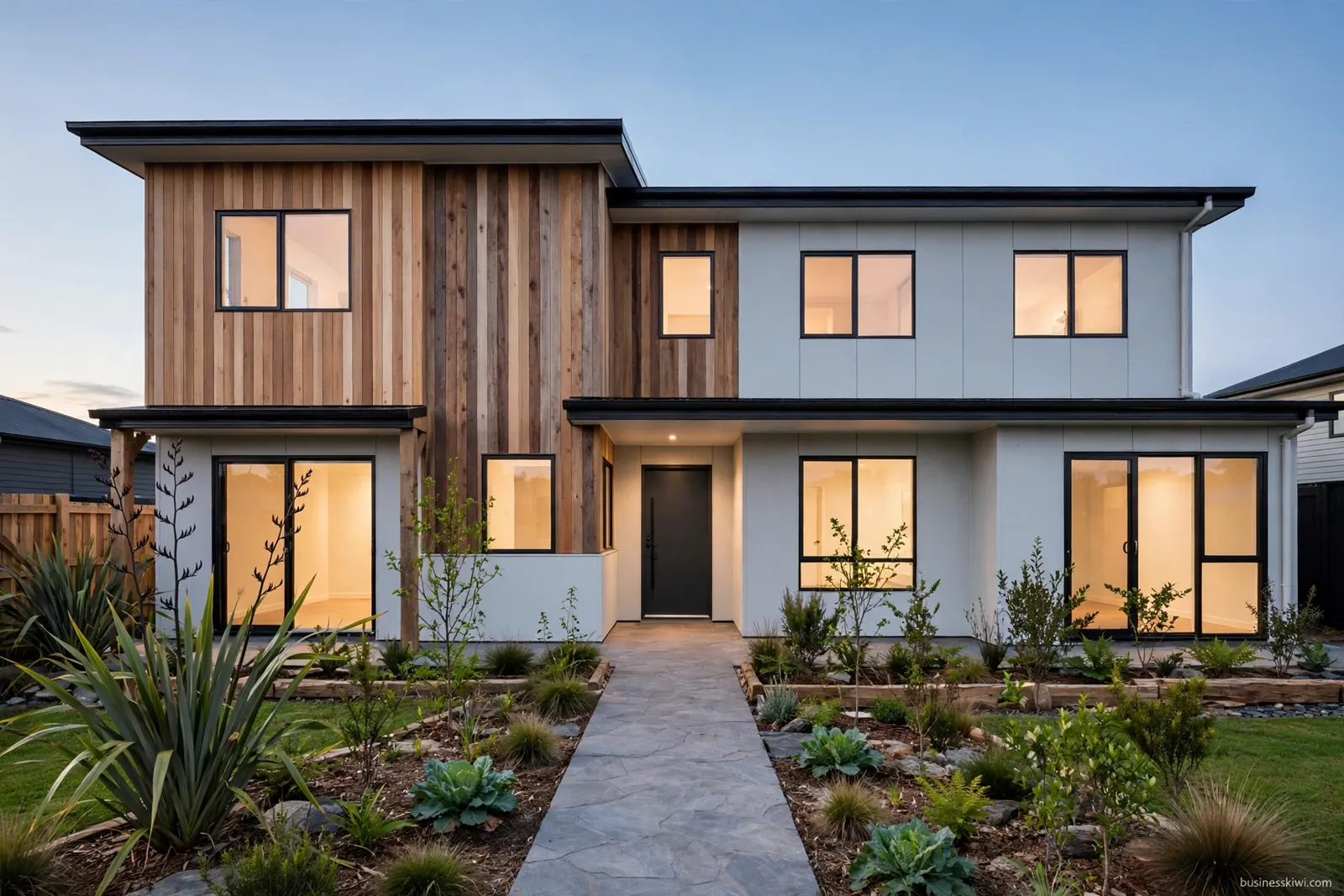
Flat Bush suits families who want a new, large home, good schools close by, and a park and a town centre within walking distance. It suits buyers who prefer modern houses over character homes, and renters who want a quiet street with a school nearby. The ethnic diversity, the range of food shops and restaurants, and the temple and the churches all make it an easy place to settle for people from many backgrounds.
It suits commuters less well if they rely on trains, because there is no station in the suburb and the bus to Manukau or Middlemore adds time to the trip. It is also a suburb where a car is close to essential for most households, given the low share of people who travel by bus or on foot. People who want a character suburb, a nightlife, or a short walk to the city centre will not find it here. Flat Bush is a residential suburb, and its appeal is space, newness, and schools rather than buzz.
Practical tips before you move here
Check the school enrolment scheme for the exact address before you sign anything. Zones in Flat Bush are real, and they change, so confirm the school and the zone on the Education Counts website rather than relying on a listing.
Drive the commute at the time you would actually travel. Ormiston Road and Chapel Road are fine outside peak hours and slow at school and commuter peaks, so a test drive at 8 in the morning tells you more than a map.
Check the bus stop. Not every street in Flat Bush is close to a bus route, and the 35 and 355 run along the main roads. If you plan to use public transport, check the walk to the nearest stop on the Auckland Transport journey planner.
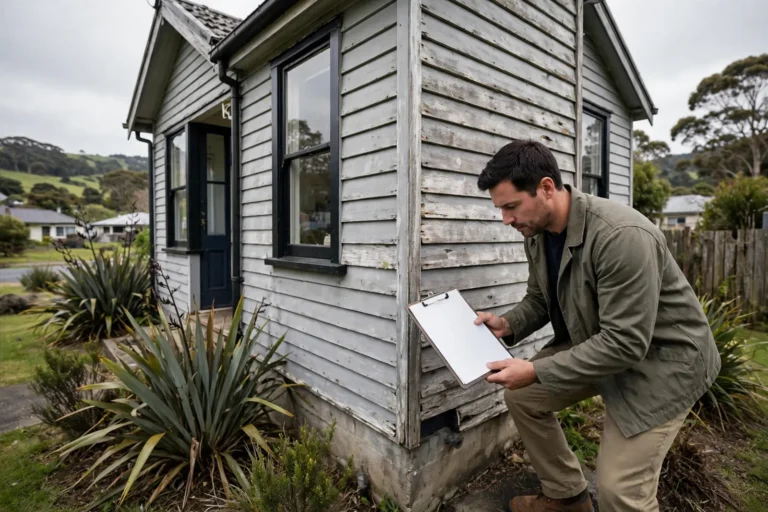
Ask about the house, not just the suburb. Most Flat Bush homes were built since the 2000s, but build quality, cladding, and maintenance still vary. Get a building inspection, check for any consent or cladding issues, and confirm what is included in the sale, because new suburbs have their share of leaky and poorly finished houses.
Visit the town centre and the park. Ormiston Town Centre and Barry Curtis Park are the two places that make the suburb work day to day, and a walk through both will tell you whether the area feels right. If you are renting, read our guide to renting in Auckland before you sign, and check the rules for a periodic tenancy so you know how much notice applies.
For more on property in New Zealand, browse the Real Estate section.
Frequently asked questions
Is Flat Bush the same as Ormiston?
No, but the two names overlap. Flat Bush is the suburb. Ormiston is the name of the town centre and of some of the newer neighbourhoods inside the suburb. Both names refer to the same part of south-east Auckland.
How far is Flat Bush from Auckland city centre?
About 25 kilometres, according to Auckland Council. The drive time depends on traffic and is much longer at peak times. There is no train station in Flat Bush, so public transport means a bus to Manukau or Middlemore station.
What is the population of Flat Bush?
Stats NZ estimates the population of the Flat Bush area at 55,900 people at 30 June 2025. At the 2023 Census it was 45,147, up from 32,244 in 2018 and 23,217 in 2013.
Which schools are in Flat Bush?
The main schools are Flat Bush School, Baverstock Oaks School, Ormiston Primary School, Mission Heights Primary School, Te Uho o te Nikau Primary School, and Chapel Downs School for Years 1 to 6; Ormiston Junior College and Mission Heights Junior College for Years 7 to 10; Ormiston Senior College for Years 11 to 13; and Sancta Maria College and Tyndale Park Christian School for wider year ranges. Several have enrolment schemes, so check the zone for your address.
Is there a train station in Flat Bush?
No. The nearest train stations are Manukau station and Middlemore station, both reached by bus. The 35 and 355 buses run to Manukau bus station, and the 314 runs to Middlemore station.
Where is the nearest library?
A temporary Flat Bush library is opening inside Ormiston Town Centre, near the food court at 240 Ormiston Road, and is set to open early in 2026. It offers full library access, including a collection of more than 3.4 million items. A permanent library and community centre are planned for the town centre over the next nine years.
What is the median rent in Flat Bush?
Stats NZ reports a median weekly rent of $680 for the Flat Bush area, against $450 for New Zealand as a whole. The figure reflects the large, modern houses that dominate the suburb. No official free source publishes a suburb median sale price, so this guide does not quote one.
Flat Bush is a fast-growing suburb, and figures change quickly. Population and rent figures are from Stats NZ, school rolls are from the Ministry of Education at 1 July 2025, and transport and library details are from Auckland Transport and Auckland Council. Check the source pages for the latest figures before you act on them.