DSCR Loan NZ: What It Is, Why You Cannot Get One Here, and What Investors Use Instead

DSCR Loan NZ: What It Is, Why You Cannot Get One Here, and What Investors Use Instead
The short answer
A DSCR loan is a mortgage that qualifies a borrower on the rental income of the property, not on the borrower’s own pay. The letters stand for debt service coverage ratio. It is a real product in the United States, where specialist lenders offer it to property investors. In New Zealand, no bank and no non-bank lender advertises a DSCR loan, and none was found in a search of New Zealand lenders, the Reserve Bank, the Financial Markets Authority and New Zealand property investment sources in November 2026. If you search for one here, you will find American lenders selling to American investors.
That does not make the idea useless. The ratio behind the product is a genuinely useful way to judge whether a rental property can carry its own mortgage. New Zealand banks simply do the sums differently. They test your whole financial position, your income, your other debts and your living costs, and they apply the Reserve Bank’s deposit and debt-to-income limits on top. This guide explains what a DSCR loan is, how the ratio works with New Zealand numbers, why the product does not exist here, and what New Zealand investors actually use instead.
What a DSCR loan is
A DSCR loan is an investment property mortgage where the lender qualifies the borrower mainly on the property’s cash flow. The usual checks still apply in some form, such as a credit check and a deposit, but the lender does not ask for the borrower’s pay slips or tax returns in the way a normal mortgage lender does. The property’s rent is the main evidence that the loan can be repaid.
In the United States, these loans are offered by specialist non-bank lenders to investors buying one to four unit rental properties. They are business purpose loans, which means the property must be an investment, not the borrower’s own home. The borrower is often buying through a company or trust, and the lender’s decision turns on whether the rent covers the mortgage payment with room to spare.
The product exists in the United States because that market has a large non-bank lending sector and a different regulatory setup. American lenders can write a loan where the property is the main security and the main source of repayment evidence. New Zealand’s market is different. Registered banks dominate residential lending here, and every lender, bank or non-bank, must meet responsible lending duties under the Credit Contracts and Consumer Finance Act 2003. Those duties require an affordability and suitability assessment of the borrower, not just of the property.

How the debt service coverage ratio is worked out
The ratio itself is simple. Divide the property’s net operating income by its annual debt service. Net operating income is the rent the property earns in a year, less the costs of running it, such as rates, insurance, maintenance and property management. Annual debt service is what the loan costs in a year, principal and interest, or interest only where the loan is interest only.
DSCR = net operating income / annual debt service
A ratio of 1.00 means the property’s income exactly covers its loan payments, with nothing left over. A ratio of 1.25 means the property earns 25 percent more than its loan costs. A ratio below 1.00 means the rent does not cover the loan, and the owner must top it up from other income.
American DSCR lenders commonly look for a ratio of at least 1.00, and many set the bar at 1.20 or 1.25. The exact bar varies by lender and by property type, and some lenders accept a lower ratio in exchange for a bigger deposit or a higher interest rate. The ratio is a lender’s own test, not a law. There is no universal minimum, and the same property can show a different ratio depending on which costs the lender counts and whether the loan is principal and interest or interest only.
The ratio is also used in commercial lending, where it measures whether a business earns enough to cover its loan payments. The idea is the same in both cases: income divided by debt payments, with a cushion above 1.00 showing the borrower can absorb a bad month.
A worked example with New Zealand numbers
The ratio is easier to judge with real numbers, so here is an example built on New Zealand figures. All of the numbers below are illustrative, not a lender’s figures and not a promise of what any property will earn. The arithmetic is the point.
Take a rental property valued at $800,000, bought with a $560,000 loan. That is a 70 percent loan to value ratio, which matches the usual deposit position for an investment property in New Zealand. The property rents for $750 a week.
Annual rent is $750 times 52 weeks, which is $39,000. The running costs are rates of $3,500, insurance of $2,200, maintenance of $2,000, and property management at 8.5 percent of the rent, which is $3,315. Total running costs are $11,015. Net operating income is $39,000 less $11,015, which is $27,985.
Now compare that income with the loan. On an interest only loan at 6 percent, the annual cost is $33,600, and the ratio is $27,985 divided by $33,600, which is 0.83. On an interest only loan at 5 percent, the annual cost is $28,000, and the ratio is 1.00. On a principal and interest loan over 30 years at 6 percent, the payment is $3,357 a month, or $40,290 a year, and the ratio is 0.69.
| Loan structure | Annual debt service | DSCR |
|---|---|---|
| Interest only at 5% | $28,000 | 1.00 |
| Interest only at 6% | $33,600 | 0.83 |
| Principal and interest, 30 years at 6% | $40,290 | 0.69 |
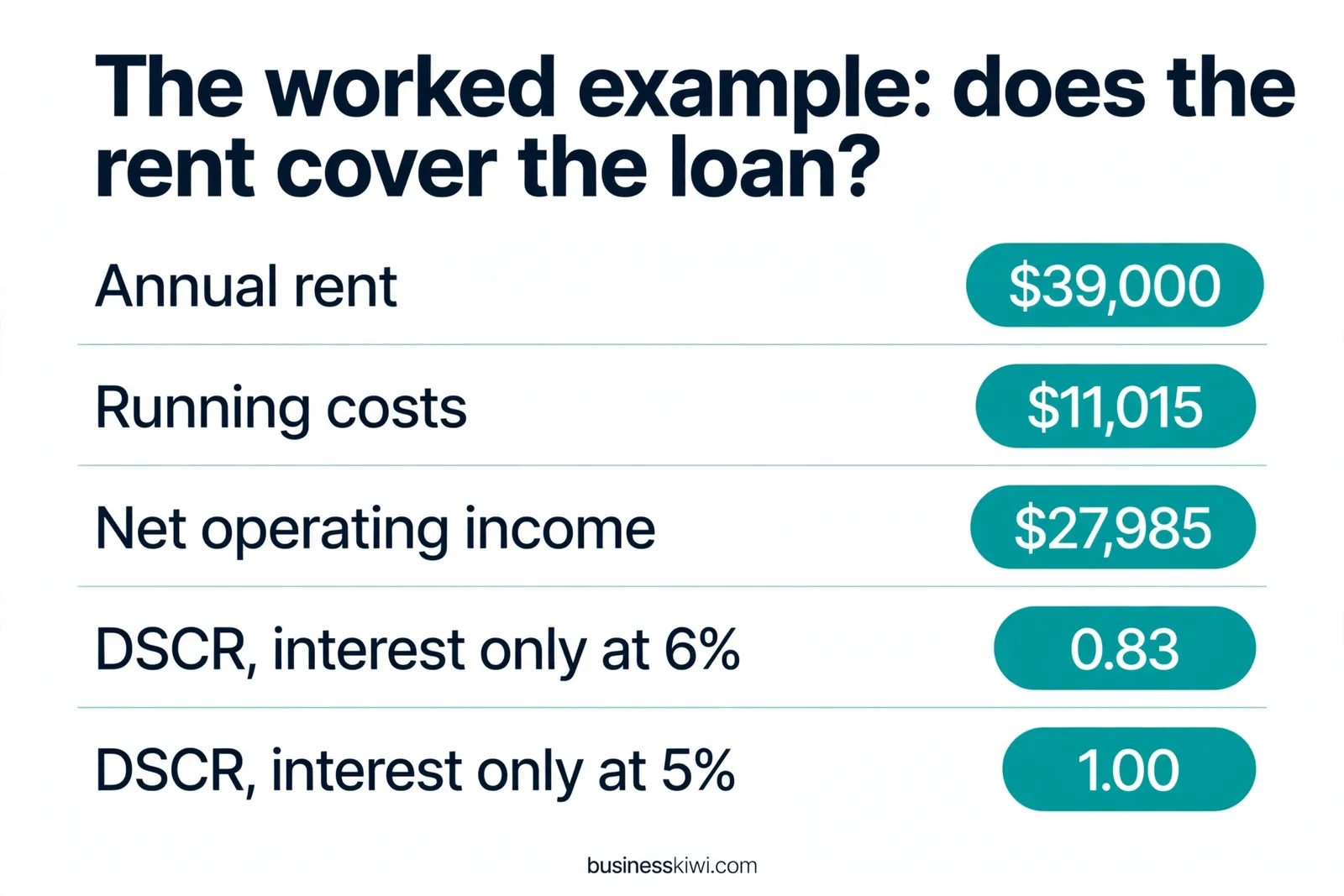
The example shows why the ratio matters and why it is a hard test at New Zealand interest rates. A property renting at $750 a week, with a 70 percent loan, does not cover its own mortgage on principal and interest at 6 percent. It only just covers an interest only loan at 5 percent. The owner would need a higher rent, a bigger deposit, a lower rate or a cheaper property to lift the ratio above 1.00 with a real cushion.
That is also why New Zealand banks do not lend on the ratio alone. If they did, many ordinary rentals would fail the test, and the bank would have no other income to fall back on. Instead, banks look at the borrower’s whole position, which is the subject of the next sections.
The short answer for New Zealand: no DSCR loans here
There is no DSCR loan product in New Zealand. No registered bank, ANZ, ASB, BNZ, Westpac or Kiwibank, advertises one. No non-bank lender found in this research offers one either. Searches of New Zealand lenders and of the Reserve Bank and Financial Markets Authority return no New Zealand DSCR product, only American lenders and American explanations of the product.
That finding matters because a lot of the material about DSCR loans online is American. It talks about credit scores, down payments of 20 to 25 percent, no tax returns, and loan amounts in US dollars. None of that applies in New Zealand. A New Zealand investor who applies for a rental property loan will be asked for personal income evidence, will be tested against the Reserve Bank’s limits, and will be assessed under New Zealand’s responsible lending rules. There is no way around the personal income check by pointing at the rent.
If a website or adviser tells you they can arrange a DSCR loan in New Zealand, ask which lender offers it, ask to see the lender’s own product page, and check that the lender is registered on the Financial Service Providers Register. A genuine New Zealand product would be on the lender’s own website. The DSCR loans found online are American products for American properties.
Why no New Zealand lender offers one
The main reason is the law. Under the Credit Contracts and Consumer Finance Act 2003, every lender in New Zealand must act in line with responsible lending principles. The Ministry of Business, Innovation and Employment’s Consumer Protection site states that lenders must conduct an affordability and suitability assessment to check the loan meets the borrower’s needs and that the borrower can afford the repayments. That assessment is about the borrower, not just the property. A loan approved on the rent alone, with no check on the borrower’s income and expenses, would not meet that duty.
The second reason is the shape of the New Zealand market. Residential lending here is dominated by registered banks, and those banks are bound by the Reserve Bank’s macroprudential rules. Those rules cap how much banks can lend at high loan to value ratios and at high debt to income ratios. A bank that lent on the property’s rent alone would still have to fit the loan inside those caps, which are set by the borrower’s total debt and total income. The rent cannot replace the income test.
The third reason is risk. A DSCR loan leaves the lender with one source of repayment, the rent. If the property is empty, or the tenant stops paying, or rates and insurance rise, there is no other income to cover the mortgage. New Zealand banks manage that risk by testing the borrower’s whole position, including a buffer for rate rises, and by counting only part of the rent.
What New Zealand banks do instead: the whole-picture test
A New Zealand bank assessing an investment property loan looks at the borrower’s entire financial position. The bank checks income from work and from any existing rentals, all existing debts, living costs, and the costs of the new property. It then tests whether the borrower could still make the repayments if interest rates rose, using a test rate higher than the rate the borrower would actually pay.
ANZ’s own investment property page describes the approach in plain terms. It says lenders typically consider the expected rental income and deduct a proportion of that income to cover expenses such as maintenance, insurance, rates and tax. It also says the borrower should think about whether they could top up the repayments if the rent is not enough, and whether they could cover the mortgage during a vacancy or after an unexpected repair. That is the opposite of a DSCR loan. The borrower’s ability to cover a shortfall is part of the assessment, not something the lender ignores.
The bank also wants evidence. For a salary earner, that usually means recent pay slips. For a self-employed borrower, it usually means filed tax returns, often for two years. For existing rentals, it means tenancy agreements and evidence of the rent actually received. The bank is building a picture of the borrower’s whole position, and the rent on the new property is only one part of it.
Guardrail one: the deposit and LVR rules
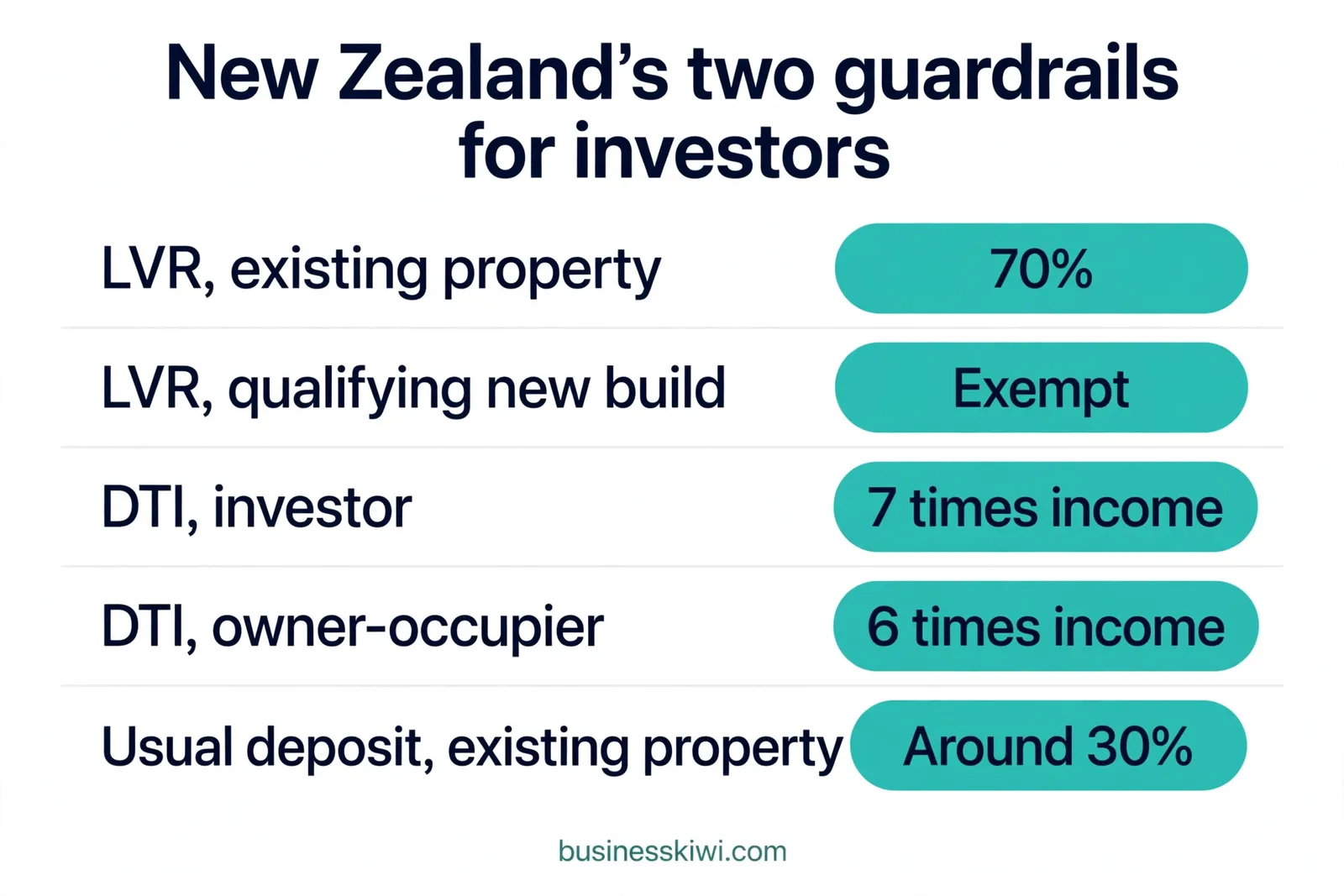
The first Reserve Bank guardrail is the loan to value ratio, or LVR. This is the loan as a share of the property’s value. A $560,000 loan on an $800,000 property is a 70 percent LVR. The Reserve Bank sets limits on how much low-deposit lending banks can do, and those limits are tighter for investors than for owner-occupiers.
From 1 December 2025, the Reserve Bank’s settings allow banks to make up to 10 percent of their new investor lending above 70 percent LVR, and up to 25 percent of their new owner-occupier lending above 80 percent LVR. In practice, that means most investors buying an existing property need a deposit of around 30 percent. ANZ’s own investment property page says the same thing: when buying an investment property, you generally need a 30 percent deposit, which is typically higher than the deposit required for the home you live in.
Qualifying new builds are treated differently. New builds are exempt from the Reserve Bank’s investor lending limits, and banks often look for a deposit of around 20 percent on a new build rental. That exemption is a deliberate policy choice to support new housing supply, and it is one of the few places where an investor can borrow with less than a 30 percent deposit from a bank.
The LVR limit is a bank-level allowance, not a promise to any individual borrower. A bank can make some loans above the threshold, but it does not have to, and it will still apply its own servicing test to every application.
| Borrower | LVR threshold | Share of new lending allowed above it | Usual deposit |
|---|---|---|---|
| Investor, existing property | 70% | Up to 10% | Around 30% |
| Investor, qualifying new build | Exempt | Not limited by the Reserve Bank | Often around 20% |
| Owner-occupier | 80% | Up to 25% | Around 20% |
Reserve Bank LVR settings in effect from 1 December 2025. Individual banks apply their own criteria on top.
Guardrail two: the debt-to-income cap
The second Reserve Bank guardrail is the debt-to-income ratio, or DTI. This is the borrower’s total debt divided by their gross annual income, before tax. It is a different ratio from DSCR. DSCR compares a property’s income with its loan payments. DTI compares a person’s total debt with their total income.
The Reserve Bank’s DTI restrictions took effect on 1 July 2024. For owner-occupiers, banks can make no more than 20 percent of their new lending to borrowers with a DTI above 6, which means total debt of more than six times gross annual income. For investors, the threshold is 7, and banks can make no more than 20 percent of their new investor lending to borrowers with a DTI above 7. The Reserve Bank reviewed the settings in October 2025 and kept them unchanged.
An example shows how the cap works. A household with gross income of $180,000 a year has a DTI ceiling of seven times income, which is $1,260,000 of total debt. If that household already owes $700,000 on its own home, only $560,000 of headroom remains for an investment loan, whatever the rent on the new property might be. The rent does not raise the DTI ceiling. Only more income, or less existing debt, does that.
DTI is now often the binding limit for investors, more so than the deposit. An investor can have a 30 percent deposit and still be declined because their total debt would exceed seven times their income. That is a deliberate feature of the rules. The Reserve Bank introduced DTI to limit how much debt households take on relative to income, and the cap applies to the borrower’s whole position, not to one property at a time. For a full walk-through of the borrowing limits, see How Much Can I Borrow NZ.
How banks count your rental income
Banks do not count all of your rent when they test whether you can afford a loan. They count a proportion of it, because some of the rent goes on rates, insurance, maintenance, vacancies and property management. ANZ’s own investment property page says lenders typically deduct a proportion of the expected rental income to cover these expenses. The exact proportion varies by bank and by property, and banks do not publish a single figure that applies to every application.
This shading is the closest New Zealand banking comes to the DSCR idea, and it works in the opposite direction. A DSCR lender asks whether the rent covers the loan. A New Zealand bank asks whether the borrower’s whole income, including a shaded share of the rent, covers all of the borrower’s debts at a stressed interest rate. The rent helps, but it is discounted first, and the borrower’s other income carries the rest.
Banks also want evidence of the rent. For a property that is already tenanted, that usually means the tenancy agreement and bank statements showing the rent coming in. For a property that is empty, the bank will usually rely on a rental appraisal from a property manager or valuer, and it will still shade the appraised figure. Short-term rental income, such as Airbnb income, is treated more cautiously by most banks, and some will not count it at all. Ask the lender how it treats the specific type of rent before relying on it in your numbers.
Non-bank lenders: more flexible, still not DSCR
Non-bank lenders exist in New Zealand, and they can be more flexible than the main banks. They include finance companies, building societies and credit unions, and specialist mortgage providers such as Pepper Money, Liberty Financial and Avanti Finance. Because they are not registered banks, the Reserve Bank’s LVR and DTI speed limits do not apply to them in the same way, and they may accept a smaller deposit or a borrower the banks have declined.
That flexibility has limits, and it is not a DSCR loan by another name. Every lender in New Zealand, bank or non-bank, must comply with the responsible lending duties in the Credit Contracts and Consumer Finance Act 2003. That means an affordability and suitability assessment of the borrower, including income and expenses, is still required. A non-bank lender may test affordability differently, for example by using the actual interest rate rather than a stressed test rate, or by counting more of the rent, but it cannot approve a loan on the property’s rent alone.
Non-bank lending also costs more. Interest rates are usually higher than bank rates, establishment fees are higher, and the loan may be for a shorter term or on interest only for a limited period. Some non-bank lenders specialise in short-term finance, such as bridging loans, rather than long-term rental mortgages. A non-bank loan can be a useful bridge back to bank lending, for example while a borrower rebuilds a deposit or clears a credit issue, but it is not a way to borrow without showing income.
Resimac, once one of the larger non-bank mortgage lenders in New Zealand, stopped accepting new home loan customers on 1 July 2024 and now serves existing customers only. Bluestone stopped accepting new home loan applications in New Zealand on 30 August 2024. The non-bank market is smaller than it was, and the lenders that remain are selective.
The tax rules that change the numbers
Tax changes the return on a rental, and two recent changes matter for anyone running the numbers. Both come from Inland Revenue, and both are current as at November 2026.
First, interest deductibility is fully restored. From 1 April 2025, you can claim 100 percent of the interest on funds borrowed for a residential rental property, and this applies from the tax year ending 31 March 2026. For the year from 1 April 2024 to 31 March 2025, the limit was 80 percent. The interest must still meet the general deductibility rules, which means the loan must have been used for the rental and the interest must not be private in nature.
Second, the bright-line test is back to two years. For a residential property sold on or after 1 July 2024, the bright-line test asks whether the bright-line end date is within two years of the bright-line start date. If it is, the gain is generally taxable, unless an exclusion such as the main home exclusion applies. A sale outside the two year period can still be taxable under other land sale rules, for example if the property was bought with the intention of selling it.
These rules change the cash flow of a rental, but they do not change how a bank assesses the loan. A bank tests affordability before tax, using its own test rate and its own shading of the rent. The tax position affects what the property returns to the owner, not what the bank will lend.
What to do if you were counting on a DSCR loan
If you came looking for a DSCR loan because a bank declined you, or because your personal income does not support the loan you want, the first step is to find out exactly why the bank said no. Ask the lender or your mortgage adviser which test failed. It could be the deposit, the DTI cap, the servicing test, the credit check, or the property itself. Each problem has a different fix, and guessing wastes time.
If the deposit is the problem, a qualifying new build is the main bank route to a smaller deposit, because new builds are exempt from the Reserve Bank’s investor LVR limits. Using equity in a property you already own is another route, although the bank will still test the whole position and will usually require at least 30 percent equity to remain in an existing investment property.
If the DTI cap is the problem, the options are to reduce debt, increase income, or buy a cheaper property. Paying down a personal loan, a credit card limit or a student loan can lift headroom, because the DTI test counts total debt, including credit limits even when the balance is zero. Increasing income takes longer, but it is the only change that lifts the ceiling itself.
If the servicing test is the problem, a higher rent, a lower purchase price, a bigger deposit or a lower interest rate can all help. A licensed mortgage adviser can run the numbers across several lenders, because each bank applies its own test rate and its own shading of the rent. A loan that fails at one bank can pass at another, and an adviser can also check whether a non-bank lender is a realistic option.
Costs and risks to plan for
Buying a rental with a mortgage involves costs beyond the deposit. Budget for legal fees, a valuation, a building inspection, lender fees, insurance, and rates. ANZ’s own investment property page notes that owning a rental involves maintenance, insurance, rates and tax on top of the repayments, and that the borrower should think about whether they could cover the mortgage during a vacancy or after an unexpected repair.
The risks are the same ones the DSCR ratio is designed to measure, and they do not go away because New Zealand banks test the borrower instead of the property. A vacancy means no rent. A tenant who stops paying means no rent and a Tribunal process. Rates and insurance rise most years. Interest rates move, and a loan that is comfortable at 5 percent can be tight at 7 percent. That is why banks test affordability at a rate above the rate you would pay, and why a prudent investor keeps a cash buffer of several months of holding costs.
How to work out whether a rental stacks up
A simple check, using the DSCR idea, will tell you whether a property can carry its own loan before you talk to a bank. It will not get you a loan, but it will stop you wasting time on a property that cannot work.
First, work out the annual rent. Use the actual rent if the property is tenanted, or a rental appraisal from a local property manager if it is empty. Do not use the highest rent you have seen advertised in the area.
Second, subtract the running costs. Rates, insurance, maintenance and property management are the main ones. Use the actual rates and insurance figures for the property where you can get them, not a guess. Allow for vacancies by counting 50 weeks of rent instead of 52 if you want a conservative figure.
Third, divide the result by the annual loan cost. Use the principal and interest payment, not the interest only payment, because the principal has to be repaid eventually. If the answer is below 1.00, the rent does not cover the loan, and you will be topping it up from your other income every month. If the answer is above 1.00, the property covers its own loan, but remember the bank will still test your whole position and will still shade the rent.
Fourth, check the DTI ceiling. Add the new loan to your existing debts and divide by your gross annual income. If the answer is above 7, most banks will decline the loan, whatever the property earns. If it is close to 7, you have little room for the next property. This is the test that stops most investors, and it is the one the DSCR idea cannot help with.
Finally, talk to a licensed mortgage adviser before making an offer. An adviser can run the servicing test at several lenders, confirm the deposit position, and check whether a non-bank lender is worth considering. A mortgage adviser is licensed by the Financial Markets Authority, and you can check their registration on the Financial Service Providers Register. For a wider view of how investment property fits alongside other options, see Investment NZ.
For more on property and starting a business, browse the Real Estate section.
Frequently asked questions
Can I get a DSCR loan in New Zealand?
No. No New Zealand bank or non-bank lender advertises a DSCR loan product, and none was found in a search of New Zealand lenders, the Reserve Bank and the Financial Markets Authority in November 2026. DSCR loans are an American product for American investment properties. New Zealand investors borrow through standard residential mortgages, with full personal income checks and the Reserve Bank’s LVR and DTI limits applied.
What DSCR do New Zealand banks want?
New Zealand banks do not use a DSCR minimum, because they do not offer DSCR loans. They test the borrower’s whole position, including income, existing debts, living costs and a shaded share of the rent, at a test interest rate above the rate the borrower would pay. You can still use the ratio yourself to judge a property, and a ratio above 1.00 on a principal and interest loan is a reasonable sign the rent covers the mortgage.
How much deposit do I need for an investment property in NZ?
For an existing property, usually around 30 percent. The Reserve Bank’s LVR settings from 1 December 2025 allow banks to make up to 10 percent of their new investor lending above 70 percent LVR, so most investors need a 30 percent deposit. Qualifying new builds are exempt from the investor LVR limits, and banks often look for a deposit of around 20 percent on a new build rental. ANZ’s own investment property page states that a 30 percent deposit is generally needed for an investment property.
How much of my rent will a bank count?
Not all of it. Banks deduct a proportion of the expected rental income to allow for rates, insurance, maintenance, vacancies and property management. ANZ’s own investment property page states that lenders typically deduct a proportion of rental income for these expenses. The exact proportion varies by bank and by property, and banks do not publish a single figure. Ask the lender how it treats your rent before you rely on it in your numbers.
Can a non-bank lender help if a bank says no?
Sometimes. Non-bank lenders are not bound by the Reserve Bank’s LVR and DTI speed limits in the same way as banks, and they may accept a smaller deposit or a borrower the banks have declined. They still have to meet the responsible lending duties in the Credit Contracts and Consumer Finance Act 2003, so they still check the borrower’s income, expenses and affordability. Their rates and fees are usually higher, and the loan may be shorter term. A licensed mortgage adviser can tell you whether a non-bank lender is realistic for your situation.
Do I need to show my personal income for an investment loan?
Yes. Every lender in New Zealand must assess affordability and suitability under the Credit Contracts and Consumer Finance Act 2003, and that assessment is about the borrower. A bank will ask for pay slips if you are a salary earner, or filed tax returns if you are self-employed, along with bank statements and details of existing debts. There is no New Zealand loan that qualifies you on the rent alone.
What is the difference between DSCR and DTI?
DSCR, the debt service coverage ratio, compares one property’s income with its loan payments. DTI, the debt-to-income ratio, compares a person’s total debt with their total gross income. In New Zealand, the Reserve Bank’s DTI rules cap most investor lending at seven times gross income. DSCR is a useful way to judge a single property. DTI is the rule that decides how much a New Zealand bank will lend you in total. A property can pass the DSCR test and still fail the DTI test, and the DTI test is the one that binds.
This guide is general information only. It is not legal, financial or tax advice. Lending rules, interest rates and tax rules change, and every lender applies its own criteria. Check the current position with the Reserve Bank of New Zealand, Inland Revenue and your lender, and talk to a licensed mortgage adviser before borrowing to buy an investment property.