CPR Courses in NZ: What Training Covers, Who Provides It and What It Costs
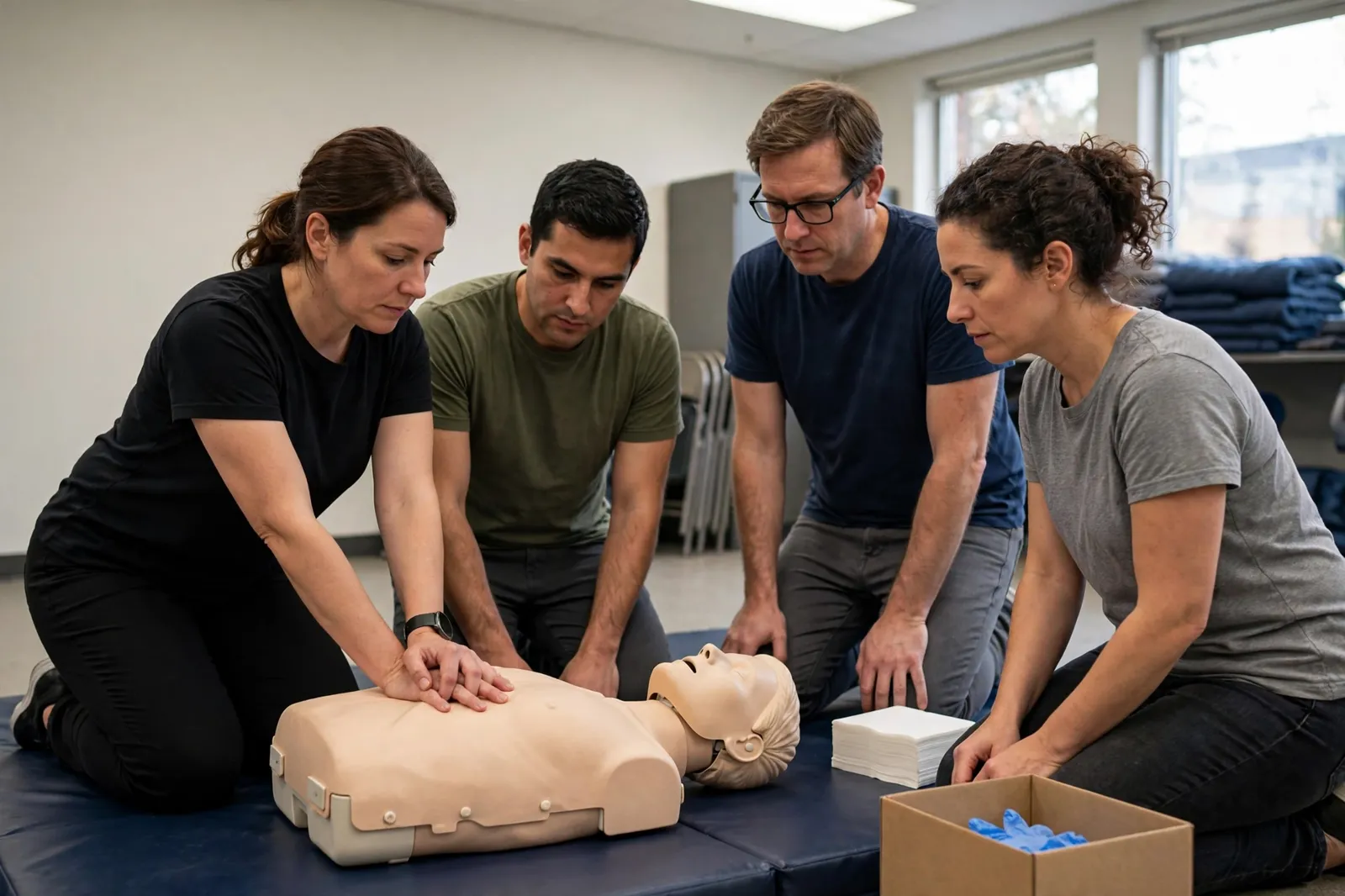
Search for a CPR course in New Zealand and you will quickly notice something. Very few courses teach CPR on its own. Cardiopulmonary resuscitation sits inside a wider system of first aid training, built around NZQA unit standards, delivered mostly by Hato Hone St John and New Zealand Red Cross, and shaped for most people by one practical question: do you need a certificate for work, or do you simply want to know what to do if someone collapses at home?
The stakes explain the interest. Hato Hone St John says more than 2,500 New Zealanders had a cardiac arrest outside hospital last year, most of them at home, and only about 1 in 10 survived. St John also says CPR combined with an AED can lift a person’s survival chances by up to 40 per cent, while every minute of delay cuts those chances by roughly 10 to 15 per cent. Those are St John’s figures, published on its community training pages, and they are the reason short CPR courses exist alongside the full first aid certificates.
This guide works through what CPR training in NZ actually involves: the skills taught, the courses on offer from the main providers, the NZQA standards behind the certificates, what employers have to provide, and what each course costs as the providers themselves publish it.
What a CPR course teaches
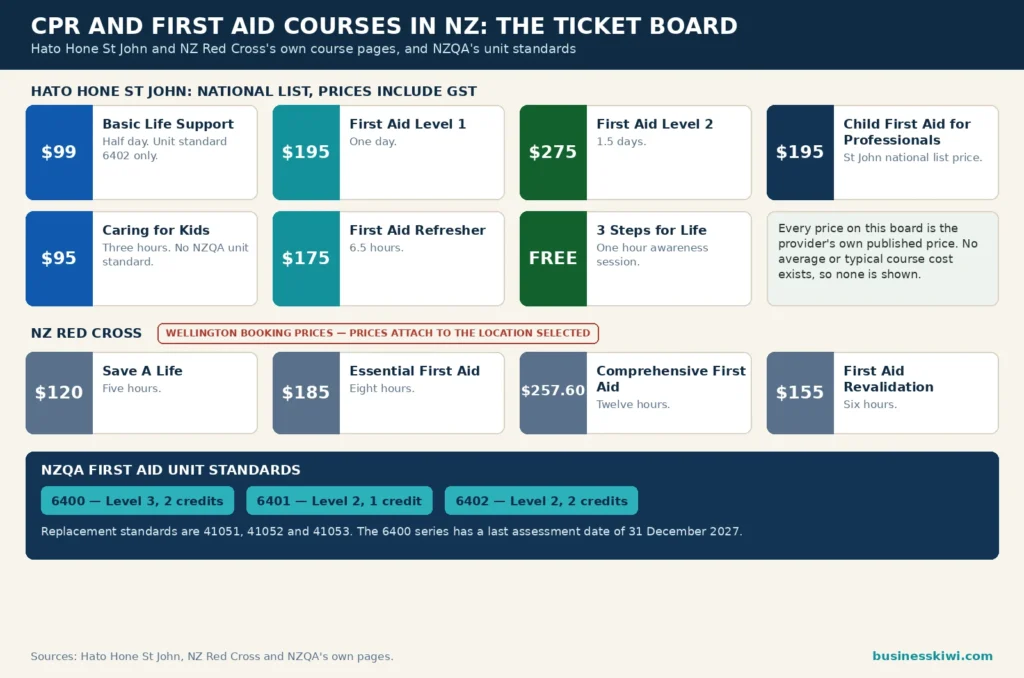
In New Zealand, CPR training is anchored to NZQA unit standard 6402, Provide basic life support. Read the course pages of either major provider and the same syllabus appears, because both teach to that standard. St John lists the 6402 content as the DRSABCD action plan, CPR for adults, children and infants, defibrillator (AED) use, choking for adults, children and infants, life-threatening bleeding including when to use an arterial tourniquet, and shock.
DRSABCD is the sequence that organises everything else. The letters stand for Dangers, Response, Send for help, Airway, Breathing, CPR and Defibrillation. On its first aid library pages, St John sets the adult version out plainly: check for danger, check whether the person responds, call 111 for an ambulance, open the airway, check for normal breathing, and if the person is not breathing normally, start CPR. St John’s published summary describes cycles of 30 chest compressions followed by 2 breaths, continued until the ambulance arrives, and it is blunt about priorities: chest compressions are the most important part, and if you cannot give breaths you should keep pushing hard and fast on the chest regardless.
Treat that paragraph as orientation only. Reading about compressions is not the same skill as performing them, and St John’s own course prerequisites hint at why. To take its assessed courses you must be able to kneel on the floor and perform CPR for a minimum of two minutes, because that is what the practical assessment involves: compressions on a training manikin, at the right depth and pace, sustained. Courses are scenario based. You practise the sequence on adults, children and infants, work through choking responses for each age group, and learn to attach an AED and follow its voice prompts. The New Zealand Resuscitation Council makes the same underlying point in its Responder Training Framework: even an untrained person is expected to recognise unresponsiveness and absent breathing, call 111, and follow instructions to start CPR and use an AED, while a trained workplace first aider adds the DRSABCD sequence, simple airway management including choking, and broader first aid skills.
One boundary is worth stating early. A CPR course teaches you to keep blood moving and buy time. It does not turn you into a paramedic, and neither provider pretends otherwise. WorkSafe puts it crisply in its first aid guidance: CPR can prolong life, but an AED is the only way to restore the heart’s normal rhythm. That is why AED practice is built into every CPR course rather than treated as an optional extra.
How CPR fits inside first aid training in NZ
Because 6402 rarely travels alone, it helps to see the ladder it belongs to. NZQA’s first aid standards form a stack of three. Unit standard 6402 (Provide basic life support) covers CPR, AED use, choking, serious bleeding and shock. Unit standard 6401 (Provide first aid) adds the everyday injury and illness load: fractures, burns, soft tissue injuries, poisoning, asthma, diabetic emergencies, seizures, chest pain, stroke and severe allergic reactions. Unit standard 6400 (Manage first aid in an emergency situation) sits on top, dealing with major incidents, head and spinal injuries, environmental conditions and coordinating a response involving at least two casualties.
Courses assemble those standards into certificates of different depths:
- CPR-focused short courses teach 6402 by itself. St John’s Basic Life Support and Red Cross’s Save A Life both sit here.
- Full first aid certificates combine the standards. A one-day course usually covers 6401 and 6402 together. Longer courses add 6400.
- Awareness sessions teach the core actions without assessment or unit standards. St John’s free 3 Steps for Life community session is the obvious example.
- Refresher and revalidation courses renew an existing certificate and are covered in their own section below.
Which rung you need depends on why you are training. A parent who wants to handle a choking toddler needs something different from a forestry worker whose employer must satisfy WorkSafe. The sections that follow take the providers first, then the rules that sit behind them.
The main providers and their courses
Hato Hone St John
St John runs the most granular ladder of the two, and every price below is the one published on its own course pages, including GST.
Its CPR-only entry point is Basic Life Support, a half-day assessed course priced at $99. It teaches the 6402 syllabus only: DRSABCD, CPR across the age groups, AED use, choking, life-threatening bleeding and shock. The certificate is valid for two years, and St John pitches it at workplace first aiders and anyone wanting basic life support skills specifically.
First Aid Level 1 is the standard workplace course: one day, $195, assessed, with a certificate valid for two years. It covers 6401 and 6402 together, and St John states that it meets the minimum qualification for a workplace first-aider. First Aid Level 2 extends that to a day and a half for $275, adding standard 6400 and the heavier end of the syllabus, including head and spinal injuries, major injuries such as amputations and crush injuries, environmental conditions and major incidents. St John describes Level 2 as suited to workplace first-aiders in high-risk environments, including outdoors work. Day one runs a full day and day two a half day, as its course page sets out.
Two child-focused options sit alongside. Child First Aid for Professionals costs $195 for one day, covers 6401 and 6402 with child and infant content throughout, and St John states that it meets the requirements of the Ministry of Education for primary school teachers and early childhood educators. Caring for Kids: Essential First Aid Skills is the parent and caregiver version: three hours, $95, no formal assessments and no NZQA unit standards, aimed at adults caring for children aged 0–8. Its content still runs through DRSABCD, child and infant CPR, AED use and choking, alongside fever, febrile seizures, breathing difficulties and EpiPen use. St John also runs the free 3 Steps for Life programme, a one-hour community session covering calling 111, starting CPR and using an AED, delivered to community organisations, clubs, marae and rural groups. It is an awareness session rather than a certificate course, and St John is clear-eyed about that distinction.
St John’s First Aid Refresher renews a Level 1, Level 2 or equivalent certificate for a further two years at $175, over a total course time of 6.5 hours. A blended version lets you complete online modules first and attend in class for the afternoon. Two catches: you must hold a current certificate less than two years old to be eligible, and the refresher does not include assessment for unit standards.
New Zealand Red Cross
Red Cross organises its range by risk level rather than by numbered levels, and its prices sit inside its booking system, shown for the training location you select. The figures below are the ones listed on its Wellington region booking pages when this guide was researched; treat the price for your own area as the one shown when you book.
Save A Life is the CPR-focused course, teaching CPR, AED use, choking and life-threatening bleeding, and it achieves unit standard 6402. Red Cross’s booking page lists it at $120 with a duration of five hours. Essential First Aid is its one-day course for low-risk workplaces: eight hours, standards 6401 and 6402, listed at $185 on the Wellington booking page. Red Cross says it meets the requirements of the Foundation First Aid Certificate. Comprehensive First Aid adds the third standard, 6400, across 12 hours, and Red Cross recommends it for high-risk workplaces; the Wellington listing prices it at $257.60. It covers everything in Essential plus more advanced material such as work-related injuries and treating head and spinal injuries, and Red Cross says it meets the requirements of the New Zealand First Aid Certificate.
Red Cross’s renewal course is called First Aid Revalidation: six hours, listed at $155. Certificates must be revalidated every two years to stay valid, and Red Cross accepts a current certificate from any previous provider, so you are not locked into revalidating where you first trained. There is a window, though. Since February 2023, Red Cross has accepted revalidation bookings where the existing certificate is no older than two years and three months from its issue date. Beyond that, the refresher route closes. Red Cross also lists an Introductory First Aid course and a First Aid for Parents and Caregivers course, neither of which carries NZQA standards; its course pages do not publish prices for those two in the material read for this guide, so the honest answer is that you confirm them at booking. At the advanced end, its Pre-Hospital Emergency Care course builds on a current Comprehensive certificate for emergency response and remote or specialist rescue work, a step well beyond what most readers of a CPR guide are shopping for.
Other NZQA-accredited training providers operate around the country as well. WorkSafe’s recommendation, discussed next, is to choose an accredited provider; the two organisations above are simply the names most New Zealanders encounter first.
The NZQA unit standards behind the certificates
Those three standard numbers keep recurring because they are the national yardstick. As NZQA’s framework currently lists them:
- 6400, Manage first aid in an emergency situation: Level 3, 2 credits.
- 6401, Provide first aid: Level 2, 1 credit.
- 6402, Provide basic life support: Level 2, 2 credits.
If CPR is your specific interest, 6402 is your standard. It is the one both CPR-only courses teach, the one every full certificate includes, and the one NZQA’s own documentation ties to the current New Zealand Resuscitation Council guidelines.
One change is working through the system. In November 2025, NZQA published a change report recording that the standard-setting body, Toitū te Waiora Workforce Development Council, has developed three new skill standards to replace the 6400 series: 41051 (Manage first aid during emergency situations, Level 3, 1 credit), 41052 (Administer first aid, Level 2, 1 credit) and 41053 (Administer basic life support, Level 2, 1 credit). NZQA lists 6402 as expiring, with the last date for assessment on 31 December 2027. In practice, courses on sale today still teach and assess the 6400 series, certificates issued against them remain the recognised workplace credential, and the transition matters mainly if you are booking training close to that 2027 date and want to know which standard your certificate will record.
What workplaces have to provide
For many readers, the real driver is not curiosity but compliance. WorkSafe’s First aid at work guide explains the duty this way: under the Health and Safety at Work (General Risk and Workplace Management) Regulations 2016, a PCBU, the person conducting a business or undertaking, must provide adequate first aid equipment for the workplace, access to facilities for administering first aid, and access to an adequate number of trained first aiders. The PCBU cannot levy or charge a worker for any of it.
Notably, the law does not set a fixed ratio of first aiders to staff. WorkSafe instead tells PCBUs to weigh the number of workers on site at any time, the nature of the work and its risks, how likely injuries are and how serious they might be, the size and layout of the workplace, and how far away ambulance services, medical centres and hospitals are. Its examples show how wide the reasonable range is. A three-person city IT firm next door to a medical centre has no trained first aiders, relying on the centre. A tiny-house builder with eight workers has two, because the work is high risk. A large vineyard half an hour from medical help runs two first aiders per ten workers, and a big low-risk contact centre keeps two present per fifty workers.
On training itself, WorkSafe recommends that workers be trained by an organisation accredited by NZQA, notes that the certificate a provider issues is generally valid for two years, and says first aiders should get refresher training after two years to keep the certificate current. Its guidance also records that the Australian and New Zealand Committee on Resuscitation (ANZCOR) recommends CPR skills be refreshed at least annually, while accepting that two-yearly refresher training is a good opportunity to practise where annual refreshers are not feasible for an industry. Separately, WorkSafe describes it as good practice for at least one worker to be trained in CPR. First aid arrangements like these usually sit inside a wider health and safety policy template and the emergency plan every workplace has to maintain, and WorkSafe expects them to be reviewed with workers as the work changes.
Course formats and durations
Training time is the first real dividing line between the options, and it tracks the depth of the certificate:
- One hour: St John’s free 3 Steps for Life community session. Awareness only, no certificate.
- Three hours: St John’s Caring for Kids, for parents and caregivers. No assessment, no unit standards.
- Half a day: St John’s Basic Life Support, the assessed CPR-only course covering 6402.
- Five hours: Red Cross Save A Life, its CPR-focused course covering 6402.
- One day: St John First Aid Level 1, and Red Cross Essential First Aid at eight hours. Both cover 6401 and 6402.
- Twelve hours: Red Cross Comprehensive First Aid, covering all three standards, run across two days in its listings.
- A day and a half: St John First Aid Level 2, a full day followed by a half day, covering all three standards.
- Six to six and a half hours: the renewal courses, Red Cross First Aid Revalidation at six hours and St John’s First Aid Refresher at 6.5 hours total.
Two format points matter if you are booking for yourself. First, assessed courses are practical and in person. St John’s prerequisites apply across its assessed range: attendees must be 14 or older, able to kneel on the floor and perform CPR for at least two minutes, and able to complete assessments in English, since practical, written and verbal assessment methods are all used. Second, the online element in this market is a supplement, not a substitute. St John’s blended refresher moves part of the theory online but still brings you into a classroom for the afternoon; the hands-on skills are practised and assessed face to face. Group and private bookings exist too: St John takes private course enquiries for teams and businesses through its First Aid Training enquiry form, which matters for employers training a whole shift at once.
What the courses cost
There is no single going rate, and anyone quoting you an average across providers is inventing it. What can be stated exactly is what each provider publishes for its own courses.
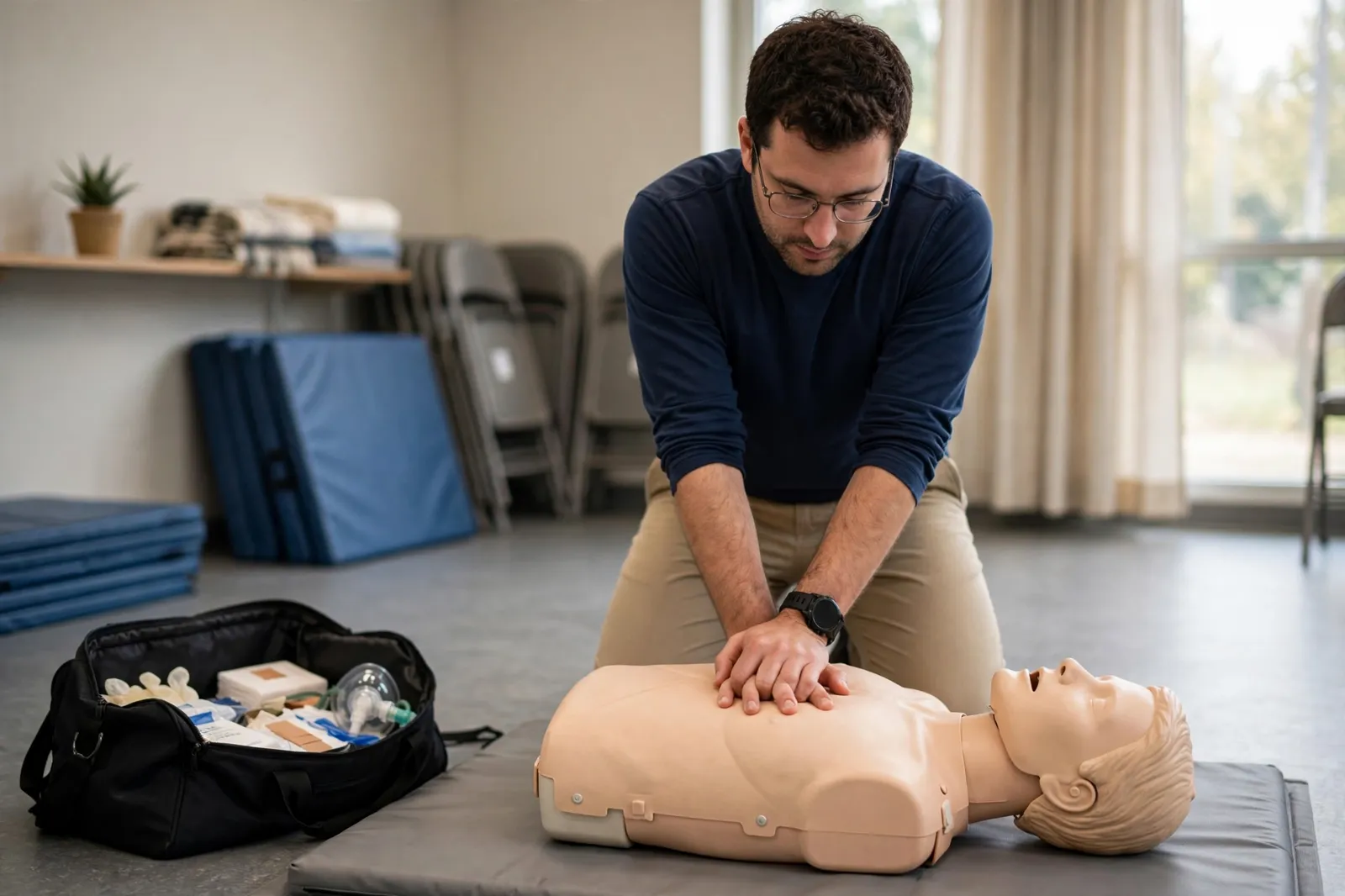
St John’s prices are national list prices including GST: Basic Life Support $99, First Aid Level 1 $195, First Aid Level 2 $275, Child First Aid for Professionals $195, Caring for Kids $95, and the First Aid Refresher $175. Its 3 Steps for Life sessions are free. St John also notes that its first aid courses are non-refundable, which is worth knowing before you book a date you might need to move.
Red Cross publishes prices inside its booking system for each training location. On the Wellington region pages read for this guide, Save A Life was listed at $120, Essential First Aid at $185, Comprehensive First Aid at $257.60 and First Aid Revalidation at $155. Because the price attaches to the location you select, check the listing for your own area rather than assuming the Wellington figure follows you. Where a provider’s page publishes no price, as with Red Cross’s introductory and parents’ courses, the price is confirmed at booking, and this guide leaves the gap empty rather than filling it with a guess.
Employers should budget beyond the sticker price. A one-day course is also a day of wages, and WorkSafe’s framing means the training decision follows the risks of the work, not the other way round. The cheapest course that does not cover the standards your workplace needs is not a saving.
Keeping a certificate current
Every certificate discussed here runs on a two-year cycle. St John’s Level 1, Level 2, Basic Life Support and child first aid certificates are each valid for two years. Red Cross states that first aid certificates expire after two years and must be revalidated every two years to remain valid. WorkSafe’s guidance matches: certificates are generally valid for two years, with refresher training after that.
The renewal mechanics differ slightly by provider. St John’s refresher requires a current Level 1, Level 2 or equivalent certificate less than two years old, takes 6.5 hours in total, and renews you for a further two years without re-assessing the unit standards. Red Cross allows a slightly longer fuse, accepting revalidation where the certificate is up to two years and three months old, and it accepts certificates earned with other providers. Miss those windows and the refresher route is gone; you book a full course again.
Worth separating from the paperwork is the skills question. ANZCOR, as WorkSafe reports it, recommends refreshing CPR skills at least annually, on the reasonable ground that compression quality fades faster than a two-year certificate cycle. Nothing stops a workplace first aider, a sports coach or a parent from doing a short CPR refresher or a free 3 Steps for Life session between certificate renewals, and for the skill that matters most in the first three minutes of a cardiac arrest, that habit is arguably the point of the whole system.
Choosing the right course
For a low-risk workplace, such as an office or retail site, the one-day courses are built for you: St John First Aid Level 1 or Red Cross Essential First Aid, each covering 6401 and 6402. WorkSafe’s own example of a small office relying on a nearby medical centre shows the duty is proportionate, but the practical answer for most workplaces is still to train at least one or two staff.
For a high-risk or remote workplace, think construction, farming, forestry, manufacturing or outdoor work, the fuller certificates exist for a reason: St John First Aid Level 2 or Red Cross Comprehensive First Aid, both adding standard 6400 and the major-incident content. Distance from an ambulance should push you up the ladder, not down it, because your first aiders are the response for longer.
For your own confidence, with no employer requirement in play, the CPR-only courses are the efficient choice: St John Basic Life Support if you want an assessed certificate, Red Cross Save A Life for a five-hour assessed option, or a free 3 Steps for Life session if a community group near you is hosting one and awareness is enough.
For children specifically, the audience splits. Teachers and early childhood educators who need the credential should look at St John’s Child First Aid for Professionals, which St John states meets Ministry of Education requirements. Parents, grandparents and babysitters are better served by St John’s Caring for Kids or the Red Cross parents and caregivers course, where the content is child-focused and there is no assessment pressure.
For healthcare and emergency roles, first aid certificates are the floor, not the ceiling. The New Zealand Resuscitation Council’s framework places health professional responders and professional responders at levels above the basic trained responder, with its own CORE training for clinicians. If your job involves clinical resuscitation, check what your employer or professional body requires rather than assuming a public first aid course covers it.
Frequently asked questions
How much does a CPR course cost in NZ?
For a CPR-focused course, St John lists Basic Life Support at $99 including GST, and Red Cross lists Save A Life at $120 on its booking page. Full first aid certificates cost more: St John charges $195 for First Aid Level 1 and $275 for Level 2, while Red Cross listed Essential First Aid at $185 and Comprehensive First Aid at $257.60 on its Wellington booking pages. St John’s 3 Steps for Life community sessions are free.
How long does a CPR course take?
The assessed CPR-only options are short: half a day for St John Basic Life Support and five hours for Red Cross Save A Life. Full certificates take longer, one day for the 6401 and 6402 combination, and a day and a half or 12 hours for courses that add standard 6400.
What is NZQA unit standard 6402?
It is the national standard for basic life support: Provide basic life support, Level 2, worth 2 credits as NZQA lists it. Its content is the DRSABCD action plan, CPR for adults, children and infants, AED use, choking, life-threatening bleeding and shock. NZQA has developed a replacement skill standard, 41053, and lists 6402 as expiring with a last assessment date of 31 December 2027.
Does my workplace have to have a trained first aider?
WorkSafe’s guidance says a PCBU must give workers access to an adequate number of trained first aiders, adequate first aid equipment and facilities, under the 2016 Regulations. There is no fixed ratio. How many first aiders is adequate depends on your worker numbers, the risks of the work, the size of the site and how far you are from medical help.
How often do I need to renew a first aid certificate?
Every two years. St John certificates are valid for two years and its refresher must be taken while your current certificate is less than two years old. Red Cross requires revalidation every two years and accepts certificates up to two years and three months old. Leave it longer and you will need to sit a full course again.
Can I learn CPR online instead of going to a course?
Not for a certificate. The assessed courses are practical: St John requires attendees to kneel and perform CPR for at least two minutes as part of assessment, and its blended refresher still includes in-class training after the online modules. Online material can prepare you, and St John’s first aid library explains the DRSABCD sequence freely, but the assessed skill is hands-on.
What age do you have to be to attend a first aid course?
St John’s assessed courses set the minimum at 14 years old, with the physical requirement to kneel and perform CPR for two minutes and assessments conducted in English. Its Caring for Kids course allows learners aged 10 to 13 to attend alongside an enrolled parent or guardian.
Is a free CPR session as good as a paid course?
It teaches the same three opening moves: call 111, start CPR, use an AED. What a free awareness session such as St John’s 3 Steps for Life does not give you is assessment, unit standards or a certificate. For community confidence it is genuinely useful. For a workplace first aider role, you need an assessed course.
Sources
- Hato Hone St John, First Aid Level 1: https://buy.stjohn.org.nz/first-aid-training/public-courses/first-aid/first-aid-level-1/
- Hato Hone St John, First Aid Level 2: https://buy.stjohn.org.nz/first-aid-training/public-courses/first-aid/first-aid-level-2/
- Hato Hone St John, Basic Life Support: https://buy.stjohn.org.nz/first-aid-training/public-courses/first-aid/basic-life-support/
- Hato Hone St John, First Aid Refresher: https://buy.stjohn.org.nz/first-aid-training/public-courses/first-aid/first-aid-refresher/
- Hato Hone St John, Child First Aid for Professionals: https://buy.stjohn.org.nz/first-aid-training/public-courses/first-aid/child-first-aid-for-professionals/
- Hato Hone St John, Caring for Kids: Essential First Aid Skills: https://buy.stjohn.org.nz/first-aid-training/public-courses/first-aid/caring-for-kids-essential-first-aid-skills/
- Hato Hone St John, 3 Steps for Life: http://www.stjohn.org.nz/What-we-do/Community-programmes/3-steps-for-life/
- Hato Hone St John, Resuscitation: adult CPR (first aid library): https://www.stjohn.org.nz/first-aid/first-aid-library/resuscitation/adult-cpr/
- New Zealand Red Cross, All first aid courses: https://redcross.org.nz/first-aid/our-courses
- New Zealand Red Cross, Save A Life (booking): https://first-aid.redcross.org.nz/book-course/save-a-life
- New Zealand Red Cross, Essential First Aid (booking, Wellington region): https://first-aid.redcross.org.nz/book-course/?region=WellingtonRegion&course=essential-first-aid
- New Zealand Red Cross, Comprehensive First Aid (booking, Wellington region): https://first-aid.redcross.org.nz/book-course/?region=WellingtonRegion&course=comprehensive-first-aid
- New Zealand Red Cross, First Aid Revalidation: https://first-aid.redcross.org.nz/book-course/first-aid-revalidation
- NZQA, Framework search result for unit standard 6402: https://www.nzqa.govt.nz/framework/search/results.do?query=6402&type=UNIT
- NZQA, Unit Standard Change Report, First Aid standards 6400–6402 (November 2025): https://www.nzqa.govt.nz/nqfdocs/summaries/2025/nov25/revsumnov25-16.pdf
- WorkSafe New Zealand, First aid at work: https://www.worksafe.govt.nz/managing-health-and-safety/businesses/general-requirements-for-workplaces/first-aid/
- New Zealand Resuscitation Council, Responder Training Framework: https://www.resus.org.nz/healthcare-resources/resuscitation-training/responder-training-framework/downloadpdf
This article is general information only and is not medical, legal or health and safety advice. In an emergency, call 111. The CPR summary in this article is educational background drawn from the providers’ published material; it is not a substitute for hands-on training, and the way to learn CPR properly is to practise it on a course with an instructor. Course prices, durations and structures are those published by Hato Hone St John and New Zealand Red Cross when this guide was researched in October 2026, and Red Cross prices in particular are shown per training location at booking, so confirm the current price and course details with the provider before you enrol. Employers should check their obligations against WorkSafe’s current guidance for their own circumstances.