Database Administrator Salary in NZ: Pay, Outlook and How to Get In

Every time you check a bank balance, book a flight or renew a licence online, a database somewhere did the heavy lifting. The person who keeps that database fast, secure and available is the database administrator, usually shortened to DBA. It is one of those jobs that stays invisible until something breaks, at which point it becomes the most important job in the building.
This guide covers what database administrators in New Zealand actually do, what the official sources say about pay, how strong demand is, and the realistic routes into the role. It is worth being upfront about one thing before we start. New Zealand has no official salary series for this occupation, and some of the numbers attached to this job title online come from places you should treat with caution. We will walk through exactly what can and cannot be verified, because knowing which figures to trust is half the battle when you are weighing up a career change.
The short answer
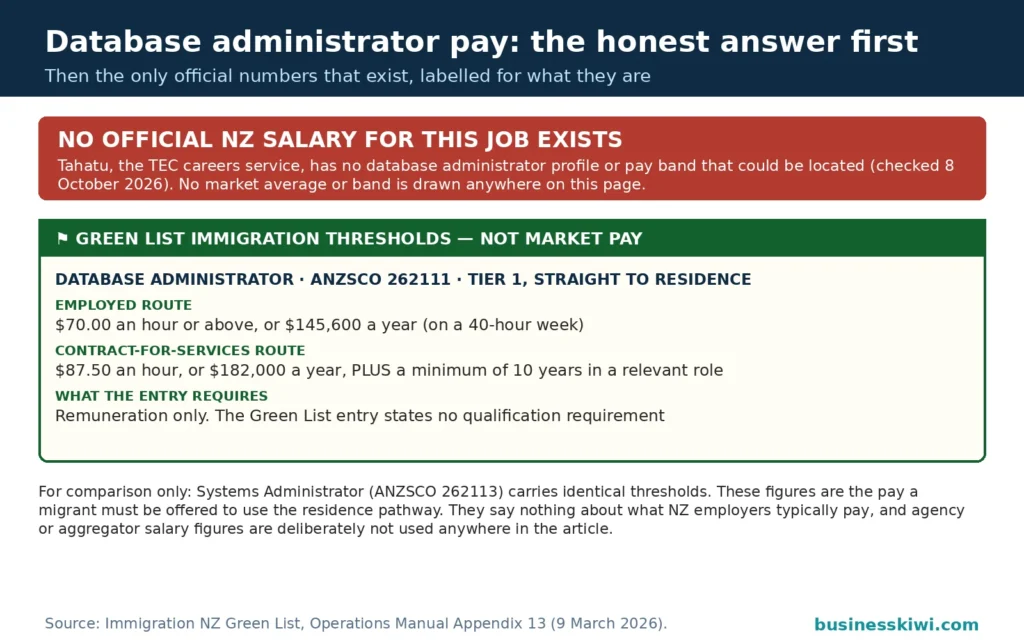
There is no official New Zealand pay figure for database administrators that holds up to scrutiny. Tahatū Career Navigator, the Tertiary Education Commission’s official careers site, builds its pay bands from Statistics New Zealand census data, the Integrated Data Infrastructure and Inland Revenue data, and it publishes bands for more than 800 career ideas. When this article was researched on 8 October 2026, we could not locate a database administrator profile or pay band on Tahatū despite extensive searching of the site, so this article does not quote one. Inventing a figure, or borrowing one from a recruitment agency, would not help you make a good decision.
What official sources do establish is still useful. The occupation sits at Skill Level 1 in ANZSCO, the classification Stats NZ and the Australian Bureau of Statistics maintain, which is the highest skill band and normally means a bachelor degree or higher. Database administrator is also a Tier 1 occupation on Immigration New Zealand’s Green List, the list of roles New Zealand wants to attract from overseas. For a job to count under that residence pathway, Immigration New Zealand requires it to pay at least $70.00 an hour, or the equivalent annual salary of $145,600 based on a 40-hour week. That threshold is an immigration setting, not a market average, and we explain the difference in detail below. Treat it as evidence that senior, well-paid DBA roles exist in New Zealand, not as a promise of what you would earn.
What a database administrator does
A database administrator looks after the systems that store an organisation’s information and make sure the right people can get at that information quickly, while everyone else is kept out. ANZSCO places the role in Minor Group 262, alongside systems administrators and ICT security specialists, and describes the group as planning, developing, maintaining and administering database management systems, operating systems and security policies so that data stays accurate, secure and available.
The day-to-day work is practical and varied. Drawing on the task list ANZSCO publishes for this group, a DBA’s work typically covers:
- Designing and maintaining database architecture, data structures, tables, dictionaries and naming conventions, so the underlying data stays accurate and complete.
- Setting up and running backups and recovery procedures, and testing them, because a backup that has never been restored is a hope rather than a plan.
- Enforcing security and integrity controls, including who can see, change or delete data, and keeping an audit trail of access.
- Testing database systems and upgrades, tracking down faults and resolving them before changes reach production.
- Owning the processes and planning for system security and disaster recovery, so the organisation knows how it would get its data back after a serious failure.
- Monitoring performance and adjusting the database when queries slow down or storage grows faster than expected.
- Preparing and maintaining documentation, policies, procedures and system logs, so knowledge does not live in one person’s head.
- Troubleshooting server and database faults and working with vendors, service providers and internal teams to fix them.
In a small organisation the DBA might be a team of one, looking after a handful of databases alongside other IT duties. In a bank, a hospital network or a large government agency, DBAs work in specialist teams responsible for estates of hundreds or thousands of databases, often across both on-premises servers and cloud platforms. The common thread is responsibility. When the database stops, the organisation usually stops with it, which is why experienced DBAs are trusted, senior people rather than back-room technicians.

Database administrator pay in NZ
Why there is no official salary figure
Most salary content for this job title comes from recruitment agencies, job boards and salary aggregator websites. Those sources were deliberately not used for this article. Their figures are built from job advertisements and self-reported surveys, their methodologies differ, and their numbers for this occupation vary so widely that quoting any one of them as fact would be misleading. BusinessKiwi’s rule is simple: if a figure cannot be traced to an official source, it does not go in the article.
The official statistical system does not fill the gap. Stats NZ collects earnings data by broad industry and occupation groupings, and Tahatū turns census, IDI and Inland Revenue data into pay bands for individual career ideas. Tahatū itself is clear that its pay information is a guide and an estimate, and that it should not be used to set pay rates or in visa applications. For database administrators, as noted above, we could not find a Tahatū profile or pay band to quote when the site was checked on 8 October 2026. The honest position is that no official body publishes a standalone New Zealand salary for this exact occupation.
The one official pay figure attached to the role
There is one set of official numbers tied directly to this occupation, and it comes from immigration policy rather than pay statistics. Immigration New Zealand’s Green List, Appendix 13 of its Operations Manual, lists Database Administrator (ANZSCO code 262111) as a Tier 1 occupation in the ICT, Electronics and Telecommunications group. Tier 1 is the Straight to Residence tier. For employment in the role to meet the Green List requirements, remuneration must be $70.00 per hour or above, or the equivalent annual salary, which Immigration New Zealand states as $145,600 per annum based on a 40-hour week.
Where the offer is based on a contract for services, the bar is set higher still: remuneration must be $87.50 per hour or above, or the equivalent annual salary of $182,000 based on a 40-hour week, and the applicant must also have a minimum of 10 years of work in a relevant role. Notably, the Green List entry for database administrators sets a remuneration requirement only. Unlike some other Tier 1 occupations, it does not list a specific qualification the applicant must hold.
Read those numbers for what they are. They tell you the level of pay Immigration New Zealand expects a genuine, senior DBA role to command before it will grant residence on the strength of the job. They do not tell you what the average DBA in New Zealand earns, and plenty of legitimate DBA jobs, particularly junior and mid-level ones, will pay less than the threshold without being poor jobs. What the threshold does confirm is that the top of this occupation is well paid, and that the government regards the skills as scarce enough to fast-track.
What moves DBA pay
Without an official series, the most useful thing we can give you is the structure of the pay market: the factors that consistently separate lower-paid DBA roles from higher-paid ones. None of the following comes with a dollar figure attached, because no official source publishes one, but each factor is real and worth weighing if you are planning a path into the work.
Experience is the biggest single factor. A junior DBA running routine maintenance under supervision is doing a different job from a senior DBA who designs the architecture, leads incident response and answers for recovery when things go wrong. Pay follows that responsibility.
Depth on a major platform matters. Most New Zealand organisations run on a small set of database platforms, principally Microsoft SQL Server, Oracle, PostgreSQL and MySQL. Genuine depth on one platform, including performance tuning, high availability and upgrade work, is worth more than surface familiarity with several.
Cloud skills are increasingly part of the brief. As estates move into services such as Microsoft Azure and Amazon Web Services, DBAs who can run databases in the cloud, migrate them from on-premises servers and manage cloud costs are in a stronger position than those whose experience is purely on-premises.
Responsibility for availability pushes pay up. Roles that carry on-call duties, after-hours incident response and formal recovery targets carry more weight, and usually more pay, than roles confined to business-hours maintenance. Sector and scale matter too. Banks, insurers, health services and large public agencies run databases where downtime is measured in real money or real risk, and they structure DBA pay accordingly. Finally, contracting sits apart from salaried employment. Immigration New Zealand’s own settings, with a higher hourly threshold for contract arrangements than for employment, reflect the fact that senior specialists are often engaged on contract at rates above salaried equivalents.
Job outlook and demand
The clearest official demand signal for this occupation is its Green List placement. Tier 1 roles are the ones Immigration New Zealand has identified as being in shortage and needed in New Zealand, with a direct residence pathway for people who meet the requirements. Database administrator sits in that tier alongside software engineers, ICT security specialists and systems administrators. Governments do not put occupations on that list casually; placement reflects sustained employer difficulty in filling the roles locally.
Beyond that signal, be careful with anyone who quotes you a precise number of DBAs working in New Zealand or a forecast growth rate for the occupation. No figure like that could be verified in the official sources read for this article, so none is quoted here. The structural drivers are easy enough to describe, though. Every large organisation now runs on databases, the volume of data keeps growing, more of it is moving to cloud platforms, and privacy and security expectations keep tightening. Each of those trends lands on the DBA’s desk. The counterweight is automation: cloud database services automate some routine maintenance that DBAs once did by hand, which is one reason the role keeps shifting towards design, performance, security and recovery rather than repetitive administration.
Entry requirements and qualifications
ANZSCO classifies this occupation group at Skill Level 1. In New Zealand terms that means most roles call for skill commensurate with a bachelor degree or higher qualification. The classification also recognises that formal qualifications are not the only route: at least five years of relevant experience, or relevant vendor certification, may substitute for the formal qualification. In some cases, experience or on-the-job training is expected on top of the qualification as well.
In practice, the common pathways look like this. Many DBAs come through a degree in computer science, information systems, software engineering or a related field, picking up database papers along the way. Others start lower down the IT ladder and specialise. Entry-level IT qualifications, such as the New Zealand Diploma in Information Technology Technical Support (Level 5), which polytechnics deliver and which includes database content among its topics, can lead into service desk and systems support roles. From there, people build database experience on the job, take on SQL and platform skills, and move into junior DBA work before stepping up. A third group arrives sideways, from software development, systems administration or data analysis, bringing deep SQL or infrastructure skills with them.
Two things are worth noting about the Green List entry if you are reading this from overseas. First, as covered above, the entry for this occupation sets a pay threshold rather than a named qualification. Second, overseas qualifications generally need to be comparable to the New Zealand standard, and Immigration New Zealand’s notes to the Green List explain that an International Qualification Assessment from the New Zealand Qualifications Authority is required for overseas qualifications unless the qualification is on the list of qualifications exempt from assessment.

Skills and certifications
The technical core of the job is SQL, the language used to query and manage relational databases. Around that core sits a cluster of skills that map closely to the ANZSCO task list: backup and recovery design, performance tuning and query optimisation, database security and access management, high availability and replication, capacity planning, and scripting to automate routine work. Just as important, and often underrated by people entering the field, are the habits around the technology: careful documentation, methodical change control, clear communication during incidents, and the discipline to test restores and rehearse recovery rather than assume they will work.
On certifications, ANZSCO itself gives the occupation an official anchor: relevant vendor certification may substitute for a formal qualification at Skill Level 1. In practice that means the major platform vendors’ database certifications carry real weight with employers. Microsoft certifies database administrators on its Azure platform, Oracle certifies on its database products, and Amazon Web Services offers a database specialty certification for its cloud platform. Which one is worth your time depends on the platform you intend to work on, and employers generally value a certification most when it is backed by hands-on experience on the same platform. A certificate without practical hours behind it rarely opens the senior doors on its own.
Career path and related roles
Database administration has a fairly clear ladder. People typically enter as a junior DBA or in a support role with database responsibilities, progress to a fully fledged DBA role running production systems, and then to senior DBA, where the work tilts towards architecture, mentoring and the hardest problems. From there, paths branch: lead or principal DBA roles, database architecture, team leadership and IT management, or a move into adjacent specialisations.
The boundaries with neighbouring roles are worth understanding, because job titles blur in advertisements. A database developer focuses on building: writing the stored procedures, schemas and application code that use the database. A DBA focuses on operating: keeping the platform secure, available and fast, whoever wrote the code. A data engineer builds the pipelines that move and transform data between systems, often into warehouses and lakes; a DBA’s home ground is the operational database itself. A systems administrator, the DBA’s closest cousin in ANZSCO unit group 2621 and also a Tier 1 Green List occupation with the same remuneration thresholds, looks after the servers, operating systems and networks the databases run on. In small organisations one person may wear all of these hats. In large ones the roles are distinct, and knowing which one you actually want helps you aim your training properly.
How to get started
Start with SQL. It is the foundation everything else sits on, it is free to practise, and you can install a database platform such as PostgreSQL or the free editions of SQL Server on your own computer and learn by building. Create databases, break them, back them up, restore them. That habit of experimenting safely is exactly the mindset the job rewards.
Next, get a recognised qualification underway if you do not already have one, whether that is a degree or a diploma-level IT qualification as a first step. While you study, aim for any IT role that puts you near production systems: service desk, application support, systems support. Employers hiring junior DBAs look for people who have already been trusted around live systems and who can show they understand change control and documentation.
Then specialise. Pick the platform your target employers use most, go deep on it, and consider the relevant vendor certification once you have practical experience to back it up. When you apply for roles, present evidence of the real work: the lab you built, the restore you tested, the tuning problem you solved. In a field where trust is the product, demonstrated care with data counts for a great deal.
Frequently asked questions
How much does a database administrator earn in New Zealand?
No official New Zealand salary figure exists for this exact occupation. Tahatū, the official careers site, publishes pay bands for many occupations but we could not locate one for database administrators when the site was checked on 8 October 2026, and this article does not use recruitment agency or aggregator figures. The only official pay numbers attached to the role are Immigration New Zealand’s Green List thresholds, covered in the next answer, and they are immigration settings rather than market pay.
Is database administrator on the Green List?
Yes. Database Administrator (ANZSCO 262111) is a Tier 1, Straight to Residence occupation on Immigration New Zealand’s Green List. Employment in the role must pay at least $70.00 per hour, or the equivalent annual salary of $145,600 based on a 40-hour week, to meet the Green List requirements. Contract-for-services arrangements face a higher threshold of $87.50 per hour, or $182,000 a year, plus a requirement for at least 10 years of work in a relevant role.
What qualifications do I need to become a DBA?
The occupation is classified at ANZSCO Skill Level 1, which means skill commensurate with a bachelor degree or higher. Most working DBAs hold a degree in computer science, information systems or a related field, but the classification is not degree-only: at least five years of relevant experience, or relevant vendor certification, may substitute for the formal qualification.
Can I become a database administrator without a degree?
Yes, it happens regularly, and the official classification allows for it. The usual route is to enter IT through support or systems roles, build database responsibilities and SQL depth on the job, and add a vendor certification on your main platform. Expect the climb to take longer and to depend heavily on the experience you can demonstrate.
Do database administrators have to work on call?
Many do, because production databases need cover outside business hours and the DBA is the person who answers when one fails at 2am. Whether a specific role carries on-call duties, and how it is rostered and compensated, varies by employer and should be spelled out in the employment agreement. Roles carrying those responsibilities generally sit higher in the pay structure.
What is the difference between a DBA and a data engineer?
A DBA operates and protects production databases: security, backups, availability, performance. A data engineer builds the pipelines that move and transform data between systems, often feeding warehouses and analytics platforms. The roles overlap around SQL and data modelling, and people do move between them, but the centre of gravity is different: reliability on one side, data flow on the other.
Are database administrators in demand in New Zealand?
The strongest official signal is the Green List: database administrator is a Tier 1 occupation, which means Immigration New Zealand treats it as a role in shortage with a direct residence pathway for those who meet the pay threshold. No official headcount or growth forecast for the occupation could be verified for this article, so treat any precise statistic you see elsewhere with caution.
This article is general information about an occupation and New Zealand immigration settings as published by official sources in October 2026. It is not career, financial or immigration advice, and pay thresholds and Green List requirements change over time. Check Immigration New Zealand for current visa criteria before making decisions.
Sources
- Tertiary Education Commission, Our data, tahatu.govt.nz
- Immigration New Zealand, Appendix 13: Green List (09/03/2026), immigration.govt.nz
- Australian Bureau of Statistics and Statistics New Zealand, ANZSCO: Minor Group 262, Database and Systems Administrators, and ICT Security Specialists, abs.gov.au