Date Stamps NZ: Types, Sizes, Prices & Band Years
The short answer
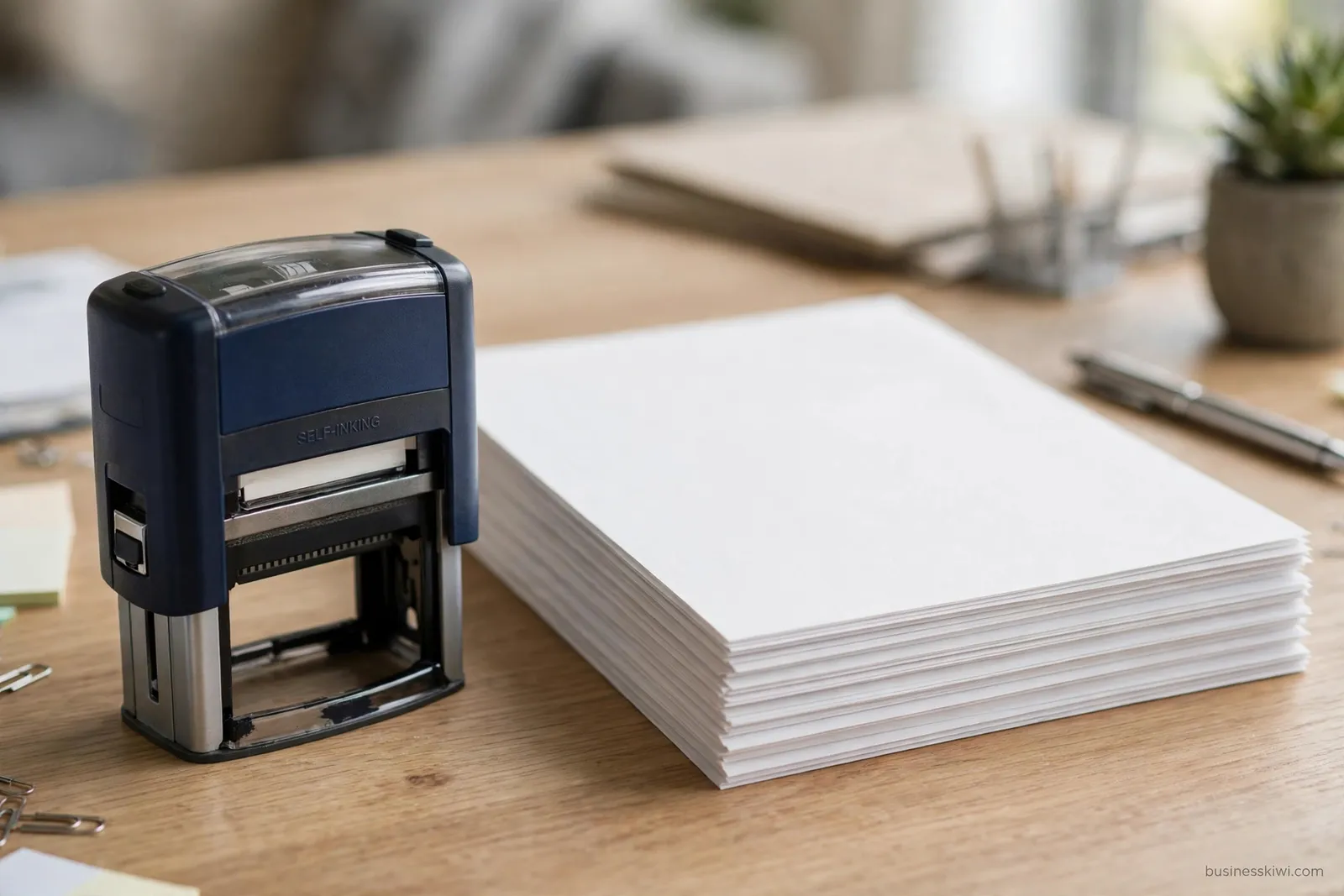
A date stamp prints the current date from adjustable rubber bands, so the date it marks is always the day you use it. Most date stamps sold in New Zealand are self inking models from Trodat and Colop, and they come in three broad forms: date only, date with a stock phrase such as RECEIVED or PAID, and date with your own custom text around it. At Stamps and More, a specialist NZ stamp retailer, Trodat date only models are listed from $42.53 and date and text models from $79.88 to $139.51, checked in October 2026. Colop publishes a 12 year span on the year band of its small daters, and the ink pads are replaceable, so the band years and the pad are the two things that decide how long a dater stays useful.
What a date stamp is and the main types
Every date stamp works the same way at its core. A set of endless rubber bands carries the days, months and years, and small wheels turn each band until the right date lines up. Press the stamp down and the bands print the date. What changes between models is everything around that mechanism: whether the stamp inks itself, how much text sits beside the date, and how heavily the body is built.
Date only stamps print nothing but the date. They are the smallest and cheapest daters. Trodat’s 4810 prints a 3.8mm date and is the entry point in the Stamps and More range at $42.53, and Colop’s Mini Dater S 120 prints a 4mm date in a 4 x 22mm imprint, which Colop describes as its smallest self inking date stamp. These suit reception desks, mailrooms and anyone who dates documents all day.
Phrase daters add a stock word beside the date. Colop’s Mini Dater S 160/L prints the date with one of four built in texts: Received, Paid, Faxed or E-m@iled. Its word band models go further: the S 120/WD and the metal framed Classic 2000/WD each carry 12 adjustable phrases or words alongside the date, so one stamp covers most of the marks an office makes on paper.
Date and text daters put your own wording around a central date. The text plate is made to order with your business name, a phrase such as PAID BY or RECEIVED, or a name and phone number. Trodat’s 4813 combines a 3.8mm date with a 26 x 9mm text plate, and its 4750 fits text around the date in a 41 x 24mm plate. Colop’s equivalents include the S 260 at 24 x 45mm with up to three lines of custom text, and its Classic 2360 and 2660, which add metal frames for heavier use. Round versions exist too, with the date in the centre of a circular imprint.
Double daters print two adjustable dates side by side. Colop’s S 120/DD and S 160/DD are built for marking a start date and an end date in one press, which Colop points to for periods and promotions.
Time and date stamps add a clock dial. Colop’s Classic R 2045 UZ is a heavy duty self inking stamp with a 12 hour time dial and an adjustable date in a 40mm round imprint, made for recording the time as well as the day on documents.
Traditional hand daters are the older form: a die plate and bands on a handle, used with a separate ink pad. Stamps and More describes traditional handheld stamps as a wooden mount, handle and text plate that need their own pad, and rates the pad at 500 to 1,000 impressions before it needs re-inking. They ask for a slower, two handed rhythm, but the separate pad lets you swap ink colours freely and the format suits large or detailed work.
Pre-inked daters store ink inside a porous die instead of a pad. Stamps and More rates pre-inked stamps at about 500 impressions before refilling, with excellent impression quality and no pad at all. In practice, the NZ date stamp ranges checked for this guide are self inking models, and the pre-inked mechanism is far more common in text stamps, which are covered in our self inking stamps guide.
Date formats and how the bands work
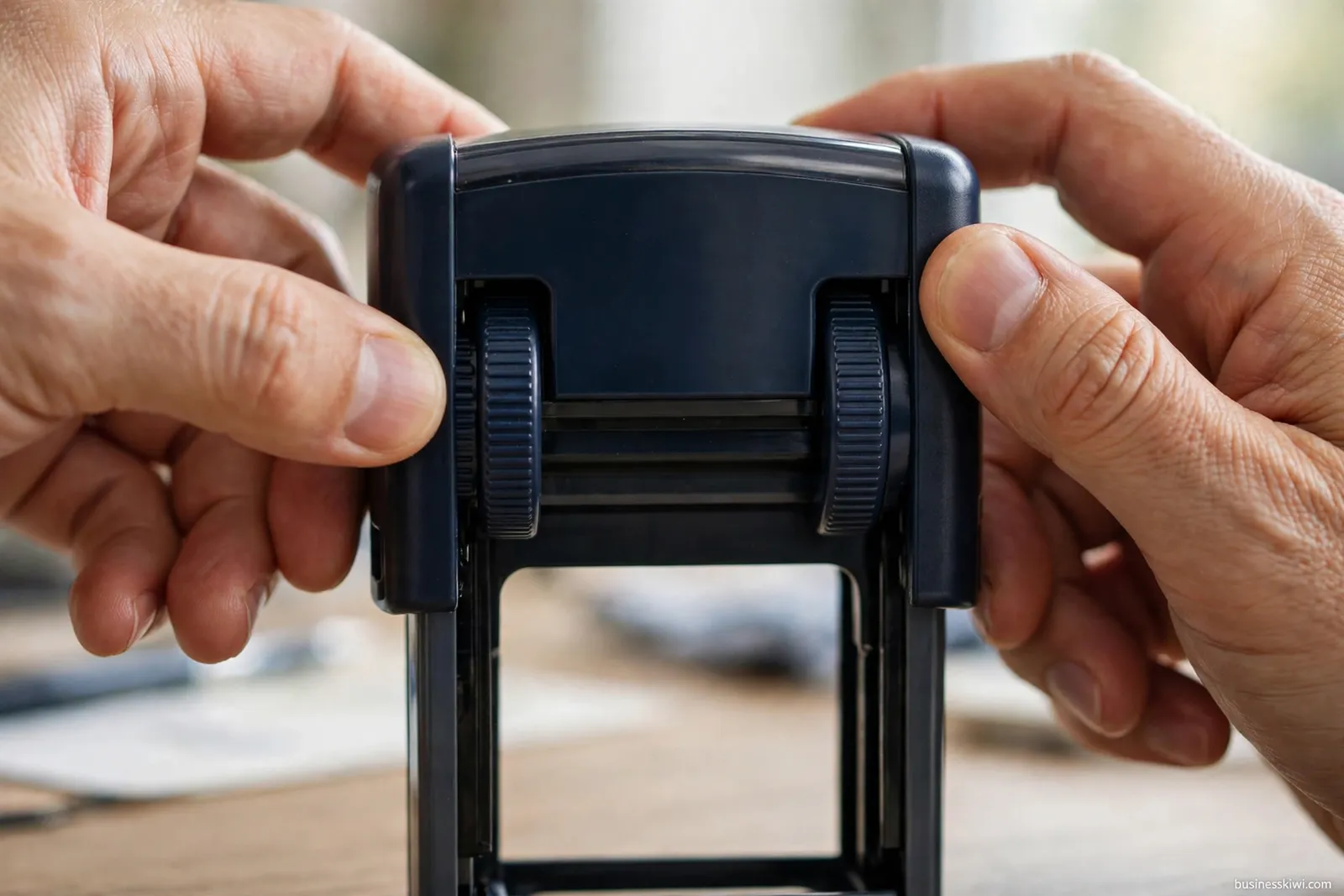
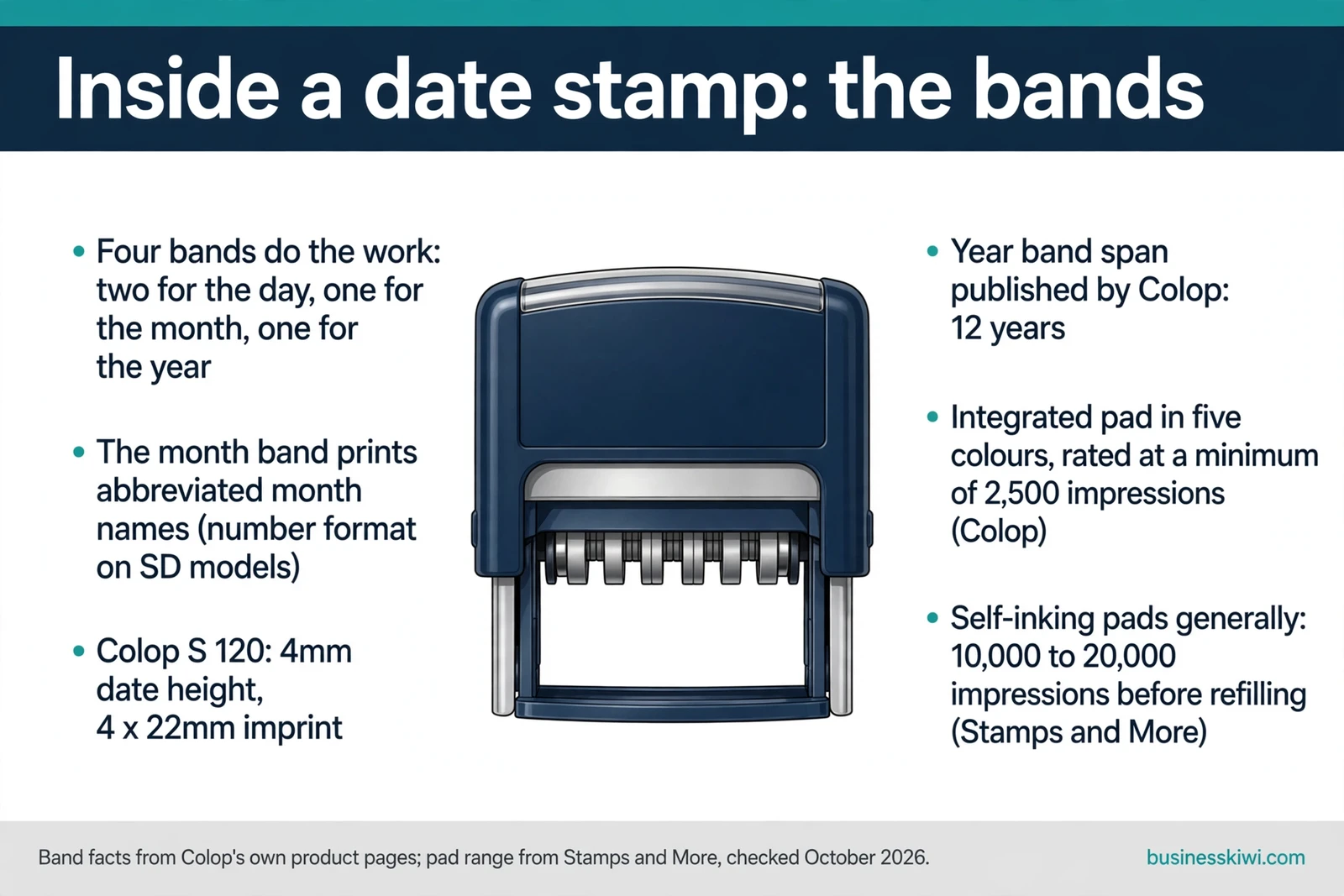
Colop’s S 120 page gives the clearest maker description of what is inside a dater. The stamp has two bands for the day, one band for the abbreviated month names, and one band for the year, and you turn white wheels at the side to move each band. That layout produces the standard New Zealand format, day, month in letters, then year, so a stamp set for 21 October 2026 prints as 21 OCT 2026.
Not every model prints the month in letters. Colop’s S 120 SD is a short format dater where the month is a number, so November prints as 11. Stamps and More describes the Trodat 4850 as producing a date in DD.MM.YYYY form. Neither format is better in itself. Months in letters cannot be misread, which helps on invoices and legal paperwork, while the all number format is shorter and fits small imprints and batch coding.
Phrase bands work the same way. On a word dater the extra band carries words instead of numbers, and you roll it to RECEIVED, PAID or whichever mark the document needs, then set the date bands as normal. On a date and text dater the text is fixed on a plate made for you, and only the date moves.
Two practical points follow from the band design. First, the day bands run 0 to 9 and the date is set digit by digit, so changing the date each morning takes seconds. Second, the year band holds a fixed run of years. When the current year rolls past the last year on that band, the stamp can no longer show the right year, and that is the real end of a dater’s working life.
Sizes: date heights and imprint areas
Date stamps are sized two ways, and both matter. The date height is the size of the printed characters. The imprint area is the whole rectangle or circle the stamp prints, including any text around the date.
Date heights in the ranges checked run from 3mm to 4mm. Trodat’s 4800, 4724 and 4729 print a 3mm date. Its 4810, 4850 and 4813 print 3.8mm. Its 4750 and 4727, and most of Colop’s daters including the Mini and Classic lines, print 4mm. Colop’s S 160/DD double dater is the exception at 3.5mm. A 4mm date is the easier read at arm’s length; 3mm suits small documents and keeps a big text plate compact.
Imprint areas start at 4 x 22mm for a date only Colop S 120. Date and text models grow from the 4813’s combined plate up through 41 x 24mm (Trodat 4750), 40 x 40mm (Trodat 4724), 50 x 30mm (Trodat 4729) and 60 x 40mm (Trodat 4727), with round plates at 45mm across on the Trodat 46145 and Colop’s Classic R 2045. As a rule, buy the plate size for the text you actually need. Every extra line of text costs money and desk space, and a small date only stamp is faster to use hundreds of times a day.
What NZ businesses use date stamps for
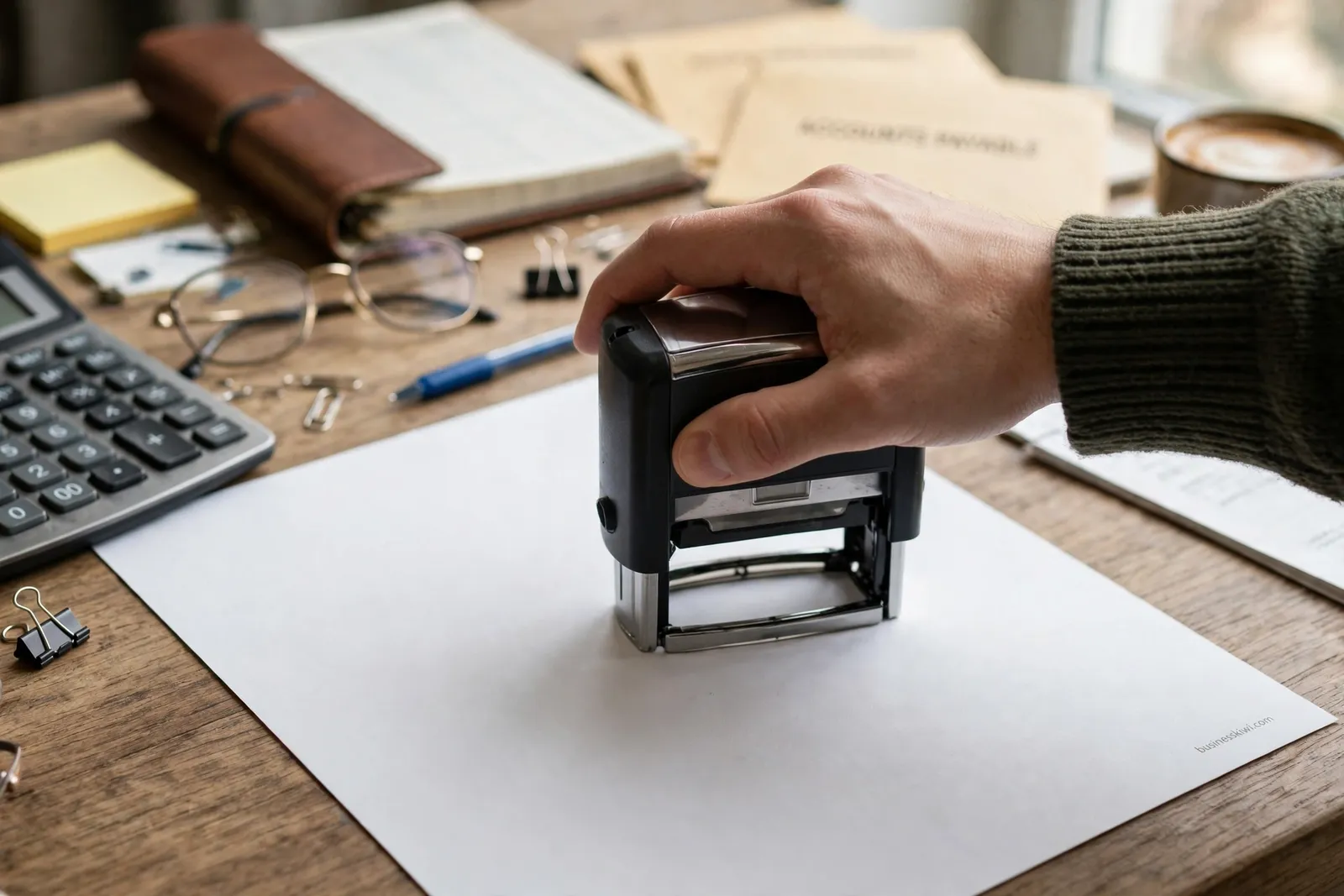
The oldest job is the accounts desk. An invoice arrives, gets stamped RECEIVED with the day’s date, is paid, and later gets stamped PAID with the date of payment. Trodat’s own examples for the custom text on its 4813 are “Received”, “Paid” and “Expires”, and Stamps and More says the 4750’s surrounding text can be a “Paid by, Received or anything else” wording of your choice. Colop builds the same convention into hardware with the S 160/L’s stock texts. That stamped pair of dates is the paper trail that shows when a document entered the business and when it was settled.
Stamps and More lists the Trodat 4850’s applications as document control and organisation, invoice and receipt processing, inventory management, quality control and general office use. That list maps closely to where daters actually sit in NZ workplaces: the mailroom dating incoming documents, the warehouse dating goods inwards paperwork, and quality control staff dating inspection records as items pass.
Food and packaging work is the other big use. A BEST BEFORE stamp puts a fixed phrase and an adjustable date on packaging, so the date can roll forward each production run. The catch is the surface. Standard endorsing ink is water based and made for paper, and Stamps and More notes that quick drying solvent inks are what plastic, wax coated and greaseproof surfaces need. Self-Inking Stamps Limited, another NZ stamp maker, sells a best before date stamp package for plastic and gloss surfaces built around exactly that problem: a 20 x 11mm imprint with BEST BEFORE above a 3.8mm adjustable date, a dry pad, and a bottle of alcohol based Noris 007 ink with a refresher to keep it fluid, listed at $94.40.
There is also a record keeping reason to date documents consistently. Inland Revenue requires businesses to keep records of all cash and electronic sales and purchases for 7 years, and its list of tax records includes invoices and receipts. A clear received or paid date on the paper copy makes that archive far easier to search and reconcile years later. The stamp does not replace good filing, but it makes every page carry its own date.
Date stamp prices in NZ
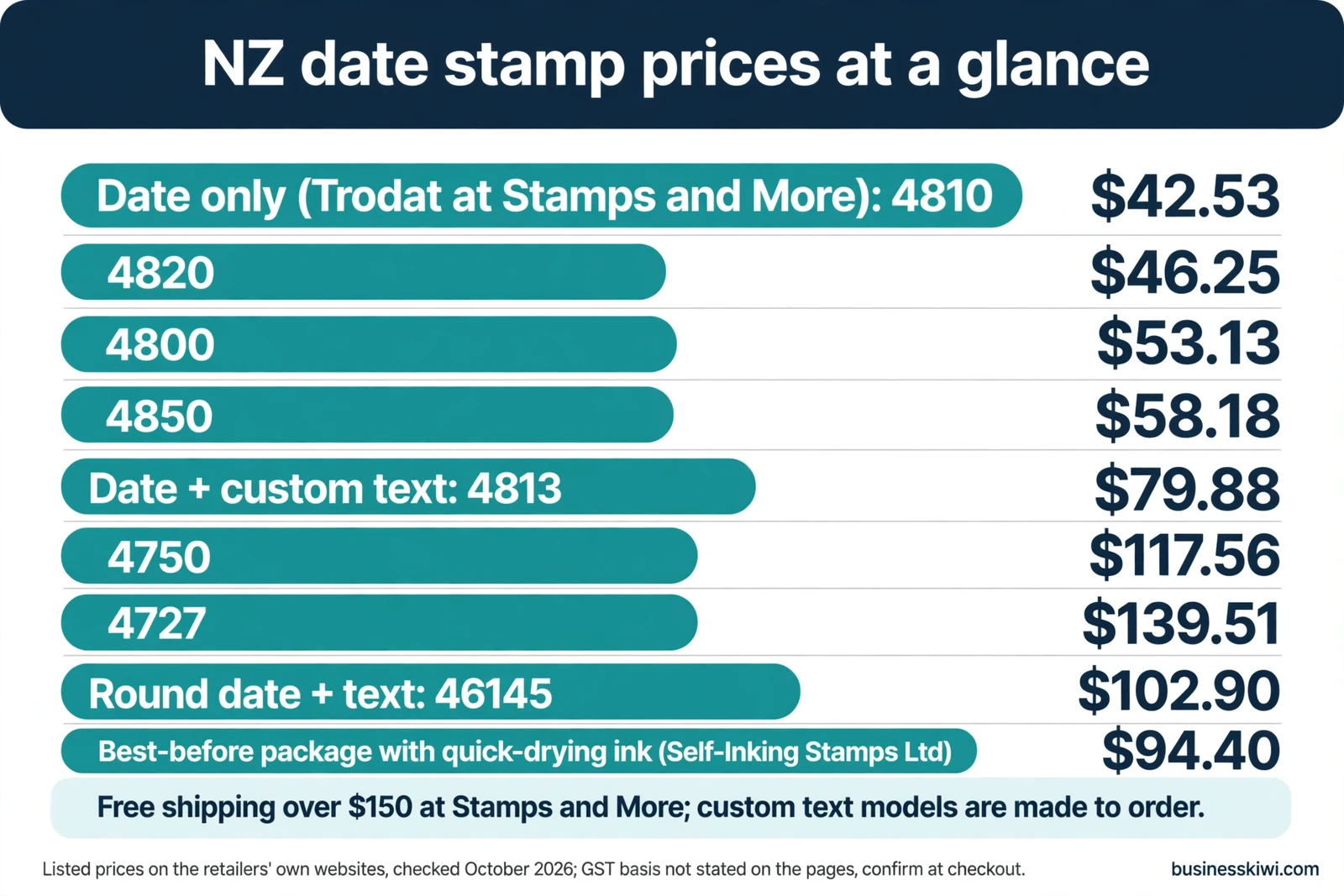
Prices below are the listed NZD prices on Stamps and More’s own date stamps range, checked in October 2026. The retailer’s pages do not state a GST basis for these prices, so confirm the final total at checkout. Date heights are shown where the retailer publishes them.
| Model (all Trodat, at Stamps and More) | Type | Date height | Listed price |
|---|---|---|---|
| 4810 | Date only | 3.8mm | $42.53 |
| 4820 | Date only | Not stated | $46.25 |
| 4800 | Date only | 3mm | $53.13 |
| 4850 | Date only | 3.8mm | $58.18 |
| 4813 | Date + custom text line | 3.8mm | $79.88 |
| 46145 | Date + text, 45mm round | Not stated | $102.90 |
| 4724 | Date + text, 40 x 40mm | 3mm | $114.35 |
| 4750 | Date + text, 41 x 24mm | 4mm | $117.56 |
| 4729 | Date + text, 50 x 30mm | 3mm | $139.00 |
| 4727 | Date + text, 60 x 40mm | 4mm | $139.51 |
The pattern is simple. Date only models sit between about $43 and $58. Adding a custom text plate roughly doubles the price, and the biggest plates top the range. The specialist best before package at Self-Inking Stamps Limited is $94.40, but that price includes the quick drying ink and refresher a gloss surface job needs, which a standard dater price does not. Stamps and More offers free shipping on orders over $150 and does not charge extra for rural delivery, and custom text models are made to order, so factor in making time on top of delivery.
Ink pads, refills and ink types
A self inking dater’s pad is a wearing part, and it is replaced, not topped up forever. Pads are model specific: the Trodat 4810 takes the 6/4910 replacement pad, sold in black, blue, green, red and violet, plus a dry version you ink yourself. Colop’s S 120 has an integrated pad in five colours that the maker rates at a minimum of 2,500 impressions. Across self inking stamps generally, Stamps and More rates pads at 10,000 to 20,000 impressions before refilling. Pad changes on modern daters are designed to keep ink off your fingers; the 4810’s cartridge swaps without touching the ink reservoir.
Two colour pads exist for phrase daters, printing the text in one colour and the date in another, which is why RECEIVED so often appears in blue over a red date. If your dater takes a two colour pad, order the two colour replacement, not the single colour version.
Ink choice matters more than pad choice. For everyday paper, endorsing ink is the standard water based ink. For plastic, wax coated, greaseproof or gloss surfaces, you need a quick drying solvent ink such as the Noris range Stamps and More stocks, or the alcohol based Noris 007 supplied with the best before package. Solvent inks need more care: Self-Inking Stamps Limited advises removing the pad, capping it and storing it airtight if the stamp will sit unused for more than two days, and using the refresher to restore dried solvent before adding more ink, because re-inking alone leaves sticky residues building up in the pad.
If the wording on a date and text stamp changes, you do not need a whole new stamp. Stamps and More sells a replacement rubber die on its own, so a changed phone number or business name can be fixed by swapping the die in the existing body.
How long a date stamp lasts
Three different clocks run on a dater. The year band is the hard limit: Colop publishes a 12 year span for the year band on its S 120 and S 120 SD, and once the band’s last year passes, the stamp cannot print the current year. The Trodat listings checked for this guide do not state a band span, so if band life matters to you, ask the retailer which years the band carries before you buy, because a band that starts part way through its run gives you fewer useful years.
The pad is the second clock, and it is resettable: swap in the model specific replacement pad and the stamp prints like new. The third clock is the die and mechanism. Neither maker publishes a rated life for the stamp body on the pages checked, but the wearing parts are the pad and the rubber die, and both are replaceable, so a looked after dater normally ends its life at the year band, not in the bin. Solvent ink models are the exception to “looked after”: leave a quick drying pad open to the air and it can dry out well before the band runs out.
Related guides: our self inking stamps guide covers custom text and logo stamps, our personalised pens guide covers branded pens for the same desk, and our online printing guide covers printed stationery. More business guides are in the Business and Industry section.
Frequently asked questions
What is the difference between a date stamp and a self inking stamp?
A date stamp is defined by what it prints: an adjustable date set on bands. Self inking describes how a stamp inks itself from a built in pad. Most modern date stamps are self inking, but traditional hand daters print the same adjustable date using a separate ink pad instead.
How many years does the year band cover?
It depends on the maker and model. Colop publishes a 12 year year band on its Mini Dater S 120 and S 120 SD. The Trodat product listings checked in NZ do not state a band span, so check the years printed on the band when you buy, because the band cannot be extended once its last year passes.
Can I get a date stamp that says RECEIVED or PAID?
Yes, two ways. Stock phrase daters such as Colop’s S 160/L carry Received, Paid, Faxed and E-m@iled beside the date, and word band models carry 12 phrases. Or order a date and text model, such as the Trodat 4750 or 4813, with RECEIVED or PAID made into the text plate around the date.
What date format do date stamps print in New Zealand?
Day, month and year, in NZ order. Colop’s standard format prints the month as an abbreviated word, as in 21 OCT 2026, and its SD models print the month as a number. Stamps and More describes the Trodat 4850’s output as DD.MM.YYYY. Check the format on the product page before ordering if the style matters for your records.
How much does a date stamp cost in NZ?
At Stamps and More, Trodat date only models are listed from $42.53 for the 4810 to $58.18 for the 4850, and date and text models from $79.88 for the 4813 up to $139.51 for the largest 4727. A specialist best before package with quick drying ink is listed at $94.40 by Self-Inking Stamps Limited. Prices checked October 2026.
Do I need special ink for stamping plastic or packaging?
Usually, yes. Standard endorsing ink is water based and made for paper; it dries slowly and smears on plastic, gloss, wax coated and greaseproof surfaces. Quick drying solvent inks, such as the Noris range, are made for those surfaces, and food packaging best before stamps are sold with them. Solvent pads also need airtight storage between uses.
Can I replace the pad or the wording instead of buying a new stamp?
Yes to both. Replacement pads are sold by model number, such as the 6/4910 pad for the Trodat 4810, and slot in without touching the ink. If your business name or phone number changes, Stamps and More sells the rubber die on its own, so the text plate can be replaced in the body you already own.
The bottom line
For most NZ offices the choice is simple: a date only self inking dater if you just date paper, a phrase or date and text model if RECEIVED and PAID marks are part of your accounts routine, and a quick drying ink setup if the stamp has to mark packaging. Check three things before you order: the date height, because 4mm reads more easily than 3mm; the year band span, because it sets the stamp’s working life; and the replacement pad code, because you will need it long before you need a new stamp.
Sources
- Colop, Mini Line & S 200 range (Mini Dater S 120, S 120 SD, S 120/WD, S 120/DD, S 160/L, S 160, S 260 and S 220 daters, sizes, date heights and 12 year bands): https://www.colop.com/en_eur/traditional-stamps/printer-line/mini-line-s200
- Colop, Mini Dater S 120 product page (band layout, day/month/year format, pad life of a minimum 2,500 impressions): https://www.colop.com/en_eur/traditional-stamps/printer-line/mini-line-s200/mini-dater-s-120
- Colop, Classic Line range (Classic 2360 and 2660 daters, R 2045 Dater, R 2045 UZ time and date stamp, 2000/WD word dater): https://www.colop.com/en_eur/traditional-stamps/heavy-duty/classic-line
- Stamps and More, Date Stamps range (Trodat 4810, 4820, 4800, 4850, 4813, 46145, 4724, 4750, 4729 and 4727 listed prices): https://www.stampsandmore.co.nz/collections/date-stamps
- Stamps and More, Trodat 4810 product page (3.8mm date, 6/4910 replacement pad, stamp type comparison, ink types): https://www.stampsandmore.co.nz/collections/date-stamps/products/todat-4810-date-stamp
- Stamps and More, Trodat 4850 product page (DD.MM.YYYY format, applications list): https://www.stampsandmore.co.nz/collections/date-stamps/products/trodat-4850-self-inking-date-stamp-25x5mm
- Stamps and More, Trodat 4750 product page (41 x 24mm text plate, 4mm date, custom text around the date): https://www.stampsandmore.co.nz/collections/date-stamps/products/sct4750-self-inking-4mm-date-stamp-41x24mm
- Stamps and More, Trodat 4813 product page (3.8mm date plus 26 x 9mm text plate, Received/Paid/Expires examples): https://www.stampsandmore.co.nz/collections/date-stamps/products/trodat-4813-self-inking-date-stamp
- Self-Inking Stamps Limited, Best Before Date Stamp for plastic and gloss surfaces (Noris 007 ink and refresher, 20 x 11mm imprint, 6/4850D dry pad, listed price $94.40): https://www.selfinkingstamps.co.nz/product/best-before-stamp-for-plastic-and-gloss-surfaces/
- Inland Revenue, Records of income and expenses (business records, including invoices and receipts, kept for 7 years): https://www.ird.govt.nz/managing-my-tax/record-keeping/records-of-income-and-expenses
This article is general information about date stamps and how they are sold in New Zealand. Prices, models and ink ranges change, so check the current price, date format and year band years for the model you choose before you order.