400W Solar Panels in New Zealand: Specs, Sizes, Real Output and Prices
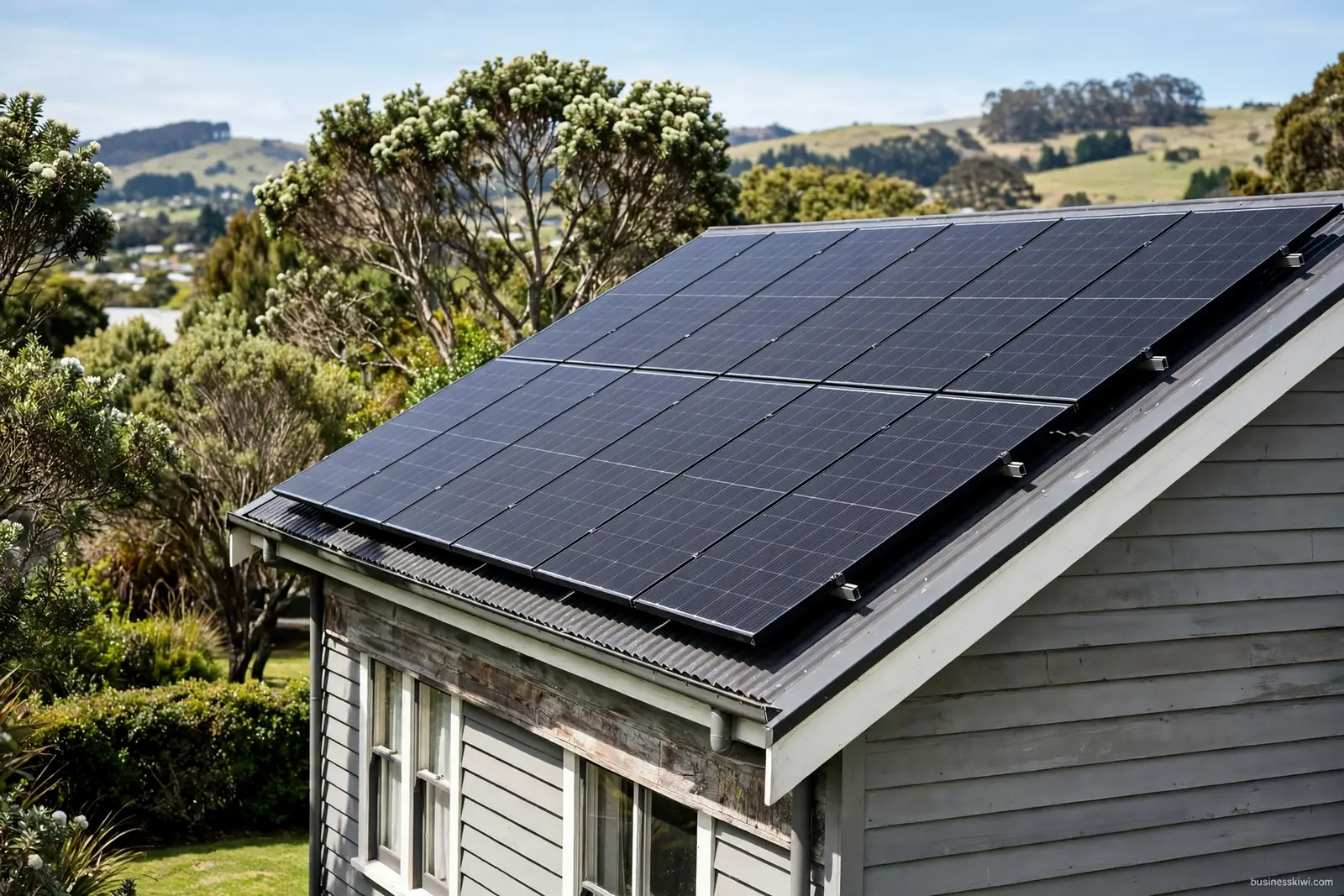
A 400 watt solar panel is a mid sized rooftop panel. The 400W figure is a laboratory rating, not a promise of what the panel delivers on your roof. On a clear summer afternoon a good 400W panel usually produces around 300 to 350 watts. Output drops further in winter, under cloud and on a hot still day.
The panels themselves are consistent in size. The three manufacturer datasheets checked for this guide describe panels about 1.72 to 1.75 metres long, about 1.1 metres wide and 19.5 to 21 kilograms in weight. Ten panels make a 4kW system. Thirteen make 5.2kW.
What the 400 watt rating actually means
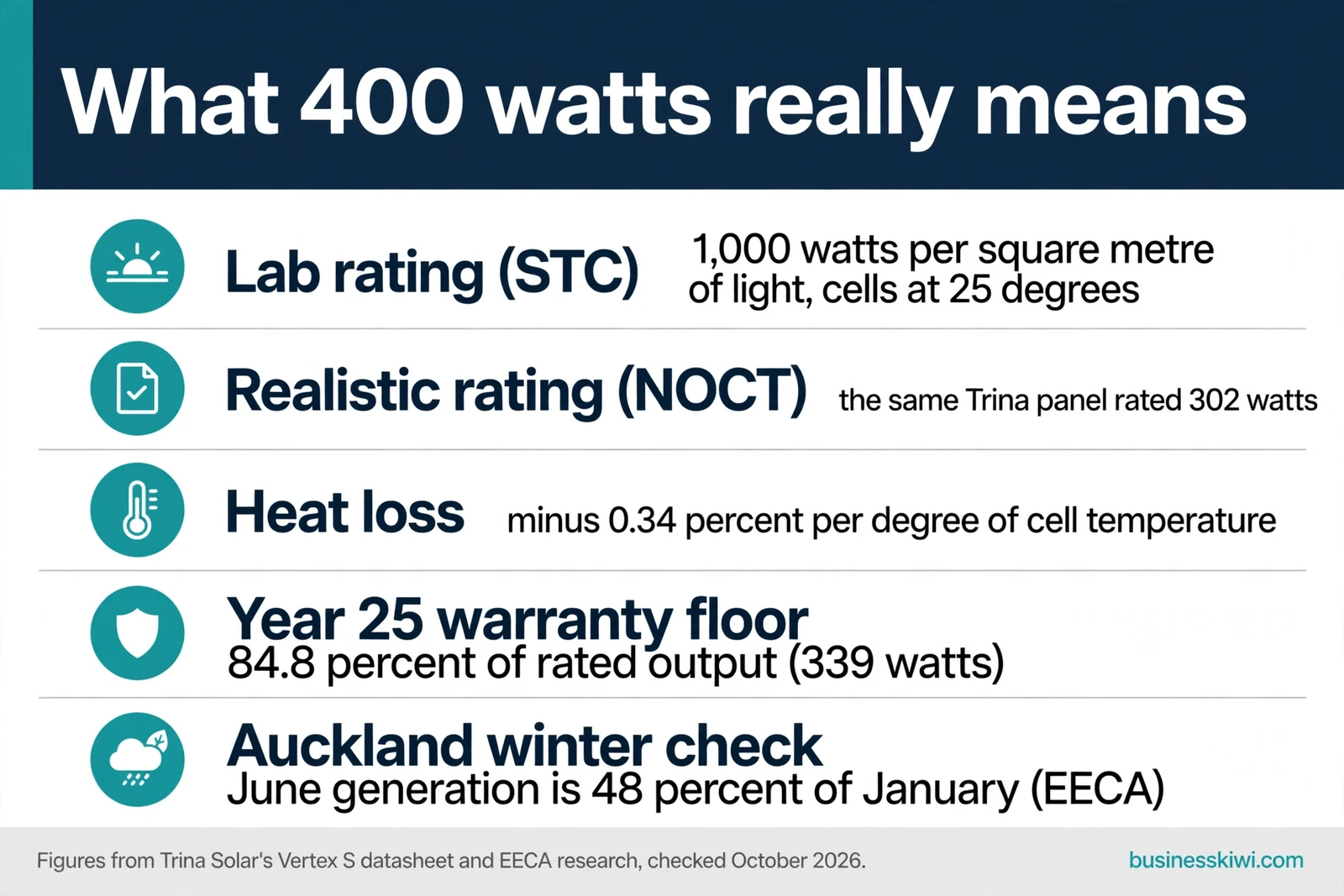
Every reputable panel is rated under the same laboratory benchmark, called standard test conditions, or STC. Trina Solar states the conditions on its Vertex S datasheet in full: irradiance of 1,000 watts per square metre, a cell temperature of 25 degrees Celsius, and an air mass of AM1.5, which describes the spectrum of the light. Measuring tolerance is plus or minus 3 percent.
Those conditions are a bright, cool, perfectly clear midday that real roofs rarely match. The rating is still useful. Because every maker uses the same test, the wattage compares panels fairly.
Trina also publishes a second rating that sits much closer to real life. It is called NOCT, short for nominal operating cell temperature. Under NOCT conditions the light is weaker, at 800 watts per square metre, the air temperature is 20 degrees, there is a light breeze and the cells sit at 43 degrees. Under those conditions Trina rates its 400W panel at 302 watts. The same panel that carries a 400W label is rated at about three quarters of that figure under realistic conditions, on the maker’s own datasheet.
Heat is the main reason for the gap. Solar cells lose power as they warm up. Trina states a temperature coefficient of minus 0.34 percent per degree Celsius. Work through an example. On a hot, still afternoon the cells in a dark rooftop panel can reach 65 degrees, which is 40 degrees above the STC cell temperature. Forty multiplied by 0.34 percent is a 13.6 percent loss, so the panel produces about 346 watts under full sun before any other losses. Cloud, roof angle, dust and inverter conversion losses take a further share.
One more datasheet detail is worth knowing. Trina states a binning tolerance of 0 to plus 5 watts for the Vertex S. A panel sold as 400W leaves the factory testing at 400 watts or slightly above, never below. Not every maker offers the same promise, so check the tolerance line on any datasheet you are quoted.
Dimensions, weight and cell type
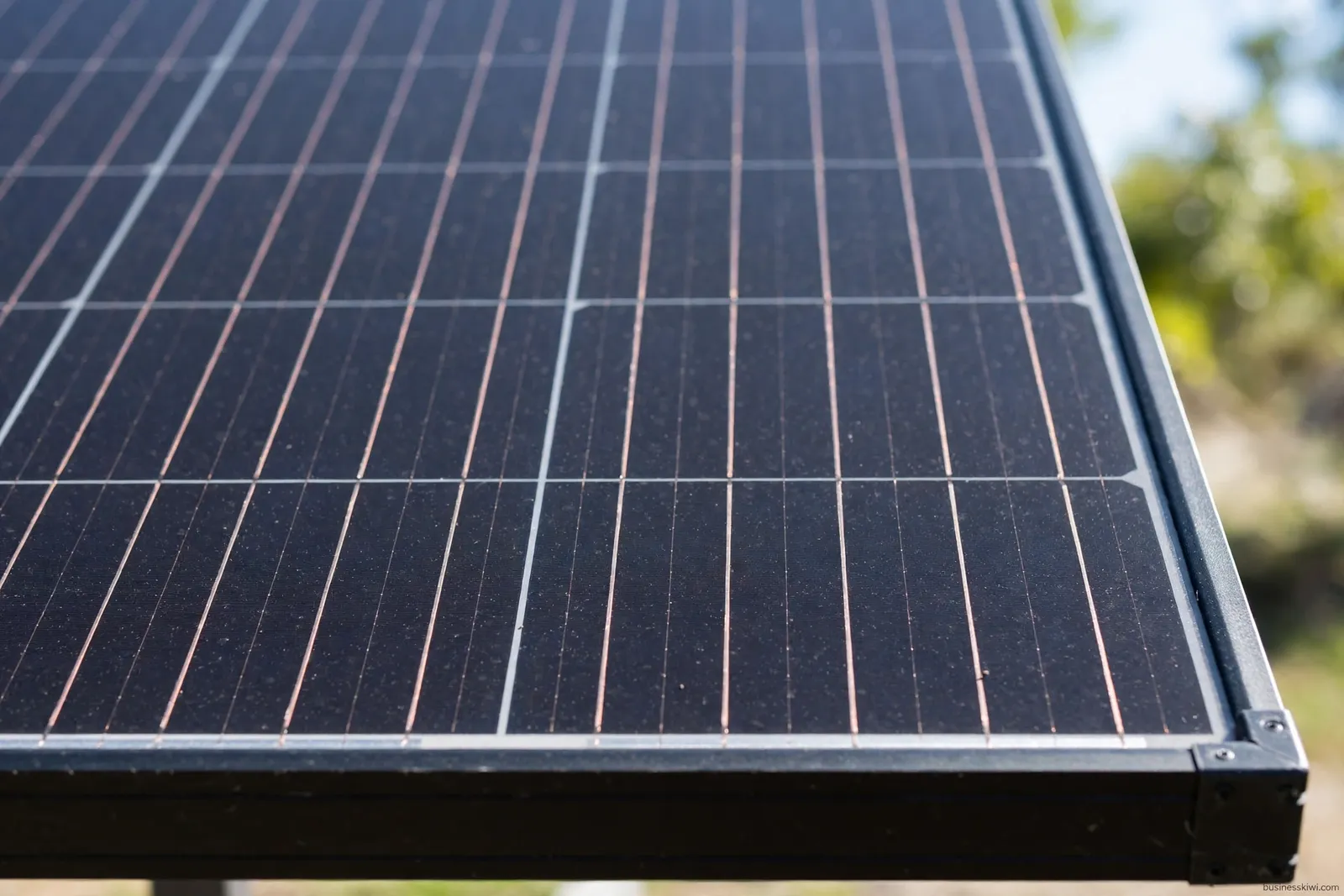
Three current 400W class panels show how tight the physical range is. Trina’s Vertex S in the 400W bin measures 1,754 by 1,096 by 30 millimetres and weighs 21.0 kilograms. It uses 120 monocrystalline cells behind 3.2 millimetre anti reflective coated glass, with a white backsheet. LONGi’s Hi-MO 5m in the 400W bin measures 1,722 by 1,134 by 30 millimetres and weighs 20.8 kilograms, with 108 half cut monocrystalline cells. JA Solar’s DeepBlue 3.0 series, which runs from 380 to 405 watts, uses the same 1,722 by 1,134 by 30 millimetre format, weighs 19.5 kilograms in the MR datasheet, and uses 108 monocrystalline half cells with PERC cell technology.
Half cut cells are now the norm in this class. Each cell is cut in two before assembly, which lowers electrical resistance inside the panel and helps when part of the panel is shaded. All three panels carry an IP68 rated junction box, so the connections on the back are sealed against dust and water.
The face area of one panel is easy to work out. The Trina panel covers 1.754 metres multiplied by 1.096 metres, about 1.92 square metres. The LONGi and JA format covers about 1.95 square metres. Call it roughly two square metres per panel when you pace out a roof.
| Specification (STC) | Trina Vertex S TSM-400DE09.08 | LONGi Hi-MO 5m LR5-54HPB-400M | JA Solar DeepBlue 3.0 JAM54S31 series |
|---|---|---|---|
| Rated power | 400 W | 400 W | 400 W bin within a 380 to 405 W series |
| Module efficiency | 20.8% | 20.5% | 19.5 to 20.7% across the series |
| Open circuit voltage (Voc) | 41.2 V | 36.90 V | 36.58 to 37.23 V across the series |
| Voltage at max power (Vmp) | 34.2 V | 30.94 V | 30.28 to 31.21 V across the series |
| Short circuit current (Isc) | 12.28 A | 13.72 A | 13.44 to 13.87 A across the series |
| Current at max power (Imp) | 11.70 A | 12.93 A | 12.55 to 12.98 A across the series |
| Dimensions | 1,754 x 1,096 x 30 mm | 1,722 x 1,134 x 30 mm | 1,722 x 1,134 x 30 mm |
| Weight | 21.0 kg | 20.8 kg | 19.5 kg |
| Cells | 120 monocrystalline | 108 half cut monocrystalline | 108 monocrystalline half cells, PERC |
| Connectors | MC4 EVO2 / TS4 | MC4 type, 4 mm2 output cable | Staubli MC4-EVO2 |
Figures are as published in each maker’s datasheet material. JA Solar publishes its electrical figures as a range across the series, so the JA column shows the series range rather than a single bin value.
How many 400W panels make a system?
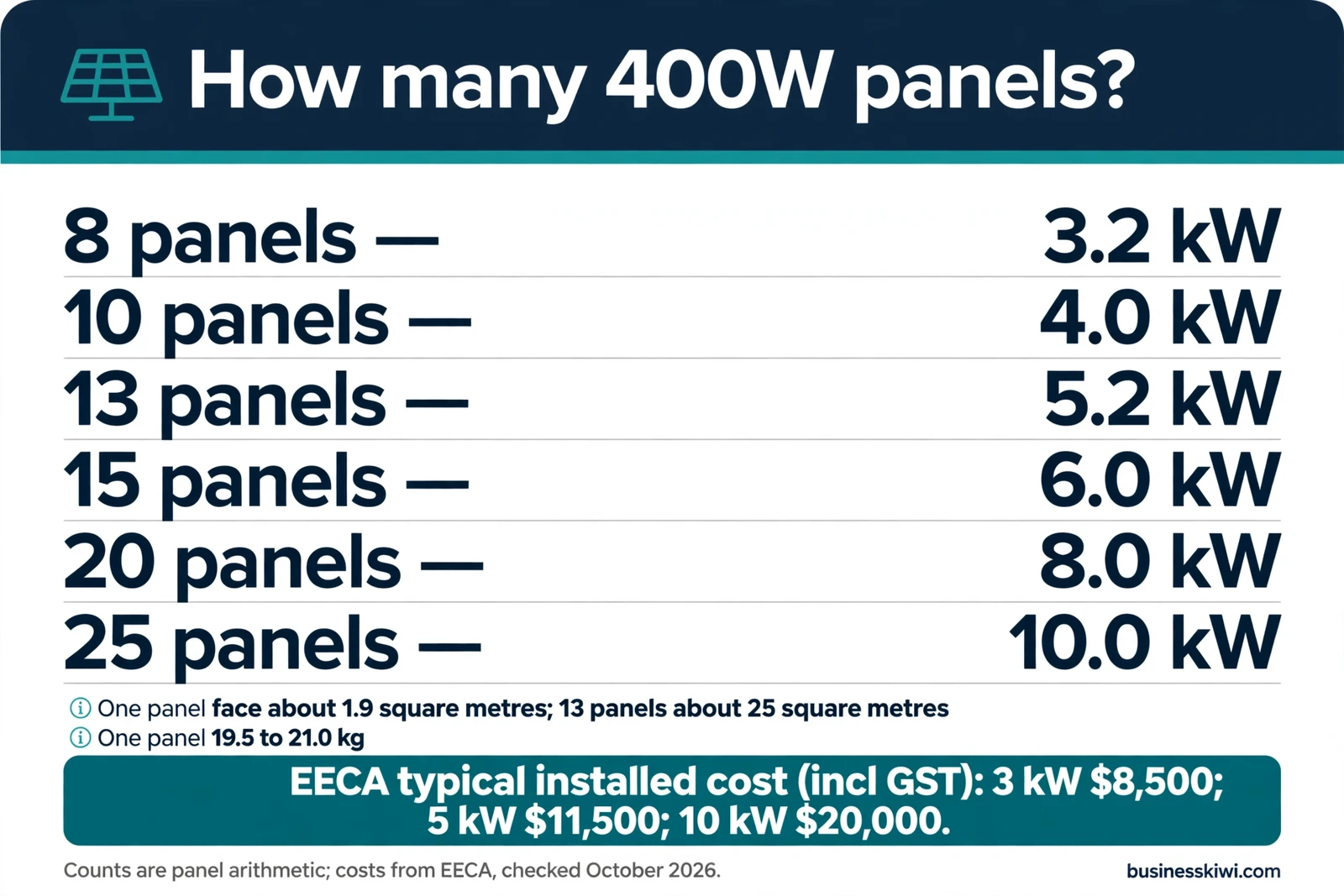
The maths is simple because 400 watts is 0.4 kilowatts. Multiply the panel count by 0.4 to get the system size in kilowatts of panel capacity, written as kW DC.
- 8 panels make 3.2kW
- 10 panels make 4.0kW
- 12 panels make 4.8kW
- 13 panels make 5.2kW
- 15 panels make 6.0kW
- 17 panels make 6.8kW
- 20 panels make 8.0kW
- 25 panels make 10.0kW
There is a wrinkle when you compare these counts with published system examples. EECA describes a typical small system as 7 panels making 3kW, a medium system as 12 panels making 5kW, and a large system as 24 panels making 10kW. Divide the kilowatts by the panel counts and those examples assume panels of about 420 watts each. A system built from 400W panels needs one or two extra panels to reach the same total. For a nominal 5kW system, that means 13 panels at 5.2kW, or 12 at 4.8kW if the roof or the budget is tight.
Installers often fit slightly more panel capacity than the inverter’s AC rating. EECA’s residential solar research modelled a panel to inverter ratio of 1.2 and found it outperformed a ratio of 1.0. A 5kW inverter paired with 6kW of panels is a normal design, not a mistake, because panels rarely produce their full rating.
Roof space and weight
Panel face area is only the starting point. Thirteen Trina panels cover about 25.0 square metres of panel face. A real array needs more roof than that. Rails and clamps add small gaps. Installers keep setbacks from the ridge, the eaves and the roof edges. Chimneys, skylights and vent pipes break up the usable area, so a roof measuring 30 square metres on paper might fit 11 or 12 panels in practice.
Weight matters on older roofs. Thirteen panels at 21 kilograms each add 273 kilograms of panel weight, before rails and cabling. The load spreads across the roof structure, and a competent installer checks the framing and the condition of the roofing material first. Panels carry 25 year performance warranties, so a roof covering due for replacement in five years is a poor base for them.
What one 400W panel produces in New Zealand
No official New Zealand source publishes a per panel production figure. What EECA does publish, in its June 2025 research report on residential solar, is a set of modelled capacity factors for rooftop arrays. A capacity factor is the share of the year, expressed as a decimal, that a system effectively runs at full output. EECA’s base case is a north facing array tilted at 30 degrees, with panels oversized at 1.2 times the inverter capacity, in the first year of operation.
The arithmetic from there is transparent. Multiply the capacity factor by the 8,760 hours in a year and by the panel size in kilowatts. For Auckland, EECA’s capacity factor is 0.181, which gives about 634 kilowatt hours a year for one 400W panel. EECA checks the same maths at system level: a 5kW system at that capacity factor produces 7,928 kilowatt hours a year. The same calculation gives about 620 kilowatt hours a year in Wellington, about 624 in Christchurch, and about 690 in Queenstown, which has the strongest solar resource of the four in EECA’s modelling.
These are modelled first year figures for a well sited array, not measurements from a specific roof. Treat them as a planning estimate for a north facing, unshaded panel. Averaged across the year, the Auckland figure is about 1.7 kilowatt hours per panel per day, but the daily average hides a big seasonal swing. EECA gives the ratio of June generation to January generation for a north facing array at 30 degrees. In Auckland, June produces 48 percent of January’s output. In Wellington the figure is 40 percent, in Christchurch 45 percent and in Queenstown 44 percent. A panel averaging 1.7 kilowatt hours a day across the year produces roughly twice that pace in midsummer and about half of it in midwinter.
Direction costs output too. In EECA’s Auckland modelling, a north west facing array at 30 degrees has a capacity factor of 0.166, about 8 percent below the north facing figure. An array split half east and half west sits at 0.146, about 19 percent below north. Shade is the other big variable, which is why installers model it on site rather than guessing.
Compatibility: inverters, optimizers and mounting
Panels in this class are electrically mainstream, and that is deliberate. Trina states on the Vertex S datasheet that the panel is designed for compatibility with existing mainstream optimizers, inverters and mounting systems, with electrical parameters inside standard inverter operating limits. The maximum system voltage is 1,500 volts DC for both the Trina panel and the JA Solar series, well above anything a residential string reaches.
On a string inverter, panels connect in series and their voltages add. Ten panels with an open circuit voltage around 37 to 41 volts each give a string of roughly 370 to 410 volts before temperature corrections. Your installer sizes the string so cold morning voltage stays inside the inverter’s limit and hot afternoon voltage stays inside its tracking range. Current matters as well. LONGi notes that the Hi-MO 5m’s working current of around 13 amps suits consumer string inverters, and some older equipment has input current limits below what modern high current panels deliver.
Microinverters and DC optimizers attach at panel level, one unit per panel or per pair. They suit roofs with shade or several roof faces, because each panel works independently instead of being dragged down by the weakest panel in a string. The check is the same as for a string inverter. The panel’s open circuit voltage and operating current must sit inside the unit’s published input limits, and reputable makers publish pairing lists for exactly this reason. Ask for the pairing in writing if your quote mixes brands.
Mounting is standardised around the 30 millimetre frame that all three panels in the table use. Rail and clamp systems grip the frame, and mounting holes follow common patterns. Bypass diodes inside the junction box, three on the JA and LONGi panels, route current around a shaded section instead of shutting the whole panel down. They soften the effect of shade. They do not remove it.
One New Zealand specific point comes from EECA’s research. Some lines companies set an export limit, often 5kW, on how much power a home system may send back to the grid. With a 5kW export limit in place, EECA found the best rate of return typically came from systems of 3 to 5kW AC. Confirm your local limit before finalising the panel count.
What you will pay in New Zealand
New Zealand rooftop installers generally do not publish a shelf price for a single rooftop panel. Panels are priced inside an installed system, bundled with the inverter, mounting gear, cabling, electrical work and the lines company application.
The verified price anchor is EECA’s published guide to typical installed costs, which includes standard installation and GST. A small 3kW system costs about $8,500. A medium 5kW system costs about $11,500. A large 10kW system costs about $20,000. A battery adds $5,000 to $15,000 depending on type and capacity. EECA says the average New Zealand home can save $1,000 or more a year on power bills with solar, and that a typical payback period is 7 to 10 years where the household uses most of what the system generates.
The one standalone 400W panel price on a New Zealand retailer’s own site that this research could verify is a different kind of product. Noel Leeming lists the Anker SOLIX PS400 at $1,449. It is a portable folding panel made to charge portable power stations, with a 24 month manufacturer warranty. It is not a rooftop module, and its price says nothing about rooftop panel pricing.
So judge a quote at system level. Compare the total installed price, the panel count and model, the inverter and the warranty terms against EECA’s typical figures for the same system size.
Buying checks and reading the warranty
Two different warranties come with every panel, and quotes often blur them. The product warranty covers defects in materials and workmanship. The performance warranty guarantees a minimum power output over time. On the datasheets checked here, Trina offers a 15 year product warranty and a 25 year power warranty on the Vertex S. LONGi offers a 12 year product warranty and a 25 year linear power warranty on the Hi-MO 5m. The longer product warranty is the more valuable of the two, because defects are the failures owners actually claim on.
Performance warranties are written as a degradation schedule. Trina guarantees the Vertex S at no more than 2 percent degradation in the first year, then no more than 0.55 percent a year, reaching at least 84.8 percent of rated output at year 25. In panel terms, a 400W Trina panel is warranted to still produce at least 339 watts under test conditions in year 25. Compare the year 25 percentage and the annual degradation rate, not just the warranty length.
Before you sign, run these checks. Ask for the exact model code in writing and match it against the maker’s datasheet, including the wattage bin. Check the binning tolerance, so you know a 400W panel cannot arrive testing at 390W. Confirm who honours the warranty in New Zealand if something fails in year nine. Keep the datasheets, invoice and warranty documents together. A claim a decade from now starts with that paperwork.
The wider guides: our solar panels NZ guide covers rooftop solar end to end, our 10kW solar system guide covers the large system end, and our solar buy back rates guide covers what exported power earns. More home and business guides are in the Business and Industry section.
Frequently asked questions
Is a 400W panel a big panel?
It is a standard residential size, about 1.9 square metres and around 20 kilograms. One person can carry it on the ground. On a roof it is a two person lift. The datasheets checked for this guide cover series from 380 to 420 watts in the same physical format, so 400W is mid range for its size class.
How many 400W panels do I need for a 5kW system?
Thirteen panels give 5.2kW of panel capacity, and twelve give 4.8kW. Either can be sold as a nominal 5kW system depending on the inverter pairing. The right count depends on your roof space, your export limit and how much power you use during the day.
How much power does one 400W panel make in a day?
There is no single honest figure, because output swings with season, region and roof direction. Using EECA’s modelled capacity factor for a north facing Auckland array at 30 degrees, one panel produces about 634 kilowatt hours a year, an average of about 1.7 kilowatt hours a day. Expect roughly double that pace in January and about half of it in June.
Can I mix 400W panels with other panels on one roof?
Panels in the same string should match, because a string performs to its weakest panel. Mixing is workable when the different panels sit on separate inverter inputs, or when each panel has its own microinverter or optimizer. Ask your installer to design for it rather than adding odd panels to a string.
Do 400W panels work with microinverters?
Yes, provided the panel’s voltage and current sit inside the microinverter’s published input limits. Modern 400W panels have relatively high operating currents, around 12 to 13 amps, so check the pairing against the maker’s compatibility list and have your installer confirm the match in writing.
How long will a 400W panel last?
The performance warranties in this class run to 25 years. Trina guarantees at least 84.8 percent of rated output at year 25 on the Vertex S, and panels commonly keep producing beyond the warranty at slowly reducing output. The product warranty, 12 to 15 years on the panels checked here, covers defects.
Why is there no simple shelf price for a rooftop 400W panel in New Zealand?
Because rooftop panels are almost always sold inside an installed system price. The panel is only one part of the cost, alongside the inverter, mounting, cabling, labour and grid connection paperwork. EECA’s typical installed prices, $8,500 for 3kW, $11,500 for 5kW and $20,000 for 10kW including GST, are the reliable benchmark.
Bottom line
A 400W panel is a sound, standard building block for a home system. Read the rating as a laboratory figure. Expect about 300 watts from it in realistic conditions, and budget on EECA’s modelled output rather than the number on the box. Thirteen panels make a 5.2kW array covering about 25 square metres of panel face. Judge any quote on the exact model code, the product warranty years, the year 25 output guarantee and the total installed price against EECA’s typical costs.
Sources
- Trina Solar, Vertex S TSM-DE09.08 backsheet monocrystalline module datasheet, 390 to 405W, version TSM_EN_2021_Aus_A. Read in full at https://www.sunpeople.com.au/wp-content/uploads/2022/02/Trina_400W_Vertex-S.pdf
- JA Solar, JAM54S31 395 to 420/GR/1500V datasheet, Global_EN_20220921A. Read in full at https://www.jasolar.com/uploadfile/2022/0928/20220928044041615.pdf
- JA Solar, DeepBlue 3.0 JAM54S31 MR series datasheet data, 380 to 405W, as reproduced in full at https://gycxsolar.com/product/ja-solar-jam54s31/
- LONGi, Hi-MO 5m LR5-54HPB-400M datasheet specifications, as published in full at https://www.wattuneed.com/en/clearance/26123-longi-solar-panel-400-wp-hi-mo-5m-0768563818653.html
- EECA, Breaking down home solar costs and savings. Read in full at https://www.eeca.govt.nz/for-homes/solar-for-homes/solar-costs-and-savings/
- EECA, Understanding the value of residential solar PV and storage in New Zealand, June 2025. Capacity factor tables and seasonal generation ratios read in full at https://www.eeca.govt.nz/assets/EECA-Resources/Research-papers-guides/Understanding-the-value-of-residential-solar-PV-and-storage-in-NZ.pdf
- Noel Leeming, Anker SOLIX PS400 Portable Solar Panel product page, price as published October 2026. Read in full at https://www.noelleeming.co.nz/p/anker-solix-ps400-portable-solar-panel—400w/N250168.html
This article is general information about 400 watt solar panels in New Zealand. It is not personalised advice about your home, your roof or your power bills. Panel specifications come from manufacturers’ datasheets and can change without notice, so confirm the exact datasheet for the model you are quoted before you buy. Solar systems must be designed and installed by qualified people and connected with your lines company’s approval. Prices shown are as published by EECA and the retailer named, checked in October 2026, and installers’ quotes will vary.