GST Number NZ: How to Find, Check and Use a GST Number

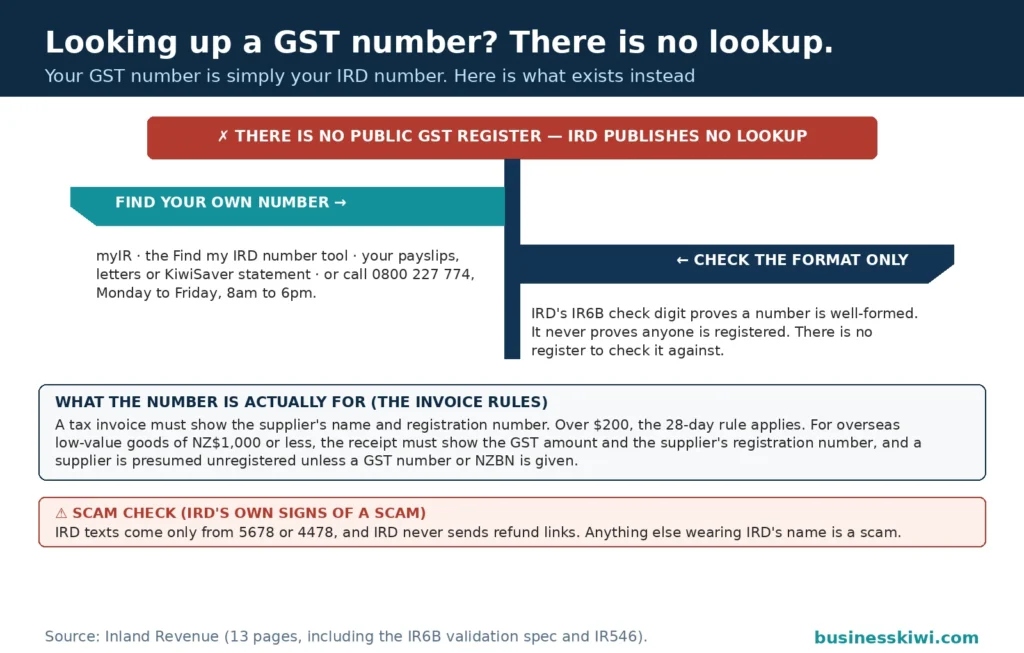
Search for a GST number checker and you will find plenty of websites offering to verify a New Zealand GST number for you. What you will not find is an official one, because Inland Revenue does not publish a public register of GST numbers. That single fact shapes almost everything about how GST numbers are found, checked and used in this country, and it is where most of the confusion starts.
People go looking for a GST number for a handful of practical reasons. They have just registered and need the number for their invoices. A supplier has sent an invoice and the number on it looks wrong. An overseas website is asking for a GST number at checkout and they are not sure whether to hand it over. Or they are setting up a new contractor and want to confirm the business is genuinely registered before claiming GST on its bills.
This guide covers the number itself: what it is, how its format works, where to find your own, how it should show up on invoices, what you can realistically do to check another business, and what to do when a number does not stack up. Registering for GST in the first place is a separate topic, and our GST registration guide covers who has to register and how the process works.
What a GST number is
A GST number is not a separate number issued for GST. When Inland Revenue confirms a registration, it does not allocate anything new. In IRD’s own words on its registration page, your GST number will be the same as your IRD number. Every GST number in New Zealand is simply the IRD number of the person or entity that is registered.
That has consequences worth understanding. A sole trader’s GST number is their personal IRD number, the same number used for their income tax. A company, partnership or trust has its own IRD number, and that is the number it uses for GST. The number belongs to the legal entity, not to a trading name, a shopfront or a brand, which is why the name attached to a number can look unfamiliar even when the number itself is correct.
The number also does not change over time. A business keeps the same IRD number, and therefore the same GST number, for as long as the entity exists. When registration is confirmed, a GST account appears in myIR and returns are filed against it. IRD says it processes registration requests within 10 working days, so there may be a short wait before the account shows up, but the number is the IRD number the business already has.
Because the one number does so much work, it gets asked for constantly: by customers on invoices, by marketplaces onboarding sellers, and by overseas suppliers selling to New Zealand businesses. Knowing what it can and cannot prove is the starting point for all of those situations.
The format of a GST number
A GST number has either eight or nine digits. Older IRD numbers have eight digits and newer ones have nine. The digits are often written in groups separated by hyphens, in the style of 123-456-789, but the hyphens are presentation only. The number is the digit sequence; follow whatever format the form in front of you asks for.
The structure is set out in Inland Revenue’s published validation specifications, the documents IRD provides so that filing software can check numbers as they are entered. An IRD number is made up of a base number of seven or eight digits, followed by one final digit called the check digit. The check digit is not random and it is not a code for anything about the business. It is calculated from the base number using a weighted formula: each digit of the base is multiplied by a set weight (3, 2, 7, 6, 5, 4, 3, 2, working from the left), the results are added together, and the total is divided by 11. The remainder determines what the check digit must be. If the first calculation produces a value of 10, which cannot be a single digit, a second set of weights is applied. If that also produces 10, no valid number exists for that base. IRD’s specifications also place genuine numbers inside the range it has actually issued, which starts at 10,000,000.
This is the basis of every legitimate GST number checker, including the validation built into accounting software. The test is purely mathematical, and it is important to be clear about what it proves. A number that fails the check digit test cannot be a genuine IRD number: someone has mistyped it, transposed digits, or made it up. A number that passes is only well formed. It might belong to a different business entirely, or to one that was registered once and has since cancelled its registration. The check digit validates arithmetic, not registration, not identity and not current status. Treat it as a screening tool, never as confirmation.
How to find your own GST number
Because your GST number is your IRD number, finding it is the same exercise as finding your IRD number, and IRD publishes several ways to do that.
Start with myIR. If you have a myIR account, your IRD number is held in your account details, and once your GST registration has been confirmed your GST account will show in myIR as well. For most businesses this is the fastest route: log in and the number is there.
If you cannot get into myIR, IRD’s website has a Find my IRD number tool. You fill out a form and verify yourself using information you have already registered with IRD. IRD also lists the places the number turns up in everyday paperwork: on payslips, on letters or statements IRD has sent you, on your KiwiSaver statement, and on income details from your employer. A company or trust will find its number on IRD correspondence addressed to the entity.
If none of that works, you can call IRD about IRD numbers on 0800 227 774 from within New Zealand, or +64 4 832 5223 from overseas. IRD’s published hours for that line are Monday to Friday, 8am to 6pm New Zealand time. You can also send IRD a secure message through myIR if you have account access through another route.
Two practical notes. First, there is no separate GST number to apply for or wait for: if you are registered, the number is the IRD number you already hold, even if your GST account is still being set up in myIR. Second, if a tax agent manages your affairs, they will hold the number on file, although keeping your own record saves asking each time a form needs it.

Your GST number on invoices and receipts
When you sell goods or services, your GST number travels with the transaction, because it forms part of the taxable supply information that supports your customer’s GST claim. The rules moved away from the old single tax invoice document some years ago. Taxable supply information can now be spread across records such as invoices, bank statements, supplier agreements and contracts, rather than living on one document. What has not changed is the substance: the supplier’s name and registration number sit at the core of that information. IRD’s guidance on supplier groups, where one business issues paperwork on behalf of others, states the requirement plainly: taxable supply information must include the name and registration number of the supplier, or of the member issuing the information.
The timing rule matters for buyers as much as sellers. Taxable supply information must be provided to a GST-registered buyer within 28 days of a request, or by another date the two parties agree, for supplies over $200. Businesses must also keep taxable supply information for the goods and services they buy and sell, which is why your own number needs to be right on everything you issue and why you are entitled to ask for proper information from the people you buy from. Our guide to tax invoice requirements works through what needs to be shown at each value level in detail.
In practice, put your GST number on every invoice and receipt you issue, whether or not a customer has asked. It is the first detail a business customer looks for, accounting software prompts them to record it against your supplier profile, and its absence generates queries and delayed payments. The supplier group arrangement is the one legitimate exception to the number matching the name of the business that did the work: in industries such as electricity retailing, an issuing member provides the paperwork, and the registration number shown can be the issuing member’s rather than the member that made the supply. If a bill looks odd for that reason, that arrangement is the likely explanation.
Your number is also requested in situations with no invoice in sight. Marketplaces and listing platforms collect it as part of onboarding sellers, and overseas suppliers ask for it at checkout. Both of those are covered below, and both are normal.
Checking another business’s GST number: what is actually possible
Here is the honest answer first. There is no public GST register in New Zealand. Inland Revenue offers no lookup, on its website or anywhere else, that tells you whether a named business is registered. Registration status is part of a business’s tax information, and IRD does not publish it. Any third-party website that presents itself as checking a number against an official register is, at best, running the check digit mathematics described above. That test has some value, but it is not verification.
So what can you actually do when it matters, before you pay a large invoice or claim GST on a contractor’s bills?
Ask for taxable supply information. A genuinely registered supplier provides it as a matter of routine, and for supplies over $200 a GST-registered buyer can require it within 28 days. A business that cannot or will not produce proper information showing its name and registration number has given you useful information about itself, just not the kind it intended.
Run the format checks. Count the digits: eight or nine. If your accounting software validates the check digit when you set up a supplier, pay attention when it complains. A failed check digit means the number is wrong, full stop. A pass means only that the number could exist.
For a limited company, look at its Companies Register record. The record carries an NZBN details page, and the invoicing details shown there include a GST number where the company has provided one. If the number on an invoice matches the number on the register record, that is a useful cross-check. But understand the limits. The details are supplied by the company itself, they are only as current as its last update, a good number of records show no GST number at all, and the register covers companies rather than sole traders or partnerships. A missing number proves nothing either way.
Note the one channel where IRD does confirm status. Under the online marketplace and listing intermediary rules, sellers must give the marketplace or intermediary their name, IRD number and GST registration status, and IRD’s published guidance for those schemes says the marketplace or intermediary can contact IRD to confirm whether a seller is GST registered, using the details the seller provided. That is a real confirmation route, but it sits inside those arrangements. IRD does not publish an equivalent service for a member of the public checking a supplier, and you should not expect IRD to discuss an unrelated business’s tax affairs with you.
Put together, verification in New Zealand is a paper trail exercise rather than a database search. Consistent details across invoices, contracts and register records, proper taxable supply information, and a number that passes the basic format tests are what you rely on. For a high-value transaction, that paper trail is also what protects your GST claim if IRD ever asks questions.
If a supplier’s number looks wrong, or they are not registered
Work through the innocent explanations before assuming the worst. A single transposed or mistyped digit is the most common reason a number fails validation, so ask the supplier to confirm the number in writing and check it against the invoice. A name mismatch is also common and often innocent: the invoice may carry the legal name of the entity, a company name for example, while you know the business by its trading name. Ask which entity you are actually contracting with.
If the supplier tells you they are not GST-registered, the position is straightforward. IRD puts it in sequence: before you can charge GST you need to register for GST. A business that is not registered cannot charge GST on its prices, and it cannot claim GST back on its own costs either. There should be no GST line, and no GST component described as GST, on its invoices at all.
If you have already been charged an amount described as GST by a supplier who turns out not to be registered, that amount is not GST you can claim in your return. GST can only be charged by a registered person, so there is no genuine GST behind the figure, whatever the invoice calls it. The practical steps are to ask for a corrected invoice with the amount removed, to decline to claim the amount as GST in the meantime, and to keep records of what you were told. If a claim has already gone in, talk to IRD or your tax adviser about correcting it rather than leaving it.
Where a supplier refuses to fix an invoice, or you have reason to think the number being used belongs to somebody else entirely, contact Inland Revenue and set out what you have, keeping the documents. A pattern of false invoicing is exactly the sort of thing IRD acts on. What you should not do is pay the invoice, claim the GST and hope: if the supplier was never registered, the claim fails on review and the cost lands on you.
GST numbers and overseas suppliers
GST numbers cross borders in both directions, and the overseas side explains several things that otherwise look strange on receipts.
Overseas businesses that sell low value goods (physical goods with a customs value of NZ$1,000 or less) or remote services such as software, streaming and online subscriptions to New Zealand consumers generally have to register for New Zealand GST once their sales here are large enough. When they charge GST, IRD requires them to show it on a receipt: the receipt must state the amount of GST charged and the supplier’s GST registration number. So a receipt from a foreign platform showing a New Zealand format GST number is not, by itself, suspicious. It is often the platform’s own New Zealand GST registration doing exactly what the rules require.
Your own GST number matters at overseas checkouts for the opposite reason. IRD instructs overseas suppliers to treat a New Zealand customer as not GST-registered unless the customer says they are registered or provides their GST registration number or a New Zealand Business Number. For low value goods, GST generally does not apply to sales made to GST-registered New Zealand businesses for business use, and remote service suppliers do not need to register at all if they only supply GST-registered businesses here. Providing your number is how the supplier knows to leave GST off.
The related concept is the reverse charge on imported services. IRD’s GST guide puts it this way: when you import services from a non-resident supplier and let them know you are GST-registered, you will usually not be charged GST. If you then use some or all of those services for something other than your taxable activity, you account for the GST on that non-taxable use yourself: you add GST to the price of the services and include it as income in your GST return. IRD’s yardstick is taxable use of 95 percent. If you estimate your taxable use of the services will be less than 95 percent of total use, you are treated as if you supplied the services to yourself. IRD’s worked example is a self-employed publicist who buys a $400 software package from overseas, uses it half for business and half at home, and is treated as supplying it to herself for $460 including $60 of GST, claiming half back as an expense in the same return. If the services are used entirely for your taxable activity, there is nothing extra to do.
Fake numbers, misuse and scams
Most GST number misuse is mundane rather than sophisticated. The patterns to recognise are an unregistered business adding a GST amount to its invoices and keeping it, an invoice carrying a number that belongs to a different business, and numbers that were simply invented and fail the check digit test immediately. The checks covered earlier, proper taxable supply information, register cross-checks and the format test, catch most of it.
Your own number needs looking after as well. It is an identifier, not a secret password, and it has to appear on your invoices. Even so, IRD warns that fraudsters sometimes use another person’s IRD number to create a myIR account and claim refunds or tax credits. The warning signs IRD lists include a bank account or address in myIR that is not yours, a notice of assessment for a return you did not file, and a return showing as filed that you never filed. If any of those appear, act on it promptly.
The other scam family trades on the number rather than using it. Messages arrive claiming to be from Inland Revenue, often about a GST refund, and ask you to confirm details including your IRD or GST number through a link. IRD’s published scam guidance gives some firm reference points: IRD does not send refund links or amounts in emails and texts, it tells you to log in to myIR instead; text messages from IRD come only from the numbers 5678 or 4478; IRD will never ask for your password; and its real websites are ird.govt.nz and myir.govt.nz, so lookalike addresses are fake. Pressure, threats and demands for payment by gift card or cryptocurrency are further signs on IRD’s list. If a message about your GST number feels off, ignore the link, go to myIR directly, and check there.
Frequently asked questions
Is a GST number the same as an IRD number?
Yes. Inland Revenue does not issue a separate GST number. When your GST registration is confirmed, the number you use for GST is your IRD number: your personal IRD number if you are a sole trader, or the entity’s IRD number for a company, partnership or trust.
Can I look up another business’s GST number?
Not through Inland Revenue. IRD publishes no register of GST numbers and offers no public lookup service. Your realistic options are to ask the business for taxable supply information showing its name and registration number, run the format and check digit test, and, for a limited company, check the invoicing details on its Companies Register record.
How do I find my own GST number?
Log in to myIR, where your IRD number is held and your GST account appears once registration is confirmed. Failing that, use IRD’s Find my IRD number tool, or check payslips, IRD letters and statements, your KiwiSaver statement or income details from your employer. IRD can also help on 0800 227 774.
What does the check digit in a GST number do?
It is a built-in error check. The final digit is calculated from the rest of the number using a weighted formula published by Inland Revenue, so software can tell whether a number has been typed correctly. Passing the test means the number is well formed. It does not prove the number belongs to the business quoting it, or that the business is currently registered.
Does a GST number have to appear on every invoice?
The supplier’s name and registration number are core parts of taxable supply information, which must be kept for supplies and provided to a GST-registered buyer within 28 days of a request for supplies over $200. The information can be spread across documents rather than sitting on one invoice, but putting your GST number on every invoice you issue is the simplest way to meet the requirement.
Can I claim GST on a purchase from a supplier who is not GST-registered?
No. Only a GST-registered person can charge GST, so an amount labelled GST by an unregistered supplier is not GST and cannot be claimed in your return. Ask for a corrected invoice with the amount removed, and if you have already claimed it, get advice about correcting the return.
Why does an overseas supplier ask for my GST number?
Because IRD tells overseas suppliers to treat New Zealand customers as not GST-registered unless the customer provides a GST registration number or a New Zealand Business Number, or otherwise confirms their status. Giving your number tells the supplier you are a registered business, so GST generally should not be added to business purchases such as low value goods bought for business use.
What should I do if I think the GST number on an invoice is fake?
Ask the supplier to confirm the number in writing and to provide taxable supply information, and run the basic checks: digit count, check digit, and the Companies Register record if it is a company. If the answers do not stack up, do not claim the GST, keep the documents, and contact Inland Revenue with what you have.
This article is general information about how GST numbers work in New Zealand. It is not tax advice, and it does not account for your individual circumstances. If a registration or claiming decision matters to your business, check the detail on ird.govt.nz or talk to Inland Revenue or a tax adviser before you act.
Sources
- Inland Revenue, Register for GST, ird.govt.nz
- Inland Revenue, Problems with IRD numbers, ird.govt.nz
- Inland Revenue, What GST is, ird.govt.nz
- Inland Revenue, How taxable supply information for GST works, ird.govt.nz
- Inland Revenue, Supplier groups, ird.govt.nz
- Inland Revenue, Flat-rate credit scheme, ird.govt.nz
- Inland Revenue, GST obligations for marketplaces, ird.govt.nz
- Inland Revenue, Supplying remote services into New Zealand, ird.govt.nz
- Inland Revenue, When to charge GST on low value imported goods, ird.govt.nz
- Inland Revenue, GST plus (IR546), ird.govt.nz
- Inland Revenue, File Upload Specification IR6B: IRD number validation, ird.govt.nz
- Inland Revenue, Signs of a scam, ird.govt.nz
- Companies Office, Companies Register NZBN details, companiesoffice.govt.nz