Kaikōura Jobs: Finding Work in a Marine Tourism Town
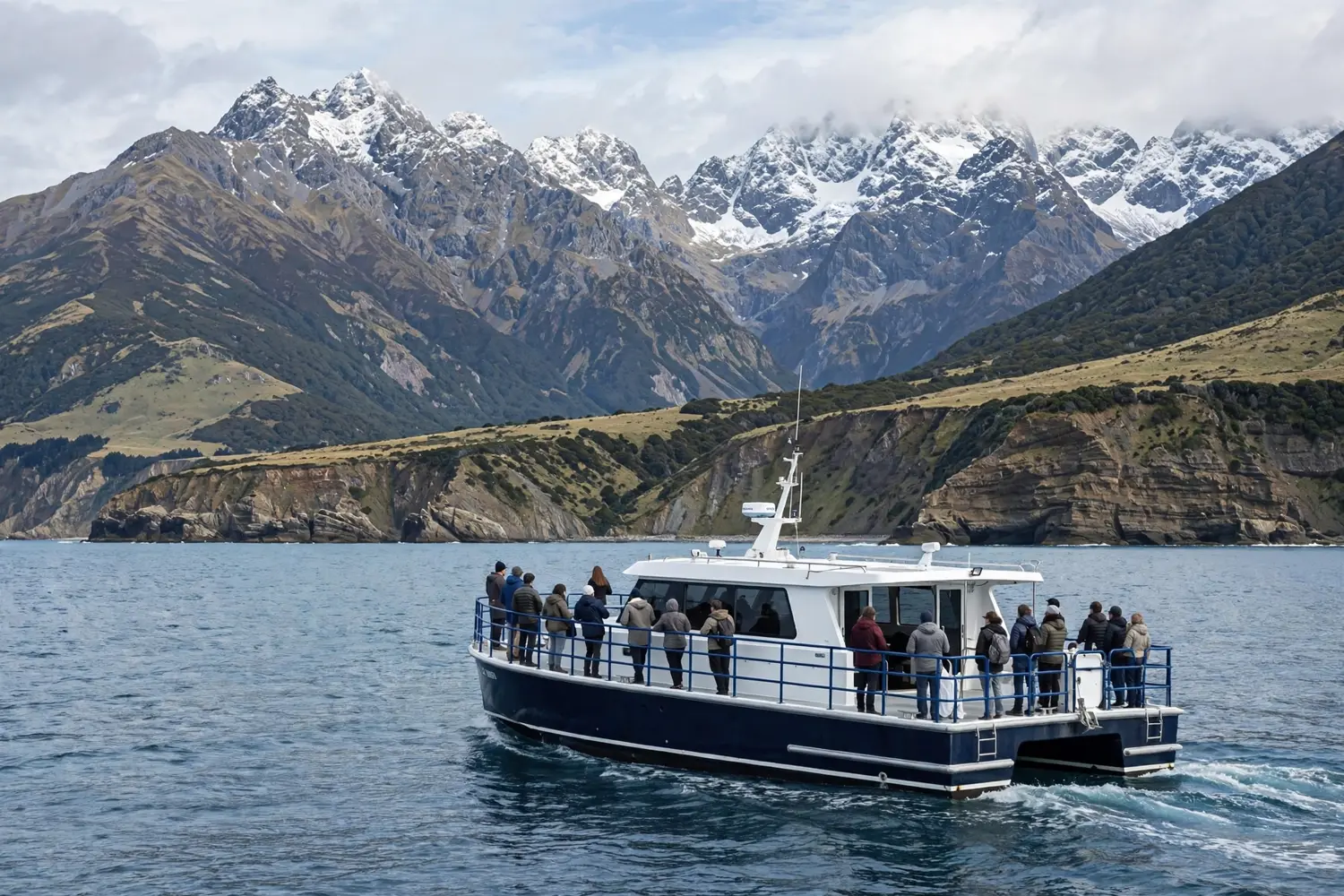
Kaikōura is a small coastal town on the east coast of the South Island, in the north of Canterbury, where the Seaward Kaikōura Range drops steeply into the Pacific Ocean. That geography explains almost everything about working there. The deep water close to shore supports an unusual concentration of marine life, the marine life supports a tourism industry out of all proportion to the town’s size, and the tourism industry, the farms behind the coast and the services that keep a small district running are where the jobs are.
This guide sets out what work exists in Kaikōura and why, what official sources say about pay, how seasonal work really behaves, and what you need sorted before you start. One caution applies throughout. Kaikōura is a very small labour market, and no official source publishes Kaikōura-specific pay rates for individual occupations. Where pay figures appear below, they are national figures published by Tahatū, the government’s career information service, and they are labelled as such. Treat them as context for a conversation with an employer, not as a promise of what a Kaikōura job will pay.
The economic base: the sea first, then the land
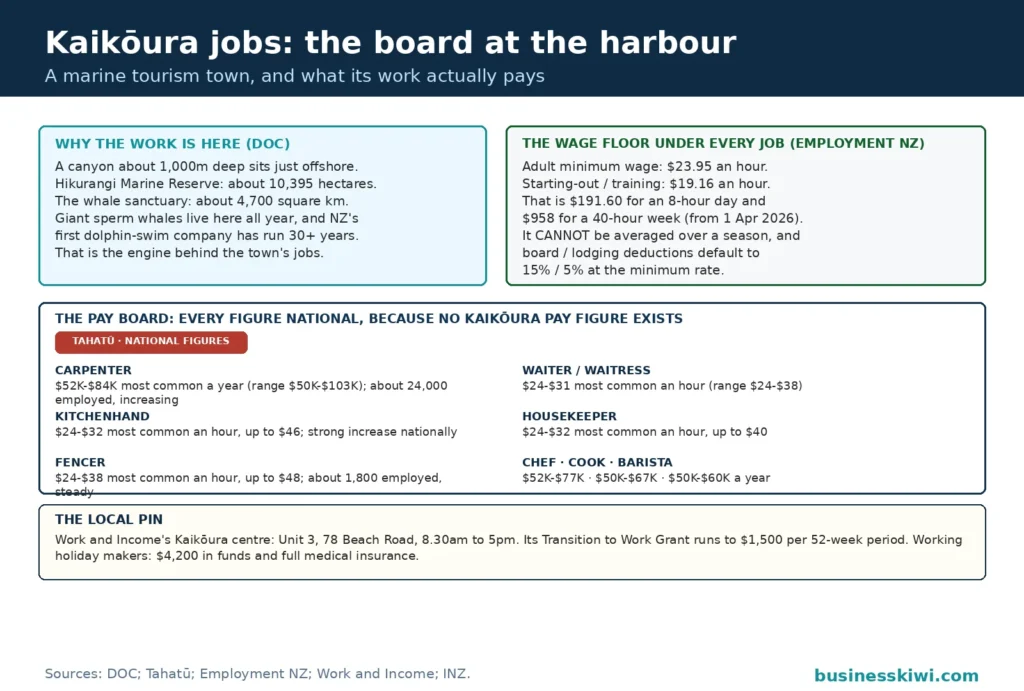
Start with the ocean, because the town does. The Department of Conservation (DOC) describes the Kaikōura Canyon running deep, to around 1,000 metres, unusually close to shore. Nutrient-rich water over that canyon is why sperm whales are regularly seen close inshore, alongside dusky dolphins, New Zealand fur seals (kekeno) and seabirds such as Hutton’s shearwaters, which breed only in the Seaward Kaikōura Range. DOC’s marine management material for the area, prepared under the Kaikōura (Te Tai o Marokura) Marine Management Act 2014, records a layered set of protections: the Hikurangi Marine Reserve of about 10,395 hectares, the Te Rohe o Te Whānau Puha Whale Sanctuary of about 4,700 square kilometres, the Ōhau fur seal sanctuary, three mātaitai reserves and taiāpure, the customary fisheries management tools. A local body, the Kaikōura Marine Guardians, advises on the area, and its membership includes Te Rūnanga o Kaikōura.
That protected, wildlife-rich coast is the foundation of the visitor economy. The two best-known operators describe their own operations on their own websites. Whale Watch Kaikoura runs boat tours to see the giant sperm whales it describes as year-round residents, sailing a fleet that includes the vessels Te Ao Mārama and Wheketere, and it also runs a gift shop. Encounter Kaikoura runs Dolphin Encounter, which it describes as New Zealand’s first dolphin swimming company, operating for more than 30 years from its site at 96 Esplanade, where it also runs a café and a gift shop. Around those anchors sit the cafés, restaurants, motels, holiday parks, shops and activity businesses that feed, house and entertain the visitors the marine life draws in.
Behind the coastal strip, the district is farmland, and farm work is the second longstanding strand of employment. Tahatū profiles fencing as a distinct occupation, the kind of work sheep and beef properties generate year-round, and employment law makes specific provision for agricultural workers, including rules about board and lodging that are covered later in this guide. The third strand is the town itself: the Kaikōura District Council, based at 96 West End, is a significant local employer in a district this size, and its planning documents, including its adopted Long-Term Plan 2024–2034, programme the roading, water and community facility work that keeps local contractors and council staff busy. DOC also has a working presence in the district through its marine management role. Schools, health services, trades and retail serving residents rather than visitors round out the picture.
Marine tourism work
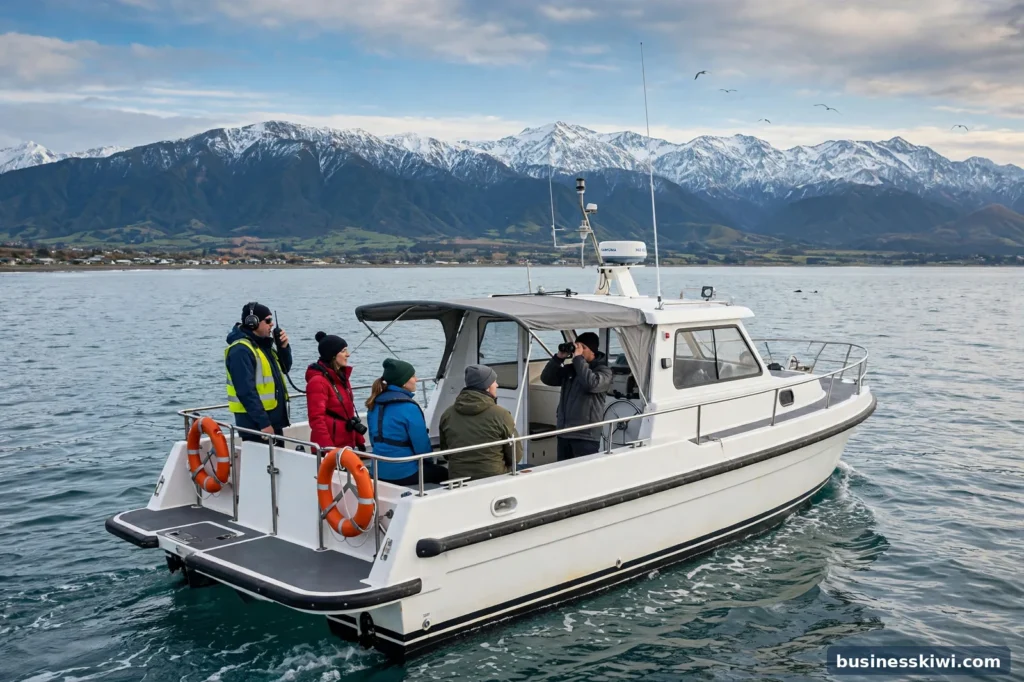
The signature Kaikōura jobs are on the water: boat crew, skippers, guides and naturalist-style hosts on whale and dolphin tours, plus the shore-based teams who run bookings, check-ins, retail and cafés attached to the tours. Whale Watch’s own site shows a business with multiple sailings on a sailing day and a retail arm, and Encounter Kaikoura’s site shows tours, a café and a gift shop operating from one base. Businesses shaped like that employ a mix of marine staff, customer service staff, hospitality staff and retail staff, not just skippers.
Two honest limits apply here. First, no official source read for this guide publishes pay for tour guides or boat crew, and Tahatū has no tour guide profile with published pay, so this guide puts no figure on guiding work. Anyone offering or taking a guiding or crew role should test the pay against the legal floor: the minimum wage, covered below, applies to every hour worked, and an employer cannot average pay across a season to make the numbers fit. Second, marine roles carry real prerequisites that employers set themselves, such as maritime qualifications for skipper roles. Those requirements come from the employer and from maritime rules, so check the operator’s own vacancies page or ask directly. Whale Watch, for example, maintains an Our Job Vacancies page on its own website, which is the right place to see what it currently asks for.

Hospitality, accommodation and retail
For most jobseekers, the largest pool of Kaikōura work is hospitality and visitor services: waiting tables, kitchens, cafés, bars, motel and holiday park housekeeping, front desks and shop counters. This is also where official pay context is strongest, because Tahatū publishes figures for these occupations nationally. Tahatū presents pay as a most common range, with a lower figure and an upper figure, and states that pay is before tax. On that basis, Tahatū puts most common pay for waiters and waitresses at $24 to $31 an hour, with a lower figure of $24 and an upper figure of $38. For kitchenhands, most common pay is $24 to $32 an hour, with an upper figure of $46, and Tahatū’s job insights for kitchenhands record a strong increase in employment nationally. Housekeepers sit at $24 to $32 an hour most commonly, with an upper figure of $40.
Kitchen careers run higher. On its food and drink career pages Tahatū lists chefs at $52,000 to $77,000 a year, cooks at $50,000 to $67,000 a year and baristas at $50,000 to $60,000 a year. Read those numbers as national context only. A small-town café cannot be assumed to pay the national most common rate, and a skilled chef in a busy Kaikōura restaurant may do better than it. What is not negotiable is the floor underneath all of it, which is the minimum wage section below. Tahatū also notes that waiting work needs no specific training, which is part of why hospitality is the usual first port of call for new arrivals and working holiday makers.
Farm and outdoor work
Farm work around Kaikōura follows the rhythm of sheep and beef properties: fencing, stock work, tractor and general farm hand work, and seasonal peaks around lambing and shearing that farmers organise through their own networks and contractors. Tahatū’s fencer profile puts most common pay at $24 to $38 an hour nationally, with a lower figure of $24 and an upper figure of $48, and records about 1,800 people employed in the occupation, with employment steady. Farm roles are also where accommodation most often forms part of the package, and Employment New Zealand’s guidance is specific about how that must work. Board (accommodation and meals) and lodging (accommodation only) can be deducted from wages only as agreed, the arrangement and its cost should be clearly recorded, and where there is no specific agreement about cost, an employer can deduct 15 percent of wages calculated at the minimum wage rate for board, or 5 percent for lodging. If a farm job includes a house or a room, get the deduction in writing before you start, and check the total package still delivers at least the minimum wage for every hour worked.
Construction, trades and public services
Building and maintenance work exists in Kaikōura at small-district scale: housing work, repairs, tourism property upkeep and the infrastructure programmes the council funds through its long-term plan. Tahatū’s carpenter profile gives the national context for the trade: most common pay of $52,000 to $84,000 a year, a lower figure of $50,000 and an upper figure of $103,000, training of three to four years, about 24,000 people employed nationally and employment recorded as increasing. Alongside the trades, the council, DOC’s local marine work, schools and health services provide a thin but steady layer of public service roles. In a district this size those roles are infrequent and usually advertised through the organisation’s own channels, so they reward people who are already local and known.
Seasonal work and the visitor year
Kaikōura’s headline wildlife does not leave for winter. Whale Watch describes its sperm whales as year-round residents, Encounter Kaikoura runs dolphin tours through the year, and DOC’s material presents the marine area as a year-round environment. Tours, cafés and accommodation therefore operate in every month, and core staff are employed year-round. What changes across the year is volume: visitor numbers peak in the warmer months, and hospitality and tour businesses roster more hours, more casual shifts and more fixed-term help when the town is fullest.
The council’s own planning tells the same story from the other direction. Kaikōura District Council is consulting on a draft Economic Development Strategy built around four priorities, one of which is a diverse, year-round economy, with housing and community wellbeing listed first. A council does not set a year-round economy as a goal unless the current pattern leans on part of the year. For a jobseeker, the practical reading is this: expect the widest choice of hospitality and tourism shifts across the summer season, expect competition for those shifts from other travellers, and treat winter roles as fewer but often steadier, because businesses keep their experienced people. That is guidance, not data, because no official source read for this guide publishes a Kaikōura hiring calendar, and any employer who promises you a specific pattern of hours should be asked to put the pattern in your employment agreement.
Seasonal workers have one protection worth knowing by name. Employment New Zealand states that the minimum wage must be paid for each hour worked and cannot be averaged over a season or period. Piece rates, which turn up in some seasonal work, are covered too: if you are paid per piece, your total pay for a pay period divided by the hours you worked must still reach at least the minimum wage. A busy fortnight cannot be used to cancel out a quiet one.
Working holiday makers
Kaikōura’s seasonal workforce includes working holiday makers, and Immigration New Zealand’s scheme pages set out the essentials. Working holiday visas are country-specific schemes. Depending on the country, applicants are aged 18 to 30 or 18 to 35, must hold at least NZD $4,200 for living expenses, must have full medical insurance for their stay and must plan to leave at the end of it. The visa allows temporary work, allows study or training for up to six months in total, and does not allow a permanent job. No job offer is needed to apply. Conditions and age limits differ by country, so check your own country’s scheme page on immigration.govt.nz rather than relying on another traveller’s version. Immigration New Zealand also notes that everyone who works in New Zealand pays tax and needs an IRD number, which is covered below. Some working holiday makers can extend their stay: the Canada scheme page, for example, describes a further three-month extension for people who have completed three months of seasonal work. Keep records of seasonal work if you think you will use that option.
How hiring actually works in a small district
There is no single Kaikōura jobs market to search. Hiring runs through several channels at once, and in a town this size the personal channels matter more than they do in a city. Start with employers’ own websites and premises. Larger local employers publish vacancies on their own sites, as Whale Watch does with its Our Job Vacancies page, and cafés, shops and motels commonly take a CV handed in at the counter seriously, because the manager is often the person standing there. That last point is general guidance about small towns rather than measured data, but anyone who has hired in a small district will recognise it: being present, available at short notice and known to be reliable counts for a great deal where the applicant pool is small.
The official channel is Work and Income, part of the Ministry of Social Development. Work and Income has a service centre in Kaikōura at Unit 3, 78 Beach Road, listed as open 8.30am to 5pm, where staff can help with jobseeking and support. Its My MSD Jobs service lets you build a jobseeker profile recording your skills, experience and the work you want, and matches you to listed jobs, showing how closely you match. Work and Income also runs the Transition to Work Grant, which can help with reasonable costs of finding or starting work, such as clothing and transport for an interview, tools or work clothing, relocation costs, or living expenses between a last benefit payment and a first pay, up to $1,500 in total in a 52-week period. Eligibility conditions apply, including citizenship or residence requirements and benefit or jobseeker registration, and applications start with a call to 0800 559 009.
The realities: housing and scale
Sort housing before you sort the job, or at least ask the housing questions before you sign. The council’s draft economic development strategy puts housing and community wellbeing at the top of its priority list, and the council is also publicly working on housing plan changes, which is official confirmation that housing is a live pressure point in the district rather than traveller gossip. This guide makes no claim about current rents or vacancy, because no official source read for it publishes those, but the questions to ask any Kaikōura employer are concrete: Is accommodation included or available through the employer? What is deducted for it, and is that deduction written into the agreement (the board and lodging rules above apply)? If it is not included, where do staff actually live, and is there anything available for the dates you need? A job that pays the national most common rate is worth little if there is no bed attached to it.
Scale is the other reality. Kaikōura offers variety within a narrow field: marine tourism, hospitality, farming, trades and public services, and not much outside it. Careers progress by becoming the person several employers want, by collecting tickets and licences that travel between sectors, and by being willing to combine work, for example café shifts alongside tour work. People who thrive in Kaikōura usually treat that breadth as the point of the place. People who need a deep, specialised labour market should look at Christchurch, and treat Kaikōura work as a season rather than a base.
Worker essentials: minimum wage, rights and tax
Employment New Zealand publishes the current minimum wage rates, effective from 1 April 2026 and reviewed every year. The adult minimum wage is $23.95 an hour before tax, which is $191.60 for an eight-hour day and $958 for a 40-hour week. The starting-out minimum wage and the training minimum wage are both $19.16 an hour. The starting-out rate applies in defined situations, including workers aged 16 or 17 who have not yet completed six months of continuous employment with their current employer, and certain 18 and 19 year olds and trainees; the training rate applies to workers aged 20 or over whose agreement requires at least 60 credits a year of industry training. There is no minimum wage for workers under 16. If your role includes supervising or training other workers, the starting-out and training rates do not apply and you must be paid at least the adult rate.
A few rules from the same source are worth holding onto. You must be paid at least the minimum wage for every hour worked. Wages must be paid in money, with deductions only as agreed, for example for board or lodging. Employers must keep accurate records of hours, wages and leave. Employer KiwiSaver contributions must be paid on top of at least the minimum wage; they cannot be counted as part of it. Migrant workers have the same minimum employment rights as New Zealand workers. Anyone who believes they are being paid less than the minimum wage can report it to Employment New Zealand on 0800 20 90 20.
Tax is straightforward if you set it up properly on day one. You need an IRD number to be taxed correctly, and you give your employer a tax code declaration on form IR330. Inland Revenue’s guidance is that your main or highest source of income uses a main tax code, and any second source uses a secondary tax code matched to your estimated total income: SB at 10.5 percent for total income up to $15,600, S at 17.5 percent up to $53,500, SH at 30 percent up to $78,100, ST at 33 percent up to $180,000 and SA at 39 percent above that. Seasonal workers holding two jobs at once are exactly the people secondary codes exist for. If you do not give your employer an IR330, tax is deducted at the non-declaration rate of 45 percent, which is a painful and avoidable outcome. Your employer deducts tax as PAYE, which also collects the ACC earners’ levy, currently $1.75 for each $100 of income up to $156,641. If your code changes, give your employer a new IR330.
Frequently asked questions
What kinds of jobs can you actually get in Kaikōura?
The realistic list is marine tourism work (boat crew, guides, bookings and retail for whale and dolphin tours), hospitality and accommodation work (cafés, restaurants, bars, kitchens, housekeeping and front desks), retail serving visitors and residents, farm work on the sheep and beef properties around the town, trades and construction, and a small number of council, conservation, school and health roles. That mix follows directly from the district’s economic base: a protected marine environment that draws visitors, farmland behind the coast, and a small town’s worth of services.
How much do hospitality jobs pay in Kaikōura?
No official source publishes Kaikōura-specific hospitality pay, so the honest answer has two parts. The legal floor is the minimum wage: $23.95 an hour for adults from 1 April 2026, or $19.16 for the starting-out and training rates where they apply. The national context comes from Tahatū, which puts most common pay for waiters and waitresses at $24 to $31 an hour, kitchenhands at $24 to $32 an hour and housekeepers at $24 to $32 an hour, all before tax. A specific Kaikōura offer can sit anywhere at or above the floor, so judge the actual offer, including any accommodation, against those reference points.
Is there work in Kaikōura all year round?
Yes, but the volume changes. The whale and dolphin tours operate year-round because the key species are present year-round: Whale Watch describes its sperm whales as year-round residents, and Encounter Kaikoura runs tours across the year. Core staff in tourism, hospitality, farming and public services work through winter. What peaks in the warmer months is the number of casual and fixed-term shifts, as visitor numbers rise. The council’s draft economic development strategy treats a diverse, year-round economy as a goal for the district, which reflects how much of the current workload follows the visitor season.
Can I work in Kaikōura on a working holiday visa?
Working holiday visa holders can take temporary work anywhere in New Zealand, including Kaikōura, and hospitality and seasonal work are the usual fit. The visa does not allow a permanent job, and you do not need a job offer before you arrive. Schemes are country-specific, with age limits of 18 to 30 or 18 to 35, a requirement to hold at least NZD $4,200 for living expenses and full medical insurance. Check your own country’s scheme on immigration.govt.nz for its exact conditions, and get an IRD number before you start, because you cannot be taxed correctly without one.
Where should I look for work in Kaikōura?
Use several channels at once. Check the careers or vacancies pages on employers’ own websites, starting with the big marine operators. Call into Work and Income’s Kaikōura service centre at Unit 3, 78 Beach Road, and set up a jobseeker profile on My MSD Jobs so you can be matched to listed work. Then work the small-town channel: visit cafés, motels, shops and tour offices in person with a CV, at a quiet time of day, and make sure people know you are in town, available and staying for a defined period. In a district this small, availability and reliability are hiring criteria in themselves.
What must I be paid, and can my pay be averaged across the season?
You must be paid at least the minimum wage for every hour you work: $23.95 an hour for most adults from 1 April 2026, and $19.16 an hour if the starting-out or training rate lawfully applies to you. Employment New Zealand is explicit that the minimum wage cannot be averaged over a season or period, and piece-rate pay must still add up to at least the minimum wage for the hours worked in each pay period. If you think you are being underpaid, Employment New Zealand takes reports on 0800 20 90 20.
What paperwork do I need before I start work?
You need an IRD number and a completed IR330 tax code declaration for your employer, with the right tax code: a main code for your main job and a secondary code for any second job. Without an IR330, your employer must deduct tax at the non-declaration rate of 45 percent. If your job includes accommodation or meals as part of the package, get the arrangement and any deduction written down before you start. If you are on a working holiday visa, you also need to stay within your visa conditions, which allow temporary work only.
Sources
- Tahatū (tahatu.govt.nz), occupation profiles: Carpenter; Waiter and waitress; Kitchenhand; Housekeeper; Fencer
- Department of Conservation (doc.govt.nz), Hikurangi Marine Reserve
- Department of Conservation (doc.govt.nz), Kaikōura/Te Tai-o-Marokura marine management
- Kaikōura District Council (kaikoura.govt.nz), homepage and Economic Development Strategy consultation page
- Whale Watch Kaikoura (whalewatch.co.nz), homepage
- Encounter Kaikoura, Dolphin Encounter (encounterkaikoura.co.nz), homepage
- Employment New Zealand (employment.govt.nz), Minimum wage rates and types
- Inland Revenue (ird.govt.nz), About tax codes
- Immigration New Zealand (immigration.govt.nz), Canada Working Holiday Visa (scheme essentials)
- Work and Income (workandincome.govt.nz), Nelson, Marlborough and West Coast service centres; Jobseeker profile (My MSD Jobs); Transition to Work Grant
This article is general information about working in Kaikōura, based on official sources read at the time of writing. It is not legal, employment, immigration or tax advice, and it does not describe any individual employer’s current vacancies or pay offers. Check current minimum wage rates, visa conditions and tax codes on the official websites listed above, and confirm pay, hours and any accommodation arrangements with an employer in writing before you start work.