Renting in Queenstown: The Rules, the Bond and How to Check Real Rents

Renting a home in Queenstown starts with the same law that applies everywhere in New Zealand, the Residential Tenancies Act 1986, but it plays out in a housing market unlike anywhere else in the country. The district’s workforce swells with the ski season and the summer peak, and a large share of its housing stock earns money from short-stay visitors instead of long-term tenants. Queenstown-Lakes District Council makes the point from its side of the fence: on its own website, the council links the growth of short-stay letting directly to the shortage of homes available for the district’s long-term renters.
That pressure makes the legal detail worth knowing before you sign anything. This guide works through what governs a Queenstown tenancy: the agreement, the bond, inspections, rent increases, healthy homes standards, and how a tenancy ends. It also covers the council rules that separate a holiday let from a rental home, the limits on what a landlord can charge you or ask you when you apply, and your options if something goes wrong. Finally, because rent figures quoted by property websites have no official standing, it shows you the one source that does: the market rent statistics Tenancy Services builds from bond data, including the current figures for Queenstown itself.
How renting in Queenstown differs
Most New Zealand rental markets are shaped by the people who live in them year-round. Queenstown’s is shaped by that, and by visitors. A landlord with a house near the lakefront or the ski fields can choose between a tenant paying weekly rent and a rolling series of holiday guests paying by the night. The economic pull toward short stays is constant, and it tightens the supply of homes for people who work in the district.
The council is working on the problem in the open. QLDC says it is implementing a Joint Housing Action Plan alongside central government, the Queenstown Lakes Community Housing Trust, iwi and the local community. For a renter, the practical effects are more immediate than any plan. Homes advertised before the winter season attract strong competition from arriving workers, and fixed terms are often aligned to seasons or to an owner’s own plans. Some tenancies on offer are short fixed terms of 90 days or less, which operate under different end-of-term rules, so the term length deserves a close read. Starting early, with documents ready, will put you ahead of most applicants.
The tenancy agreement
Every residential tenancy should start with a written agreement, and Tenancy Services is clear that a tenancy agreement must be in writing. The landlord must give you a copy of the signed agreement before the tenancy starts. If there is no written agreement, the Residential Tenancies Act still applies and both sides still have to follow its rules. A verbal arrangement does not leave you unprotected, but a written agreement is far easier to rely on in a dispute.
An agreement must include a set of essentials: the names and contact addresses of landlord and tenants, the property address, the dates the agreement is signed and the tenancy begins, an address for service for each party, whether any tenant is under 18, the bond amount, the rent and how it will be paid, any chattels provided, and, for a fixed term, the end date. Most new, renewed or varied agreements must also include a signed healthy homes compliance statement on current compliance.
Read the agreement carefully before signing, and get advice if there is anything you do not understand. Landlords can add extra conditions, but those conditions must comply with the law; a clause that conflicts with the Act does not become valid just because you signed it. If the property is managed by a property manager, the agreement should name both the owner and the management company as landlord. Where the owner is not named, the property manager takes on all of the landlord’s responsibilities, including for Tenancy Tribunal orders.
One distinction matters a great deal in a town full of shared housing. If you sign the agreement with the landlord, you are a tenant and the Act covers you. If someone else signs and you simply share the place, you are a flatmate, and agreements between tenants and flatmates are not covered by the Act. Flatmates should still record what they have agreed in writing, but their protection is much thinner. If you want the Act’s protection, your name needs to be on the agreement.

The bond
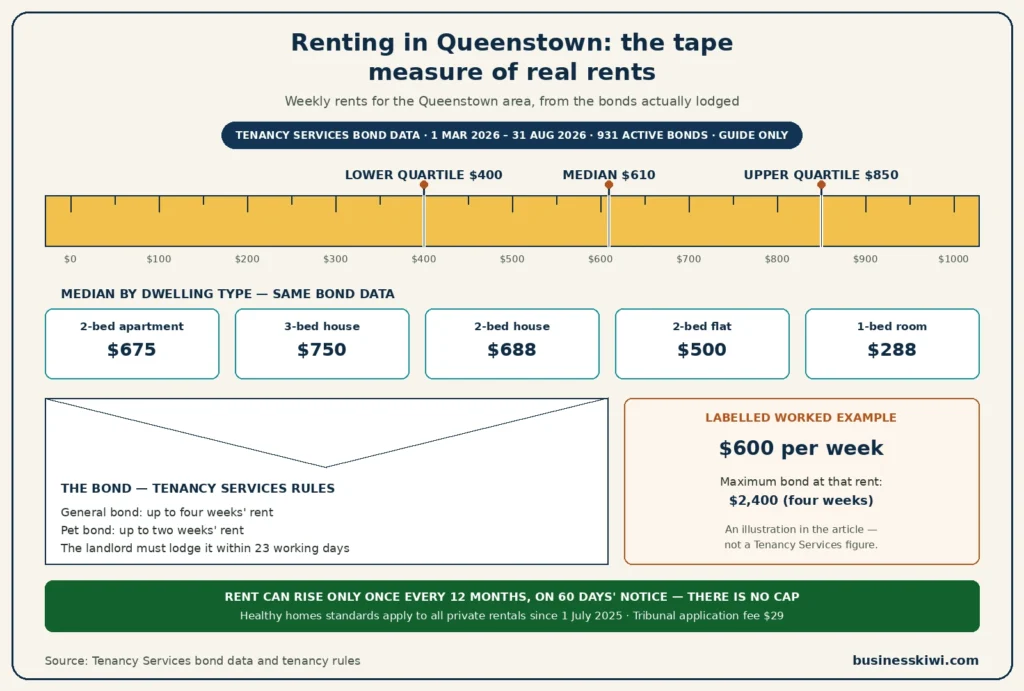
A bond is the security a landlord holds against unpaid rent or damage, and Tenancy Services sets its rules. A landlord can charge a general bond of up to four weeks’ rent. Where a pet bond applies, tenants should budget for up to two weeks’ rent for that as well, the maximums Tenancy Services publishes. On a worked example only, a tenancy at $600 a week could carry a bond of up to $2,400. That is arithmetic on a round example, not a Queenstown figure.
The process matters as much as the amount. You must be given a receipt. If you pay the bond to the landlord, the landlord must lodge it with Tenancy Services within 23 working days of receiving it. Lodging late is against the law and can attract a penalty. If you have not received confirmation of lodgement within six weeks, Tenancy Services advises contacting the landlord, because a bond that was never lodged is a common source of trouble later.
Before you move in, do the initial inspection properly: Tenancy Services recommends a thorough inspection with the landlord, with the property inspection report completed and signed by both parties, noting existing marks and damage room by room. That report is the baseline the bond refund is judged against.
Two more bond points catch people out. If your rent increases, the landlord can ask you to top up the bond to match, and that extra amount must also be lodged within 23 working days. At the end, the refund runs on agreement: both parties inspect together, agree the final inspection report, and only then does the landlord submit a bond refund request. Check the amount on the refund form before you confirm it. If you cannot agree, the Tenancy Tribunal can decide. Work and Income can also help with bond and accommodation support for people who meet the criteria.
Inspections during the tenancy
Landlords are entitled to inspect a rental property, and in a professionally managed market like Queenstown’s you should expect regular inspections. An inspection can take place between 8am and 7pm, no more often than once every four weeks. The landlord must give you at least 48 hours’ notice, and the notice cannot be given more than 14 days in advance.
You do not have to be present, but the landlord should ask whether you want to be. If you will be out, you can leave a note about anything you want checked, a practical way to raise maintenance issues. Landlords are advised to bring the original inspection report and to take photos, taking care not to include the tenant’s belongings where possible. If a reinspection is needed because you agreed to fix or clean something by a set date, the same 48 hours’ notice applies again. Entry outside these rules is not something you have to accept.
Rent and rent increases
Rent is normally paid weekly or fortnightly, with the amount, frequency and payment method set out in the agreement. The rules governing increases matter most, because they decide how stable your housing costs will be after you move in.
Tenancy Services states the position plainly. A landlord can only increase rent once in every 12-month period: the increase cannot take effect within 12 months of the tenancy start date, or within 12 months of the last increase taking effect. The landlord must give at least 60 days’ written notice, stating the new rent and the day it takes effect. In a fixed-term tenancy, rent can only be increased if the agreement itself allows for it. The law does not set a cap on how large an increase can be.
There are narrow exceptions. An increase outside the 12-month restriction is possible if the tenant agrees and the landlord has substantially improved the property or provided better facilities for the tenant’s benefit, or the agreement has been changed to the tenant’s benefit. A landlord can also ask the Tenancy Tribunal to order an increase in specified circumstances. If you believe your rent is substantially above the rent for similar properties, you can negotiate, and if needed apply to the Tribunal to have it reviewed. Fixed-term tenants must apply within set windows, including within three months of the tenancy beginning. The Tenancy Services market rent tool, covered below, is the official yardstick for that comparison, though it gives an indication only.
Healthy homes: warmth is not optional
Queenstown winters are alpine winters. A house that is hard to heat is not just uncomfortable here, it can be non-compliant. All private rental properties in New Zealand have had to meet the healthy homes standards since 1 July 2025, and the landlord is responsible for keeping the property at that standard.
The standards have five parts. For heating, the landlord must provide one or more fixed heaters that can directly heat the main living room, of an acceptable type and with at least the required heating capacity for that room. For insulation, ceiling and underfloor insulation has been compulsory in rentals since 1 July 2019, and some existing insulation has to be topped up or replaced. For ventilation, each livable space must have a window or door that opens to the outside and can be fixed open, and kitchens and bathrooms must have extractor fans. For moisture ingress and drainage, the property must have efficient drainage, guttering and downpipes, and a ground moisture barrier where there is an enclosed sub-floor. For draught stopping, landlords must block unreasonable gaps and holes that cause noticeable draughts.
Enforcement has teeth. A landlord who does not meet healthy homes obligations is in breach of the Act and may face financial penalties of up to $7,200. The signed compliance statement that must appear in new or renewed agreements carries its own penalty of up to $500 per tenancy if it is missing. As a tenant, you can ask the landlord for information about how the property complies, and the landlord must provide it within 21 days.
Short-term letting versus a long-term tenancy
The boundary between a holiday let and a rental home is drawn in two places: tenancy law, and QLDC’s district rules. Knowing which side of the line your arrangement sits on tells you which protections you have.
Under QLDC’s published rules, short-term visitor accommodation means hosting paying guests for any period under 90 days. The council offers a blunt clarification on its own page: if the same paying guests stay for 90 days or more, they are classed as tenants and the property is classed as a rental. Within the short-stay side of the line, the council runs three categories. Residential Visitor Accommodation covers a home or flat let to guests for under 90 days; the operator must register with the council and meet the standards for the property’s zone. Homestay accommodation, where the host lives at the property while guests stay, must also be registered and is capped at five paying guests per night in most zones. Hotels, motels, backpackers, managed apartments and staff accommodation fall under Visitor Accommodation and require a resource consent.
The council also uses the rates system to steer behaviour. A property available to short-term visitors for up to 28 days in total faces no rates impact. Beyond that, homestays and Residential Visitor Accommodation operating under 180 days are rated Mixed Use, lifting rates by 25 to 35 percent, and operations of 181 to 365 days are rated Accommodation, lifting rates by 50 to 80 percent. Operating unlawfully can draw Resource Management Act enforcement, and rates can be adjusted without notice.
For someone looking for a home, the practical points are these. A property marketed by the night is visitor accommodation regulated by the council, not a tenancy, and booking one does not give you tenancy rights. A genuine long-term letting, documented in a tenancy agreement, sits under the Residential Tenancies Act, with a lodged bond, inspection rules and Tribunal access. Seasonal workers are sometimes housed in arrangements between the two, including rooms provided alongside a job. If you sign a tenancy agreement, you are a tenant under the Act. If you do not, as with flatmate arrangements, the Act may not cover you, and Tenancy Services directs disputes in living arrangements outside tenancy law to the Disputes Tribunal instead. Before accepting accommodation tied to a job, ask what document you will sign and whether a bond will be lodged.
Finding a rental and applying
Tenancy Services suggests working several channels at once: searching online, local newspaper classifieds, your own networks, community noticeboards and local social media pages, and asking at real estate agencies and property management companies. In Queenstown, employer networks matter too, since many workers find rooms and houses through the businesses that hire them.
A landlord will usually ask you to complete a pre-tenancy application form. As Tenancy Services describes it, the form covers your name and contact details, where you are living now and your renting history, your ID details, and references the landlord can contact. It also records your permission for a credit check, which should only be run on the landlord’s preferred applicant, not on everyone who applies.
Privacy law limits what can be collected. Under the Privacy Act 2020, as Tenancy Services summarises it, a landlord must have a lawful purpose connected to the tenancy for collecting your information and must not collect more than is necessary. You should not be asked what you spend your income on, or what religion you belong to, although a credit check to assess creditworthiness is legitimate. The landlord must tell you why the information is being collected, what it will be used for and who it will be shared with. It cannot be used for another purpose or shared without your agreement, it must be stored securely, and you have the right to see it and have it corrected.
Discrimination is separately unlawful. A landlord cannot refuse to rent to you, or end your tenancy, for reasons that breach the Human Rights Act. Tenancy Services gives two clear examples: a landlord cannot turn you down because of the church you attend, and cannot rewrite an agreement after signing because they learn you are unemployed. Breaches can be taken to the Tenancy Tribunal or the Human Rights Commission.
The money side of applying is tightly regulated. Landlords and their agents cannot charge you a letting fee. That ban has been in place since 12 December 2018 and covers charges to renew or extend a tenancy as well. Letting agents can charge the landlord for their work, never the tenant. Key money, any payment other than rent and bond demanded for granting or changing a tenancy, is also prohibited. The single exception is an option fee paid to hold a property while you decide: capped at one week’s rent, and refundable or credited to your rent if you go ahead. Get the option arrangement in writing, including how long you have to decide. Your real upfront costs are the bond and rent in advance under the agreement. Anyone who asks you for a letting fee or key money is asking for something the law does not allow, and that is a warning sign about the tenancy itself.
If things go wrong: rights, mediation and the Tenancy Tribunal
Most tenancy problems are mundane: a repair not done, a disagreement over cleaning or damage, an inspection notice that arrived late. The system expects you to raise issues early, keep records, and put things in writing, because that paperwork is the evidence base for everything that follows.
If talking does not resolve a problem, the Tenancy Tribunal is the formal route. An application to the Tribunal is also how you access mediation and the FastTrack resolution process: once you apply, Tenancy Services will either offer scheduled mediation, formalise a FastTrack application, or schedule a hearing. Many disputes settle at mediation.
Applying is deliberately cheap and simple. The application fee is $29, paid by the person applying. If you are on a benefit, Work and Income may be able to help with the fee. If your application succeeds, the Tribunal can order the other party to repay your application fee, but you must ask for that when you apply; the same point can be settled as part of a mediation agreement. Applying online takes about 10 minutes and the form can be saved for up to 30 days. You will need a RealMe login, your bond number if you have one, and electronic copies of your agreement and supporting documents. Paper forms exist for those who need them, and if an application has been made against you, you can file a cross-application and ask for both to be heard together. Withdrawing an application does not get the fee back, except where you paid twice or paid without submitting.
Ending a tenancy
For a periodic tenancy, one that has no end date, the tenant’s obligation is simple: at least 21 days’ written notice, with no reason needed. If one tenant on a joint periodic tenancy gives notice, it ends the tenancy for everyone named.
The landlord’s position has two tiers. A landlord can end a periodic tenancy with 90 days’ written notice without giving a reason, provided the notice is not retaliatory. Shorter notice of 42 days is available only in specific situations: the owner or a member of their family needs the property as their main home, moving in within 90 days of the tenancy ending and living there for at least 90 days; the property is usually used to house the landlord’s employees or contractors, or was bought for that purpose, and that was clearly stated in the tenancy agreement; or the property has been sold under an unconditional agreement that requires vacant possession. Where a landlord gives less than 90 days’ notice, the reason must be stated in the notice. Every notice must be in writing, show the tenancy address and the end date, and be signed. If your landlord gives you 90 days and you want to leave earlier, you can, but you must still give your own 21 days’ notice. A tenant affected by family violence can also withdraw from a tenancy on at least two days’ written notice in the approved form with qualifying evidence, without financial penalty.
Fixed-term tenancies work differently. A fixed term can usually only be ended early if both parties agree, or in limited situations set out in the Act. When the term expires, the tenancy does not simply end. If neither side gives proper written notice, it automatically becomes a periodic tenancy. Either party who wants the tenancy to finish at the end of the fixed term must give written notice within what Tenancy Services calls the effective period, the window that starts on the 90th day before expiry and ends on the 21st day before expiry. No reason is needed. Alternatively, both parties can agree in writing to renew or extend for a further fixed term, signed by both. Short fixed-term tenancies of 90 days or less are the exception: they end on the agreed date, do not convert to a periodic tenancy, and no notice is required, which is precisely why seasonal workers should check the term length before relying on a home continuing.
What rents actually look like: the official figures
Almost every rent figure quoted for Queenstown comes from listing websites or property companies, and none of it is official. There is one exception, and it is the source worth using. Tenancy Services publishes market rent statistics built from bonds lodged by landlords. The figures are updated monthly, cover the previous six months of bond information excluding the most recent month, and are expressed as weekly rent. Tenancy Services is upfront about the limits: the data is a useful guide, but it should not be used alone to determine the market rent of any property, because it says nothing about an individual home’s condition or features.
For the Queenstown market rent area, the Tenancy Services figures for 1 March 2026 to 31 August 2026, drawn from 931 active bonds, put the median weekly rent at $610. The middle half of tenancies in that area sat between the lower quartile of $400 and the upper quartile of $850 a week. The breakdowns by dwelling type show how wide the spread is. Two-bedroom apartments recorded a median of $675 a week, three-bedroom houses $750, two-bedroom houses $688, and two-bedroom flats $500. A single room, the entry point for many seasonal workers, recorded a median of $288 a week.
Read those numbers the way Tenancy Services presents them: as a snapshot of rents on bonds active in that area over six months, not as the asking price for the next property you view. Check the area and dwelling type that match the home you are considering, and check again close to the time you sign, because the window rolls forward every month. If your landlord proposes a rent well above the comparable figures, this data, rather than anything on a listings site, is the evidence base both sides and the Tribunal will take seriously.
Frequently asked questions
How much bond can a landlord charge me in Queenstown?
The bond is capped by national law, not by the local market. A landlord can charge a general bond of up to four weeks’ rent, and a pet bond of up to two weeks’ rent where one applies. You must receive a receipt, and the landlord must lodge the bond with Tenancy Services within 23 working days.
Can a landlord or agent charge me a letting fee?
No. Letting fees have been prohibited since 12 December 2018, and the ban includes any charge to renew or extend a tenancy. Letting agents charge the landlord for their services, not the tenant. Key money, any extra payment other than rent and bond demanded to grant a tenancy, is also banned. The only exception is an option fee to hold a property while you decide, capped at one week’s rent and refundable or credited to rent if you proceed.
How often can my rent be increased?
Once every 12 months at most. An increase cannot take effect within 12 months of the tenancy starting or within 12 months of the last increase taking effect, and the landlord must give at least 60 days’ written notice stating the new rent and the date it starts. In a fixed-term tenancy, an increase is only possible if the agreement allows it. There is no legal cap on the size of an increase.
How much notice must I get before a property inspection?
At least 48 hours, and no more than 14 days ahead. Inspections can only happen between 8am and 7pm and no more often than once every four weeks. You do not have to be home, though the landlord should ask if you want to be there.
What happens when my fixed-term tenancy ends?
Unless someone acts, it automatically becomes a periodic tenancy. To end it on the expiry date, either party must give written notice within the effective period, between 90 and 21 days before the term ends, or both can agree to renew or extend it in a signed written agreement. A short fixed term of 90 days or less is different: it ends on the agreed date and does not roll over.
How much notice do I need to give to leave?
On a periodic tenancy, at least 21 days’ written notice, with no reason required. A landlord needs 90 days’ written notice without a reason, or 42 days in the specific situations the law allows, such as the owner or their family moving in, employee accommodation stated in the agreement, or a sale requiring vacant possession.
What does it cost to apply to the Tenancy Tribunal?
The application fee is $29, paid by the person applying, and applying is also the way to access mediation or FastTrack resolution. Work and Income may help with the fee if you are on a benefit. If you succeed, the Tribunal can order the other party to repay the fee, provided you asked for that in your application.
Where can I check official rent figures for Queenstown?
Use the market rent tool on the Tenancy Services website. It publishes weekly rent statistics from bond data, updated monthly over a rolling six-month window, for areas including Queenstown, Arthurs Point and Dalefield. For the Queenstown area in the six months to 31 August 2026, the median was $610 a week across 931 active bonds. Treat the figures as a guide, not as a valuation of a specific property.
Sources
- Tenancy Services, “Rent increases and reductions”, tenancy.govt.nz
- Tenancy Services, “Ending a periodic tenancy”, tenancy.govt.nz
- Tenancy Services, “Preventing problems with bonds”, tenancy.govt.nz
- Tenancy Services, “Tenancy agreements”, tenancy.govt.nz
- Tenancy Services, “Healthy homes compliance”, tenancy.govt.nz
- Tenancy Services, “Inspections”, tenancy.govt.nz
- Tenancy Services, “How to apply to the Tenancy Tribunal”, tenancy.govt.nz
- Tenancy Services, “Letting fees and key money”, tenancy.govt.nz
- Tenancy Services, “Information for new tenants”, tenancy.govt.nz
- Tenancy Services, “Pre-tenancy applications”, tenancy.govt.nz
- Tenancy Services, “Expiry of a fixed-term tenancy”, tenancy.govt.nz
- Tenancy Services, Market rent tool, Queenstown area, tenancy.govt.nz
- Queenstown-Lakes District Council, “Short Term Accommodation”, qldc.govt.nz
This article is general information about renting in Queenstown and New Zealand tenancy law as published by Tenancy Services and Queenstown-Lakes District Council. It is not legal advice and does not cover every situation. Tenancy rules and market rent figures change over time, so check the Tenancy Services website for the current position before you act, and seek advice from Tenancy Services, a Community Law Centre or a lawyer for your specific circumstances.