Spousal Maintenance in NZ: Who Can Apply, How the Family Court Decides and How Long It Lasts

When a marriage, civil union or de facto relationship ends, the two households that replace it rarely start on equal footing. One partner may have spent years out of the paid workforce raising children, while the other built a career and a much higher income. Spousal maintenance is the legal mechanism that can require the better-off former partner to help cover the other person’s reasonable living costs for a time, while both adjust to supporting themselves.
Maintenance is often misunderstood. It is not an automatic payment that follows every separation, not a formula or a percentage of income, and not the same thing as child support or dividing up property. It is a needs-based obligation under the Family Proceedings Act 1980, and whether it is payable at all depends on the circumstances of the two people involved.
This guide explains who can apply, the legal test the Family Court applies, how the court approaches the amount and the duration, what happens if circumstances change, how maintenance interacts with Work and Income benefits, and where to get legal advice, including legal aid.
The short answer
Spousal maintenance is a payment one former partner makes to the other, as regular payments, a lump sum, or both, because that person cannot practicably meet their own reasonable needs and the law says the former partner should help. The obligation comes from Part 6 of the Family Proceedings Act 1980.
Three points matter most. First, there is no formula and no standard amount: the court weighs the means and reasonable needs of both people against the factors in the Act. Second, there is no automatic entitlement: an applicant must show they cannot meet their reasonable needs for a reason the Act recognises, such as the effect of how the couple divided work and childcare during the relationship. Third, maintenance is normally transitional: the Act expects each person to take responsibility for their own needs within a reasonable time after the relationship ends, and ongoing maintenance beyond that point is the exception rather than the rule.
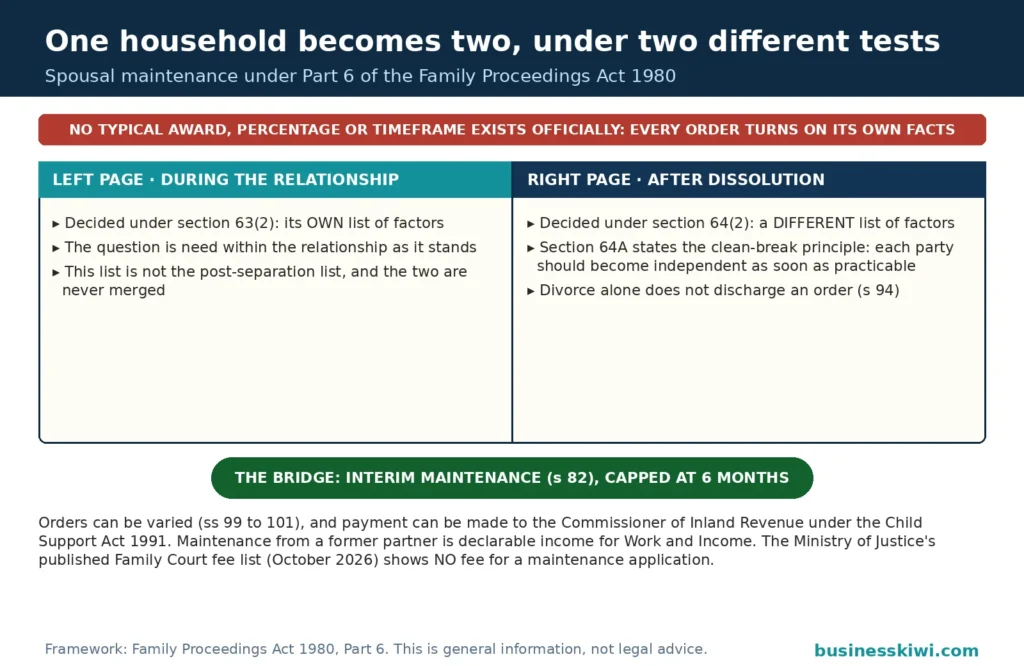
What spousal maintenance is, and what it is not
A maintenance order is a Family Court order requiring one person to pay money for the support of a former spouse or partner. The Ministry of Justice describes maintenance as payments a court might order one person to make to a former partner to help cover their costs of living, whether as regular payments over a set period or as a lump sum. It tends to arise where one person’s income and standard of living will be much lower than the other’s after the relationship ends, for example a stay-at-home parent compared with the main income earner.
Maintenance is about covering reasonable living costs, not punishing anyone or equalising incomes for life. Two related areas of family law are often confused with it.
It is not child support
Child support is money for the care of children. It sits under a separate scheme, the Child Support Act 1991, administered by Inland Revenue, rather than being set case by case by the Family Court under the Family Proceedings Act. A parent can owe child support with no spousal maintenance involved, and spousal maintenance can be payable where there are no children at all. The two are assessed independently, although the Family Court does take a person’s responsibilities, including supporting other people, into account when it assesses maintenance.
It is not relationship property division
Dividing relationship property is about splitting the assets and debts the couple built up together, under the Property (Relationships) Act 1976. The Ministry of Justice explains that couples can agree the division themselves, and an agreement is enforceable through the court if it is in writing and both partners have had independent legal advice. If they cannot agree, the Family Court can identify the relationship property and decide how it is divided. Deadlines apply: an application generally needs to be made within one year of a divorce, or within three years of a de facto relationship ending, although the court can allow a late application.
Property division deals with the past, sharing what the couple accumulated. Maintenance deals with the future: one person’s ongoing ability to meet living costs after separation. The two are connected, though, because the court must consider the means each person has as a result of the property division when it assesses maintenance.
Who can apply for spousal maintenance
Spouses and civil union partners can apply for a maintenance order while the marriage or civil union is still in place, on the ground that the other party is liable to maintain them under the Act. Applications are heard and determined in the Family Court. After a marriage or civil union has been dissolved, either former spouse or partner can apply against the other. An order can in some circumstances be sought against a deceased former partner’s estate, if applied for within 12 months of the grant of administration in New Zealand, a deadline the court can extend where the application precedes the estate’s final distribution.
De facto partners are covered too, but the position is slightly different. The Act provides for maintenance orders after de facto partners have stopped living together, using definitions drawn from the Property (Relationships) Act 1976. For a de facto relationship of short duration, however, the court cannot make a maintenance order after the relationship ends unless there is a child of the relationship, or the person applying made a substantial contribution to the relationship, and in either case the court must also be satisfied that refusing to make an order would result in serious injustice.
The legal test the Family Court applies
Section 61 of the Family Proceedings Act 1980 provides that in maintenance proceedings the court applies the principles set out in sections 62 to 66 of the Act. The core principle is needs-based: one party is liable to maintain the other to the extent necessary to meet the other person’s reasonable needs, where that person cannot practicably meet those needs themselves for a reason the Act recognises. If a person can meet their own reasonable needs, the liability does not arise.
During a marriage or civil union
While a marriage or civil union is still in place, each party is liable to maintain the other where the other cannot practicably meet their reasonable needs because of any of the circumstances in section 63. Those circumstances include:
- the effect of the division of functions in the relationship on each person’s ability to support themselves, or to become self-supporting, taking account of their likely earning capacity and any other relevant circumstances
- responsibilities either person has for the ongoing daily care of minor or dependent children of the relationship, after the couple have stopped living together
- the standard of living the couple had while they were together
- any physical or mental disability
- being unable to get work that it is reasonable to do and that would pay enough to live on
- a reasonable period of education or training that would increase earning capacity, where it would be unfair to expect the person to support themselves straight away, including where that person supported the other partner through their own training
After a divorce, or after de facto partners separate
Section 64 applies a similar test once a marriage or civil union has been dissolved, or de facto partners have stopped living together. Each party can be liable to maintain the other to the extent necessary to meet their reasonable needs, where the other cannot practicably meet them because of the division of functions during the relationship (including any de facto period immediately before a marriage or civil union), day-to-day care of minor or dependent children, the standard of living while the couple lived together, or the education and training situation described above. Outside these provisions, neither party is liable to maintain the other after a divorce or after a de facto relationship has ended.
The clean break expectation
Section 64A then adds the principle that shapes how long maintenance lasts. Each party must assume responsibility for their own needs within a reasonable time after the divorce, or after de facto partners stop living together. Once that reasonable time has passed, neither party is liable to maintain the other under section 64. There is an exception: one party remains liable, to the extent necessary to meet the other’s reasonable needs, if the court considers it unreasonable to expect the person seeking maintenance to manage without it, and reasonable to require the other to keep paying. In deciding that, the court looks at the ages of the parties, how long the relationship lasted, each person’s ability to become self-supporting in light of the division of functions, likely earning capacity and any ongoing daily care of children, and any other relevant circumstances.
In practice, maintenance is usually ordered for a defined transition period, long enough for the lower-earning partner to retrain, increase hours or reorganise their life. Longer orders tend to be reserved for older applicants, long relationships, disability or ongoing care of children, where self-support within a reasonable time is not a realistic expectation.
How the court works out the amount
Once liability is established, section 65 lists what the court must take into account in deciding whether to make an order and for how much: the means of each party, including potential earning capacity, not just current income, and including any means a person has because of how the relationship property was divided; the reasonable needs of each party; the fact that the paying party may be supporting someone else; the financial and other responsibilities of each party; and any other circumstances that make one party liable to maintain the other. Potential earning capacity is assessed against the background of how the couple divided functions during the relationship, and the standard of living during the relationship can inform what counts as reasonable needs.
Two further principles complete the picture. Under section 62, the fact that a person’s reasonable needs are being met by a benefit does not remove the other party’s liability to maintain them. And under section 66, conduct plays only a narrow role: the court may consider behaviour by the person seeking maintenance that is really a device to prolong their inability to meet their own needs, and misconduct so serious that it would be repugnant to justice to require the other party to pay. Ordinary arguments about who behaved badly are not the basis of a maintenance decision.
Interim maintenance while the case is decided
Court proceedings take time, and living costs do not wait. Section 82 of the Act allows for interim maintenance. Once an application for a maintenance order has been filed (or an application to vary, extend, suspend or discharge one), a District Court Judge can order the other party to pay a periodical sum the Judge thinks is reasonable towards that partner’s future maintenance, until the case is finally decided or the interim order stops sooner. An interim order can last no more than six months, and it can be varied, suspended, discharged or enforced in the same way as a final Family Court order.
How the court decides the amount and how long it lasts
Because the test is built on reasonable needs and means, no percentage, table or calculator can tell you what maintenance will be in a given case. No official figure, average or typical award exists, and any website quoting one should be treated with caution. The court works out what one person reasonably needs, what they can realistically provide for themselves, and what the other can fairly be required to pay after their own reasonable needs and responsibilities are met.
An order can take different forms. On an application made during a marriage or civil union, the Family Court can order periodical payments for a period it thinks fit, not exceeding the joint lives of the parties, a lump sum towards future maintenance, a lump sum towards past maintenance, or a combination, with a lump sum payable at a future date, by instalments, or on terms. After a divorce or the end of a de facto relationship, the court can order periodical payments for a term it thinks fit, not exceeding the life of the person receiving them, with the lump sum options available as well.
How the money flows is also set by the Act. Money payable under a maintenance order is paid to the Commissioner of Inland Revenue, in accordance with the Child Support Act 1991, unless the court directs otherwise. The court can instead direct payment to the person being maintained, into their bank account, or to another person, and a lump sum can be directed to Public Trust or a trustee the court approves. Orders are enforced under the Child Support Act 1991, with Inland Revenue required to act to give effect to the order.

Applying to the Family Court
The first route is agreement. Many couples settle maintenance between themselves as part of an overall separation agreement, negotiated directly or with lawyers, without the court deciding anything. Such an agreement is usually faster, cheaper and more flexible than litigation, and the Ministry of Justice encourages people to talk to a lawyer about their rights and obligations when they separate. If agreement is not possible, either party can apply to the Family Court for a maintenance order.
An application is filed at the Family Court using the court’s application forms, supported by evidence about each person’s income, assets, expenses and circumstances, because the whole test turns on means and needs. Forms are available from the court and the Ministry of Justice, and court staff can help with filing. The other person is given the application and can respond, and a Judge then decides, if necessary after a hearing. Applicants should expect to document their budgets, earnings and efforts to support themselves, because the decision depends on full and honest financial disclosure.
On fees, the Ministry of Justice’s published list of Family Court application fees, as at October 2026, does not include a fee for a maintenance application, although some related applications, including an application for an order about relationship property, do carry fees, so check the current list before filing anything. Beyond filing fees, the Ministry notes that people may face lawyer’s fees if they do not have legal aid, and the court can make cost contribution orders in some cases.
Changing or ending a maintenance order
Maintenance orders are not set in stone. Under section 99 of the Act, the Family Court or the District Court can, at any time and having regard to the same principles in sections 62 to 66, discharge a maintenance order, vary or suspend it in whole or in part, discharge it and substitute a new order, or extend its term. This applies even where the original order was made by consent. If an order is discharged or otherwise ends, arrears already owing at that point remain recoverable unless a court remits them, and the court has power to remit arrears and to suspend their payment. A variation that increases the amount can be backdated to when the grounds for the change arose.
Some events end orders by operation of the Act rather than by fresh application. A periodical payments order, and an order for a lump sum towards future maintenance, cease to have effect if the person receiving maintenance marries or enters a civil union, unless the parties have agreed otherwise. For orders made after a divorce or the end of a de facto relationship, the court cannot make an order at all for someone who has since married, entered a civil union, or entered a de facto relationship with another person, and existing orders of that kind cease to have effect when the recipient does any of those things, again subject to any agreement to the contrary. On the other hand, divorce by itself does not discharge a maintenance order: section 94 says a dissolution does not, of itself, end the order. People with an existing order who are divorcing should get legal advice about how the order is affected.
Spousal maintenance and Work and Income benefits
Maintenance and benefits interact in both directions. On the liability side, section 62 of the Family Proceedings Act is explicit: a person’s liability to maintain a former partner is not extinguished just because that person’s reasonable needs are being met by a benefit under the Social Security Act 2018. The paying partner cannot argue that a benefit ends the matter.
On the practical side, if you receive a benefit or other help from Work and Income, maintenance counts as income. Work and Income’s application forms list maintenance payments, and payments from a former partner, among the income sources you must tell them about, and its guidance is that income must be declared so payments can be set correctly. Starting, stopping or changing maintenance, and the separation itself, should be reported promptly, because they can change your entitlement. For example, Inland Revenue shares child support payment information with Work and Income, which treats the payments as income averaged over the following weeks and adjusts benefit payments accordingly. Maintenance is a different payment from child support, but the underlying rule is the same: money coming in from a former partner is income Work and Income needs to know about.

Getting legal advice and legal aid
Spousal maintenance is an area where early advice pays off, because the outcome depends on detailed evidence about income, earning capacity, budgets and the history of the relationship. The Ministry of Justice notes that it can be helpful to talk to a lawyer when applying to, or going through, the Family Court, and that a lawyer can help with forms, applications and representation.
If cost is a barrier, there are several official routes to help. Community Law Centres operate throughout New Zealand and help with family problems as well as other areas of law. The Family Legal Advice Service provides free initial legal advice for people who qualify for it, usually one or two meetings with an approved lawyer, once every 12 months; it can explain rights, responsibilities and options, but its lawyers cannot represent you in court. For ongoing representation, legal aid is government funding that helps people who cannot afford a lawyer to pay for one, and for family cases a lawyer helps you apply. Legal aid is treated as a loan: you may have to repay some or all of it, depending on the type of case, how much you earn, what property you own, and whether you receive money or property because of the case. The Ministry’s website has a legal aid lawyer finder and eligibility detail.
Even if you plan to represent yourself, get advice before you file, or before you sign a separation agreement covering maintenance. An agreement signed without understanding the Act’s tests, and without independent legal advice, can leave one party under-supported or the other paying more than a court would order.
Frequently asked questions
Is there a formula or percentage for working out spousal maintenance?
No. Unlike child support, which Inland Revenue assesses under its own scheme, spousal maintenance has no formula. The Family Court applies the factors in sections 62 to 66 of the Family Proceedings Act 1980 to the evidence about each person’s means, earning capacity, responsibilities and reasonable needs.
How long does spousal maintenance usually last?
There is no standard period. The Act expects each person to assume responsibility for their own needs within a reasonable time after the relationship ends, so orders are commonly made for a set transition period, and can be longer where age, a long relationship, disability or ongoing care of children makes self-support unrealistic in that time.
Can I get maintenance if I am receiving a benefit?
Receiving a benefit does not remove a former partner’s liability. Section 62 of the Act says the liability is not extinguished because your reasonable needs are met by a benefit. You do need to tell Work and Income about maintenance you receive, because it is treated as income and can affect your payments.
Does spousal maintenance stop if I repartner or remarry?
Usually, yes. Periodical maintenance, and a lump sum for future maintenance, stop if the recipient marries or enters a civil union, unless the parties agreed otherwise. For orders made after a divorce or the end of a de facto relationship, entering a new de facto relationship also ends the order, on the same basis. The paying partner’s new relationship does not automatically end an order, though it may support a variation application.
Can a maintenance order be changed if circumstances change?
Yes. Either party can apply under section 99 of the Act, and the court can vary, suspend, extend or discharge the order, or replace it with a new one. Job loss, illness, a new child, retirement or a significant change in care arrangements are the kinds of changes that can justify an application. Arrears already accrued usually remain payable unless the court remits them.
What if my former partner stops paying?
If the payments are under a court order, the order is enforceable under the Child Support Act 1991 machinery, with Inland Revenue required to act to give effect to it. If payments rest only on a private agreement, enforcement depends on the agreement’s terms, which is why agreements are best recorded properly with independent legal advice, or converted into a court order where security matters.
Do I need a lawyer to apply for maintenance?
No. You can apply yourself, and court staff can help with forms and filing. Because so much turns on financial evidence and the statutory factors, legal advice is recommended. Legal aid may be available if you cannot afford a lawyer, free initial advice may be available through the Family Legal Advice Service if you qualify, and Community Law Centres help with family matters.
This article is general information about New Zealand law only. It is not legal advice, and it does not cover every situation. Spousal maintenance outcomes depend heavily on individual circumstances, so talk to a family lawyer, a Community Law Centre or a legal aid lawyer about your own situation before applying, agreeing or signing anything.
Sources
- Ministry of Justice, Divide relationship property, justice.govt.nz
- Ministry of Justice, Family Court fees and funding, justice.govt.nz
- Ministry of Justice, Get legal advice and help, justice.govt.nz
- New Zealand Legislation, Family Proceedings Act 1980, legislation.govt.nz
- Work and Income, Child support, workandincome.govt.nz
- Work and Income, Declare income, workandincome.govt.nz
- Work and Income, Income and assets form, workandincome.govt.nz