Partnership Visa Support Letters: What to Include, With Example Structure

Someone who cares about you has asked for a letter. Or perhaps you are the applicant, working through a partnership application, and a friend has offered to write one. Either way, the same questions come up. What is Immigration New Zealand (INZ) actually looking for in these letters? Who should write them? And what separates a letter that genuinely helps an officer understand a relationship from one that adds bulk to a file and nothing more?
This guide answers those questions using INZ’s own published guidance on partnership applications. It is about the letters written by friends, family members, colleagues and others who know a couple well. It does not cover letters you write to INZ about your own application, such as cover letters. For those, see our guide to writing a letter to Immigration New Zealand.
One point before anything else: INZ does not publish a set format for support letters, and no letter, however heartfelt, decides an application on its own. Officers decide partnership cases on the whole body of evidence. A good letter is one useful piece of that picture.
Quick answer
- Support letters for a partnership application are written by people who know the couple, such as family, friends, flatmates, colleagues or community members, and who can describe the relationship from their own observation.
- INZ assesses whether a couple are living together in a relationship that is credible, genuine and stable. Letters speak most directly to one part of that test: whether other people recognise the relationship.
- INZ publishes no required format, no set number of letters and no template. What carries weight is specific, first-hand detail that only someone who knows the couple could supply.
- Each letter should stand on its own. Writers should say how they know the couple, how long they have known them, what they have personally seen of the shared life, and how INZ can contact them.
- Letters support the documentary evidence. They do not replace it. Tenancy agreements and shared accounts do the heavy lifting on the living together requirement.
What INZ is actually assessing
Everything in a support letter should be written with the assessment in mind, so it helps to understand what that assessment is.
INZ defines a partnership as two people who live together in a genuine and stable partnership, whether that is a legal marriage, a civil union or a de facto relationship. For a partnership visa, an officer has to be satisfied on more than the label. INZ’s own partnership guidance puts it this way: the couple must be living together, and the relationship must be credible, genuine and stable. Credible means the story holds together and can be believed. Genuine means the relationship exists for its own sake, entered into with the intention of lasting, rather than arranged to obtain a visa. Stable means it looks likely to endure. Living together means sharing the same home as partners. INZ’s instructions are explicit that keeping separate homes and visiting each other, staying together on holiday, or sharing a house as flatmates does not amount to living together.
A marriage certificate on its own does not satisfy any of this. INZ states plainly that marriage alone is not sufficient evidence, and that couples need to provide a range of documentation. The responsibility for proving the relationship sits with the applicant, not with INZ.
Within that framework, officers work through the facts of each couple’s life. INZ’s published instructions list factors such as how long the relationship has lasted, the nature and extent of the couple’s shared home, how far their finances are intertwined, property they own or use together, their commitment to a shared life, any children of the relationship and how they are cared for, how household duties are shared, and the reputation and public side of the relationship. For residence, the couple must also show they have been living together for at least 12 months when the application is lodged, and only evidence from after both partners turned 18 counts.
Letters from people who know the couple cannot speak to most of those factors. A tenancy agreement proves a shared home in a way a letter never will. But one factor on INZ’s list is exactly what letters are for: the reputation and public aspects of the relationship, or, as the visa pages put it, whether other people recognise the relationship. That is the ground a support letter should cover, firmly and specifically.
Where support letters fit in the evidence picture
On its visa pages, INZ lists the kinds of evidence a couple can provide. The list includes marriage or civil union certificates, proof of a shared residence such as a joint mortgage or tenancy agreement, evidence of financial interdependence, birth certificates for children, correspondence addressed to both partners at the same address, photographs together, communication records, evidence of jointly owned assets, joint utility accounts, and documents showing public or family recognition of the relationship.
Support letters sit inside that last category. They are one recognised strand of evidence, not a separate requirement and not a substitute for the documents around them. Published decisions of the Immigration and Protection Tribunal, which hears residence appeals, show how they appear in real files: couples routinely include letters from parents, siblings, friends, employers and church or community members alongside their tenancy agreements, bank records and photographs, and decision makers refer to those letters when weighing whether a relationship is genuine and stable and whether the couple have family and community support.
Two practical consequences follow. First, quantity is not the point. Three letters from people who genuinely know the couple at different points of their life together are worth more than a dozen near-identical notes from acquaintances. Second, a letter works best when it lines up with the documents in the file. If a writer says the couple have lived at a particular address since a particular month, that should match the tenancy evidence rather than contradict it.
There is also a formal statement in every partnership application that should not be confused with these letters. The New Zealand partner completes an official partnership support form: the Partnership Support Form for Residence for a residence application, or the form for partners supporting partnership based temporary entry applications (INZ 1146) for a temporary visa. That form is the partner’s own declaration of support. The letters covered in this guide are different. They come from third parties, and they are about observation, not sponsorship.

Who should write one
The best writer is someone whose connection to the couple gives them something real to say. Common choices include:
- Parents, adult siblings and other close family, especially where they have seen the couple together over a long period or at family events.
- Friends who knew one or both partners before the relationship and have watched it develop.
- Flatmates or former flatmates who have seen the couple’s day to day life at home.
- Employers or colleagues who know the couple socially or can confirm how the relationship is recognised at work.
- Members of a church, sports club, cultural group or community organisation the couple belong to together.
- Neighbours, particularly where the couple’s shared home life is visible to them.
Length of acquaintance matters, but so does quality of contact. A cousin in another country who met the couple once at a wedding has less to offer than a friend who has had dinner at their home every few weeks for two years. A mix of writers often works well: one person who can speak to the early relationship, another who sees the couple’s current household, a family member who can describe how the relationship is treated within the family.
There is no rule that writers must be New Zealand citizens or residents. A parent overseas who hosted the couple, or a friend who lived with them before they moved, may have highly relevant things to say. If a letter is written in a language other than English, INZ’s document rules require a translated version to accompany the documents, so arrange a full translation rather than a summary.
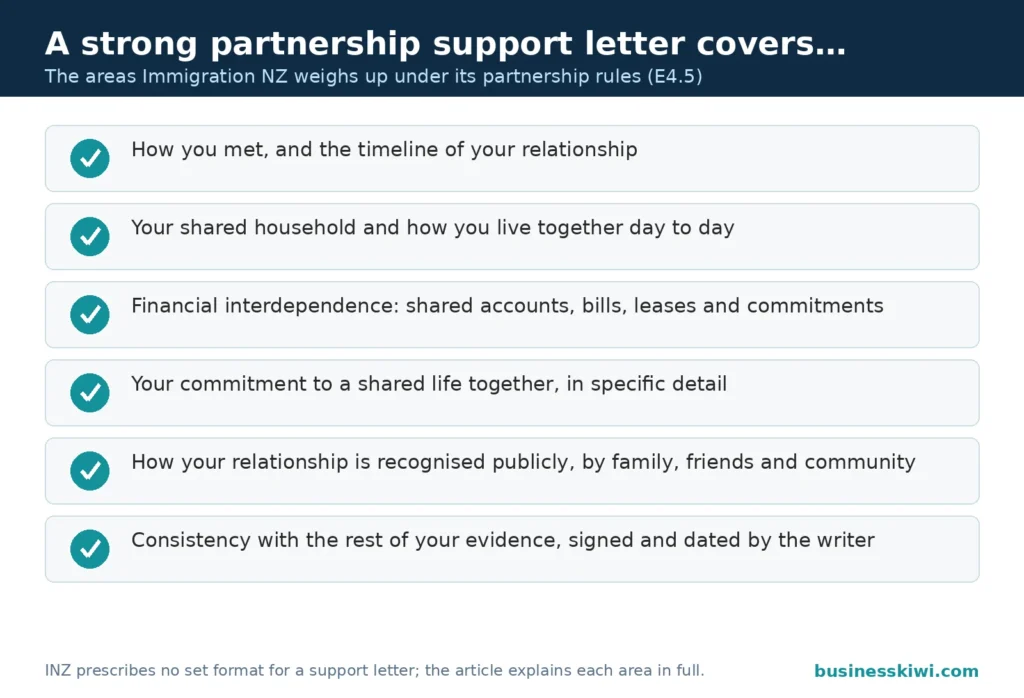
What a strong letter covers
Because INZ sets no format, the shape of the letter is up to the writer. The elements below are the ones that make a letter useful to an officer reading it cold.
Who the writer is. Full name, where they live, what they do, and their own circumstances in a line or two. This is the foundation of the letter’s credibility. An officer should be able to tell immediately whose voice this is.
How the writer knows the couple. The connection to each partner, how they met, and how long they have known them. Knowing one partner well and the other through them is fine; the letter should just be honest about it.
How the relationship began, as the writer saw it. When the writer first became aware of the relationship, and in what circumstances. Writers should stick to what they actually witnessed rather than retelling the couple’s own account as if it were their own memory.
Specific observations over time. This is the heart of the letter. Occasions the writer spent with the couple, visits to their home, holidays or events attended together, how the couple function in ordinary life. Dates, places and small concrete details do the work here. One remembered evening tells an officer more than a paragraph of general praise.
The public and family side of the relationship. Whether the couple are treated as a couple by their family and community: invitations addressed to both, roles at family events, how they are introduced, whether they are recognised as partners in the writer’s workplace, congregation or club.
The household, where the writer has seen it. For writers who have been in the couple’s home, ordinary observations about shared living (cooking, chores, shared space, caring for children or pets) speak directly to the living together picture.
A clear closing. The writer should confirm the letter is their own honest account, give a phone number and email address, and say they are willing to be contacted by INZ. INZ’s guidance says it may verify information provided in an application, so contact details are not a formality.
Signing and dating the letter is sensible practice: it fixes the account in time and shows who stands behind it. Nothing on INZ’s partnership pages requires these letters to be sworn or made as statutory declarations, and writers should not feel they need a lawyer’s involvement simply to describe what they have seen.

Example structure
The following structure is a guide to organising your own words, not a script. Every heading should be answered from the writer’s own experience, in the writer’s own voice.
- Heading and date. Writer’s full name and address, the date, and a line identifying whose application the letter supports.
- Introduction. Who the writer is, and the short version of how they know the couple.
- How I know them. The fuller account: how the writer met each partner, how long they have known them, how often they are in contact.
- What I have seen of the relationship. Two or three specific episodes or patterns, with approximate dates: meeting the partner for the first time, visiting their home, a family occasion, a trip, a difficult period the couple handled together.
- The couple in our family and community. How the relationship is recognised by the people around it.
- Closing. A plain statement that the writer believes the relationship is genuine and ongoing, their contact details, and their willingness to answer questions. Signature.
To show the tone rather than the whole letter, here is one illustrative middle paragraph, written for a fictional couple:
I first met Daniel at a flat warming in Grey Lynn in March 2022, when he and Aroha had just signed the lease together. My wife and I have been to their place for dinner perhaps a dozen times since, and they come to us most months. When Aroha’s father was in hospital in Hamilton last winter, Daniel drove down with her each weekend for six weeks and stayed with her mother so she was not alone in the house. That is simply how they operate. Nobody who spends time with them would describe them as anything other than a couple building a life together.
Notice what that paragraph does. It names a place and a date, describes repeated contact rather than a single event, and grounds its conclusion in things the writer personally saw. That is the standard to aim for, in your own words and from your own experience.
What to avoid
- Identical or near identical letters. If several writers use the same sentences, the letters stop looking like independent accounts. Officers read these letters side by side, and matching wording undermines every letter in the set.
- Working from a script supplied by the couple. Writers can be told which topics are useful, but the words, memories and judgements must be their own. A letter that sounds coached reads that way.
- Claims the writer cannot know. A friend cannot state when a couple first met if they were not there, or certify what happens inside the couple’s finances. Second hand claims should be framed as what the writer was told, or left out.
- Exaggeration and overstatement. Sweeping declarations about a perfect relationship invite scepticism. INZ acknowledges that partnership assessment involves a high degree of subjective judgement, and measured, believable accounts serve couples better than dramatic ones.
- Dates that fight the documents. A letter saying the couple moved in together in June, attached to a file where the tenancy began in September, creates a problem where none existed. Writers should check the basic timeline with the couple before writing.
- Vagueness. “They are a lovely couple and very much in love” may be true, but it gives an officer nothing to work with. Specifics are the whole value of the letter.
- Anything untrue. INZ warns that providing false or misleading information to an immigration officer is a criminal offence, and allegations of relationships entered into for immigration purposes are taken seriously. A writer who is not comfortable with a claim should not make it.
If INZ asks questions or raises concerns
A support letter does not always have the last word, and that is normal. INZ’s partnership guidance states that where an officer is not satisfied the requirements are met, INZ may request additional documentation, and that it may verify the information provided. During assessment, INZ may also interview the applicant and their partner, or in some cases visit the couple, to test whether the relationship is credible, genuine and stable. A writer who has given contact details may well be contacted as part of that verification.
Where INZ holds concerns or information that could count against an application, the applicant gets an opportunity to respond before the decision is made. Published tribunal decisions record this as a basic fairness requirement: potentially prejudicial information must be put to the applicant, with a reasonable chance to comment. In practice, couples in this position are often asked for more evidence, and fresh letters that address the specific gaps, from people who can speak to the period or point in question, are far more useful than repeating the original set.
If the outcome is still a decline, the options depend on the visa type. According to INZ, an applicant whose temporary visa application is declined can ask for the decision to be reconsidered if they are in New Zealand lawfully and they apply within 14 days. Applicants outside New Zealand cannot seek a reconsideration but can lodge a new application. A declined residence application can be appealed to the Immigration and Protection Tribunal within 42 days of the decision. These deadlines are short, and they are a strong reason to get proper advice quickly rather than improvise.
FAQs
Does INZ require support letters for a partnership visa?
No. INZ does not list support letters as a mandatory document. Its evidence list includes documents showing public or family recognition of a relationship, and letters from people who know the couple are one way of providing that. They strengthen the recognition side of an application; they do not replace the core documents about living together and shared finances.
How many letters should a couple include?
INZ publishes no number. A small set of letters from people who each know the couple well, covering different periods of the relationship, is generally more persuasive than a large set of shallow ones. Every letter should add something the others do not.
Can family members overseas write letters?
Yes. There is no published rule limiting who can write. A parent or friend outside New Zealand who has hosted the couple or spent real time with them may have valuable first hand knowledge. If the letter is not in English, provide a full translation with it, as INZ requires translated versions of documents that are not in English.
Should letters be statutory declarations?
INZ’s partnership pages do not require support letters to be statutory declarations or sworn statements. A signed, dated letter with the writer’s contact details is the normal form. The partner’s own support is given on INZ’s official partnership support forms, which are separate documents.
What if a couple have not lived together for the full period yet?
For residence, INZ requires the couple to have been living together for at least 12 months when they apply. For temporary partnership visas, INZ grants shorter visas where a couple have lived together for less than 12 months: a one year visa, with further visas available up to three years in total, moving to up to three years once the couple have lived together for 12 months or more. Letters covering the relationship before the couple shared a home still help on duration and recognition, but they cannot substitute for the living together evidence itself. Our NZ work visa guide explains the temporary options in more detail.
Can a support letter fix a weak application?
No. Letters are supporting evidence. If the documentary record on living together, shared finances and shared responsibilities is thin, letters will not carry the application on their own. They work as part of a complete file, which is why couples should treat them as one element of the evidence, planned alongside the rest.
For the wider picture on partnership categories and requirements, browse our Visa and Immigration guides.
Sources
- Immigration New Zealand, “Partnership visas” (published 5 August 2025), immigration.govt.nz: how INZ defines partnership, the credible, genuine and stable test, evidence types including public and family recognition, verification, interviews and visits, the 12 month living together requirement for residence, and reconsideration and appeal timeframes.
- Immigration New Zealand, “Partner of a New Zealander Resident Visa”, immigration.govt.nz: eligibility, the evidence an application should show, the requirement that evidence postdate both partners turning 18, the partnership timeline and evidence checklist, the Partnership Support Form for Residence, and translation requirements for documents not in English.
- Immigration New Zealand, “Partner of a New Zealander Work Visa”, immigration.govt.nz: eligibility, visa lengths based on how long a couple have lived together, the same relationship evidence points, and the Form for Partners Supporting Partnership-Based Temporary Entry Applications (INZ 1146).
- Immigration New Zealand, Operational Manual, temporary entry instructions for partners (E4.5), immigration.govt.nz: definitions of a genuine and stable partnership and of living together, and the factors officers weigh, including the reputation and public aspects of a relationship.
- Immigration and Protection Tribunal residence appeal decisions, published by the Ministry of Justice at forms.justice.govt.nz (including decisions 205803 and 207507): how support letters from family, friends, employers and community members appear in partnership files, and the requirement that potentially prejudicial information be put to an applicant for comment.
- Immigration Advisers Authority, “Who can give advice?”, iaa.govt.nz: who may legally give New Zealand immigration advice.
Disclaimer
This article is general information about how support letters fit within New Zealand partnership visa and residence applications, based on Immigration New Zealand’s published guidance at the time of writing. It is not immigration advice, and it does not assess any individual application. Only a licensed immigration adviser, or a person exempt from licensing such as a New Zealand lawyer holding a current practising certificate, can give immigration advice about your situation. If you need help with an application, use a licensed adviser listed on the Immigration Advisers Authority register or an exempt professional.