Japan Entry Requirements for NZ Travellers: Visas, Visit Japan Web and Arrival Rules

Japan is one of the easier long-haul trips for a New Zealander to organise, at least on paper. There is no visa to apply for before a holiday, and the flight from Auckland lands you in a country that processes millions of visitors a year. The catch is that the simplicity depends on details: how long you stay, what you carry in your suitcase, whether your passport outlasts your trip, and whether the work you are imagining is allowed on a tourist entry.
This guide sets out what New Zealand passport holders need to know before they fly, drawn from the Japanese government’s published rules and New Zealand’s official travel advice: the visa-free tourist entry, the arrival process, customs limits, the working holiday route, and the options when a trip turns into something longer.
Quick answer
- New Zealand passport holders do not need a visa for a holiday in Japan. Under the visa exemption arrangement, you are granted Temporary Visitor status on arrival, with a period of stay of 90 days.
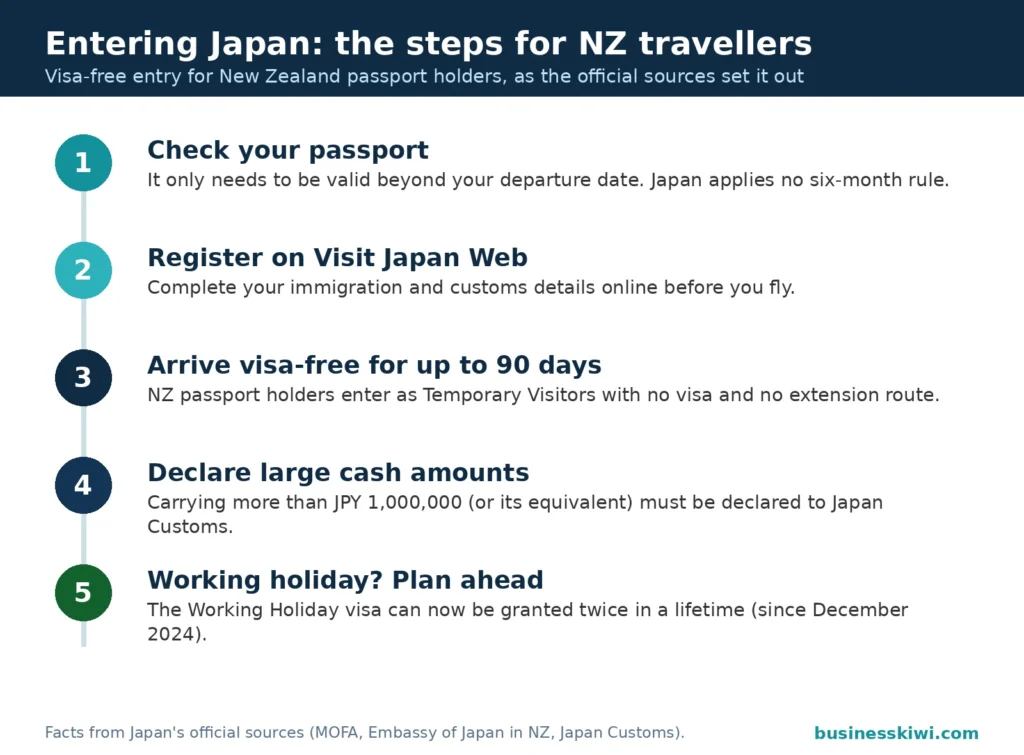
- Your passport only needs to be valid beyond the date you plan to leave Japan. There is no six-month validity rule for NZ visitors.
- You cannot work for pay on a Temporary Visitor entry, and the 90 days cannot be extended for New Zealanders. Longer stays for work, study or family reasons need a visa sorted before you travel.
- Before you fly, register on Visit Japan Web, the Japanese Digital Agency’s free online service for immigration details and customs declaration. It gives you a 2D code to show on arrival.
- Duty-free allowances per adult include 3 bottles of alcohol, set tobacco limits, 2 ounces of perfume, and other goods up to a total overseas market value of JPY 200,000. Cash and similar instruments worth more than JPY 1,000,000 must be declared.
- Travellers aged 18 to 30 can apply for a Working Holiday Visa, which allows a one-year stay with casual or temporary work to top up travel funds.
- SafeTravel, the New Zealand government’s advisory service, rates Japan at its lowest advisory level and recommends registering your travel and holding comprehensive travel insurance.
Visiting as a tourist: the visa exemption for NZ passport holders
Japan runs reciprocal visa exemption arrangements with 74 countries and regions, and New Zealand is one of them. If you hold a NZ passport and your trip is a short one, you simply arrive. At the airport an immigration inspector examines you, and if you meet the conditions for landing you receive landing permission with the status of residence “Temporary Visitor” and a period of stay of 90 days. That permission, recorded in your passport, is your legal basis for being in the country; there is no separate tourist visa to obtain in advance.
The Temporary Visitor status covers a wider range of activities than pure sightseeing. Japan’s published guidance for short-term stays includes recreation and sports, visiting relatives, friends or acquaintances, attending conferences, and short-term business affairs such as market research, business liaison, negotiations, contract signing and after-sales service. Someone flying in for a trade fair or a round of unpaid meetings with a Japanese partner company is generally within the status.
What the status never allows is paid activity. It is prohibited to run a revenue-generating business operation in Japan or to receive remuneration there. Teaching a few classes for cash, picking up bar shifts, or doing paid freelance work for a Japanese client all fall outside the status, no matter how brief. If money changes hands for work done in Japan, you need a work-permitting status arranged in advance.
Ninety days is also a firm ceiling for New Zealanders. A small group of exemption countries, including the United Kingdom, Germany and Ireland, can apply to the Ministry of Justice to stretch a stay towards six months; New Zealand is not in that group, so the extension route does not exist for NZ passport holders. When your 90 days ends, you leave. Treating the arrangement as a rolling entitlement you can reset with a quick flight out and back is risky: landing permission is decided fresh at each examination, and an inspector who sees a pattern of back-to-back stays can refuse entry.
Passport and documents
The rule that catches travellers out in other parts of Asia does not apply here. The Embassy of Japan in New Zealand states that you can travel to Japan as long as your passport is valid beyond the date you plan to leave, and that it does not need to be valid for any set period such as six months. A passport expiring a month after your return flight is acceptable to Japan.
Beyond the passport, be ready to satisfy the inspector about the shape of your trip. Japan’s foreign ministry notes that on arrival you may be asked about the purpose of your visit and how long you intend to stay, and you may be required to show a return ticket. Entry can be refused at that landing inspection. Having your return booking accessible, your first accommodation’s name and address, and enough funds for the trip covers the usual questions. Registering on Visit Japan Web also puts your accommodation and flight details into the system before you land.
Two further points. First, most foreign nationals provide fingerprints and a facial photograph at immigration as part of the landing examination, so expect a brief biometric step at the counter. Second, personal history matters. The Embassy of Japan in New Zealand directs travellers with a criminal history to the grounds for denial of landing in Japan’s Immigration Control Act, and stresses that the embassy has no access to your record and that entry is decided by the border officer on the day. If that is you, read the official guidance well before booking non-refundable flights.

Visit Japan Web and the arrival process
Visit Japan Web is a web service run by Japan’s Digital Agency, used for the immigration and customs procedures that once meant paper cards. You create an account, register your passport details, your flight and the address where you will stay, then complete the immigration and customs sections. The service produces a 2D code, which you present on your smartphone or tablet when you go through the procedures. The Digital Agency says all you need to register is your airline ticket, your passport and an email address.
The same service can also be used for tax-free shopping during your stay. A few practical notes:
- The service is free, and it is a website, not an app you buy. The Embassy of Japan in New Zealand warns that unofficial third-party sites charge to register on your behalf and may be scams; use the official service.
- Paper has not disappeared: Japan Customs notes that declaration forms are available on the aircraft, on ships, or at Customs itself, so if your phone dies you can still complete a written declaration.
- On arrival, follow the signs for immigration first. You present your passport (and your 2D code if you registered), give fingerprints and a photograph, answer any questions, and receive landing permission. Then you collect your bags and clear customs, where the declaration you made, on paper or electronically, is checked. Electronic customs declaration gates are available at seven international airports for travellers using the system.
If your plans change after registering, update the registration so officials see the right details.
Money and customs on arrival
Every arriving passenger has to declare their belongings. Japan Customs runs a green and red channel system: green if you have nothing dutiable and nothing prohibited or restricted, red for everyone else. Unaccompanied baggage needs a duplicate written declaration, and the goods must arrive within six months.
The duty-free allowance for each adult covers personal effects in reasonable quantities, plus these set limits:
- Alcohol: 3 bottles, with a bottle counting as roughly 760 ml.
- Tobacco: 200 cigarettes, 50 cigars, 10 individual packages of heat-not-burn tobacco, or 250 g of other tobacco products. If you mix types, the combined allowance works out to a total of 250 g.
- Perfume: 2 ounces, about 56 ml.
- Other goods: the total overseas market value of everything else must be under JPY 200,000. Items worth less than JPY 10,000 each are ignored in that calculation, which removes most small souvenirs from the count. There is no allowance for a single item worth more than JPY 200,000; duty and tax apply to its full value.
Travellers under 20, Japan’s legal age for alcohol and tobacco, get no alcohol or tobacco allowance at all, and children under six only have an allowance for items clearly meant for children, such as toys. Go over the limits and simplified duty and tax rates apply to the excess.
Cash has its own rule. If you are carrying cash or other means of payment worth more than JPY 1,000,000 in total, or the equivalent in another currency, you must declare it to Customs on a separate form. The threshold covers cheques, traveller’s cheques, promissory notes and securities as well as notes and coins, and gold bullion of at least 90 percent purity weighing more than 1 kg is declarable too. This is a declaration requirement rather than a ban.
The prohibited list is strict and enforced. Narcotic drugs, including cannabis in any form, stimulants, MDMA, opium and psychotropic substances are banned, apart from items specifically designated under health ministry rules. Firearms, ammunition and parts, explosives, chemical weapon precursors, counterfeit money and forged credit cards, obscene materials, child pornography, and goods that infringe intellectual property rights are also banned. Restricted items need attention rather than avoidance: plants, animals and meat products must go to the quarantine counter for inspection before customs examination, which catches out Kiwis carrying jerky or snacks from home; medicines and cosmetics face quantity limits (pharmaceuticals are limited to a two-month supply); and hunting guns or swords need a possession permit. If you take prescription medication, check the official guidance before you pack it, because some medicines that are routine in New Zealand are controlled in Japan.
One more trap sits at the other end of the trip: goods bought tax-free in Japan must be exported, not used up or given away in the country, and Customs can check them at departure.

Working holidays in Japan for NZers
The Japan–New Zealand Working Holiday Scheme has run since 1985 and is the standard route for a longer, slower trip. A Working Holiday Visa lets you stay for one year and take casual or temporary work to top up your travel funds, with no separate work permission needed. The holiday has to remain the main purpose. If your real aim is full-time employment, the embassy will point you to a work visa instead, and work in businesses that affect public order and good morals, such as bars, cabarets, nightclubs and gambling premises, is off limits.
Eligibility, as published by the Embassy of Japan in New Zealand, is as follows:
- You hold a New Zealand passport and are residing in New Zealand when you apply. NZ citizens living or travelling overseas are not eligible.
- You are aged 18 to 30 inclusive at the time of application.
- You have no dependent children.
- You are in good health and have no criminal record.
- You live in the region served by the consular office where you apply.
- You can show funds for the start of the trip. The embassy requires a recent official bank statement, showing at least three months of transactions, with a balance of at least NZ$3,000 (NZ$4,500 for a married couple). If you have not bought your return ticket, the statement must include a further NZ$1,000.
Since December 2024, eligible New Zealanders can be granted a Working Holiday Visa twice in their lifetime, provided the first one was held on a NZ passport. The application itself is a paper exercise done in person. Applications must be lodged by the applicant at the consular counter; applications sent by post, courier, friends, family or visa agencies are not accepted. Wellington and Christchurch do not require a booking, while the Consulate-General in Auckland has required an online appointment since June 2025. The document set includes the application form, a passport valid until after you leave Japan with room for the visa label, a recent 45 × 35 mm photo, a curriculum vitae, a detailed month-by-month stay programme, and a one-page typewritten cover letter explaining why you want to go. That cover letter must be your own work: the embassy states that an AI-generated or copied letter is grounds for the application to be declined or for you to be called in for an interview. The embassy asks applicants to allow at least ten working days for processing, and its current estimate is around two to three weeks depending on completeness.
Once granted, you must enter Japan within one year of the issue date. The one-year stay cannot be extended, and the visa is single-entry, although a special re-entry permit can be obtained at the airport if you need to leave and return during the year. On arrival at the major airports you are issued a residence card, and within 14 days of finding a place to live you register your address at the municipal office. Residents staying more than three months must enrol in Japanese National Health Insurance, and the embassy recommends private travel insurance before you leave New Zealand as well.
Staying longer or for other purposes
Anything beyond a holiday or a working holiday means a status of residence matched to what you will actually do, and a visa issued before you travel. Japan’s status system is specific: there are categories for work (covering fields such as engineering, humanities and international services, skilled labour, business management and specified skilled work), a Student status for studying at Japanese institutions, statuses for spouses and dependants of Japanese nationals and of people already resident. For most long-term categories, the process starts in Japan: the employer, school or family member first obtains a Certificate of Eligibility from the Immigration Services Agency, and that certificate then supports your visa application at the Embassy of Japan or a consulate in New Zealand. The working holiday route is one of the exceptions that does not use a certificate.
The practical lesson is timing. You cannot treat the 90-day Temporary Visitor entry as a placeholder and convert it into a work status once you have found a job; changing status from inside Japan is not the routine pathway, and job hunting on a tourist entry does not entitle you to start work. If there is any chance your trip involves employment, study beyond the tourist window, or joining a spouse in Japan, start with the Embassy of Japan in New Zealand and the Immigration Services Agency’s published procedures before you book anything.
Common mistakes and refusals
Working on a tourist entry. Paid work of any kind sits outside the Temporary Visitor status. The consequences are not limited to the job: engaging in activities outside your status can lead to deportation and will harm future applications.
Overstaying. Your landing permission shows the date your stay expires. Remaining past it makes you an overstayer liable to deportation. Under Japan’s Immigration Control Act, a person deported from Japan is barred from landing again for five years (ten years for a repeat deportation). Someone who comes forward voluntarily and leaves under a departure order faces a one-year bar instead, which is a strong reason to come forward quickly if something goes wrong, rather than hoping nobody notices.
Arriving with the wrong things in the bag. Cannabis is illegal in Japan full stop, including products that are legal where you bought them. Meat products, fruit and plants that skip the quarantine counter, and medications over the permitted quantities all create problems at customs. False declarations attract penalties under Japanese law.
Skipping the basics. Turning up without evidence of onward travel or accommodation, letting your passport expire before your departure date, or paying an unofficial website to “register” you for Visit Japan Web are all avoidable. The genuine service is free and run by the Digital Agency.
Ignoring the home-side advice. SafeTravel, run by New Zealand’s Ministry of Foreign Affairs and Trade, advises travellers to exercise normal safety and security precautions in Japan, its lowest advisory setting. It recommends registering your travel plans so the ministry can reach you in an emergency, holding comprehensive travel insurance that includes adventure activities and medical evacuation by air, and being alert to petty crime and drink-spiking in Tokyo’s entertainment districts. Earthquakes, tsunami and severe weather are part of life in Japan, and the advisory points travellers to the NHK World-Japan app for updates. The New Zealand Embassy in Tokyo (phone +81 3 3467 2271) is the consular contact if things go seriously wrong.
FAQs
Do New Zealanders need a visa for Japan?
No, not for a holiday or a short business trip. NZ passport holders enter under the visa exemption arrangement and receive Temporary Visitor status with a 90-day period of stay on arrival.
How long can I stay in Japan without a visa?
Up to 90 days, and unlike some other exemption countries, New Zealanders cannot apply to extend a Temporary Visitor stay.
Does my passport need six months’ validity for Japan?
No. The Embassy of Japan in New Zealand states that your passport only needs to be valid beyond the date you plan to leave Japan.
Can I work while on holiday in Japan?
Not on a Temporary Visitor entry. Paid work requires a status that permits it. Travellers aged 18 to 30 can instead apply for a Working Holiday Visa, which allows casual or temporary work during a one-year stay.
Is Visit Japan Web compulsory?
It is the recommended way to handle your immigration details and customs declaration, and Japan Customs recommends the electronic route. Paper declaration forms are still available on the aircraft or at Customs.
How much cash can I take into Japan?
There is a declaration threshold rather than a simple allowance. If you carry cash, cheques, traveller’s cheques, promissory notes or securities worth more than JPY 1,000,000, you must declare them to Customs on a Customs form.
What happens if I overstay my 90 days?
Overstaying can lead to deportation. A person deported from Japan cannot land again for five years, or ten years for a repeat case. Leaving voluntarily under a departure order reduces the bar to one year.
For more guides on visas, passports and immigration, browse the Visa & Immigration hub.
Sources
- Ministry of Foreign Affairs of Japan, “Exemption of Visa (Short-Term Stay)”: https://www.mofa.go.jp/j_info/visit/visa/short/novisa.html
- Ministry of Foreign Affairs of Japan, JAPAN eVISA FAQ (entry may be refused at landing inspection; return ticket may be requested): https://www.evisa.mofa.go.jp/faq
- Embassy of Japan in New Zealand, “Visa Application Process” (NZ passport holders, stays under 90 days, passport validity, Visit Japan Web warnings): https://www.nz.emb-japan.go.jp/itpr_en/visa-application-process.html
- Embassy of Japan in New Zealand, “Working Holiday Visa” (eligibility, documents, funds, offices, after-issue notes): https://www.nz.emb-japan.go.jp/itpr_en/working_hoiday_visa.html
- Digital Agency, Government of Japan, “Visit Japan Web” (service description and 2D code procedures): https://services.digital.go.jp/en/visit-japan-web/
- Japan Customs, “Procedures of Passenger Clearance” (declaration, allowances, currency, prohibited and restricted articles): https://www.customs.go.jp/english/summary/passenger.htm
- Japan Customs, FAQ 7105, “Duty-Free Allowance for Accompanied Personal Effects of Overseas Travelers”: https://www.customs.go.jp/english/c-answer_e/keitaibetsuso/7105_e.htm
- Immigration Services Agency of Japan (Ministry of Justice), agency overview (landing examination, fingerprints and facial photographs): https://www.moj.go.jp/isa/content/001425124.pdf
- Immigration Control and Refugee Recognition Act, official English translation, Japanese Law Translation Database (grounds for denial of landing, periods of landing denial after deportation or departure orders): https://www.japaneselawtranslation.go.jp/en/laws/download/1934/09/s26Bc003390208en1.0_h21A79.pdf
- SafeTravel, New Zealand Ministry of Foreign Affairs and Trade, “Japan” destination advisory: https://www.safetravel.govt.nz/Destinations/Japan
Disclaimer
This guide is general information for New Zealand travellers, based on official Japanese and New Zealand government sources published at the time of writing. Entry to Japan is never guaranteed in advance: the decision to grant landing permission rests with the immigration inspector who examines you on arrival, and Japanese rules, allowances and procedures change from time to time. Check the Ministry of Foreign Affairs of Japan, the Embassy of Japan in New Zealand and SafeTravel shortly before you travel, and treat those official sources as the final word for your own situation.