Family Visa NZ: Partner, Parent and Child Pathways Explained
There is no single product called a “family visa” in New Zealand. Instead, Immigration New Zealand (INZ) runs a family category made up of separate visas for partners, parents and dependent children, each with its own rules. Almost all of them share one feature: an anchor person, a New Zealand citizen or resident who is already here and who supports or sponsors the application. A partner joins a New Zealander. A parent is sponsored by an adult child. A child joins a parent who lives here.
This guide maps the whole family category at a glance, so you can work out which pathway fits your family and where to dig deeper. It covers the three partnership visas and the culturally arranged marriage option, the four parent pathways, the rules for dependent children, and what sponsorship involves. Where INZ states a fee or threshold on its own pages, we give it exactly as published. Where it does not, we have left the figure out rather than guess.
One timing point matters before anything else. From 25 September 2026, both people in a partnership application must be aged 18 or over when they apply, and INZ only recognises relationship evidence from after both partners turned 18. The change affects every dedicated partnership visa, including the culturally arranged marriage visa.
The family category at a glance
Family visas divide into two broad groups: resident visas, which let the holder live in New Zealand indefinitely, and temporary visas, such as visitor and work visas, which allow a defined stay and often act as a stepping stone while a couple builds the history residence requires, or while parents wait for a residence outcome.
Across the category, three themes repeat. The relationship must be genuine and provable on paper, not just real in daily life. Every applicant must meet health and character requirements, which usually means medical examinations, chest X-rays and police certificates. And the New Zealand citizen or resident at the centre of the application is not a bystander: they must support or sponsor it, prove their own status, and often accept legal responsibility for the applicant’s costs.
Who counts as family is narrower than many people expect. Partners count. Parents count, and in some cases grandparents or legal guardians stand in the place of parents. Dependent children count, within strict age and dependency limits. Adult children, siblings and extended family have no family pathway of their own and must qualify for a visa in their own right.
Partner pathways
What INZ means by partnership
INZ does not limit partnership to marriage. A partner can be a spouse, a civil union partner or a de facto partner, but in every case the test is the same: the couple must be living together in a genuine and stable relationship. Living together is the element couples most often underestimate. INZ asks for evidence showing how long the couple has been together, how long they have lived together, that they share finances and other responsibilities, that they spend time together, and that other people recognise the relationship.
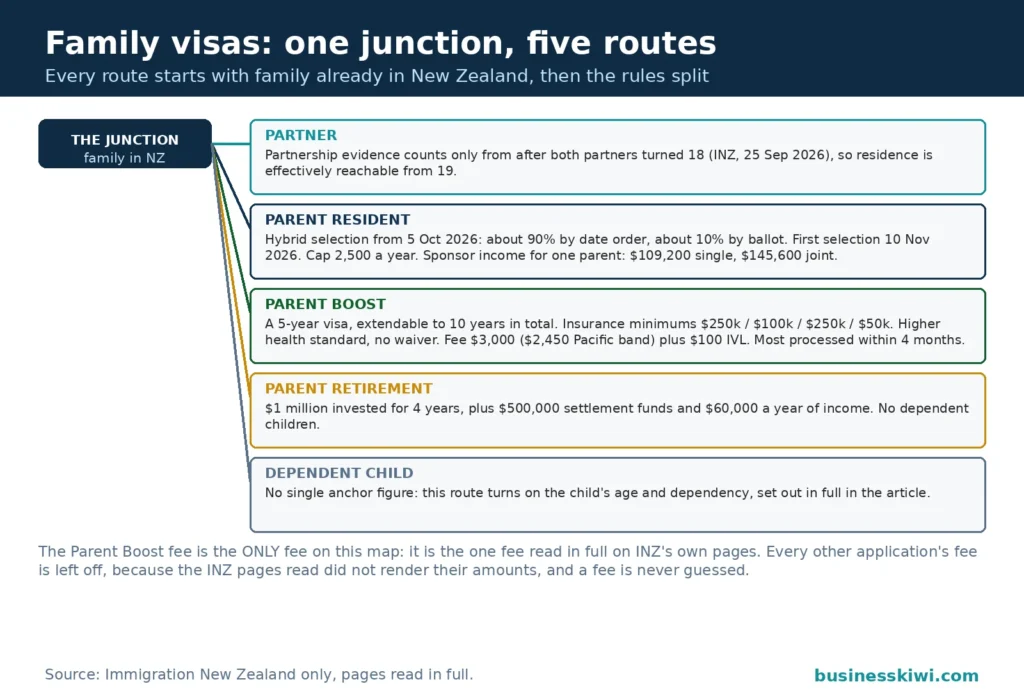
The 18 or over rule that began on 25 September 2026 has a practical effect worth understanding. Because the 12 months of living together needed for residence only starts counting once both partners are 18, in practice a couple cannot qualify for partnership residence until both partners are at least 19. Evidence from before both partners turned 18 is simply not used. If you are preparing a partnership application, our guide to writing a support letter for a partnership visa application explains how the people around a couple can help evidence the relationship.
Partner of a New Zealander Visitor Visa
The visitor option suits partners who want to be together here but are not yet applying for residence. The applicant cannot work on this visa. How long it lasts depends on the couple’s history: partners who have lived together for less than 12 months receive a 1 year visa and can apply for further visas to stay up to 3 years in total, while partners who have lived together for 12 months or more can receive a visa of up to 3 years.
Applicants must show they have enough money to live on, which INZ sets at NZD $1,000 a month, or NZD $400 a month if accommodation has already been paid for, or have an acceptable sponsor. They must also show they can leave New Zealand at the end of the stay. The New Zealand partner completes the Form for Partners Supporting Partnership-Based Temporary Entry (INZ 1146) and must be eligible to support a partnership residence application within 12 months, a test explained below. Dependent children aged 19 or younger can be included.
Partner of a New Zealander Work Visa
The work visa follows the same length pattern as the visitor visa: 1 year where a couple has lived together for less than 12 months, with further applications possible up to 3 years in total, and up to 3 years where the couple has already lived together for 12 months or more. The difference is that the holder can work here, which makes this the usual bridge while a couple completes the 12 months of living together that residence requires.
The requirements mirror the visitor visa: an eligible supporting partner who completes the INZ 1146 form, evidence of living together in a genuine and stable relationship drawn only from after both partners turned 18, good health and character, genuine reasons for coming, and enough money to live on or an acceptable sponsor. Our detailed guide to the Partner of a New Zealander Work Visa walks through the evidence and conditions in full. Partners of workers and students have separate visas, outside this overview, because the anchor person there holds a temporary visa.
Partner of a New Zealander Resident Visa
Residence is the goal for most couples. To apply, the couple must have been living together in a genuine and stable relationship for at least 12 months at the time of application, counted from after both partners turned 18, and the evidence must cover that 12 month period. The visa lets the holder stay in New Zealand indefinitely, and after holding it for 2 years in a row they can apply for a Permanent Resident Visa.
There is one faster outcome for a small group of couples. INZ says it may grant a Permanent Resident Visa straight away where the partner is a New Zealand citizen, the couple has lived together for at least 5 years, and the citizen partner has lived outside New Zealand for at least 5 years, meaning less than 3 months a year spent here. The New Zealand partner completes a Partnership Support Form for Residence and must meet the sponsor eligibility limits described below, as well as character requirements. Dependent children aged 24 or younger can be included if they are single, have no children of their own once they are 18 or older, and, at ages 21 to 24, rely on an adult for financial support. Our guide to the Partner of a New Zealander Resident Visa covers the full criteria, and our overview of the Resident Visa explains how this visa sits within the wider residence system.
Culturally Arranged Marriage Visitor Visa
One partnership situation gets its own visa. Where a marriage has been arranged by someone other than the couple themselves, following an identified cultural tradition, the couple will usually not have lived together before the wedding, so the usual living together evidence cannot exist. The Culturally Arranged Marriage Visitor Visa covers that situation, whether the couple recently married overseas or plan to marry in New Zealand.
The couple must have met before applying, there must be no legal impediment to the marriage, such as either person already being married or the couple being close relatives, and INZ looks for evidence that the marriage is genuinely culturally arranged: communication between the families or a matchmaker, documents showing the arrangement is publicly recognised, or confirmation from an independent source that it forms part of the couple’s cultural customs. The New Zealand partner must be eligible to support this visa and a partnership residence application later on. Once living together here, the couple moves on to the partnership visas above, and eventually to residence.

Parent pathways
Parents have four distinct options, solving different problems. One offers residence through a capped, sponsor income tested category. One offers residence to parents who can invest. Two are visitor visas that do not lead to residence at all.
Parent Resident Visa
This is the main residence pathway for parents, and it works in two stages. A parent first submits an expression of interest (EOI) into the parent category pool. Only parents whose EOI is selected and who are invited to apply can lodge a residence application. INZ can approve 2,500 Parent Resident Visas each year, and selections happen 4 times a year.
The selection system changed on 5 October 2026. Under the new hybrid model, about 90 percent of EOIs are selected in date order, oldest first, and about 10 percent are drawn by ballot. The first selection under the new model was scheduled for 10 November 2026. Existing EOIs moved into the new pool automatically, keeping their original place. A parent can only have one EOI in the pool at a time, and no documents are needed at that stage, just details of how the requirements are met.
The sponsoring child carries most of the weight in this category. They must be 18 or older, have been a New Zealand citizen or resident for at least 3 years before the parent applies, live in New Zealand, and have spent 184 or more days here in each of those 3 years. Sponsorship can be by the adult child alone, jointly with their partner, or by two adult children together. Grandparents and some legal guardians can also be sponsored in defined circumstances, such as where the child’s parents have died.
Income is the hurdle that stops many families. The sponsor must have earned at least the minimum income for 2 years in the 3 year period before the EOI was selected, proven with Inland Revenue tax statements, and only taxable income counts. The threshold is set from the New Zealand median wage, which INZ lists as NZD $72,800 from 30 April 2026. One sponsor needs 1.5 times the median wage for one parent, currently NZD $109,200, and two joint sponsors need twice the median wage, NZD $145,600. Each extra parent adds half the median wage.
Parents must also meet health and character requirements, and must speak and understand English or agree to pay for lessons in New Zealand. After 10 years in a row on the visa, the holder can apply for a Permanent Resident Visa. Our full guide to the Parent Resident Visa works through the sponsor rules, income tables and selection process in detail.
Parent Retirement Resident Visa
Parents with significant funds of their own have a second residence route that does not depend on a sponsor’s income. The Parent Retirement Resident Visa requires the parent to invest NZD $1 million or more in acceptable investments in New Zealand for 4 years, hold at least NZD $500,000 in settlement funds on top of that, and have an annual income of NZD $60,000 or more. The funds cannot be borrowed and must have been earned or acquired lawfully. If the application is approved in principle, the money must be transferred and invested within 12 months, and completing the 4 year investment period makes the holder eligible for permanent residence.
The parent must have an adult child who is a New Zealand citizen or resident living in New Zealand. One firm limit catches families out: the applicant must have no dependent children. If they do, they are not eligible at all.
Parent Boost Visitor Visa
The Parent Boost Visitor Visa is a long stay visitor visa for parents who want extended time with their children, without or while waiting for residence. It is a multiple entry visa granted for 5 years, and INZ’s published answers confirm a second visa can follow, giving up to 10 years in total. It is not a pathway to residence, and holders are expected to keep ties with their home country.
A parent must be sponsored by an adult child who is a New Zealand citizen or resident, have no dependent children, and apply from outside New Zealand. The financial test can be met one of three ways: the sponsor earns enough, the parent has an ongoing annual income of at least NZD $33,663.24 (or NZD $51,182.56 with a partner included), or the parent holds personal funds of at least NZD $170,000 (or NZD $260,000 with a partner). The parent income and funds figures are based on New Zealand Superannuation rates and are updated each April.
Two features set this visa apart. The health standard is higher than for other visitor visas, there is no medical waiver, and holders must complete a health and insurance check from outside New Zealand during the third year of the visa. Health or travel insurance is compulsory throughout, with minimum cover set by INZ: NZD $250,000 a year for emergency medical care, NZD $100,000 a year for cancer treatment, NZD $250,000 for repatriation and NZD $50,000 for return of remains. INZ’s published fee is NZD $3,000 for most applicants, or NZD $2,450 under the Pacific fee band, plus the NZD $100 International Visitor Conservation and Tourism Levy, and INZ estimates most applications are processed within 4 months.
Parent and Grandparent Visitor Visa
For shorter, repeated visits, the Parent and Grandparent Visitor Visa lets parents and grandparents visit family here multiple times on the same visa. Each stay can be up to 6 months, 18 months in total across 3 years, and no work is allowed.
The visitor must be living outside New Zealand and be sponsored by their child or grandchild, or by that child’s parent if the child is under 18. The sponsor must be a New Zealand citizen or resident, meet INZ’s requirements for acceptable sponsors, and not be sponsoring anyone else at the same time. Applicants need a chest X-ray and medical examination unless certificates were provided to INZ within the last 36 months, and they or their sponsor must be able to pay for health care during the visit. For a one off trip, a standard Visitor Visa, which allows stays of up to 9 months, is the simpler fallback.
Children
Dependent Child Resident Visa
Where a parent is a New Zealand citizen or resident living in New Zealand, their dependent children can apply for residence in their own right. The child can stay indefinitely, and after 2 years in a row on the visa can apply for a Permanent Resident Visa. The parent must have the legal right to remove the child from their home country, which for children aged 15 or younger means custody documents or the other parent’s agreement.
INZ’s definition of dependent is precise. A child aged 17 or younger qualifies, subject to the general tests. From 18 to 24 the child must have no children of their own, and from 21 to 24 they must also rely on an adult for financial support. At every age the child must be single: a child living with a partner is not considered single, even if they have lived together for less than a year. Children aged 16 or older may also need to meet an English language requirement, or have lessons paid for, in some cases.
Children on temporary visas
The age limits are tighter for temporary visas. For visitor and student visas a dependent child is 19 or younger, single, and relying on a parent for financial support, with no children of their own at 18 or 19. Children aged 20 or older cannot be included in a parent’s visitor or student application; they need a visa of their own.
One exception helps families mid process. Children aged 20 to 24 may still count as dependent for a Child of a New Zealander Visitor Visa or a Child of a Worker Visitor Visa if they have applied for, or are included in, an application for an eligible residence visa, such as the Dependent Child Resident Visa or a partnership residence application. Adoption recognition rules changed on 18 September 2025: INZ now recognises international adoptions only from an exempt country, under the Hague Convention, or as customary adoptions.
Sponsorship: what the New Zealander signs up for
Sponsorship is a legal undertaking, not a character reference. INZ states that while a sponsored person is in New Zealand, their sponsor must make sure they have the things necessary for their health and welfare, such as food, clothing and healthcare, and somewhere suitable to stay, provided directly or paid for. The sponsor must also pay the cost of the person’s return travel home if the person does not pay for it themselves, and the costs of any deportation, including finding, detaining and sending them home.
Three points surprise people. The sponsor is legally responsible even if the sponsored person promised to pay their own way. Sponsorship cannot be withdrawn. And it runs from the day the person arrives, or the day their visa is granted if they are already here, until they leave or are granted a new visa. Parent residence sponsors take on a longer version, agreeing to meet living costs for the parent’s first 10 years here.
Partnership support has its own extra limits. A New Zealand citizen or resident can support only one partner for residence in any 5 year period, and only 2 partners in total. They must not have acted as a partner in a successful residence application within the past 5 years, or in more than one ever, and must not be liable for deportation. To support a temporary partnership visa, the partner must also be eligible to support a residence application within the following 12 months. Supporting partners must meet character requirements too: INZ states that a partner with convictions for domestic violence or sexual offences will not meet them, although a character waiver can be considered.

Why family applications are declined
INZ does not publish refusal statistics by reason, but its visa pages show the same pressure points. Most declined family applications fail on evidence rather than eligibility. For partners, that means thin proof of living together: a marriage certificate alone does not show a genuine and stable relationship, and INZ weighs the whole pattern of shared finances, shared responsibilities, time together and public recognition of the relationship. Evidence from before both partners turned 18 is ignored entirely.
For visitor based applications, genuine intentions are the second theme. INZ says it considers the information in the application, what it knows of the person’s circumstances, and anything the person has given it before. Visitors must also show they can leave at the end of their stay, with a ticket or the money to buy one on top of living costs. Health and character are the third theme: criminal convictions or being a security risk can lead INZ to refuse a visa, and police certificates must be current.
Frequently asked questions
Is there one family visa that covers everyone?
No. New Zealand has no single family visa. Partners, parents and dependent children each have their own visas within the family category, and most require a New Zealand citizen or resident to support or sponsor the application.
Do we have to be married for a partner visa?
No. INZ recognises legal marriage, civil unions and de facto relationships. In every case the couple must show they live together in a genuine and stable relationship, so a marriage certificate alone is not enough.
How long must we have lived together for partner residence?
At least 12 months when you apply, and only time from after both partners turned 18 counts, following the rule change on 25 September 2026. Couples below 12 months usually start with a partner work or visitor visa, which lasts 1 year at first and can extend to 3 years in total.
Can my parents live in New Zealand permanently?
Possibly, through two residence routes. The Parent Resident Visa is capped at 2,500 approvals a year, starts with an expression of interest, and requires a sponsoring child who meets strict income tests. The Parent Retirement Resident Visa suits parents who can invest NZD $1 million for 4 years, hold NZD $500,000 in settlement funds and earn NZD $60,000 a year or more.
What income does a sponsor need for the Parent Resident Visa?
The threshold is based on the New Zealand median wage, listed by INZ as NZD $72,800 from 30 April 2026. A single sponsor needs 1.5 times that figure for one parent, currently NZD $109,200, earned in 2 of the 3 years before the expression of interest was selected and proven with Inland Revenue records. Joint sponsors need twice the median wage, and each extra parent adds half the median wage.
Can my parents visit while residence is being processed?
Yes. Holding other parent visas does not prevent a parent from having an expression of interest in the Parent Resident Visa pool, although a person can only hold one visa at a time. The Parent Boost Visitor Visa allows stays across 5 years with sponsorship and compulsory insurance, while the Parent and Grandparent Visitor Visa allows up to 6 months at a time and 18 months in total over 3 years.
Up to what age is a child dependent?
It depends on the visa. For residence, a dependent child is 24 or younger, single, with no children of their own from age 18, and financially dependent from 21 to 24. For visitor and student visas the limit is 19 or younger, and older children need their own visa unless they qualify under the Child of a New Zealander or Child of a Worker visitor visas while a residence application is under way.
What does a sponsor have to pay for?
Essentially everything the sponsored person needs while they are here: food, clothing, healthcare and suitable accommodation, plus their travel home if they do not pay for it, and deportation costs if they are deported. Sponsorship cannot be withdrawn.
This article is general information about Immigration New Zealand’s family category, based on INZ’s published pages as at October 2026. Immigration settings, fees and income thresholds change frequently. It is not immigration advice for your situation; for advice, speak to a licensed immigration adviser or check the current requirements with Immigration New Zealand before you apply.
Sources
- Partner of a New Zealander Resident Visa, immigration.govt.nz
- Partner of a New Zealander Work Visa, immigration.govt.nz
- Partner of a New Zealander Visitor Visa, immigration.govt.nz
- Culturally Arranged Marriage Visitor Visa, immigration.govt.nz
- Parent Resident Visa, immigration.govt.nz
- Parent Resident Visa sponsor income requirements, immigration.govt.nz
- Parent Resident Visa expression of interest (EOI) selection process, immigration.govt.nz
- Parent Retirement Resident Visa, immigration.govt.nz
- Parent Boost Visitor Visa, immigration.govt.nz
- Parent Boost Visitor Visa FAQs, immigration.govt.nz
- Parent and Grandparent Visitor Visa, immigration.govt.nz
- Dependent Child Resident Visa, immigration.govt.nz
- Bringing children, immigration.govt.nz
- Your responsibilities as a sponsor, immigration.govt.nz
- New age and evidence requirements for some partnership-based visas, immigration.govt.nz