Visitor Visa NZ Processing Time: How Long a Visitor Visa Takes, and What Slows It Down

If you need a Visitor Visa to come to New Zealand, the processing time decides when you can safely book flights and commit to travel dates. Immigration New Zealand (INZ) publishes current wait times for visitor visas and updates them every week, so there is a real figure to plan around rather than a guess.
This article sets out those published times, explains what the numbers actually mean, and covers the things that push an individual application to the slower end of the range. Every figure below comes from INZ’s own website, checked on 12 October 2026.
The short answer
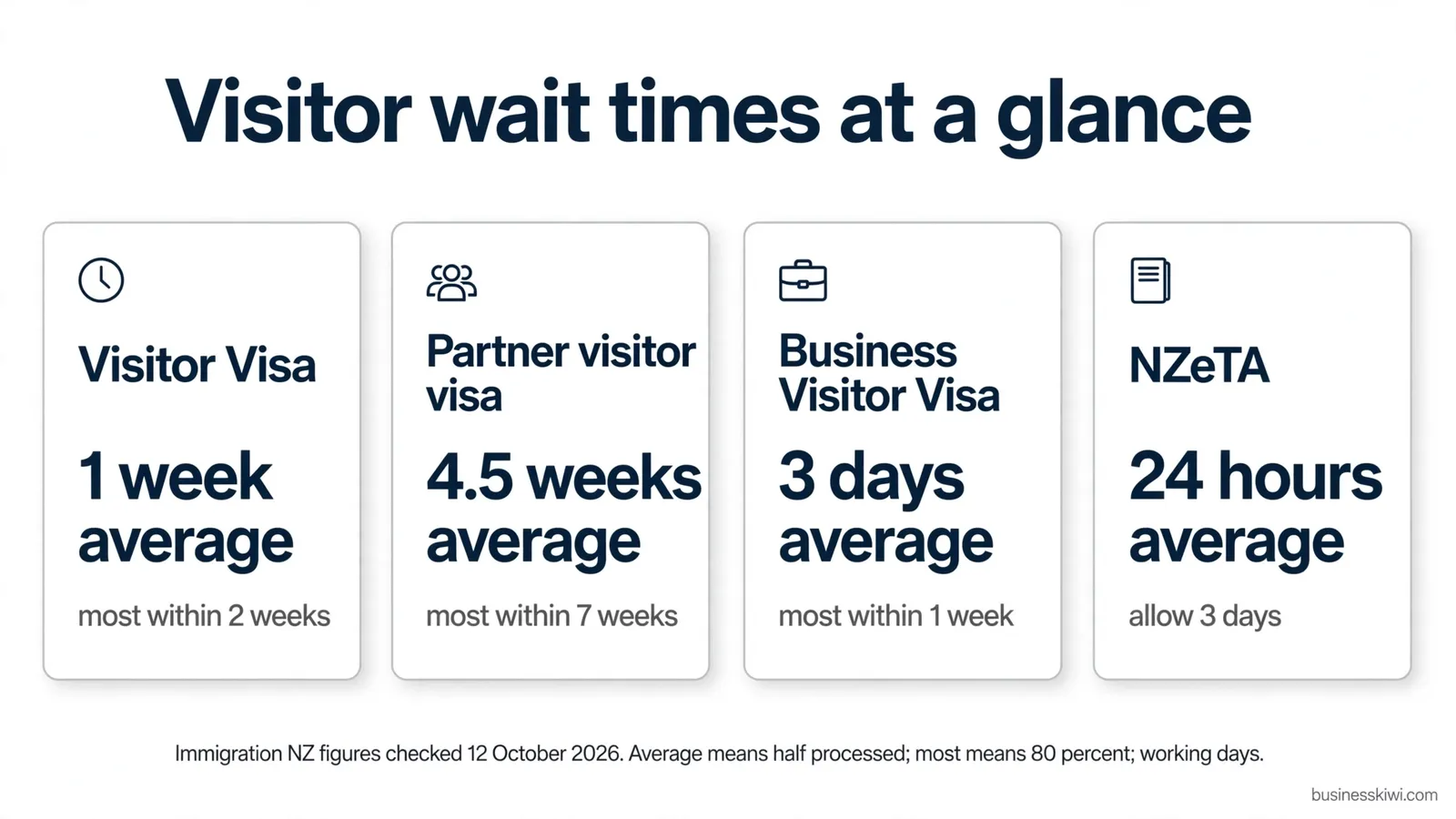
INZ’s visitor visa wait times page, checked on 12 October 2026, gives these figures for applications processed in the previous 4 weeks:
- Visitor Visa: average wait time of 1 week, with most applications completed within 2 weeks.
- Partner of a New Zealander Visitor Visa: average of 4.5 weeks, most completed within 7 weeks.
- Business Visitor Visa: average of 3 days, most completed within 1 week.
- NZeTA: average of 24 hours, with INZ advising travellers to allow 3 days.
The headline Visitor Visa figure matches the summary on INZ’s Visitor Visa page itself, which states a processing time of 80% within 2 weeks and a cost from NZD $441. So for a standard Visitor Visa, plan on about a week, allow two, and apply well before you travel, because the figures describe recent applications and are not a promise for yours.
How Immigration New Zealand measures processing times
INZ uses two measures, and both are worth understanding before you plan around them.
The average wait time is the point by which half of the applications in the period had been processed. In plain terms, half of recent applicants got a decision faster than the average, and half waited longer. The second measure, most completed within, is the point by which 80 percent of applications had been processed. That is the more useful planning number, because it covers four out of five applicants rather than only half.
Both figures are calculated in working days. Working days exclude Saturdays, Sundays and New Zealand public holidays, so a two-week timeframe stretches across more calendar days if it includes a long weekend.
The table is a rolling snapshot. It covers applications processed in the last 4 weeks and INZ updates the page weekly, which means the numbers move as application volumes and staffing change. A figure quoted from last month may already be out of date. INZ also publishes processing time data for the previous 6 months in its research and statistics section if you want to see the trend rather than the latest week, and its fees, decision times and where to apply tool gives times for visa types that are not shown in the visitor table.
One more point of interpretation. INZ notes that an application which includes all the documentation it needs will be processed closer to the average wait time. The gap between the average and the 80 percent figure is largely made up of applications that needed extra checks or extra documents. How complete your application is matters more than almost anything else in this article.

The Visitor Visa in brief
Processing time only makes sense alongside what the visa is. The Visitor Visa is for people travelling on a passport from a country whose citizens must apply for a visa before travelling to New Zealand. Citizens of visa waiver countries travel on an NZeTA instead, and Australian citizens travelling on an Australian passport need neither.
A Visitor Visa lets you holiday in New Zealand, visit family and friends, and study for up to 3 months. You can stay for up to either 6 months or 9 months depending on the visa you are granted, and you cannot stay longer than 9 months in any 18-month period. A multiple-entry visa allows repeat visits, with a total of up to 6 months in each 12-month period. You cannot work for a New Zealand employer on this visa, although working remotely for an employer or client based overseas is permitted.
You can include your partner and dependent children aged 19 or younger in your application. To qualify, you must be in good health and of good character, have genuine reasons for visiting, show you can leave New Zealand at the end of your stay, and either hold enough money for your living expenses or have an acceptable sponsor. INZ sets the funds benchmark at NZD $1,000 a month, or NZD $400 a month if your accommodation is already paid for.
Most people apply online, and from 1 October 2026 applications for this visa must be made online. The application fee is listed by INZ as from NZD $441. The exact amount depends on where you apply from, so confirm your figure in INZ’s fees tool before you submit.
What can slow a visitor visa application
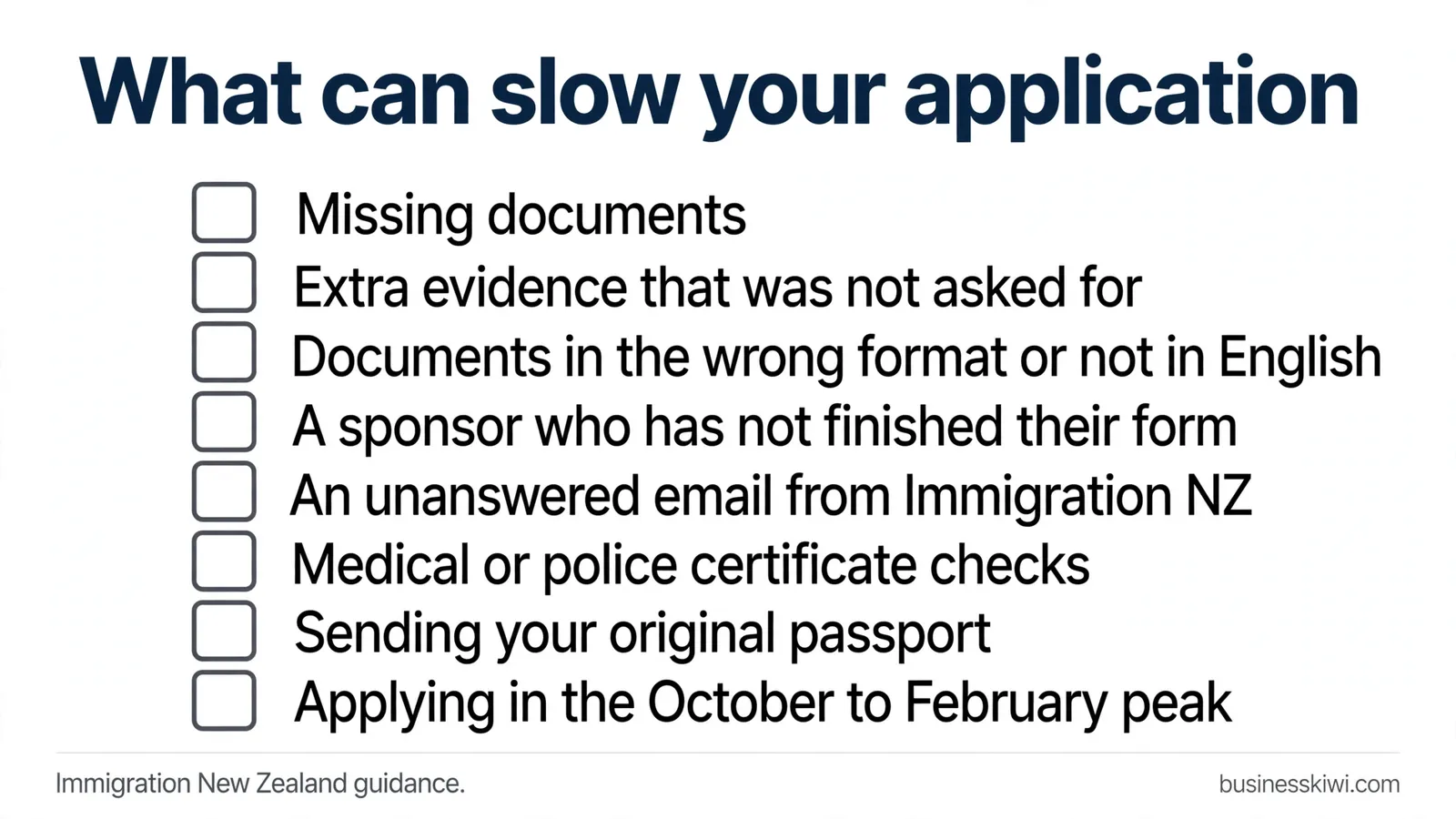
INZ publishes a page explaining why some applications are processed faster than others. The factors below come from that page and from the Visitor Visa requirements themselves, and most of them are within the applicant’s control.
Complexity. Some applications simply need more assessment. INZ lists examples: applying to come to New Zealand for the first time, medical issues or a history of medical issues for anyone included in the application, group applications, and information that needs further review, such as travel history or your links and circumstances in your home country. A previous trip that raised concerns, for example staying after a visa expired, also slows things down, as do declared character issues that INZ must assess.
Waiting on third parties. INZ sometimes has to wait for information from others, such as organisations that issue police certificates. If your police certificate or medical evidence is coming from an organisation with its own queue, that wait sits inside your processing time.
Evidence problems. INZ asks applicants to include only the evidence it requests. Sending extra, unrequested material can slow processing, and so can evidence in the wrong format, evidence that is out of date, or documents that are not in English without translations. For online applications, sending your original passport also causes delay. INZ only needs a photo or scan of it.
A sponsor who has not finished their part. If you are applying for a Visitor Visa online and you have a sponsor, your sponsor must complete an online form. INZ cannot process your application until that form is done, so an idle sponsor is a common and avoidable cause of delay.
Unanswered requests. INZ may email asking for more information, such as medical evidence or new photos. If that email sits unread, the application sits still. Check the email account you applied with, including the junk and spam folders.
Peak season. Visitor visa applications surge in the New Zealand summer period. INZ lists October to February as the peak period for visitor visas, and its Visitor Visa page warns that processing is busiest between September and March, with very high numbers of Christmas applications. Applications lodged in the peak are competing with far more other applications, which is one reason INZ urges people to apply as early as they can.
The health and character checks behind the clock
Two sets of checks sit behind many slower applications, and both have their own lead times.
For health, INZ may ask for a chest X-ray, a medical examination or both. As a general guide from INZ’s Visitor Visa page, a stay of less than 6 months does not normally need a chest X-ray, and a stay of less than 12 months does not normally need a medical certificate. If you will stay more than 6 months, a chest X-ray is required if you are a citizen of a country that does not have a low incidence of tuberculosis, or you have spent more than 3 months in the last 5 years in such a country. X-ray and medical evidence must be less than 3 months old when INZ receives it, so booking panel physician appointments too early can waste the evidence, and booking them late adds weeks inside your application.
For character, you may need police certificates. INZ requires them if you are aged 17 or older and your total time in New Zealand, including time spent here in the past, will be 24 months or longer. Certificates must come from countries you are a citizen of and any country you have spent more than 5 years in since turning 17, and they must be less than 6 months old when you apply. If you supplied certificates with an earlier application within the last 24 months, you do not need to provide them again. Where INZ asks for a certificate or medical partway through processing, your application effectively pauses until it arrives, which is why applicants who need them are better to organise them before submitting.
Small accuracy points matter too. INZ warns that identity details must be entered exactly as they appear on your passport, because mistakes in those details delay applications and can lead to a decline.
How to check the progress of your application

Once you have applied, you track the application in Immigration Online. Log in, open the My Visas tab (or My groups for a Group Visitor Visa), and find your application under Submitted applications. The Status column shows where it sits, and a view application progress link gives more detail.
The statuses have plain meanings. Submitted means INZ has received the application. Preparing application means your details and documents are being confirmed, and INZ may contact you for more documents during this stage. Waiting on you means INZ needs something from you, such as travel documentation or a medical examination. Waiting on your sponsor means the sponsor’s form is outstanding. Gathering information means your documents are almost ready for assessment and checks with other agencies and INZ’s health team are under way. Under assessment means everything is ready and your application is in the queue for a decision, which may not happen immediately when application volumes are high.
Two habits help. First, INZ states that you do not need to do anything after submitting unless it contacts you, so a quiet inbox usually means processing is under way rather than stalled. Second, keep checking the email address tied to the application, because a request for information that goes unanswered is one of the simplest causes of a long wait. INZ also advises that if your application is not complete, you may wait longer for a decision, so respond to any request in full rather than in part.
If it is taking longer than the published times
Start with the two checks above: your online status and your email, including spam. In many cases the application is waiting on a document or on a sponsor rather than sitting in a queue.
If there is a genuinely urgent reason, INZ runs an escalation process. Applications are normally allocated to an immigration officer in the order they are received. An escalation request asks INZ to allocate yours urgently instead. It needs a compelling or very important reason: INZ gives compelling personal and business circumstances, humanitarian factors, and matters of national interest as the qualifying grounds. An accepted escalation moves your application to an officer sooner. It does not change the assessment itself, and it is not a general fast-track service for people who applied late.
For Visitor Visa escalation requests, the route depends on where you are from. Applicants from Pacific countries and territories use INZ’s Pacific visa escalations email address. Applicants from outside the Pacific contact the Immigration Contact Centre by phone. You still need to meet the escalation criteria either way, and INZ will tell you whether your request is accepted.
What not to do
INZ’s clearest piece of advice sits on the Visitor Visa page itself: it recommends that travellers do not book any non-refundable travel until after their Visitor Visa is approved. Published processing times describe recent applications. They are not a guarantee for yours, and a cheap non-refundable fare is poor compensation for a decision that lands a week later than the average.
Three smaller habits also protect your timeline. Do not send your physical passport for an online application, because INZ asks for a scan or photo only and the original slows things down. Do not pad the application with documents INZ did not ask for, because extra evidence takes time to work through and can work against you. And if you have a sponsor, do not assume their form is done. Ask them, because your application cannot move until it is.
Related guides: coming to see your children or grandchildren? Read our guide to the visitor visa for parents. For more visa guides, browse the Visa & Immigration section.
Frequently asked questions
How long does a Visitor Visa take to process?
Based on INZ’s published wait times checked on 12 October 2026, the average wait for a Visitor Visa was 1 week, and most applications, meaning 80 percent, were completed within 2 weeks. Those figures cover applications processed in the previous 4 weeks and INZ updates them weekly, so check the current table before you rely on them.
What does average wait time mean?
It is the time by which half of the applications in the period had been processed. INZ’s second figure, most completed within, is the time by which 80 percent had been processed. For planning, the 80 percent figure is the safer one to use, because it reflects what most applicants actually experience.
Are processing times counted in calendar days or working days?
INZ calculates both wait time figures using working days. Working days exclude Saturdays, Sundays and New Zealand public holidays. The published figures are expressed in weeks and days for readability, but a public holiday inside your application window will stretch the calendar time.
Why is my application taking longer than 2 weeks?
About one in five applications takes longer than the most completed within figure. Common reasons INZ gives include missing or extra evidence, evidence in the wrong format or not in English, a sponsor who has not completed their form, medical or police certificate checks, and applications that need further review of travel history or circumstances. Peak season volumes between October and February also stretch times.
Can I get my Visitor Visa processed urgently?
Only in limited circumstances. INZ’s escalation process can allocate your application to an officer urgently if you have a compelling reason, such as compelling personal or business circumstances, humanitarian factors or a matter of national interest. Pacific applicants email INZ’s Pacific visa escalations address, and other applicants call the Immigration Contact Centre. Escalation speeds up allocation, not the decision itself.
How do I check where my application is up to?
Log in to Immigration Online and open the Submitted applications section under the My Visas tab. The Status column shows the current stage, and the view application progress link shows more detail. INZ will email you if it needs more information and again when a decision is made.
How much does a Visitor Visa cost?
INZ lists the Visitor Visa cost as from NZD $441 on its Visitor Visa page, checked on 12 October 2026. The exact fee depends on where you are applying from, and INZ’s fees, decision times and where to apply tool shows the amount that applies to you. Check it before you apply, because fees change.
The bottom line
A standard Visitor Visa is currently one of the faster New Zealand visas: an average of 1 week, with 80 percent of applications completed within 2 weeks on INZ’s figures checked on 12 October 2026. The applicants who wait longest are usually not unlucky. They are the ones whose evidence was incomplete, whose sponsor had not finished their form, or whose medical and police checks started only after INZ asked. Apply early, include exactly what INZ asks for, keep an eye on your email and your online status, and keep non-refundable bookings until the visa is in hand.
Sources
- Immigration New Zealand, Visitor visa and NZeTA wait times, https://www.immigration.govt.nz/process-to-apply/waiting-for-a-visa/processing-a-visa-application/how-long-it-takes-to-process-an-application/visitor-visa-and-nzeta-wait-times/
- Immigration New Zealand, Visitor Visa, https://www.immigration.govt.nz/visas/visitor-visa/
- Immigration New Zealand, Why some applications are processed faster than others, https://www.immigration.govt.nz/process-to-apply/waiting-for-a-visa/processing-a-visa-application/why-some-applications-are-processed-faster-than-others/
- Immigration New Zealand, How long it takes to process an application, https://www.immigration.govt.nz/process-to-apply/waiting-for-a-visa/processing-a-visa-application/how-long-it-takes-to-process-an-application/
- Immigration New Zealand, Checking your visa application status, https://www.immigration.govt.nz/process-to-apply/waiting-for-a-visa/check-your-application-progress/
- Immigration New Zealand, Escalation for urgent applications, https://www.immigration.govt.nz/process-to-apply/waiting-for-a-visa/processing-a-visa-application/escalation-for-urgent-applications/
This article is general information about visitor visa processing times in New Zealand. It is not immigration advice for your situation. The processing times and fees quoted are Immigration New Zealand’s published figures as at 12 October 2026, and they change over time: INZ updates its wait times weekly, and the time your application takes will depend on your own circumstances and how complete your application is. Always check the current figures on the Immigration New Zealand website before you apply or book travel, and consider speaking with a licensed immigration adviser if you need advice about your own case.