Immigration Lawyer Fees NZ: What Advice Costs and How the Charges Work

Ask a simple question, “how much does an immigration lawyer cost in New Zealand?”, and you will not find a simple answer. There is no official price list for professional immigration help, no set scale of fees, and most practices publish nothing at all about what they charge. What you can pin down is how the charging works, what rules sit behind it, and what the government layer underneath it costs, because that part is published.
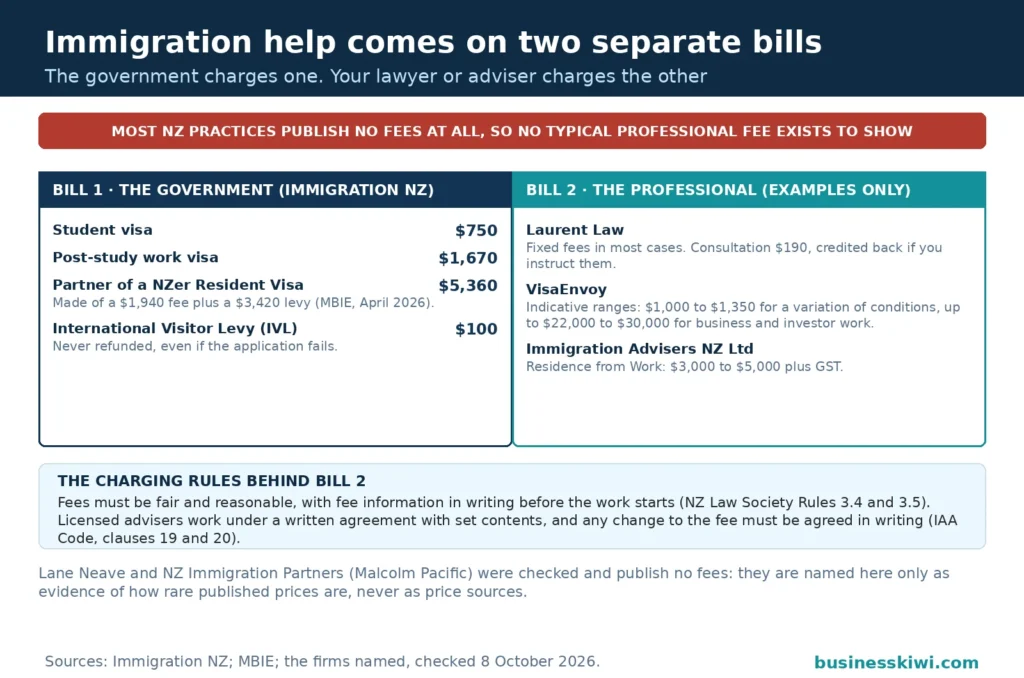
Every represented applicant pays two separate bills. The first goes to Immigration New Zealand (INZ) for the visa itself, and everyone pays it whether they use help or not. The second is the professional fee charged by the lawyer or licensed immigration adviser you engage. This guide works through both layers: the INZ charges, the professional fees on top, the rules that govern each type of practitioner, and what you can do if a bill looks wrong.
Two bills, not one
The government charge and the professional fee are set by completely different parties, and confusing them causes misunderstandings. INZ sets its own application charges, and it charges the same amount whether you lodge the application yourself or a representative lodges it for you. Hiring help does not raise or lower the INZ charge by a cent.
The professional fee is a private contract between you and the practitioner. It buys their time, their knowledge of immigration instructions, and their work preparing and managing your case. It is negotiable in a way the INZ charge never is, and it varies widely because cases vary widely. Keeping the two layers separate, in your mind and in any quote you are given, is the first step to understanding a bill.
The government layer: what Immigration New Zealand charges
INZ charges are made up of an application fee and an immigration levy, combined into a single amount when you apply. The current charges date from 1 October 2024, when the Government reset them on a cost recovery basis, so the people using the system cover most of the cost of running it rather than taxpayers generally. Before that reset the system was heavily subsidised.
What you pay depends on the visa, your nationality, and where you lodge the application. INZ groups applicants into bands, with lower, subsidised rates continuing for applicants from Pacific countries, which is why no single table can cover everyone and why INZ directs applicants to its online fees, decision times and where to apply tool for their exact charge. The table below shows several headline charges, checked against official sources in October 2026.
The partner resident visa figure shows how the two components stack up. The Ministry of Business, Innovation and Employment, which oversees INZ, has confirmed that the $5,360 total is an application fee of $1,940 plus an immigration levy of $3,420. The fee covers assessing the application; the levy funds wider system costs that cannot be tied to one file, such as immigration ICT, compliance work and settlement services. Residence applications sit at the expensive end of the schedule because they take far more officer time to assess.
Most temporary entrants pay one further charge on top: the International Visitor Conservation and Tourism Levy (IVL) of $100. It applies to most visitor visas, NZeTA requests, student visas, working holiday schemes and some work visas, and it is collected with the visa charge. INZ is blunt about one feature of the IVL: it is never refunded, even if your application is declined. Budget for it as money spent the moment you apply.
Two practical points follow. Get your exact INZ charge from the official fees tool before you budget, because band and location differences are real. And when a representative quotes you a total, ask them to split it: how much is the INZ charge, how much is their fee, and how much is disbursements. A transparent quote separates the layers without being asked.
Lawyer or licensed adviser: two regulators, two rulebooks
New Zealand immigration advice can only be given by a licensed immigration adviser or by someone exempt from licensing. The largest exempt group is lawyers holding a current New Zealand practising certificate. That single distinction decides which rulebook governs your fee.
Licensed immigration advisers are regulated by the Immigration Advisers Authority (IAA) and must follow its Code of Conduct. Lawyers are regulated by the New Zealand Law Society under its conduct and client care rules. A lawyer does not need an IAA licence to give you immigration advice, and an adviser cannot do some things a lawyer can, such as appearing for you in court. INZ takes the boundary seriously: if a person named on your application is neither licensed nor exempt, INZ will refuse to accept the application or decline it, and giving immigration advice without a licence or exemption is an offence.
On fees, both rulebooks land in a similar place: fees must be fair and reasonable, the deal must be in writing before work starts, and there is a complaints route if things go wrong. The detail differs, and the sections below take each in turn.
What professionals actually charge: the transparency problem
Here is the finding that matters most, stated plainly. Most New Zealand immigration lawyers and licensed advisers do not publish their fees. There is no schedule on their websites, and usually no indicative range either. The standard pattern is an initial assessment of your situation, followed by a quote for the work. Until a practice has seen your case, it will not commit to a number.
That pattern holds at the top of the market. Lane Neave, one of the country’s largest immigration law practices, publishes no fee schedule and offers a free immigration status review instead. New Zealand Immigration Partners, formerly Malcolm Pacific and one of the largest adviser firms, likewise publishes no professional fees: a free first consultation on investor cases, then a no obligation quotation. To get a number from firms like these, you have to ask, and it will be specific to your case.
A minority of practices do publish, and their figures are the best evidence available of what representation costs. Treat them as named examples, not market averages, because no official average exists.
Laurent Law, an Auckland immigration law firm, works mainly on fixed fees. In most cases it can set a fixed fee for the work; where a matter cannot sensibly be quoted as a lump sum at the outset, it gives an estimate instead and records the fee basis with the client in writing before starting. Its initial consultation is offered at a reduced fee of $190, and if you go on to instruct the firm, that consultation fee is credited against your quote. Figures checked on the firm’s own site in October 2026.
VisaEnvoy, which handles New Zealand cases, is unusual in publishing indicative ranges for common services on its own site. Those ranges, checked in October 2026, run from $1,000 to $1,350 for a variation of conditions, $1,500 to $1,900 for a visitor visa, $1,500 to $2,000 for a student visa, and $1,800 to $3,300 for an Accredited Employer Work Visa or for responding to a PPI letter, the letter INZ sends when it has concerns about an application. Residence work costs more: $5,500 to $7,900 for a Skilled Migrant Category resident visa and $4,500 to $6,000 for a partner of a New Zealander resident visa. At the top end, its business and investor visa range is $22,000 to $30,000, and ministerial appeals or appeals to the Immigration and Protection Tribunal sit at $4,000 to $7,000. The firm notes that the final fee can move if health or character issues are present, which is exactly the sort of complication that pushes any practice’s fee up.
Immigration Advisers New Zealand Ltd, an Auckland practice of licensed advisers, publishes prices visa by visa on its own site. Its published price for a Residence from Work visa, for example, is $3,000 to $5,000, plus GST if applicable. Practices differ on whether quoted figures include GST, so ask before you compare two quotes.

How lawyers charge: the Law Society rules
A lawyer’s fee must be fair and reasonable for the service provided. That is the core rule, and there is no official tariff behind it. What the rules do guarantee is information: before starting work, a lawyer must give you client care information in writing, and the engagement is documented through terms of engagement and a letter of engagement setting out the specifics of your matter, including the basis on which fees will be charged and when you will be billed. If the cost cannot be stated at the outset, you are still entitled to know how the fee will be calculated.
In practice, immigration lawyers charge one of two ways. Some quote a fixed fee for a defined application, suiting standard work whose scope can be predicted. Others charge an hourly rate, suiting advice work, problem cases and appeals where nobody can honestly predict the hours. Many practices mix the two, fixing routine stages and charging time for complications. Either way, the basis should be in your engagement documents, and any estimate revisited with you if the matter outgrows it.
The Law Society publishes the factors its Standards Committees use when deciding whether a bill was fair and reasonable, and they double as a checklist of what legitimately drives a fee: the time and labour involved, the skill required, the importance of the matter to you, urgency, complexity, the lawyer’s experience and expertise, any quote or estimate given, and the fee usually charged in the market and location for similar work. A large bill is not automatically unfair if those factors support it, and a small one is not automatically fair. The quote or estimate you were given matters a great deal: another reason to get the fee basis in writing at the start.
How licensed advisers charge: the IAA Code of Conduct
Licensed advisers work under the IAA’s Code of Conduct, and its fee rules are specific. Before any work starts, your adviser must give you a written agreement to sign that sets out the services to be provided and the fees. The Code prescribes what that agreement must cover, including the services, how the fee is charged (an hourly rate with an estimate of the time involved, or a fixed fee), GST, the likely disbursements such as INZ’s own fees, payment terms, and the adviser’s refund policy.
Clause 20 of the Code then governs the fee itself. Fees must be fair and reasonable in the circumstances, the adviser must work in a way that does not unnecessarily increase fees, and any additional fees or changes to the agreed fees must be explained to you and recorded and agreed in writing. An adviser cannot quietly let a fixed fee drift upwards: if complications change the cost, you are entitled to hear about it and agree in writing before the extra work is charged. Invoices must carry full descriptions of what each fee relates to.
These rules give adviser clients a strong paper trail. Keep your written agreement, every variation you sign, and every invoice. They are the documents the IAA will ask for if you ever complain, and they are the baseline against which “fair and reasonable” gets judged.

What pushes a fee up or down
Whether you use a lawyer or an adviser, the same drivers move the price. The IAA’s own guidance to advisers on setting fees lists influences that read like a description of most quotes: the practitioner’s qualifications and experience, the time the case will take, its complexity or difficulty, how much work you have already done yourself, and the level of personal service you want.
Complexity is the biggest single driver. A clean Accredited Employer Work Visa with a straightforward history is routine work. Add any of the following and the fee climbs:
- Responding to a PPI letter, where INZ has raised concerns that could sink the application and each point must be answered with evidence.
- Character issues, such as a past conviction or a previous decline, which may need detailed submissions or a character waiver request.
- Health issues, where medical reports must be obtained and argued against INZ’s health requirements.
- Family applications, where a partner and children each add evidence, forms and checking to the file.
- Residence and business categories, where the evidence burden is simply heavier.
- Appeals, reconsiderations and ministerial requests after a decline, which are advocacy work rather than form filling.
- Urgency, where work has to be turned around ahead of a visa expiry or a deadline INZ has set.
Staged payments are common on bigger matters: a deposit or first stage fee, then instalments as the application reaches defined steps, rather than one lump sum at the start. If cash flow matters to you, raise it before you sign, and get the payment pattern recorded in the engagement documents.
Disbursements: the costs that are not fees
Quotes often bundle a third element alongside the professional fee and the INZ charge: disbursements, meaning money the practitioner pays out to third parties on your behalf. Typical disbursements in immigration work include the INZ application charge itself, medical examinations and chest X-rays, police certificates, certified translations, English language tests, and courier fees.
Two habits protect you here. First, check whether a quote includes disbursements or lists them as extra, because a lower fee with disbursements on top can cost more than a higher all-in figure. Second, remember that some disbursements are payable whether or not you use a representative: medicals, police certificates and translations are costs of the application itself, not of the advice.
Doing it yourself: the option that costs no fee
You do not have to use a representative at all. INZ states this directly, including in its guidance on protecting yourself from immigration scams: you are not required to use an adviser to apply for a visa, and you can apply on your own using the information on INZ’s website, which provides the forms and a guide for each visa. Anyone who tells you that you must use an adviser, or must use them specifically, is giving you a warning sign, not a fact.
The honest trade off is time and risk against money. A standard application, for someone whose situation matches the visa’s design, with clean health and character history and documents in order, is well within many people’s ability to lodge themselves. The case for paying usually strengthens where the stakes or the difficulty rise: a residence application your whole move depends on, a prior decline, a PPI letter to answer, health or character complications, or a deadline you cannot afford to miss. Professional help buys error checking and knowledge of how INZ assesses evidence. It does not buy a guaranteed outcome, and no practitioner is allowed to promise you one.
A middle path exists too: pay for an initial consultation or a one off assessment, get your pathway and document list confirmed, then lodge the application yourself. Several firms offer that first assessment free.
If the bill feels wrong: complaints, refunds and fee reviews
Start with the practitioner. Both regulators expect you to raise a fee concern directly first, and firms can and do adjust bills, agree payment arrangements, or explain charges that turn out to be justified. Put your concern in writing and keep the reply.
If that fails, your route depends on who charged you. For a lawyer, fee complaints go to the Lawyers Complaints Service of the New Zealand Law Society. There are limits: a Standards Committee generally cannot consider a bill that is more than two years old, or a bill under $2,000 excluding GST, unless special circumstances apply, such as being billed for work that was never done. Committees assess the bill against the fair and reasonable factors described earlier, and for a large or complicated bill they may appoint an independent costs assessor to report on it. Outcomes range from no action to an order cancelling or reducing the bill, or refunding money already paid. You can complain after paying. A lawyer cannot pursue court action over a disputed bill while the committee is considering it, though interest can still be charged and your file retained until payment. The process can take 3 to 18 months.
For a licensed adviser, use the adviser’s own internal complaints procedure first, which the Code requires them to have and to tell you about. If that does not resolve it, you can complain to the Immigration Advisers Authority. Complaining to the IAA is free, anyone can do it from anywhere, and the IAA states it will not affect your immigration status. The adviser will be told about the complaint. The IAA can close the complaint or refer it to the Immigration Advisers Complaints and Disciplinary Tribunal, which can impose sanctions including censure, fines, training requirements, changes to the adviser’s licence, and compensation. For a pure contract or refund argument, the IAA also points complainants to the Disputes Tribunal.
Neither regime offers a quick, binding “fee review” of the kind some people expect: these are complaints processes, judged against professional standards, and they take time. That is why the written fee agreement at the start matters so much. It is the strongest evidence in any later argument about what was agreed.
Frequently asked questions
How much does an immigration lawyer charge per hour in NZ?
There is no standard hourly rate and no published scale. Lawyers set their own rates; the Law Society requires the fee to be fair and reasonable, and the charging basis given to you in writing before work starts, and many immigration practices prefer fixed fees for standard applications in any case. If you are quoted an hourly rate, ask for an estimate of the total time as well, and get both recorded in your letter of engagement.
Do immigration advisers charge a consultation fee?
Some do and some do not, and both patterns are easy to find. Laurent Law charges a reduced fee of $190 for an initial consultation, credited against your quote if you instruct the firm. At the other end, Lane Neave offers a free immigration status review and New Zealand Immigration Partners offers a free first consultation on investor cases before quoting. Check the practice’s own website or ask.
Are professional fees refundable if my visa is declined?
Usually not in full. The answer sits in your agreement, not in any general rule: professional fees pay for work done, and a decline does not undo the work. Advisers’ written agreements must state their refund policy, and lawyers’ engagement terms cover the same ground, so read that clause before you sign. Government charges are separate: the IVL is never refunded, even on a declined application.
Is it cheaper to use a licensed adviser than a lawyer?
Not automatically. Both charge fees that must be fair and reasonable, both commonly quote after assessing your case, and the published examples in this article show advisers and lawyers charging in overlapping ranges for similar applications. The bigger differences come from the case itself, its complexity and the practitioner’s experience. Choose on expertise for your type of case, and on the clarity of the written quote.
Can I apply for a visa myself without an adviser or lawyer?
Yes. INZ does not require you to use a representative, and its website provides the application forms and guides for each visa. What you cannot do is take immigration advice from someone who is neither a licensed immigration adviser nor exempt, for example a lawyer with a current practising certificate. Friends and family can help you fill in forms, but tailored advice must come from someone authorised to give it.
What should a fee quote include?
The professional fee itself, whether GST is included or added, the INZ application charge and any levy, expected disbursements such as medicals, police certificates and translations, the payment schedule, and what happens to the fee if the case changes scope. For a licensed adviser, the written agreement must cover the services, the fee basis, GST, likely disbursements, payment terms and the refund policy. If a quote arrives as a single unexplained number, ask for the breakdown before you agree.
Why did my quote change after the work started?
Cases change. INZ may issue a PPI letter, a medical or police issue may surface, or documents may raise questions nobody could see at the start. For advisers, the Code of Conduct requires any additional fees or changes to agreed fees to be explained to you and agreed in writing. For lawyers, the engagement terms and estimates should be revisited with you in the same way. A change you agreed in writing is normal practice; extra charges you never agreed to are grounds for a complaint.
This article is general information about how immigration advice is charged in New Zealand. It is not legal advice, and it is not immigration advice about your situation. Fees and charges change, so confirm current figures with the practice and with INZ’s fees tool before relying on them. Figures in this article were checked against the sources below in October 2026.
Sources
- Immigration New Zealand, Increase to visa charges comes into effect from 1 October, immigration.govt.nz
- Immigration New Zealand, Paying the International Visitor Conservation and Tourism Levy (IVL), immigration.govt.nz
- Immigration New Zealand, Getting immigration advice, immigration.govt.nz
- Immigration New Zealand, Protecting yourself from immigration scams, immigration.govt.nz
- Education New Zealand, INZ student visa update: August 2024, enz.govt.nz
- Ministry of Business, Innovation and Employment, Official Information Act response on Partner of a New Zealander Resident Visa charges, fyi.org.nz
- Immigration Advisers Authority, Working with a licensed immigration adviser, iaa.govt.nz
- Immigration Advisers Authority, Fees: Code of Conduct toolkit, iaa.govt.nz
- Immigration Advisers Authority, Content of written agreements: Code of Conduct toolkit, iaa.govt.nz
- Immigration Advisers Authority, Complain about a licensed immigration adviser, iaa.govt.nz
- New Zealand Law Society, How the Standards Committees assess complaints about fees, lawsociety.org.nz
- New Zealand Law Society, Client care, lawsociety.org.nz
- Laurent Law, Certainty of Fees, laurentlaw.co.nz
- VisaEnvoy, Our Fees: New Zealand Visa Professional Fees, nz.visaenvoy.com
- Immigration Advisers New Zealand Ltd, Residence from Work Visa published fee, nzimmigration.info
- Lane Neave, Free immigration status review, laneneaveimmigration.co.nz
- New Zealand Immigration Partners, Active Investor Plus Visa NZ, malcolmpacific.com