Grandparent Visa NZ: How Grandparents Can Visit or Stay Near Family in New Zealand

For many New Zealand families, the hardest part of migration is the distance from grandparents. Grandchildren grow up on video calls, and visits are squeezed into a few weeks every year or two. Immigration New Zealand (INZ) has a visa built for exactly this situation: the Parent and Grandparent Visitor Visa, which lets parents and grandparents of New Zealand citizens and residents visit repeatedly on one visa over three years. Around it sit three other options: the Parent Boost Visitor Visa for much longer stays, the standard Visitor Visa for simpler one-off trips, and the Parent Resident Visa for families whose goal is permanent residence.
This guide explains each route as INZ currently publishes it, with the grandparent-specific visa at the centre. Visa settings change, and fees and income thresholds are updated from time to time, so treat this as a map of the system rather than a substitute for INZ’s own pages on the day you apply.
The four options at a glance
The right visa depends on two questions. How long does the grandparent want to spend in New Zealand, and is the goal visiting or living here permanently?
The detail matters, because the conditions differ sharply between a visa built for repeat visits and one built for a five-year stay.
The Parent and Grandparent Visitor Visa
This is the visa most grandparents will use. It is a multiple entry visitor visa designed for parents and grandparents who want to visit family in New Zealand more than once, without applying for a fresh visa for every trip.
How long it allows in New Zealand
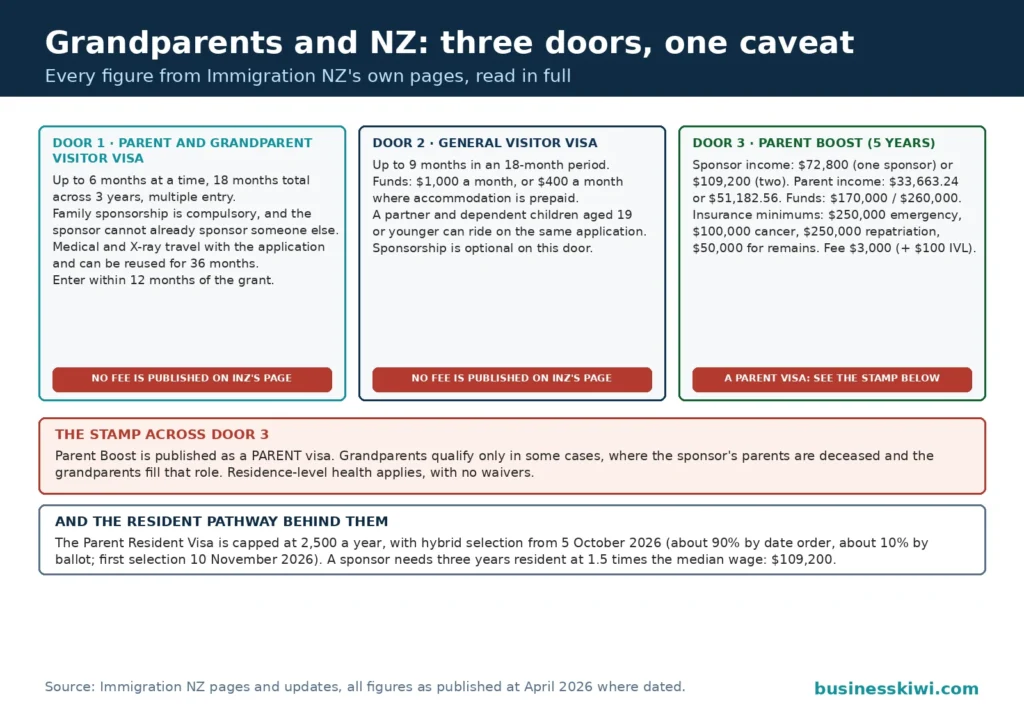
The visa allows stays of up to 6 months at a time, with a maximum total stay of 18 months across a 3-year period, travelling in and out as often as the holder likes. Two timing rules catch families out: the holder must enter New Zealand within 12 months of the visa being granted, and must leave before it expires. The pattern suits grandparents who want to be here for a good part of each year, perhaps for a birth, school holidays and the summer, while keeping their home overseas. It is not a way to live here continuously: once 18 months in the country are used, the allowance is gone.
Who can apply
To apply, a grandparent must have children or grandchildren who are New Zealand citizens or residents, and must be living outside New Zealand when they apply. They must be sponsored, be in good health and of good character, and have genuine reasons for coming. They must also pay for any health care they receive while in New Zealand. INZ recommends full medical insurance for the stay, although insurance is not a formal requirement of this visa the way it is for Parent Boost.
A partner can be included, with evidence of the relationship, such as a marriage or civil union certificate or joint mail to a shared address, plus evidence of the partner’s identity, good health and character.
Sponsorship: the family’s part of the deal
Sponsorship is compulsory for this visa, and it comes from inside the family. The sponsor is the applicant’s child or grandchild. If that child or grandchild is 17 or younger, their parent can sponsor instead, and the family must then show the sponsor’s relationship to the child or grandchild as well.
The sponsor must be a New Zealand citizen or resident and meet INZ’s requirements for acceptable sponsors. They provide a certified copy of their New Zealand passport, birth certificate or certificate of citizenship, or their New Zealand Resident Visa, or an Australian passport, plus evidence of the family relationship, such as a birth certificate, adoption papers or household registration papers. One limit matters for larger families: a sponsor cannot be sponsoring anyone else at the same time. The sponsorship is documented on INZ’s Sponsorship Form for Temporary Entry, which the sponsor completes and signs and the applicant includes with the application.
Health and character requirements
Applicants must be in good health. For this visa that means providing a chest X-ray and a medical examination with the application, unless INZ already holds medical certificates for the person issued within the last 36 months. The evidence must be less than 3 months old when INZ receives it, which makes timing the medical appointments a practical pressure point. INZ also advises citizens of India applying from India who have a medical condition to apply at least 4 months before travel, because assessment takes longer.
Character is handled through police certificates. An applicant aged 17 or older whose total time in New Zealand will reach 24 months or more, counting past time here on other visas, must provide police certificates less than 6 months old, from the countries they are a citizen of and any country they have spent more than 5 years in since turning 17. Certificates provided with an earlier application within the last 24 months can be reused. A criminal conviction, or being a security risk, can mean no visa.
Genuine intentions
Every visitor visa turns on genuine intentions. INZ considers the information in the application, what it knows about the applicant’s personal circumstances, and anything the person has provided before. One point is specific to this visa: the grandparent must intend to visit their children or grandchildren in New Zealand, and those family members must intend to be in New Zealand when the visit happens. A plan to use the visa while the family is itself overseas for the year would cut against its purpose.
Documents and how to apply
Applications are made online through INZ. When applying, the grandparent provides a copy of their passport or an acceptable photo, evidence of the chest X-ray and medical examination where required, proof of the relationship to the sponsor, the completed Sponsorship Form for Temporary Entry, police certificates where required, and translations of any documents that are not in English. The passport must be valid for at least 3 months after the planned departure date.
INZ’s application steps run in a sensible order. First, check it is the right visa: INZ itself points out that a single visit could be made on the general Visitor Visa instead, because it has fewer requirements. Then gather documents, entering identity details exactly as they appear on the passport, since mistakes can delay or sink an application. Medical appointments and police certificates are organised during this stage. The application is submitted online with the fee, INZ may ask for further evidence while processing, and progress can be tracked through the applicant’s account. An approved applicant receives an eVisa.
One gap to flag honestly: INZ’s page for this visa points applicants to its fees section rather than printing a fee on the page itself, so check the current fee on INZ’s website when you apply rather than relying on any figure quoted elsewhere.
On arrival, every traveller completes a New Zealand Traveller Declaration, and INZ can refuse entry permission to someone who is not a genuine visitor, does not meet character requirements, whose circumstances have changed since the visa was granted, or who cannot show onward travel or the money to leave.
What holders can and cannot do
Holders cannot work in New Zealand on this visa. INZ’s page notes that remote work for an employer or client based outside New Zealand may be possible, but there are no work rights for a New Zealand employer. The conditions recorded in the eVisa govern the stay, and overstaying or working in breach of them puts future visas at risk.

The Parent Boost Visitor Visa: the long-stay option
The Parent Boost Visitor Visa opened on 29 September 2025 and changed the shape of family visiting. It allows an eligible parent to stay for up to 5 years, leaving and re-entering as often as they like, and to apply for a second 5-year visa, giving up to 10 years in total. INZ is explicit that it is not a pathway to residence: a long visit, not a stepping stone.
A grandparent caveat
Read the eligibility carefully. Parent Boost is a parent visa. INZ’s published answers state that, as with the Parent Resident Visa, it is available for parents of New Zealand citizens and residents, except in some cases where the sponsor’s parents are deceased and grandparents who fill that role could be included. A grandparent outside that position cannot use Parent Boost and should look at the Parent and Grandparent Visitor Visa instead. This is the most common misunderstanding about the new visa, and it is better discovered here than in a declined application.
Sponsorship and the three financial routes
The applicant must be outside New Zealand both when applying and when the visa is granted, must have no dependent children, and must be sponsored by an adult child, aged 18 or older, who is a New Zealand citizen or resident. Joint sponsorship is allowed: an adult child and their partner, two adult children, or one adult child of the parent together with one adult child of the parent’s partner. Sponsors take on real obligations, including covering essential costs such as accommodation and daily living costs, ensuring access to health and financial support, and covering repatriation or deportation costs if required.
The family must meet one of three financial routes, and only one can be nominated. The first is sponsor income. Under the thresholds applying to applications lodged on or after 30 April 2026, a single sponsor needs a minimum annual income of NZD $72,800 to sponsor 1 parent, rising by NZD $36,400 per additional parent, so NZD $109,200 for 2 parents. Two joint sponsors need NZD $109,200 for 1 parent, rising in the same steps. Sponsors must have earned at least the minimum income for 2 of the 3 completed New Zealand tax years before applying, and thresholds reset each year against the median wage, so check INZ’s current table before relying on these numbers.
The second route is the parent’s own income: at least NZD $33,663.24 a year for a single parent, or NZD $51,182.56 for a couple, set by reference to New Zealand Superannuation rates. The third is the parent’s own funds: at least NZD $170,000 in a bank account for a single parent, or NZD $260,000 for a couple. Borrowed or gifted money does not count; the funds must genuinely belong to the parents and be available for the whole visit.
Health, insurance and the third-year check
Parent Boost has the heaviest health settings of any visitor visa in this guide. Applicants must meet an acceptable standard of health aligned with the residence standard, and INZ states that medical waivers will not be considered. Health insurance is mandatory for the entire stay, with minimum cover levels: emergency medical care of at least NZD $250,000 a year, cancer treatment of at least NZD $100,000 a year, repatriation of NZD $250,000, and return of remains of NZD $50,000. Cover can come from a New Zealand or offshore provider with the required credit rating. The first 12 months is bought upfront after an approval in principle, with evidence provided within 3 months of that approval.
Between the third and fourth years, the holder must leave New Zealand and complete a compliance check from offshore: a new medical certificate, plus evidence that acceptable insurance has been maintained throughout. If the medical shows the person no longer meets the health standard, the visa may be cancelled. Letting insurance lapse at any point can lead to cancellation, deportation liability, or ineligibility for a future Parent Boost or Parent Resident Visa.
Other mechanics matter. The holder must arrive within 6 months of approval, and the 5-year period runs from the first arrival date, not the approval date. Parents and partners can travel separately. A second visa requires applying from offshore again, with continued links to the home country still to be shown. Someone who stays past expiry is liable for deportation.
Cost and processing
INZ’s published figures for Parent Boost are a fee of NZD $3,000 for most applicants, or NZD $2,450 for applicants eligible for the Pacific fee band, covering the immigration fee and levy, plus the International Visitor Conservation and Tourism Levy of NZD $100. Insurance costs are on top of that and vary by age and health. INZ estimates the majority of applications will be processed within 4 months, longer than a standard visitor visa because the requirements are more complex. There is no English language requirement.
Holders may study for up to 3 months each year, and remote work for an offshore employer is possible, as with other visitor visas. They cannot take a job in New Zealand.
The general Visitor Visa as a fallback
Not every grandparent needs a family-specific visa. For a single trip, or where the sponsorship or relationship evidence for the Parent and Grandparent Visitor Visa does not fit, the general Visitor Visa is the fallback, and INZ itself suggests it for one-off visits because it has fewer requirements.
The stay pattern is different. A Visitor Visa allows a maximum stay of 9 months in an 18-month period. INZ issues either a multiple entry visa, allowing repeated visits totalling up to 6 months in each 12-month period, or a single entry visa allowing one stay of up to 9 months. A single entry visa expires if the holder leaves New Zealand.
The requirements are the classic visitor ones. The applicant must be in good health and of good character, have genuine reasons for coming, show they can leave at the end of the stay, and show enough money to live on: at least NZD $1,000 a month, or NZD $400 a month if accommodation is already paid for, evidenced by bank or credit card statements and any pre-paid accommodation proof. Sponsorship is optional rather than required: a family member can sponsor using the same Sponsorship Form for Temporary Entry, but a grandparent with their own funds does not need one. Evidence of the ability to leave, such as an onward ticket or the funds to buy one, sits on top of the living-cost money. Holders cannot work in New Zealand, with the same limited remote work possibility for an overseas employer, and can study for up to 3 months in any 12-month period. Partners and dependent children aged 19 or younger can be included in the application, one practical difference from the family-specific visas.

The Parent Resident Visa, briefly
Residence is a different conversation, and it belongs mainly to parents rather than grandparents. The Parent Resident Visa lets New Zealand citizens and residents sponsor a parent to live in New Zealand permanently. It is a two-stage process. The family first submits an expression of interest (EOI). Only people whose EOI is selected and who then receive an invitation to apply can lodge a residence application.
The category is capped at 2,500 visas per financial year, and demand exceeds places, so selection is the bottleneck. The selection model changed on 5 October 2026: under the hybrid system, approximately 90 percent of EOIs are selected in date order and around 10 percent through a ballot, with the first selection under the new model scheduled for 10 November 2026. EOIs no longer expire after 2 years, provided the applicant confirms every 2 years that they wish to remain in the pool and keeps their information up to date, at no additional fee.
Sponsorship is demanding. The sponsor must be a New Zealand citizen or resident who has lived in New Zealand for at least 3 years. One sponsor must earn at least 1.5 times the median wage for 1 parent, which from 30 April 2026 is NZD $109,200 a year; two joint sponsors must earn at least 2 times the median wage, NZD $145,600 for 1 parent, with half the median wage added per extra parent. The income must have been earned in 2 of the 3 years before the EOI was selected, and only taxable income shown in Inland Revenue records counts.
A full guide to the Parent Resident Visa exists separately on this site and covers the EOI process and sponsor rules in the depth they need. The point for grandparents is simpler: this is a parent category, the wait can be long, and while a family waits, the visitor visas above are how grandparents actually spend time here. Holding a Parent Boost Visa does not prevent a family from also having an EOI in the pool, although a person can only hold one visa at a time, so a new grant cancels the old one.
Why visitor visa applications are declined
INZ’s pages make the failure points clear, and they are worth knowing before a family spends money on medicals and fees.
The first is genuine intentions. INZ weighs the application, the applicant’s personal circumstances, and their history with INZ. The applicant must show they are a genuine visitor who will keep links with their home country and leave before the visa expires. Parent Boost builds this in, with offshore application, an offshore mid-visa check, and an offshore application for the second visa.
The second is money. Visitor Visa applicants who cannot show the monthly amounts, or whose funds are not in their own name, fail the living-cost test. Parent Boost applicants who cannot meet one of the three financial routes, or whose funds are borrowed or gifted, are not eligible at all.
The third is health and character. A medical that does not meet the standard, or a conviction that triggers the character rules, ends the application. Parent Boost is the strictest here, with no medical waivers.
The fourth is paperwork. Missing relationship evidence, an incomplete sponsorship form, identity details that do not match the passport, untranslated documents, and stale medical or police evidence all cause delays, and INZ warns that identity mistakes can lead to a declined application or refusal of entry even after a visa is granted.
Frequently asked questions
Is there a specific visa for grandparents visiting New Zealand?
Yes. The Parent and Grandparent Visitor Visa is INZ’s multiple entry visitor visa for parents and grandparents of New Zealand citizens and residents. It allows stays of up to 6 months at a time, and 18 months in total over 3 years, on one visa.
Can a grandparent use the Parent Boost Visitor Visa?
Usually not directly. INZ publishes Parent Boost as a visa for parents of New Zealand citizens and residents. Its guidance allows grandparents only in some cases where the sponsor’s parents are deceased and the grandparents fill that role. Other grandparents use the Parent and Grandparent Visitor Visa.
How long can a grandparent stay in New Zealand each year?
It depends on the visa. On the Parent and Grandparent Visitor Visa, up to 6 months at a time and 18 months in total across 3 years. On a general Visitor Visa, up to 9 months in an 18-month period, or 6 months in each 12-month period on a multiple entry visa. A parent on Parent Boost can stay up to 5 years.
Does a grandparent need a sponsor?
For the Parent and Grandparent Visitor Visa, yes: the child or grandchild sponsors the application, or the grandchild’s parent does if the grandchild is 17 or younger. For the general Visitor Visa, sponsorship is optional, because the visitor can instead show their own funds of at least NZD $1,000 a month, or NZD $400 a month with accommodation pre-paid.
Can a grandparent work or help in a family business on these visas?
No. None of the visitor visas in this guide allows work in New Zealand. Remote work for an employer or client based outside New Zealand may be possible, and study is allowed for up to 3 months in a 12-month period, or 3 months each year on Parent Boost. Paid or unpaid work for a New Zealand employer requires a work visa.
Does the Parent and Grandparent Visitor Visa need health insurance?
INZ recommends full medical insurance for the stay, and the holder or sponsor must pay for any health care received in New Zealand, but insurance is not a formal condition of that visa. It is mandatory for the Parent Boost Visitor Visa, with minimum cover levels set by INZ, including NZD $250,000 a year for emergency medical care.
How much does the grandparent visa cost?
INZ’s Parent and Grandparent Visitor Visa page refers applicants to its fees information rather than stating a fee on the page, so check the current fee on immigration.govt.nz before applying. For comparison, INZ publishes the Parent Boost Visitor Visa fee as NZD $3,000, or NZD $2,450 for the Pacific fee band, plus the NZD $100 International Visitor Conservation and Tourism Levy.
Can a grandparent live in New Zealand permanently?
Not on any visitor visa. Permanent residence for family runs through the Parent Resident Visa, a capped parent category with an EOI selection process and high sponsor income requirements, or the Parent Retirement Resident Visa. A grandparent’s realistic route to long stays is the visitor visas covered in this guide, alongside advice about their own circumstances.
Sources
- Immigration New Zealand, Parent and Grandparent Visitor Visa, immigration.govt.nz
- Immigration New Zealand, Visitor Visa, immigration.govt.nz
- Immigration New Zealand, Parent Boost Visitor Visa: FAQs, immigration.govt.nz
- Immigration New Zealand, New Parent Boost Visitor Visa is now open, immigration.govt.nz
- Immigration New Zealand, Income thresholds to increase for Pacific and parent visa categories, immigration.govt.nz
- Immigration New Zealand, Changes to the Parent Resident Visa Category, immigration.govt.nz
- Immigration New Zealand, Parent Resident Visa sponsor income requirements, immigration.govt.nz
This article is general information about New Zealand visa options published by Immigration New Zealand. It is not immigration advice, and it cannot assess any family’s eligibility. Visa rules, fees and income thresholds change, so check the current requirements on immigration.govt.nz before applying. For advice about your own situation, INZ’s position is that you should use a licensed immigration adviser or an immigration lawyer.